
Summing Up Developer Work in One Ridiculously Long camelCase Word on Twitter
Description
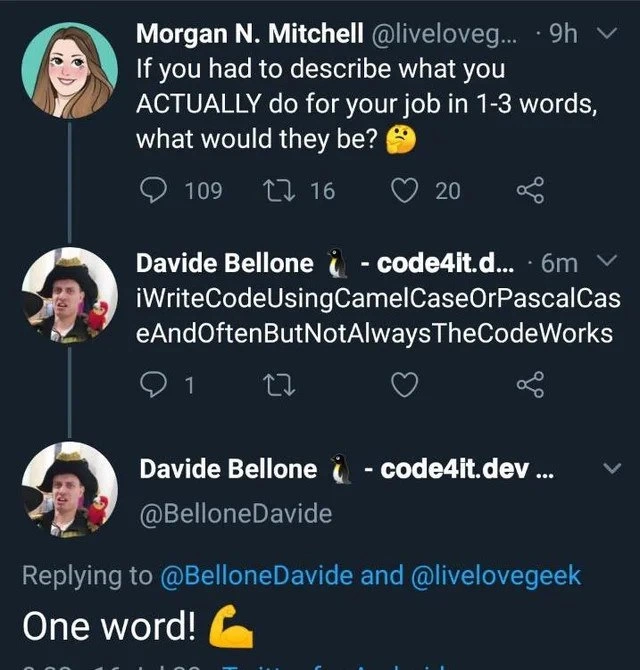
Dark-mode Twitter screenshot with three stacked tweets; profile photos and handles are partially blurred for privacy. Tweet 1 (Morgan N. Mitchell @liveloveg…, 9h) reads: “If you had to describe what you ACTUALLY do for your job in 1-3 words, what would they be? 🤔” and shows 109 replies, 16 retweets, 20 likes. Tweet 2 (Davide Bellone 🐧 - code4it.d…, 6m) answers with a single, very long camel-cased string: “iWriteCodeUsingCamelCaseOrPascalCaseAndOftenButNotAlwaysTheCodeWorks”, poking fun at variable-naming conventions and imperfect code. Tweet 3, a self-reply from the same account, simply says: “One word! 💪”. The humor arises from abusing CamelCase/PascalCase to compress an entire job description into one ‘word’, highlighting developer culture around naming, code style guides, and the reality that code only *sometimes* works

Comments
6Comment deleted
renameAllTheCamelCaseLeftoversFromThe2008MonolithWhilePretendingItCountsAsDeliveringBusinessValue
After 20 years in the industry, I've realized the hardest problem in computer science isn't cache invalidation or naming things - it's explaining to stakeholders why 'iWriteCodeUsingCamelCaseOrPascalCase' technically counts as one word in our sprint retrospective
Every senior engineer knows the three-word job description: 'It depends, actually.' But Davide's camelCase monstrosity perfectly captures the reality - we spend more time debating whether it's `getUserById` or `GetUserByID` than actually solving the problem, and even when we finally ship, there's that nagging 'OftenButNotAlwaysTheCodeWorks' disclaimer we're all too familiar with. The real flex? Convincing yourself that camelCase without spaces technically counts as one word in your PR description
Requirements: “1 - 3 words.” Implementation: one 80-character CamelCase identifier. Lesson: if the spec doesn’t define the tokenizer, engineering will
Spec said “1 - 3 words,” so we shipped a single identifier - perfectly compliant, unreadable, and destined to fail the naming review and the canary alike
CamelCase for humble APIs, PascalCase for grandiose classes - either way, prod decides if it works