
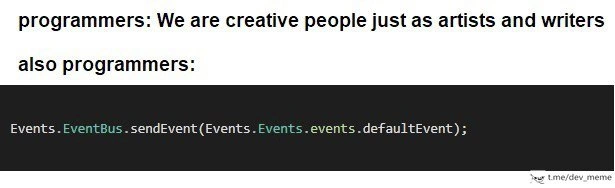
The Grand Creativity of Over-Engineered Code
Description
The image is a two-part meme that satirizes the creative self-perception of programmers. The first part, with black text on a white background, states, 'programmers: We are creative people just as artists and writers'. The second part, labeled 'also programmers:', presents the punchline: a screenshot of a single line of code against a dark background. The code reads, 'Events.EventBus.sendEvent(Events.Events.events.defaultEvent);'. There is a small, faint watermark for 't.me/dev_meme' in the bottom corner of the code block. The humor lies in the stark contrast between the claim of creativity and the reality of writing absurdly verbose and repetitive code. The example line shows terrible naming conventions and excessive nesting, with the word 'Event' appearing five times. For senior developers, this is a painfully familiar sight from legacy systems or over-engineered enterprise frameworks (often seen in languages like Java), where poor API design and namespacing lead to such unreadable and unwieldy code
Comments
25Comment deleted
I see the architect was a fan of the AbstractSingletonProxyFactoryBean school of naming conventions. You don't write code like that; it's procedurally generated by the tears of the maintenance team
grep -R "Event" | wc -l returned 11,342 - turns out our “ubiquitous language” is just EventBus.EventService.EventHandler in the Events module… truly domain-driven, if the domain is existential dread
After 15 years of arguing about microservice boundaries and event sourcing patterns, you realize the real distributed system was the Events.Events.events we named along the way
Ah yes, the classic 'Events.EventBus.sendEvent(Events.Events.events.defaultEvent)' - when your event-driven architecture becomes so meta it achieves self-awareness through sheer namespace recursion. This is what happens when your abstraction layers have abstraction layers, and your team's 'creative solution' to event handling looks like it was designed by the Department of Redundancy Department. At least when the inevitable refactoring ticket comes, you can defensively argue it follows the Single Responsibility Principle - it's singularly responsible for making code reviewers question their career choices
When every bounded context is named “Events”, you’ve built an event‑driven monolith: perfect autocomplete, zero semantics, and a code review that lasts two sprints
We’re creative - then ship Events.EventBus.sendEvent(Events.Events.events.defaultEvent). DDD by tautology: our ubiquitous language is just “event.”
Claiming artistic creativity while turning a simple event into a 50-level recursion tower - because who needs a for-loop when you have eventBus.sendEvent(eventBus.sendEvent(...))?
Replaces with spaces the braces in cases where braces in places cause stasis Comment deleted
Isn't it a poetry? Comment deleted
Naming is always the hardest thing... Comment deleted
i hate oop Comment deleted
I hate functional programming all my homies use Object-oriented programming Comment deleted
Sometimes creativity is stupidity Comment deleted
thy art is murder - their name fits the best here Comment deleted
Event event = new Event(default_event); Comment deleted
wrong DocumentActionListenerEvent documentActionListenerEvent = new DocumentActionListenerEvent(DocumentActionListenerEvent.DEFAULT_DOCUMENT_ACTION_LISTENER_EVENT); Comment deleted
DEFAULTDOCUMENTACTIONLISTENEREVENT ---> DEFAULT_DOCUMENT_ACTION_LISTENER_EVENT Comment deleted
FIXED Comment deleted
fuck forgot to turn capslock off lol Comment deleted
Heard you hate fp function callbackCaller(...callbacks) { let callbacksCount = 0 if(!callbacks.length) return return callbacks[n](callbacks[++n]) } function callback1(nextCallback) { if (!nextCallback) return return nextCallback } callbackCaller( callback1, callback1(function callback2() { return antoherCallback } ) Comment deleted
I have no idea what that does, but I don't like it Comment deleted
imtelligemt Comment deleted
Sorry Comment deleted
!report Comment deleted
Okok Comment deleted