
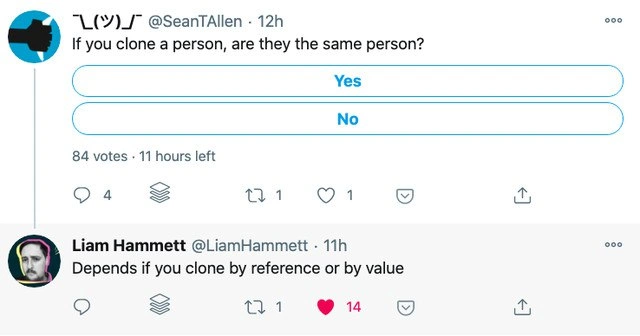
Twitter poll debates cloning humans, dev replies with reference vs value punchline
Description
Screenshot of a Twitter conversation. At the top, a tweet from user "¯\_(ツ)_/¯ @SeanTAllen • 12h" asks, “If you clone a person, are they the same person?” Below the question are two thin, blue-outlined poll buttons labeled “Yes” and “No.” A status line reads “84 votes • 11 hours left.” Twitter action icons show 4 replies, 1 retweet, 1 like, and a share icon. Beneath, a reply from “Liam Hammett @LiamHammett • 11h” states, “Depends if you clone by reference or by value,” with icons showing 1 reply, 2 retweets, a red heart with 14 likes, and a share icon. Visually it mimics Twitter’s white UI with avatars on the left and grey metadata text. The technical joke compares human cloning to programming copy semantics: in many languages a shallow copy (reference) shares identity while a deep copy (value) creates a distinct object, highlighting CS fundamentals about object identity, memory, and equality that developers instantly recognize


Comments
10Comment deleted
Clone a human by reference and you’ve got aliasing; clone by value and 18 years later you’re diff-ing two eventually-consistent life threads - good luck debugging free will with distributed tracing
After 20 years in the industry, I've learned that the real question isn't whether the clone is the same person, but whether they'll inherit the original's technical debt and unresolved JIRA tickets. At least with reference cloning, you only have one set of legacy code nightmares to maintain
The real question is whether the clone shares the same memory address or if we've allocated a new instance with copied state. And if it's by reference, do we need to worry about one clone's existential crisis causing a segfault in the other? This is why senior engineers always clarify copy semantics in code reviews - because 'clone' without context is just asking for a philosophical merge conflict
Clone by reference: one headcount, two standups; clone by value: two headcounts, twice the cache-invalidation surface
Clone by reference: two engineers sharing one pager; clone by value: two pagers and twice the incident blame
Clone by reference: your twin inherits all mutable state bugs. By value: independent, but good luck with the serialization overhead
Is reference like DNA and value like memories? Comment deleted
I'm fairly sure it is the opposite. Copying the physical will only make another separate instance, with the same state at best. Two instances will go their separate ways right after. To keep it the same person you will have to reference into memory, personality and whatever else — so that both previous and new instances would remain and continue to be the same object in the future. I think the question is not exactly correct in the first place. Cloning implies a copy, and since there are no references to humans IRL... Comment deleted
👍🏻. Comment deleted
Memory and personality are still stored in body. So coping a body also copies the rest. Comment deleted