
The Satisfying Spectacle of Ancient Disk Defragmentation
Description
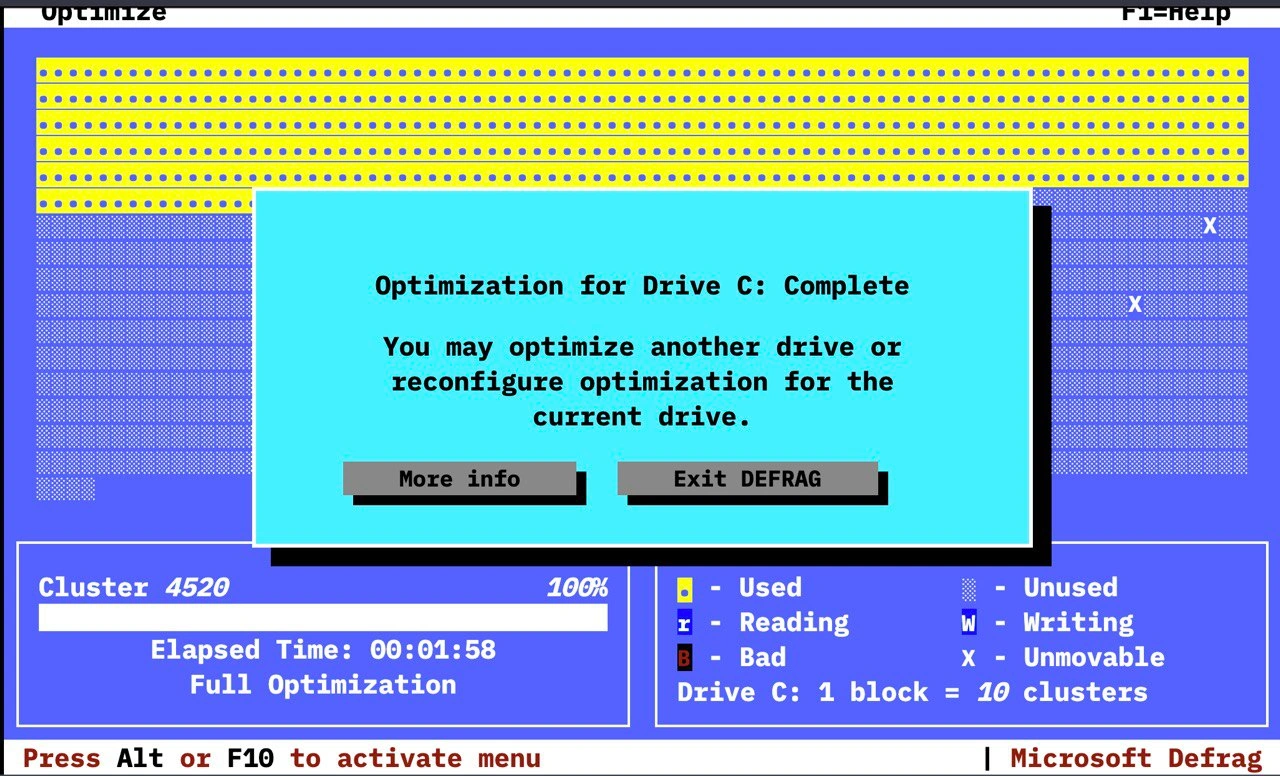
A screenshot of the Microsoft Defrag utility from a vintage operating system like MS-DOS or Windows 9x. The user interface has a classic text-based, blocky aesthetic with a deep blue background. The main part of the screen shows a grid of characters representing disk clusters, with most being yellow (used) and some light blue (unused), indicating a fully optimized drive. A central light-blue dialog box with a drop shadow announces 'Optimization for Drive C: Complete'. Below this, it says 'You may optimize another drive or reconfigure optimization for the current drive.' Two buttons, 'More info' and 'Exit DEFRAG', are present. Information at the bottom shows 'Elapsed Time: 00:01:58' and 'Full Optimization' next to a 100% progress bar. This image evokes strong nostalgia for senior engineers who remember the manual and visually satisfying process of disk defragmentation on older mechanical hard drives, a task now obsolete with modern file systems and SSDs


Comments
7Comment deleted
Remember when 'optimization' meant neatly arranging blocks on a disk? Now it means adding another caching layer and hoping the Kubernetes pod doesn't restart during a memory spike
Defrag in ’95: pack blocks for zero seek latency; cloud in ’24: split the code into 400 services so every request gets its own world tour - turns out we’ve reinvented fragmentation at scale
Watching defrag was the original "waiting for CI/CD pipeline to complete" except at least the blocks moved in patterns that made sense, unlike our current deployment that somehow takes longer after we containerized everything
Ah yes, the Windows 95 defrag screensaver - back when watching colored blocks rearrange themselves for 2 hours was considered both system maintenance AND entertainment. Modern SSDs have robbed us of this meditative experience, along with the existential dread of seeing that one red 'Bad' block appear mid-optimization. Those were the days when 'Full Optimization' meant you could finally go make coffee, eat lunch, and contemplate your life choices while your 2GB hard drive reorganized itself at the blazing speed of... well, eventually
DEFRAG: the OG heap compaction for FAT - two hours of block Tetris so you could report reduced seek latency and call it a 10x improvement
Cluster 4520 at 100%: the last time any storage layer achieved full optimization without silent fragmentation creeping back overnight
Defrag was the OG compaction - rearranging clusters for locality; pity our microservices and org chart still have worst‑case seek times