
Networking Post #749 · source on Telegram
The OSI Model vs. Reality
Description
A humorous, simplified diagram explaining the 7 layers of the OSI model from a pragmatic programmer's perspective. The standard layers (Physical, Data Link, Network, Transport, Session, Presentation, Application) are listed, but with funny, cynical descriptions. For example, the Application layer might be described as 'Where the magic happens' and the Physical layer as 'Is the cable plugged in?'. The meme resonates with developers because it contrasts the complex, theoretical model taught in computer science courses with the practical, often messy reality of debugging network issues. It's a classic example of theory vs. practice, highlighting that most network problems are solved by checking the most basic things first
More like this
More like this in Networking →
Use J and K for navigation
Comments
7Comment deleted
I've solved 90% of my 'complex' networking issues by debugging layer 1: yanking the cable out and plugging it back in again. The other 10% were DNS
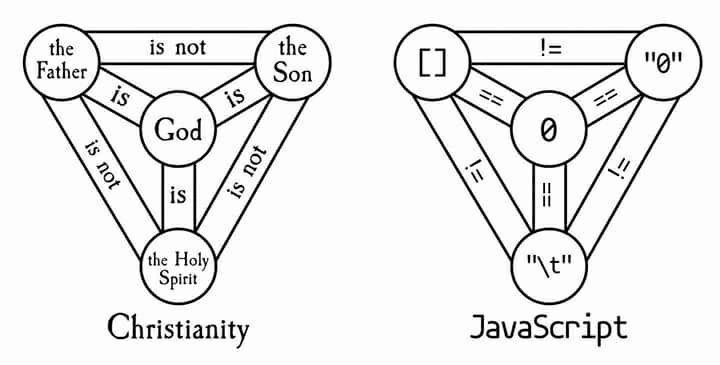
The spec calls it ‘Abstract Equality Comparison,’ but after twenty years it still feels more like faith-based computing than formal semantics
Both systems involve accepting that three things can simultaneously be one thing while remaining distinct, and both require years of theological study to understand why '[] == 0' is true but '[] === 0' is heresy
Just like the Trinity, JavaScript's type coercion is a mystery that three equals signs can't fully explain - though unlike theology, we actually have a spec document, we just choose to ignore it and use triple equals everywhere instead
ECMA‑262’s Abstract Equality is basically theology: three distinct values all equal to 0, and salvation arrives only when the linter preaches ===
JS Trinity: united by == coercion, but === exposes the schism - much like refactoring that 2010 jQuery monolith
JavaScript's holy trinity: [] == 0, "0" == 0, "\t" == 0; none of them are equal to each other - proof that '==' is a religion and '===' is the separation of church and state