
CentOS 7: Accidentally Secure by Being Obsolete
Description
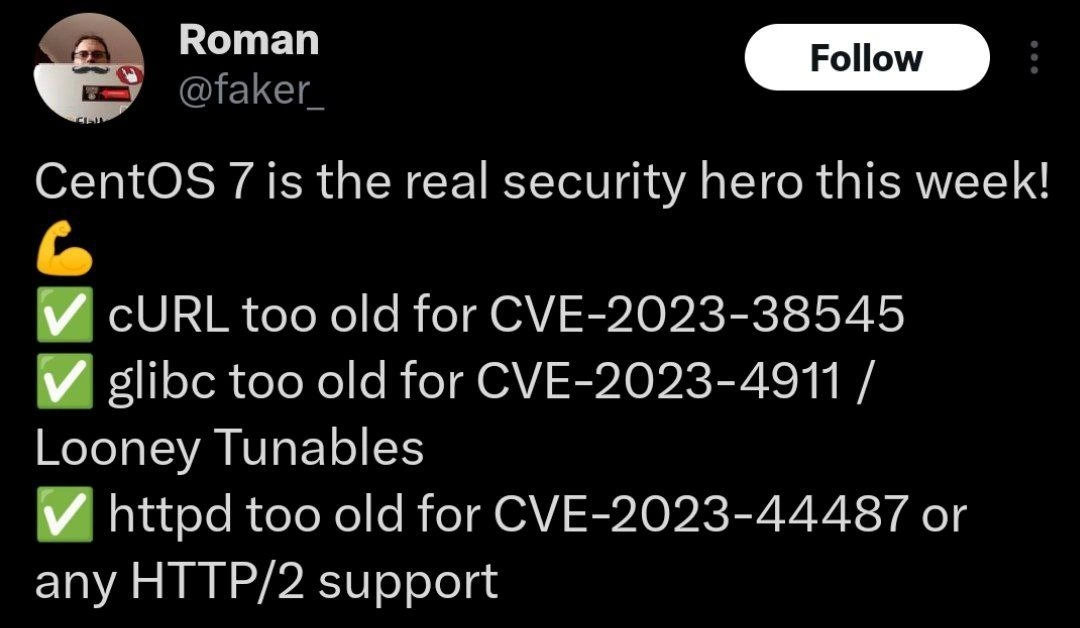
A screenshot of a tweet from the user Roman (@faker_). The tweet, set against a black background with white text, proclaims, 'CentOS 7 is the real security hero this week! 💪'. Below this declaration are three points, each preceded by a green checkmark emoji: 'cURL too old for CVE-2023-38545', 'glibc too old for CVE-2023-4911 / Looney Tunables', and 'httpd too old for CVE-2023-44487 or any HTTP/2 support'. The visual is simple, mimicking a dark-mode social media interface. The meme's humor is rooted in irony. It celebrates a legacy operating system (CentOS 7) for being so outdated that it is immune to several recent, high-profile security vulnerabilities (CVEs). This is a classic 'failing successfully' scenario that resonates with developers and system administrators who manage aging infrastructure. While normally a huge liability, the legacy status of the system's packages becomes a temporary, accidental shield against modern exploits


Comments
12Comment deleted
Our CISO just approved the 'Ancient Technology Shielding' protocol. All new vulnerabilities will now be mitigated by ensuring our stack is at least five years behind the exploit's release date
Welcome to deprecation-driven defense: keep the fleet on CentOS 7 - when cURL predates the bug and Apache predates HTTP/2, every modern exploit just 404s on arrival
The moment when your production CentOS 7 boxes become the most secure systems in your fleet not through diligent patching, but because they're running software so ancient it predates the very concepts modern exploits are trying to abuse - proving that sometimes the best defense against zero-days is running negative-day software
Ah yes, the enterprise sysadmin's ultimate defense strategy: 'Our infrastructure is so legacy that modern vulnerabilities simply bounce off like arrows against a castle that predates gunpowder.' CentOS 7 has achieved what security teams dream of - complete immunity through aggressive non-adoption of new features. It's the digital equivalent of being too old to get drafted: 'Sorry CVE-2023-*, our cURL was compiled when HTTP/2 was still a draft RFC and our glibc predates the Looney Tunables era.' Meanwhile, the security team's risk register just got three automatic 'Not Applicable' entries, and somewhere a CISO is wondering if technical debt is actually a sophisticated defense-in-depth strategy they never understood
CentOS 7: where EOL stands for Exploit-Obviation Layer - no cURL 38545, no Looney Tunables, no HTTP/2 Rapid Reset, because the future never shipped
CentOS 7: Proof that technical debt accrues interest in the form of zero-day immunity
Our CISO calls it temporal sandboxing: pinned to cURL 7.29, glibc 2.17, and httpd-without-mod_http2 - no exploits, just no features
what about debian? Comment deleted
stop giving office managers ideas Comment deleted
Centos 6? Comment deleted
Broke: update packages every month to patch vulnerabilties Woke: do not update packages for years to not introduce new vulnerabilities Comment deleted
These three vulns are for all the older versions as well iirc. Comment deleted