Skip to content
DevMeme
5094 of 7435
The Unsung Engineer vs. The Tech Celebrity
TechHistory Post #5574, on Oct 12, 2023 in TG

The Unsung Engineer vs. The Tech Celebrity

Why is this TechHistory meme funny?

Level 1: The Road and the Car

Imagine a world of cars and roads. Steve Jobs is like the guy who built a super cool sports car – it’s shiny, everyone wants one, and he gets famous for it. Dennis Ritchie is like the person who invented asphalt and paved the roads that every car drives on. Now, the funny thing is, people will talk all day about how amazing the sports car is and how brilliant its creator must be (the media loves that story!). But hardly anyone thinks about the road builder, even though without good roads, that fancy car wouldn’t get very far at all. This meme is making the same kind of comparison with computers. Steve Jobs made neat gadgets you can hold in your hand – like iPhones and iPads – so he’s celebrated and almost treated like a celebrity or a hero. Dennis Ritchie worked behind the scenes on the basic language and system that all our computers use internally. He’s not a household name, even though what he built is everywhere, kind of like the roads under every car. The joke is funny (and a bit true) because we often praise the flashy, visible invention and forget to thank the quiet, crucial invention that made it possible. It’s like cheering for an actor on stage but forgetting the writer who crafted the story. The meme is a little reminder that the biggest building blocks of technology – the “roads” of computing – were laid down by people like Dennis Ritchie, even if they didn’t get the loud applause that guys like Steve Jobs did.

Level 2: Inventor vs Showman

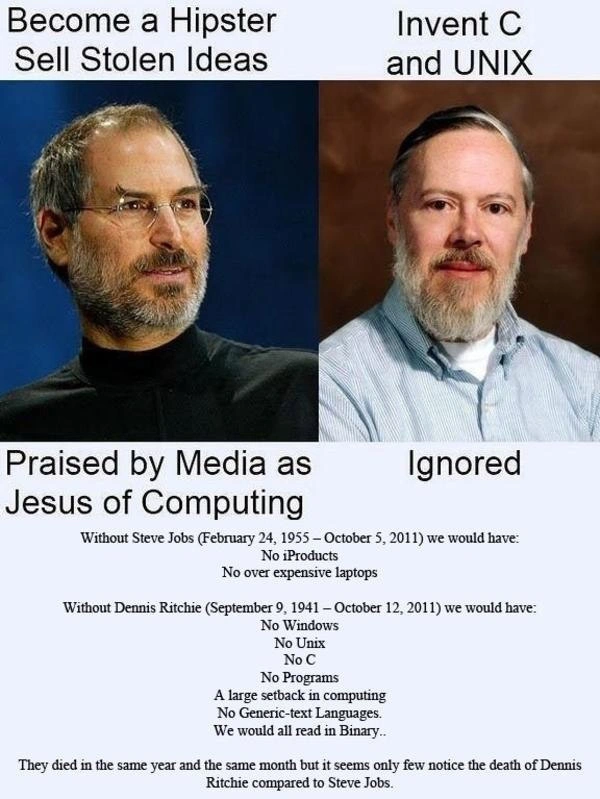
Let’s break down the meme’s two sides in plain terms. On the left is Steve Jobs, the famous co-founder of Apple. He’s the showman – the guy who got on stage in a black turtleneck to unveil shiny gadgets like the Macintosh computer, the iPod, the iPhone, and the iPad. Jobs was brilliant at design and marketing: he didn’t single-handedly engineer every Apple device, but he had the vision to take ideas (sometimes ideas others pioneered) and turn them into products people love. He’s often associated with AppleProducts – anything with that “i” in front (iPhone, iPad, iPod, iMac…). The meme humorously calls him a “Hipster who sells stolen ideas”. “Hipster” here is poking fun at his trendy, cool persona and the whole culture around Apple. “Stolen ideas” refers to the fact that many technology concepts behind Apple’s big innovations were not originally invented by Apple. For example, the graphical user interface (icons, windows, mouse) was first developed at Xerox PARC; Jobs saw it and then used it in the first Macintosh – effectively taking an idea and selling it as part of Apple’s product. He did this with several concepts, but crucially, he made them user-friendly and marketable. That’s why the meme says “Praised by media as Jesus of Computing” below his picture. It’s a tongue-in-cheek way to say the media treats him like a messiah or savior of technology – giving him almost worshipful praise, as if he performed miracles (turning gadgets into gold in the eyes of consumers). When Steve Jobs died on October 5, 2011, it was worldwide news; people who never cared about tech were suddenly talking about computing’s “greatest visionary.”

On the right side is Dennis Ritchie. He’s the inventor – a computer scientist who isn’t a household name but contributed two of the most fundamental building blocks of software: the C programming language and the Unix operating system. If you’re new to these terms: C is a programming language developed in the early 1970s. It’s one of the most influential languages ever – many modern languages (like C++, C#, Java, even JavaScript’s syntax) are based on C or heavily influenced by its style. Unix is an operating system (the core software that manages a computer’s hardware and lets other programs run). Unix was initially created around 1969-1971 by a small team including Dennis Ritchie at Bell Labs. What’s special about Unix is that it introduced a design that could be used on different machines (it was portable thanks to being written in C) and it introduced a lot of ideas we take for granted in OperatingSystems today (like having a hierarchical file system with directories, or treating various devices and inputs uniformly as files). Many offshoots of Unix exist – Linux (which runs on most servers and Android phones) is basically a reimplementation of Unix ideas, and macOS on your MacBook is actually Unix-based too. Even Windows, although not a direct Unix descendant, was created in a world where Unix set the standard for OS concepts and is largely written in C/C++ which follows from Ritchie’s language. So Ritchie’s work is deeply embedded in TechHistory – it’s the foundation. But Ritchie wasn’t a showman; he was a reserve, academic type (note his photo: no stage, just a quiet portrait with a beard and a collared shirt). The meme labels his side “Ignored,” meaning the mainstream media and public largely ignored his death and contributions. In fact, Dennis Ritchie died just a week after Jobs, on October 12, 2011, but hardly anyone outside the tech community noticed because it wasn’t widely reported beyond some tech news.

The large block of text in the meme explicitly contrasts their contributions. Let’s decode that, as it lists what each person’s absence would mean:

  • Without Steve Jobs (1955–2011) we would have:

    • No iProducts – No iPhone, iPad, iPod, etc. Basically, many of Apple’s iconic gadgets might not exist or be as popular.
    • No over-expensive laptops – A jab at Apple’s MacBook laptops, which are famously pricey. So without Jobs, maybe we wouldn’t have super expensive sleek aluminum laptops setting trends (or perhaps laptops wouldn’t be as stylish).
  • Without Dennis Ritchie (1941–2011) we would have:

    • No Windows – This one might surprise you: Windows is Microsoft’s operating system, not directly related to Ritchie. But the point is Windows was created using the C/C++ languages and its developers were influenced by the culture of operating systems that Unix kick-started. If C and Unix hadn’t been around to advance the field, something like Windows might have been delayed or very different (possibly much harder to develop). It’s an exaggeration, but underscores how deeply Ritchie’s inventions affected all operating systems, even those from other companies.
    • No Unix – This is obvious: Ritchie literally co-created Unix. Without him, the entire family of Unix-like systems (which includes Linux, macOS, etc.) wouldn’t exist in their known form.
    • No C – Also obvious: he invented the C language. Without C, a huge number of software projects and other programming languages (C++, Objective-C, even parts of Python and Java which are implemented in C) wouldn’t be around, at least not the same way.
    • No Programs – This one is a bit of comedic hyperbole. It doesn’t mean absolutely no programs would exist, but a huge amount of software is either written in C or in languages derived from C. Many of our operating systems, databases, browsers, and even language compilers themselves are written in C/C++. Without C, the software landscape would be completely different and likely decades behind. It emphasizes that modern software development as we know it owes a lot to C.
    • A large setback in computing – Summarizing the above: removing Ritchie’s contributions would push back progress in computing by many years. It might be like losing the inventor of the wheel in terms of impact – yes, eventually others might create something similar, but much later and after more struggle.
    • No Generic-text Languages – By “generic-text languages” they mean high-level programming languages that use regular text code (letters, keywords, etc.) that are not specific to one machine. C was one of the first such powerful, widely-used languages for system development. Before that, many programs (especially operating systems) were written in assembly language, which is very low-level and specific to each machine type. If those “generic” languages hadn’t evolved, coding might still be mostly done in very machine-specific ways. (There were other languages like FORTRAN or COBOL in earlier decades, but C’s influence on general-purpose and systems programming was uniquely powerful.)
    • We would all read in Binary – This line drives the point home with humor. “Reading in binary” suggests a world where we’d be reading streams of 0s and 1s to program computers. Of course, in reality, even without Dennis Ritchie, other programming languages did exist (like BASIC or Pascal by the 1970s, and others would come). But the joke exaggerates: without the contribution of C (and what it kicked off), maybe we’d still be stuck with extremely low-level coding or something archaic. Essentially, it means without user-friendly programming languages, writing software would be as hard as literally working with binary code – which is something only computers normally do. Humans generally write code in a higher-level language (like C, Python, Java, etc.), and then a compiler or interpreter translates it to binary for the machine. Dennis Ritchie’s work made that human-machine translation far more feasible and standardized.

In summary, the meme humorously contrasts a famous tech CEO and a brilliant computer scientist. It’s saying: one man gave us cool gadgets and a brand (and got lionized like a rockstar 🕺), while the other gave us the very tools and infrastructure that all modern software runs on (and got little public praise). The humor (and slight bitterness) in the meme comes from that imbalance. It’s poking fun at how the general public and media sometimes don’t recognize the real builders behind the scenes. Developers find this funny because it’s a bit of an “inside joke” – we know and deeply respect Ritchie’s contributions, and we also know how over-the-top the cult of Steve Jobs can be. Both men were important, but in very different ways. Steve Jobs made technology approachable and desirable for millions of people; Dennis Ritchie made technology possible for those who build it. The meme isn’t saying Steve Jobs did nothing – rather, it jokingly exaggerates that he “sold ideas” – but it reminds us that without the likes of Dennis Ritchie, those ideas couldn’t be realized. It’s a classic case of visionary vs implementer: the visionary gets the spotlight, the implementer quietly changes the world.

Level 3: Fame != Contribution

“They died in the same year and the same month but it seems only few notice the death of Dennis Ritchie compared to Steve Jobs.”

For seasoned developers, this meme hits a poignant note of IndustrySatire. It highlights the stark disparity in recognition between a media-celebrated tech icon and an unsung engineering hero. Steve Jobs, depicted on the left, is the archetype of the charismatic product visionary – often hailed (half-jokingly, as the meme does) as the “Jesus of Computing”. In life and death, he was idolized by mainstream media; think magazine covers with his portrait, breathless news coverage of every product launch, and even a slew of movies and books mythologizing him. Jobs had a knack for showmanship: trademark black turtleneck, theatrical keynotes, and a reality-distortion field that could make incremental tech advances sound revolutionary. He’s the guy who could sell “stolen” ideas with such flair that people believed Apple invented them. (The meme’s edgy line “Become a Hipster, Sell Stolen Ideas” alludes to how Jobs took existing concepts – GUI interfaces from Xerox PARC, the mouse, even the concept of personal computing – and turned them into polished products. He wasn’t writing the code or engineering the hardware alone; he was packaging others’ innovations in a way that made consumers want them desperately. In startup lingo, he was the ultimate product evangelist and hype man.) Because of this, the media worship around him grew to almost cult-like levels. Many in the general public sincerely think Steve Jobs personally “invented” things like the smartphone or even the computer, not realizing he had teams of brilliant engineers (and earlier pioneers) behind him. This is the classic cult of personality in tech: a single figurehead gets almost messianic credit for collective, incremental progress.

On the right, we have Dennis Ritchie – the engineer’s engineer, a bearded computer scientist in a button-down, with a legacy tenfold deeper in the technical strata. Yet outside of developer circles, Ritchie’s name elicited blank stares. When he passed away (just one week after Jobs in October 2011), the news was a mere blip. No live TV retrospectives, no nationwide mourning – just a few respectful notes on tech forums and the occasional obituary in tech magazines. Inside the programming community, we mourned the father of C and co-creator of Unix, knowing full well that his work enabled everything from Microsoft Windows to UNIX/Linux servers to the software running on Apple devices. But try explaining that to a news editor – “Father of C” doesn’t have the sexy ring of “Father of the iPhone.” 📰 The meme’s humor is laced with frustration: Fame != Contribution in the tech world. It’s an equation every senior developer learns. The people who actually architect the platforms and languages (the OperatingSystems, languages and frameworks) often remain in the shadows, while the flamboyant product leaders and CEOs bask in spotlight. We chuckle (or maybe grind our teeth) at the irony that without Ritchie, modern software would be unrecognizable, yet he’s virtually unknown to the Apple fan who lines up for the latest iGadget. Even many developers owe their livelihoods to C and never realize one quiet man helped write the playbook back in the ’70s.

The juxtaposition in the meme is exaggerated for effect – calling Jobs a hipster selling others’ ideas and Ritchie “ignored” – but it rings true enough to hurt. TechHistory is full of such dichotomies: the marketers and visionaries often get the credit (and the movies made about them), whereas the brilliant implementers stay footnotes. (Consider how many know Bill Gates, a savvy businessman who pushed a version of BASIC and DOS, versus Gary Kildall, who actually created an early operating system CP/M that inspired DOS – one became a billionaire celebrity, the other remained relatively obscure. Or how everyone quotes Apple’s “Think Different” campaign, but few can name Alan Turing or Grace Hopper who laid computing’s groundwork.) The meme specifically calls out that both Jobs and Ritchie died in the same month of 2011, yet the public reactions were worlds apart. Those of us in dev communities remember that surreal week: social media flooded with grieving statuses and tribute videos for Jobs, while Ritchie’s passing got a much smaller, quieter wave of homage mostly from programmers posting quotes like “printf("Goodbye, world");” as a subtle farewell. Some of us half-joked that if Dennis Ritchie had charged a 99¢ license fee for using C, he’d be as rich and famous as any tech CEO – but he was a scientist, not a showman.

Why does this disparity persist? Because society celebrates visible products over invisible infrastructure. An iPhone is tangible, shiny, life-changing for a user; C and Unix are abstract, under-the-hood tools that only developers directly see. It’s cool to idolize the genius who put 1000 songs in your pocket; it’s harder to explain the genius who made it possible to write an operating system that fits in that pocket. The meme’s biting punchline listing “Without Dennis Ritchie we’d have: No Windows, No Unix, No C, No Programs...” lays it out bluntly for those in the know. Windows is built in C/C++ and its design owes to concepts formalized in earlier OS work. Mac OS X (the very OS Jobs’s computers run) is a certified Unix-based system, so without Unix and C, even Apple’s crown jewels wouldn’t shine. It’s a delicious irony that the Apple empire, which made Jobs a legend, is built atop the very tools and systems Dennis Ritchie pioneered (C, Unix, and their derivatives). In other words, Jobs built the house, but Ritchie invented concrete and steel – guess who the public thanks? This meme resonates among developers because it validates a shared sentiment: “We remember the real heroes behind our tools.” It’s a nod of respect to the quiet coder in the back, the tech historian’s favorite unsung legend, and a gentle eye-roll at how mainstream narratives often miss the forest for the Apple trees.

Level 4: Portable Code Revolution

At the deepest technical level, this meme contrasts visionary consumer tech with the foundations of modern computing. The right side (Dennis Ritchie) represents a paradigm shift in software: the creation of the C programming language and the UNIX operating system. These inventions fundamentally changed how computers were built and programmed. In the early 1970s at Bell Labs, Ritchie co-authored UNIX and designed C to rewrite UNIX in a high-level language. This was revolutionary – an operating system kernel had always been written in low-level assembly tied to one machine. By writing UNIX in C (a portable assembly language), they enabled the OS to be recompiled on different hardware. This portable code revolution meant one codebase could run on multiple computers, which was a radical break from rewriting everything for each new machine. It’s the reason we have common operating systems across diverse devices today. Before C, developers often had to write programs in machine-specific code (think patterns of 0s and 1s or cryptic assembly instructions). Ritchie’s C gave programmers a way to write in a human-readable text language that could be efficiently translated (compiled) into those 0s and 1s. Without this leap, every program and every OS might still be handcrafted in binary, specific to each model of computer – a painfully slow and error-prone process.

Crucially, C didn’t appear in isolation: it was co-evolved with UNIX. UNIX introduced key operating system concepts – a hierarchical file system, multi-user environments, device independence, and the famous philosophy of “everything is a file.” These concepts underpin modern OperatingSystems design (even Windows borrowed many ideas that trace back to UNIX’s design principles). The influence is so deep that today’s CFamilyLanguages (C++, C#, Objective-C, Java, etc.) all inherit C’s syntax and low-level capabilities, and virtually every popular OS (from Linux to Mac OS to Windows) is written in C or its descendants. When the meme says “Without Dennis Ritchie we would have no Windows, no Unix, no C, no Programs,” it’s hyperbolic but grounded in truth: Ritchie’s work set the standard for software and system design. Unix’s codebase and ethos spread globally (universities taught it; companies adopted it), becoming the template for later systems. C, as the lingua franca of programming, allowed software like databases, compilers, and even entire new languages to be built atop a common, efficient foundation. The meme jokingly adds “No generic-text languages – We would all read in Binary,” hinting that without high-level languages like C, programming might still be done by flipping bits or writing machine code directly. In technical terms, C provided abstraction without sacrificing performance, enabling humans to program complex systems without drowning in binary digits, yet still produce fast, machine-level output. This balance between human-readable code and hardware-efficient execution is why C (and by extension, the operating systems written in C) became the bedrock of computing. Dennis Ritchie’s contribution was as foundational to software engineering as constructing the power grid is to modern cities – an invisible infrastructure that everything else relies on.

Meanwhile, the left side (Steve Jobs) symbolizes innovations in consumer technology built on top of those foundations. Jobs’s fame comes from products like the Apple II, Macintosh, iPod, iPhone, etc., which captured the public’s imagination. But even those groundbreaking devices were running on the fundamentals that engineers like Ritchie developed years prior. For example, macOS and iOS (the operating systems for Macs and iPhones) are UNIX-based under the hood (specifically, they’re built on a UNIX derivative called BSD, with a kernel originating from Mach – both influenced by the original Unix design). The software for these devices is largely written in C-based languages (Objective-C, C++, Swift which interops with C). In essence, Jobs’s “magical” gadgets run on Ritchie’s software magic – a classic example of applied innovation atop theoretical and engineering breakthroughs. From a computer science perspective, the humor (tinged with irony) comes from recognizing that the flashy AppleProducts so lauded by media wouldn’t exist without the uncelebrated lower-level work: no easy-to-use graphical interface or killer app runs without an operating system, and that OS wouldn’t exist (or would look very different) without C and UNIX blazing the trail. The meme underscores a core truth in tech history: glamorous front-end invention often rests on grungy back-end innovation. The media and general public may not realize it, but every time they click an icon or tap a touchscreen, layers of Ritchie’s legacy are executing behind the scenes. In computing’s family tree, if Steve Jobs is the charismatic parent of the iPhone generation, Dennis Ritchie is the grandparent of the entire ecosystem, quietly imparting the DNA (C code, Unix principles) that makes the modern computing world possible.

Description

A two-panel comparison meme contrasting Apple co-founder Steve Jobs with computer scientist Dennis Ritchie. The left panel features a photo of Steve Jobs with text above reading 'Become a Hipster Sell Stolen Ideas' and text below reading 'Praised by Media as Jesus of Computing'. The right panel shows a photo of Dennis Ritchie with text above reading 'Invent C and UNIX' and text below reading 'Ignored'. The bottom section of the image details their respective impacts: 'Without Steve Jobs...we would have: No iProducts, No over expensive laptops'. In contrast, 'Without Dennis Ritchie...we would have: No Windows, No Unix, No C, No Programs, A large setback in computing, No Generic-text Languages, We would all read in Binary..'. A concluding line notes, 'They died in the same year and the same month but it seems only few notice the death of Dennis Ritchie compared to Steve Jobs.' The meme is a commentary popular within the developer community that foundational engineering contributions, like Ritchie's creation of the C language and the Unix operating system, are often overlooked by the public in favor of charismatic product visionaries like Jobs, despite Ritchie's work being arguably more fundamental to modern computing itself
Comments

29
Anonymous ★ Top Pick The media praises the architect who designed the beautiful penthouse, while the engineers who designed the foundation, steel, and concrete that prevent the whole thing from collapsing are just a footnote in the building permit
  1. Anonymous ★ Top Pick

    The media praises the architect who designed the beautiful penthouse, while the engineers who designed the foundation, steel, and concrete that prevent the whole thing from collapsing are just a footnote in the building permit

  2. Anonymous

    Funny how the black-turtleneck showman tweaks a bezel and gets a standing ovation, while the grey-bearded coder who gave our kernels their mother tongue is still just a “warning: unused brilliance” in the media’s build log

  3. Anonymous

    The irony that the person who created the foundation that makes all modern operating systems possible got less media coverage than the person who put a pretty UI on top of BSD - proving once again that in tech, the closer you are to the metal, the further you are from the spotlight

  4. Anonymous

    The irony is profound: one man gave us the C language that powers everything from kernels to embedded systems, and UNIX - the foundation of Linux, macOS, Android, and countless servers. The other gave us beautifully marketed products built on top of that foundation. Yet the media canonized the marketer while the architect of modern computing passed almost unnoticed. It's the ultimate metaphor for our industry: everyone celebrates the UI, but nobody remembers the syscalls that make it possible. Ritchie's legacy is literally running on the device you're using to read this - his work is so fundamental it's invisible, which is perhaps the highest compliment in systems programming, even if it means dying in obscurity

  5. Anonymous

    Press loves the keynote; production loves C and UNIX’s ABI - it’s the thing keeping the shiny demo from segfaulting mid-applause

  6. Anonymous

    In tech, the keynote gets the glory, but your entire estate still boots a POSIX descendant compiled by a C toolchain older than your OKR framework

  7. Anonymous

    Steve's legacy: touchscreens. Dennis's: every touchscreen OS. Media priorities: impeccable

  8. @Araalith 2y

    Oh, come on. Progress has never depended on just one man. There is always another "Steve" or "Dennis".

  9. @dovbenn 2y

    F

  10. @InnerTempest 2y

    F

  11. Deleted Account 2y

    🫡

  12. @ZgGPuo8dZef58K6hxxGVj3Z2 2y

    Tbh that statistic is bs you can't know what else would get invented if he weren't...

  13. @SamsonovAnton 2y

    "We would all read in Binary" seems quite an exaggeration.

  14. @beton_kruglosu_totchno 2y

    "No Generic-text languges" O rly?

  15. @Assarbad 2y

    Going by "innovative" Apple has been since his death, I think there was something more to him than this meme lets on. But then, I have found that the most prominent and loud "voices" aren't necessarily the most qualified. I think we can agree that in overall society perhaps Ritchie is undervalued. But among those who know, he's not. But perhaps he also wasn't as vain as Jobs?

  16. @TimurWasHere 2y

    Cuz Steve Jobs made a lot of money and he's popular by different mom's basement business analytics. Apple fan boys too ofc

  17. @CcxCZ 2y

    Lol "no programs" C was derivative of BCPL which was derivative of ALGOL AWK was largely inspired by SNOBOL. Creators of UNIX certainly did a lot of work but don't pretend that happened in vacuum. Learn your computer history if you want to do a meme about it.

  18. @CcxCZ 2y

    FFS Zamenhof had a formal programming language way before his computer got built. He just was unlucky to be born on the wrong side of WW2 and didn't really get funds to build stuff, unlike Turing.

  19. @CcxCZ 2y

    https://rigaux.org/language-study/diagram.html I kind of wish Modula or Ada have made it instead of C.

    1. @anatoli26 2y

      Rust! Rust should have been from the beginning! 😆

      1. @CcxCZ 2y

        I understand your sarcasm, but look into Ada. It's actually designed for safety critical code, with modern editions allowing seamlessly integrating proofs of correctness. Sadly most of the code has been historically stuck behind NDAs in aerospace and similar industries.

        1. @anatoli26 2y

          Actually that was not sarcasm, but sadly Rust & its ecosystem that we love wasn’t possible in those days

          1. @CcxCZ 2y

            I'm quite meh on that personally. If there was a stable and relatively simple core language that was self-hosting without relying on the LLVM monstrosity I'd be way more interested.

  20. @RiedleroD 2y

    yes, but also no

  21. @gizlu 2y

    what is "generic-text language"?

    1. @alexandr_guluta 2y

      not binary

    2. @CcxCZ 2y

      I assumed language for processing plain text, such as ed, sed and awk.

    3. @ZgGPuo8dZef58K6hxxGVj3Z2 2y

      Visual Basic. (Maybe Python prob not)

  22. @kandiesky 2y

    The normies only care about marketing and not actually doing something They are full on NPCs and very retarded at that

Use J and K for navigation