
Peak XML: The Ultimate Binary Representation
Description
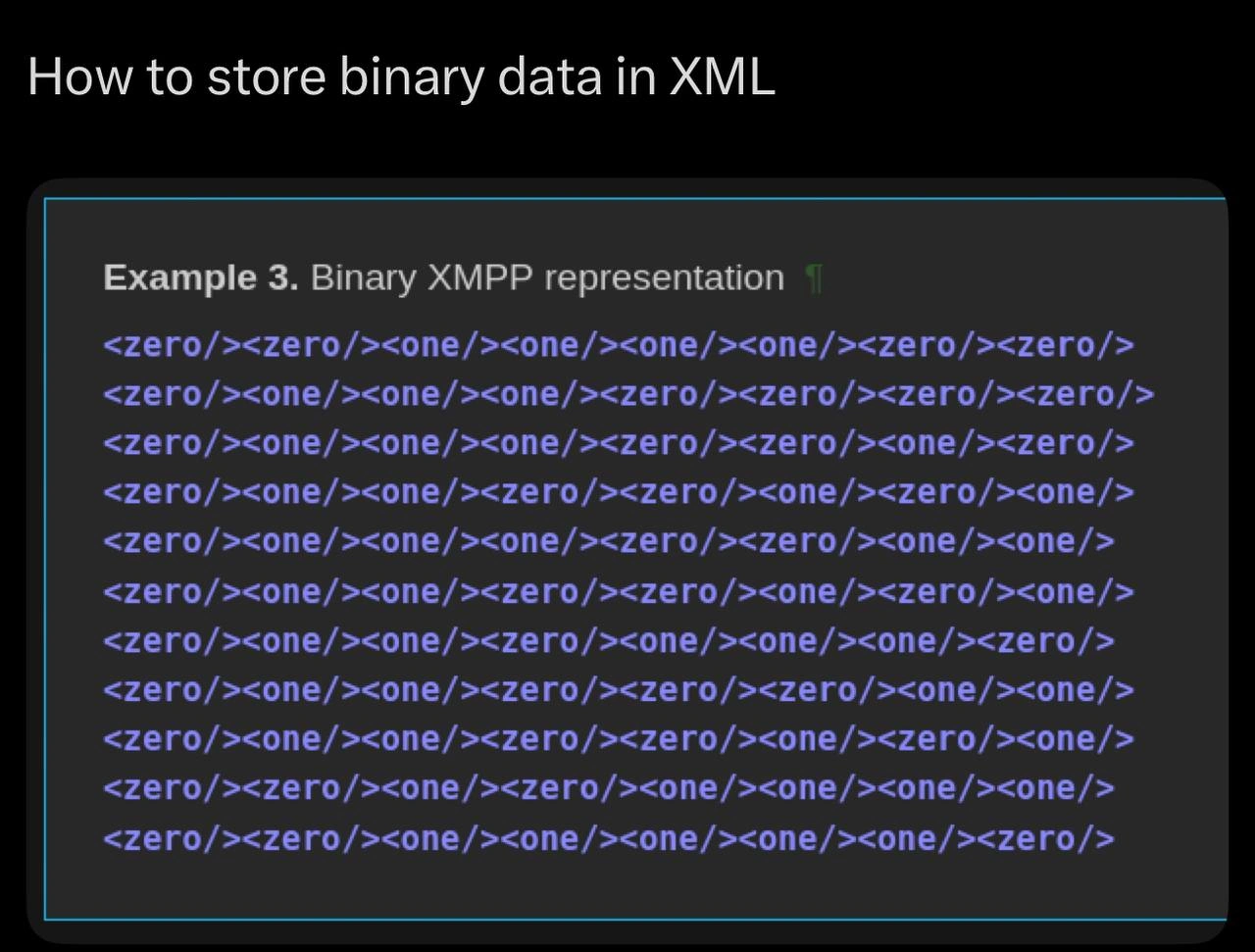
A screenshot of a code example under the heading 'How to store binary data in XML'. The image is in a dark mode interface. Inside a bordered box, a title reads 'Example 3. Binary XMPP representation', followed by ten lines of XML-like code. Instead of using standard binary digits (0 and 1), the data is represented with verbose XML tags: '<zero/>' for 0 and '<one/>' for 1. This meme satirizes the notorious verbosity and inefficiency of XML. The technical joke is that while this is a technically possible way to represent binary data in a text format, it is absurdly impractical, consuming massive amounts of space compared to standard methods like Base64 encoding. It's a humorous jab at the 'everything must be XML' design philosophy that was once prevalent, which often led to over-engineered and inefficient solutions

Comments
21Comment deleted
An enterprise architect looked at this and said, 'Finally, a human-readable, schema-valid, and self-documenting representation for a boolean.'
Sure, it’s 10 GB for one byte, but hey - at least it’s "human-readable" enough to survive the next mandatory SOAP migration
This is what happens when the architect who insisted on 'everything must be semantic XML' discovers binary data exists - next they'll propose storing JPEGs as nested <pixel> tags with RGB attributes for 'better queryability'
When your architect insists on 'human-readable' binary data and you take it literally - turning 8 bytes into 1KB of XML tags. At this encoding efficiency, you could store an entire megabyte of data in just... *checks notes* ...112 megabytes of XMPP stanzas. Perfect for that enterprise messaging system where bandwidth is infinite and parsing time is just a social construct. Base64 was clearly too compact and efficient for modern distributed systems
XML binary: where 1KB becomes 1MB, proving schemas value pedigree over payload efficiency
Base64 adds 33% overhead; BaseXML turns a 1 KB payload into a multi‑megabyte DOM and a surprise cloud egress bill
Binary XMPP: when “human readable” becomes “pager readable” - BaseTag-2 that turns 1 MB into a quarterly bandwidth budget
What the absolute cancer is this Comment deleted
Well this is clearly more efficient Comment deleted
i'll stick to base64 thanks Comment deleted
Why base64? You know there are butterflies, right? Comment deleted
💀 https://xmpp.org/extensions/xep-0239.html Comment deleted
its a joke standard tho Comment deleted
Like the RFC 1149? Comment deleted
Use of port 10110 is obviously secure, since 10110 in base 2 is 22 in base 10, the same default port as Secure Shell Okay, I love that Comment deleted
port 10110 Nobody can hack me 💀😂😂 Comment deleted
4. Internationalization Considerations¶ The <zero/> and <one/> elements use English-language words as the element names. Clearly it would have been preferable to define an i18n-friendly binding, such that German-language applications could encode Binary XMPP using the <null/> and <eins/> elements, Greek-language applications could use the <μηδέν/> and <ἑνα/> elements, etc. Flexibility regarding internationalization of the element names may be added in Binary XMPP 2.0. Comment deleted
How dare are you to ruin the party? Comment deleted
actually I was laughing at the contact information at first. but only then noticed this Type note Comment deleted
I'll stock to json, thanks Comment deleted
Hell naww😭💀 Comment deleted