
The Illusion of Security: Using Base64 as 'Encryption'
Description
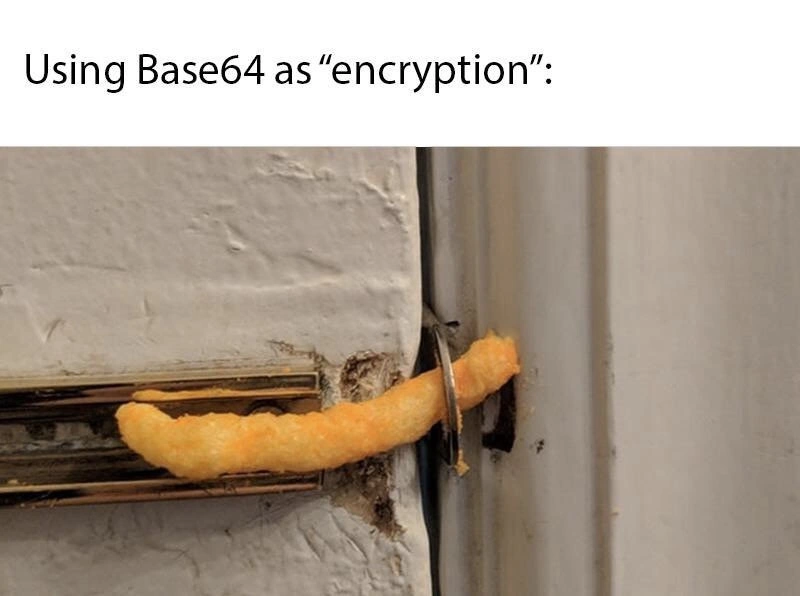
This meme provides a powerful visual metaphor for a common security fallacy in software development. The top of the image has the text 'Using Base64 as “encryption”:'. Below this caption is a close-up photograph of a door's slide latch. Instead of a sturdy metal bolt, a single, orange, puffy cheese curl (like a Cheeto) is threaded through the lock mechanism, pretending to secure the door. The image is absurd, as the cheese curl is obviously fragile and could be broken with the slightest force. The technical joke is a direct analogy: Base64 is an encoding scheme designed to represent binary data in text format, not a method of encryption. Like the cheese curl lock, it offers a superficial layer of obfuscation that is trivially reversible. Experienced developers recognize this as a critical anti-pattern, often seen in code written by beginners who misunderstand the fundamental difference between encoding (changing format) and encryption (securing with a key)


Comments
23Comment deleted
A junior dev told me he 'encrypted' the API keys with Base64. I told him that's like leaving your house key under the doormat, but the doormat is transparent and has 'KEY IS HERE' written on it
Every time someone brags that our “kube-secrets” are safe because they’re Base64-encoded, I picture this Cheeto deadbolt and wonder which will crumble first - the snack or our audit narrative
The only thing Base64 encrypts is your promotion prospects when the security audit finds it protecting production API keys - at least the pool noodle has the decency to be obviously useless
Ah yes, the classic 'security through encoding' approach - because nothing says 'protected data' like a transformation that literally has a 'decode' button in every browser's dev console. It's the equivalent of writing your password on a sticky note, but in a different font, and calling it 'encrypted.' At least with actual encryption, an attacker needs computational resources or a key; with Base64, they need... the ability to copy-paste into atob(). I've seen this in production more times than I care to admit, usually accompanied by comments like 'encrypted for security' in code reviews that somehow got approved. The real tragedy is when this passes compliance audits because someone checked the 'data is encoded' box without understanding the difference between encoding and encryption. It's 2024, folks - if your 'encryption' scheme can be defeated by a Stack Overflow snippet from 2009, it's time to have a conversation with your security team
If your “encryption” can be undone by piping to base64 -d, your key management strategy is basically “buy more Cheetos.”
Base64 “encryption” is when a codec gets promoted to a control - wrap it as a Kubernetes Secret, admire the trailing ==, and hope the pen tester’s grep only looks for “AES”
Base64 'encryption': the architectural choice where you trade unbreakable security for the thrill of inevitable decoder rings
Md5 Comment deleted
YouTube args be like Comment deleted
using XOR(s, 'Lol' * ceil(s.size()/3)) as an encryption Comment deleted
Using full 52-round™ ROT13 as encryption. 😎 Comment deleted
using the hashed date of when the user registered as salt for SHA-256 encryption: 💪 Comment deleted
For salt it’s not that bad actually May be you meant for pepper? Comment deleted
Maybe he meant that time of registration is fully stored on the server and registration date is calculating on frontend? Even if miliseconds is not stored hacker can iterate password over in 1000 times Comment deleted
not sure what pepper is in this context, but I did mean to write a simple, but working solution to password encryption. Comment deleted
it seems to be good enough, since the whole point of using salt is to break reverse tables, and they won't store a billion variations for every password Comment deleted
But sha256 isn’t encryption, that’s hashing Comment deleted
But it doesn't matter Comment deleted
yes, sorry. I meant password hashing. Comment deleted
Basic http auth: hello, it's me Comment deleted
if (password == "********") { true; } Comment deleted
in open source code Comment deleted
Is that a fucking cheetos? Comment deleted