
Learning Post #463 · source on Telegram
A Backend Developer's First 24 Hours with JavaScript
Description
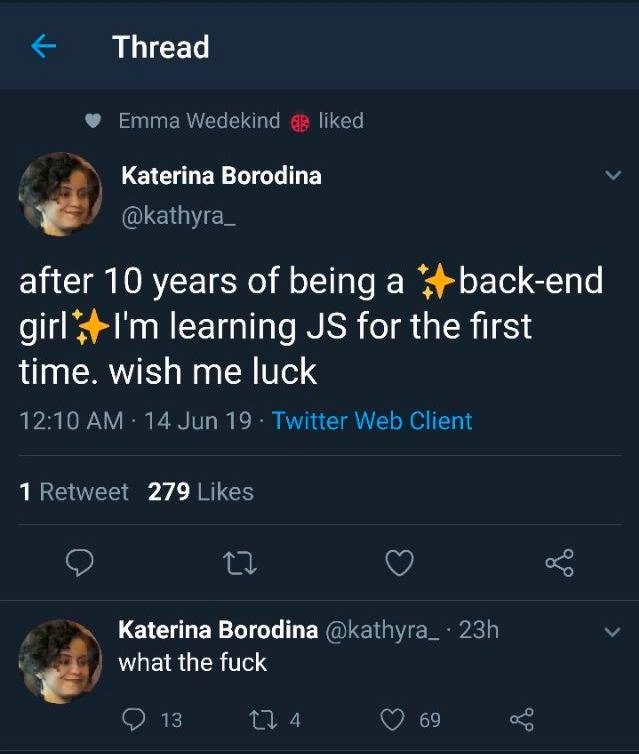
A screenshot of a Twitter thread from user Katerina Borodina (@kathyra_). The first tweet, posted at 12:10 AM, reads, "after 10 years of being a ✨back-end girl✨i'm learning JS for the first time. wish me luck". It conveys optimism and a new challenge. The second image is a reply from the same user 23 hours later, which simply says, "what the fuck". This stark, frustrated response captures the humorous and often painful experience many seasoned developers, particularly from strongly-typed backend environments, have when first encountering JavaScript's quirks, type coercion, and unique ecosystem. The dramatic shift from cheerful anticipation to raw exasperation in less than a day is a highly relatable narrative in the developer community
More like this
More like this in Learning →
Use J and K for navigation
Comments
7Comment deleted
The JavaScript initiation ritual: Day 1, you write 'Hello, World!'. Day 2, you discover `[] + {}` results in `[object Object]` but `{} + []` gives you `0`, and you start questioning the nature of reality
Spent a decade preaching ACID; two hours into JavaScript and I'm explaining why [] == ![] is true - turns out even the type system is eventually consistent
After a decade of writing strongly-typed code with predictable behavior, discovering that '0' == false but '0' == [] is false while [] == false is true really makes you appreciate why your frontend colleagues have trust issues
After a decade of strongly-typed backend bliss with predictable behavior and sensible error messages, discovering that JavaScript considers `[] + []` to be an empty string, `[] + {}` to be '[object Object]', but `{} + []` to be 0 (depending on context) is the exact moment every backend engineer questions their life choices. The 23-hour gap between 'wish me luck' and 'what the fuck' is actually impressive restraint - most of us hit that realization around the third time `==` does something inexplicable
Nothing humbles a backend veteran faster than learning that in JavaScript, Abstract Equality is negotiated by ToPrimitive at runtime and that 'this' is whoever called the meeting
After a decade of ACID and static types, JavaScript greeted me with “==” as eventual consistency, “this” as leader election, and NaN being a number - turns out “wish me luck” was under-provisioned
10 years backend bliss: strong types, predictable GC. JS Day 1: 'typeof NaN === "number"' - reality's plot twist