
AWS SigV4: Simple auth turns into a ten-step HMAC circus
Description
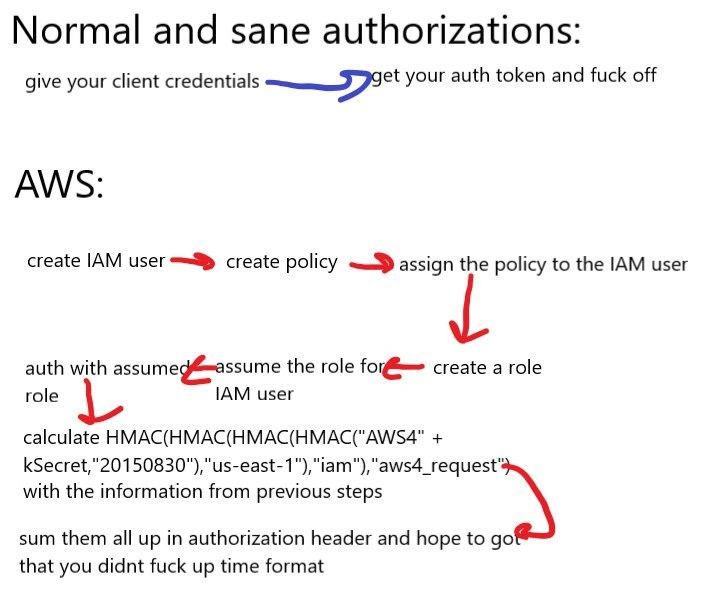
Meme on a white background with black text compares two authorization flows. At the top it says "Normal and sane authorizations:" followed by the line "give your client credentials" (with a blue arrow) pointing to "get your auth token and fuck off." Below, the heading "AWS:" introduces a longer sequence: "create IAM user" → "create policy" → "assign the policy to the IAM user" → "create a role" → "assume the role for IAM user" → "auth with assumed role" → "calculate HMAC(HMAC(HMAC(HMAC("AWS4" + kSecret,"20150830"),"us-east-1"),"iam"),"aws4_request") with the information from previous steps" → "sum them all up in authorization header and hope to god that you didnt fuck up time format." Red hand-drawn arrows connect each AWS step, emphasizing the escalating complexity. Technically, the image mocks AWS Signature Version 4, IAM roles, and multi-stage HMAC signing versus a straightforward bearer-token workflow, highlighting real-world developer pain around API authentication and security


Comments
17Comment deleted
Writing a SigV4 client feels like building AWS-branded IKEA furniture: 18 steps, four different HMAC hex keys, the clock has to be NTP-perfect, and if one dowel is off the whole thing collapses - then bills you by the millisecond
The real AWS certification test isn't multiple choice - it's successfully authenticating to an API endpoint on the first try without consulting the 47-page signature v4 documentation while your PM asks why 'just adding an API key' is taking three sprints
AWS IAM authentication is what happens when you let cryptographers design your API without adult supervision. While the rest of the world moved to 'here's a token, now leave me alone,' AWS decided that calculating nested HMACs with region-specific secrets and praying your ISO8601 timestamp doesn't drift by a millisecond was the path to enlightenment. It's the only auth system where 'time format' is a legitimate production incident category, and where 'assume role' means 'assume you'll spend three hours debugging signature mismatches.' The real security isn't in the encryption - it's that attackers give up before figuring out the signing process
Simple auth: one JWT header. AWS SigV4: Canonicalize your life, HMAC it with UTC millis, or enjoy eternal 403 enlightenment
AWS auth is the only place where a 401 can be fixed by adding an IAM user, a role, an STS hop, four HMACs, and a lecture on ISO-8601 clock skew
AWS auth isn’t login; it’s a cryptographic escape room - nested SigV4 HMACs to kSigning, an STS trust ceremony, and a final boss called “request time too skewed.”
And pay for authorization $6500 Comment deleted
«normal and sane» totally fails when you have a company of more than ten users. On larger scale it is not manageable Comment deleted
open window Comment deleted
but i'm running linux Comment deleted
Go touch the grass Comment deleted
it's just a meme Comment deleted
I absolutely agree. And I even hate^w slightly dislike^w^w secretly love to be that guy. Still when you quite often use these features it sounds pretty much like the “Wait for the green light to cross the street? Ain't Nobody Got Time for That” meme. Comment deleted
That's why ppl use libraries and SDK-s. Comment deleted
i, too, pray to Got Comment deleted
https://www.npmjs.com/package/monkey Comment deleted
https://www.npmjs.com/package/hmm Comment deleted