
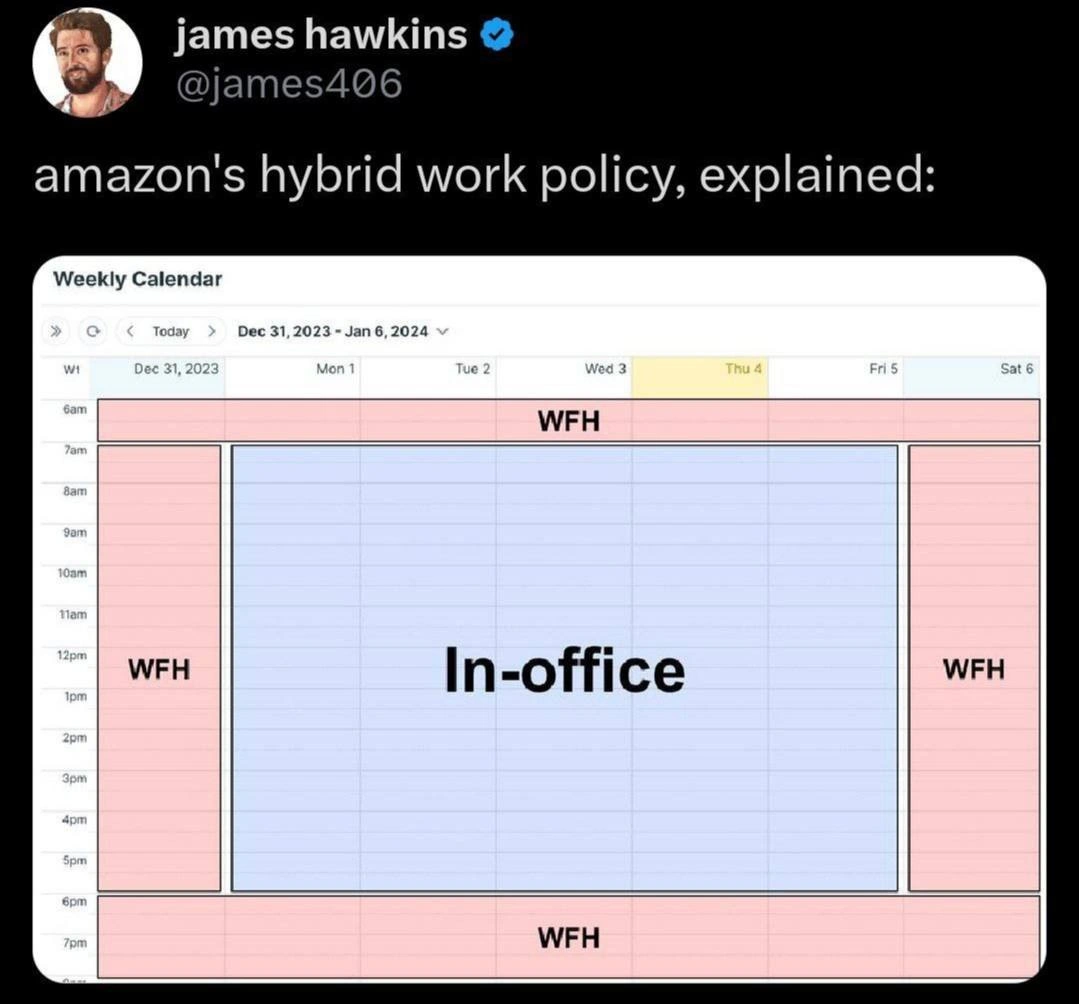
Amazon's Hybrid Work Policy as an Extended Workday
Description
This image is a screenshot of a tweet from user James Hawkins (@james406), which reads, 'amazon's hybrid work policy, explained:'. Below the text is a visual representation of a weekly calendar. The calendar displays a large, solid blue block labeled 'In-office' that covers the core working hours of the day (approximately 7 AM to 7 PM). This central block is completely surrounded by smaller, pink-colored blocks labeled 'WFH' (Work From Home) that fill the time slots early in the morning, during the lunch hour, and late into the evening. The joke satirizes the implementation of hybrid work policies at companies like Amazon, suggesting that instead of offering flexibility, the policy effectively creates an 'always-on' culture. The time that would have been spent commuting or on breaks is now framed as additional 'Work From Home' time, sandwiching the mandatory in-office hours and leading to a longer, more demanding workday


Comments
11Comment deleted
Amazon's hybrid policy is just EC2 with extra steps: you provision your own desk at home for the morning, burst into the office VPC for 8 hours, then handle the egress traffic back home while still being on the clock
Turns out their “hybrid” schedule is just like our architecture: a wafer-thin layer of edge services called WFH wrapped around the same old 9-to-5 on-prem monolith
Amazon's 'hybrid' work policy is like claiming your microservice architecture is loosely coupled when every service still needs to hit the same monolithic database during business hours - technically distributed, practically centralized, and everyone knows the real bottleneck is the commute latency
This calendar perfectly captures the distributed systems approach to hybrid work: the 'In-office' block is the critical path with the smallest time slice, while WFH handles all the async operations. It's like Amazon's leadership principles met CAP theorem and chose Availability and Partition tolerance over Consistency - employees are highly available from home, partitioned from the office, but consistently productive. The real joke? Calling this 'hybrid' is like calling a microservice with 95% of its logic in one service 'distributed architecture.'
Amazon's hybrid policy: a sparse matrix of in-office requirements amid dense WFH bliss - perfect for optimizing commute latency
Amazon’s “hybrid” policy is basically active‑passive: the office is the primary region with strong consistency 9 - 5, and WFH is the DR site that only gets traffic nights and weekends - aka a misconfigured load balancer dressed up as culture
Their “hybrid” is implemented like a routing table: 0.0.0.0/0 → in‑office; WFH only routes to the nights/weekends subnet
What the Wfh mean? Comment deleted
Work from home Comment deleted
Well, "In-office" then does not say a word about working, so... Comment deleted
HRs are INFURIATED by this simple hack... Comment deleted