
AI ML Post #4946 · source on Telegram
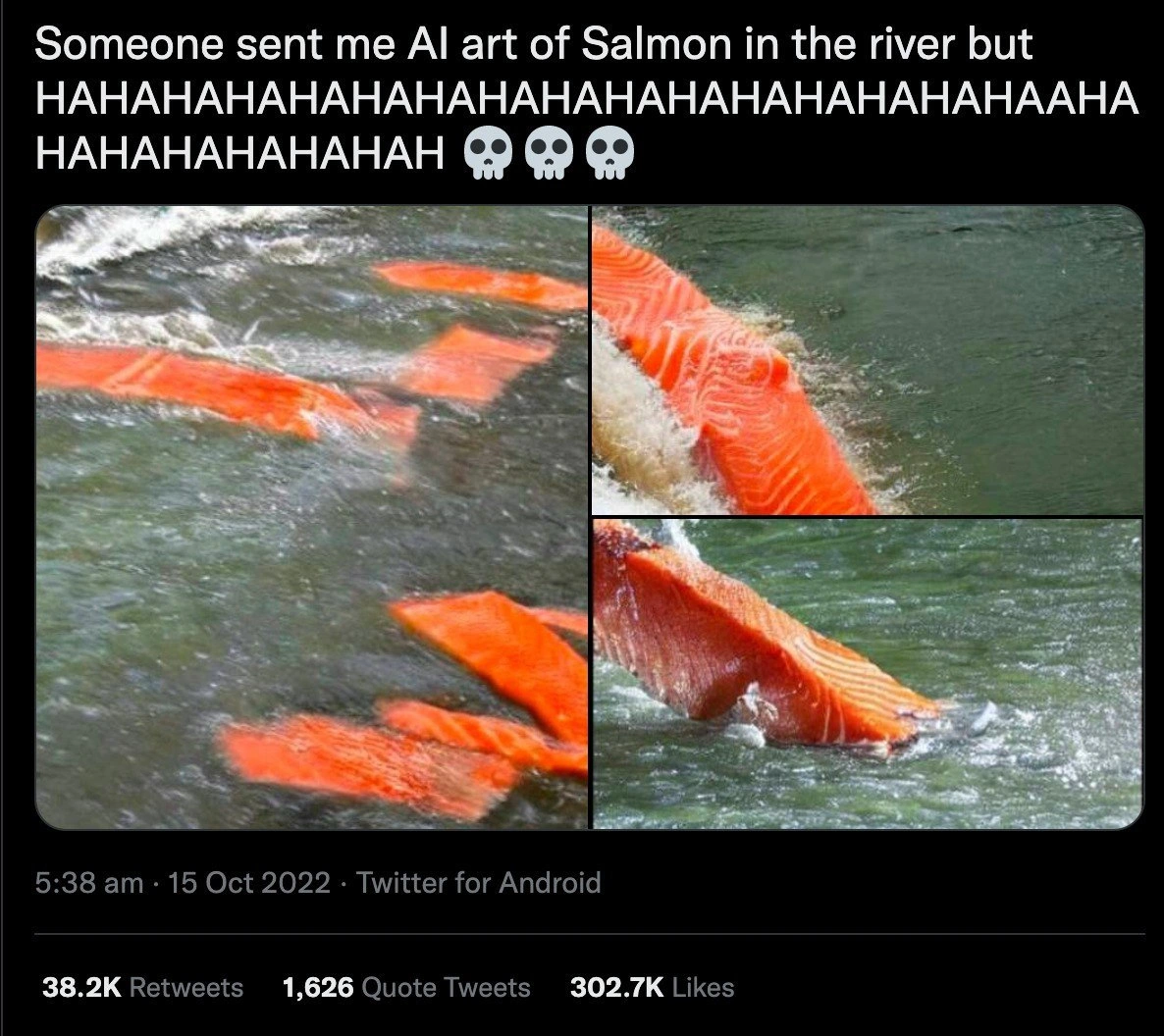
AI model hilariously renders salmon fillets swimming like fish in a river
Description
Screenshot of a tweet in dark-mode Twitter UI. The tweet reads: “Someone sent me AI art of Salmon in the river but HAHAHAHAHAHAHAHAHAHAHAHAHAHAHAHAHAHAHAHAHAHAHAHAHAHAH 💀💀💀”. Below the text is a four-pane collage of AI-generated images: raw orange salmon fillets, clearly grocery-store cuts, awkwardly float and splash amid river water instead of real fish. The status bar shows “5:38 am · 15 Oct 2022 · Twitter for Android” and engagement counts of 38.2 K Retweets, 1,626 Quote Tweets, and 302.7 K Likes. Humor comes from a diffusion model’s literal misinterpretation of the prompt - an example of generative AI limitations and hype vs. reality that developers frequently encounter when experimenting with text-to-image systems


More like this
More like this in AI ML →


Use J and K for navigation
Comments
6Comment deleted
Text-to-image nailed “salmon in the river” the same way our data lake nailed “stream processing”: raw fillets dumped in moving water and everyone pretends it’s still a living ecosystem
This is what happens when your training data comes from a sushi restaurant's Instagram feed instead of National Geographic
This is what happens when your training dataset has more images of salmon from Whole Foods than from the Columbia River. The model achieved perfect accuracy on 'salmon in water' but failed to specify which ontological category of salmon - a classic case of precision without recall on the semantic layer. It's the computer vision equivalent of that production bug where your e-commerce site started shipping live chickens because someone merged the 'poultry' inventory databases
Asked for salmon in the river, got fillets swimming upstream - when your corpus is mostly food blogs, the model nails texture transfer and completely misses semantics
AI prompt parsing: 'salmon in river' → fillets upstream. Peak type coercion from Fish to FishSlice[]
Compositionality is SQL-hard - the model basically ran: SELECT salmon_texture FROM internet WHERE background='river' LIMIT 1