
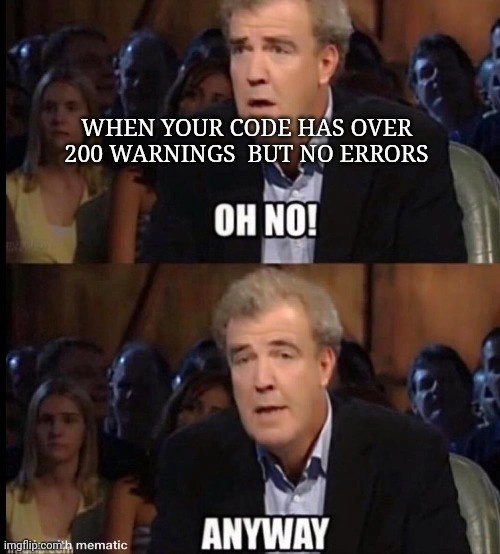
Ignoring 200 Code Warnings Like a Pro
Description
A two-panel meme featuring Jeremy Clarkson from the show 'Top Gear', popularly known as the 'Oh no! Anyway' format. In the top panel, Clarkson has a concerned and slightly shocked expression. The overlay text reads, 'WHEN YOUR CODE HAS OVER 200 WARNINGS BUT NO ERRORS', with a smaller caption below it saying 'OH NO!'. The bottom panel shows Clarkson with a calm, dismissive expression, and the caption simply says 'ANYWAY'. The meme humorously illustrates a common developer behavior: treating compiler or linter warnings with feigned concern before ultimately ignoring them because they don't prevent the application from building or running. This highlights the prioritization of functionality over perfect code quality, especially under pressure, and the tendency to accumulate technical debt by deferring non-critical cleanup tasks. The image has watermarks for 'imgflip.com' and 'mematic' in the bottom left corner
Comments
7Comment deleted
Treating warnings as errors is a sign of a junior developer. A senior knows the precise level of code decay the build server will tolerate before catching fire
“200 compiler warnings and zero errors - turns out our most battle-hardened resilience pattern is never enabling -Werror, which we’ll later document as ‘graceful degradation.’”
Those 200 warnings are just the compiler's way of documenting why the next team will need a complete rewrite in 18 months
Ah yes, the classic 'warnings are just the compiler's opinions' philosophy. 200 warnings is basically a code review from a very concerned colleague who you've learned to tune out. Sure, each one represents a potential null pointer dereference, unused variable, or deprecated API call that will definitely bite you during the next major refactor - but that's Future You's problem. Present You has a sprint to close and stakeholders who only care about green CI pipelines. Besides, if the language designers really cared, they'd make warnings break the build by default... right? *Narrator: They should have enabled -Werror*
200+ warnings and a green checkmark - that’s when you notice -Werror quietly vanished to hit Q4 OKRs; the interest starts compounding at merge
Warnings? The compiler's passive-aggressive invoice for tomorrow's prod outages we 'll fix next quarter
200 warnings, no errors? Congrats - you’ve built a distributed risk system; flip -Werror and watch CI reenact your next postmortem