Skip to content
DevMeme
7036 of 7435
Windows 11 Says Hey Guys, Crowd Correctly Screams Malware
Microsoft Post #7715, on Feb 16, 2026 in TG

Windows 11 Says Hey Guys, Crowd Correctly Screams Malware

Why is this Microsoft meme funny?

Level 1: The Friendly Stranger

Imagine someone new walks into the neighborhood saying "hey guys!" — but everyone already knows this person sneaks flyers into your mailbox, accidentally leaves your front door unlocked, and sometimes falls asleep in your driveway blocking the car. So the whole street points and yells "Burglar!" The newcomer is genuinely confused, because technically they live here. The joke is that Windows 11 acts exactly like the programs it's supposed to protect you from — and the crowd has stopped pretending not to notice.

Level 2: Reading the Charge Sheet

Three accusations sit in that small black bubble, each mapping to a real concept:

  • "plays ad in notepad"adware behavior: software that displays advertising you didn't ask for. Modern Windows surfaces promotions inside built-in apps, which feels especially jarring in Notepad, historically the simplest program on the machine.
  • "delivers CVE" — a CVE (Common Vulnerabilities and Exposures entry) is a catalogued security flaw with an ID like CVE-2026-XXXXX. When a built-in app has one, every Windows machine on Earth is exposed until patched — that's why bloating simple tools with networked features worries security folks.
  • "crashes" — instability, the oldest Windows grievance, here listed as the closing flourish of a malware-style rap sheet.

If you're new to the industry, the lesson is about attack surface: every feature added to a program is new code that can fail or be exploited. A Notepad that only edits text can barely hurt you. A Notepad with accounts, AI buttons, and ad delivery is a small web browser wearing Notepad's clothes — and it gets judged accordingly.

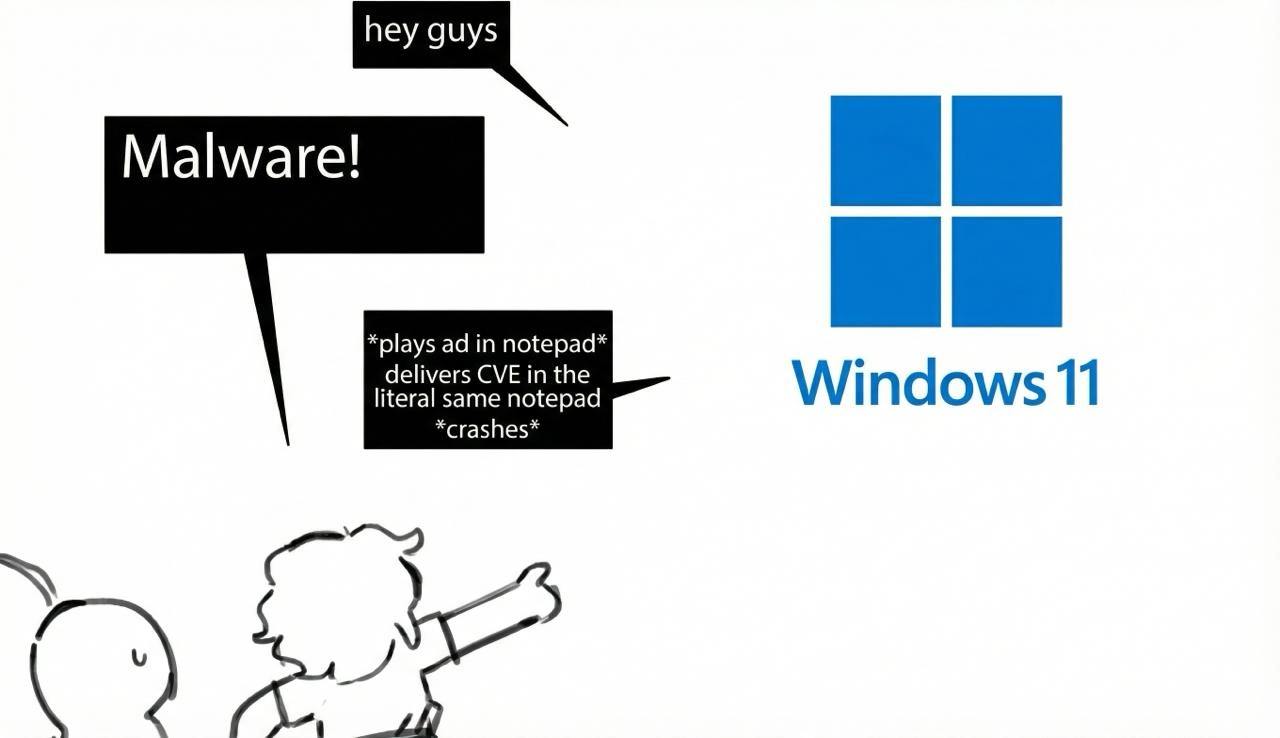
The comic's structure is the "community sees newcomer, screams" template: the pristine Windows 11 logo waves a friendly hey guys, and crude stick figures point and shout "Malware!" — with the punchline bubble doing the forensic work: *plays ad in notepad* delivers CVE in the literal same notepad *crashes*. The joke lands because it's a behavioral-analysis argument. Antivirus heuristics don't care about intent; they classify by behavior. Injects unsolicited advertising? Adware. Ships remotely exploitable code paths? Vulnerable dropper. Destabilizes the host? Classic malware tell. The meme simply runs the OS through its own threat-detection rubric and lets the verdict speak.

The Notepad detail is what makes seasoned Windows users wince rather than laugh. notepad.exe was the last bastion of computing minimalism — a tool whose entire value proposition was doing nothing. Then Microsoft rebuilt it as a Store-updated app and began using it as surface area: promotional banners for Microsoft 365, a Copilot button, sign-in prompts. Meanwhile the same modernization expanded its attack surface — a text editor that renders rich content, talks to accounts, and auto-updates is a text editor that can carry a CVE (a publicly catalogued security vulnerability). The meme's phrase "the literal same notepad" is the indictment: the bloat and the vulnerability aren't separate failures, they're the same architectural decision photographed from two angles. Every feature bolted onto a trusted, ubiquitous binary inherits that binary's privileges and ubiquity — which is exactly how malware authors think about distribution.

This is the enshittification pattern applied to an operating system: the user stopped being the customer and became the inventory. Ads in the Start menu, ads in File Explorer, ads in the text editor — each individually defensible in some PM's OKR deck ("driving Microsoft 365 awareness"), collectively indistinguishable from the adware that 2000s-era Windows users installed antivirus software to remove. The irony has a perfect circle to it: Windows Defender exists to stop binaries that show ads, execute attacker-controlled code, and crash your machine. The incentive structure guarantees nobody inside can say this out loud; the OS is a distribution channel now, and distribution channels get monetized until the stick figures start pointing.

Description

A minimalist webcomic-style meme. On the right is the official Windows 11 logo (four blue squares) saying 'hey guys' in a small speech bubble. On the bottom left, crude hand-drawn stick figures point at it; a large black speech bubble shouts 'Malware!', and a second black bubble narrates Windows 11's behavior: '*plays ad in notepad* delivers CVE in the literal same notepad *crashes*'. The meme equates Windows 11 with malware by listing real grievances: Microsoft injecting ads/promotions into Notepad, the same bundled app shipping security vulnerabilities (CVEs), and general instability - behavior that, from any third-party binary, would get it quarantined by antivirus

Comments

4
Anonymous ★ Top Pick Malware authors are furious: ads, arbitrary code execution, and a crash loop in one binary - Microsoft shipped their whole roadmap as a text editor
  1. Anonymous ★ Top Pick

    Malware authors are furious: ads, arbitrary code execution, and a crash loop in one binary - Microsoft shipped their whole roadmap as a text editor

  2. @TheFloofyFloof 4mo

    the markdown viewer was what was vulnerable

    1. @ZmEYkA_3310 4mo

      Yeah and also an outlook 0 click because the rtf lib was fucked too

    2. dev_meme 4mo

      This one doesn’t work as an excuse

Use J and K for navigation