Skip to content
DevMeme
1729 of 7435
Seeking a Cryptographic High, Not a Chemical One
Cryptography Post #1933, on Aug 18, 2020 in TG

Seeking a Cryptographic High, Not a Chemical One

Why is this Cryptography meme funny?

Level 1: Not That Kind of Dealer

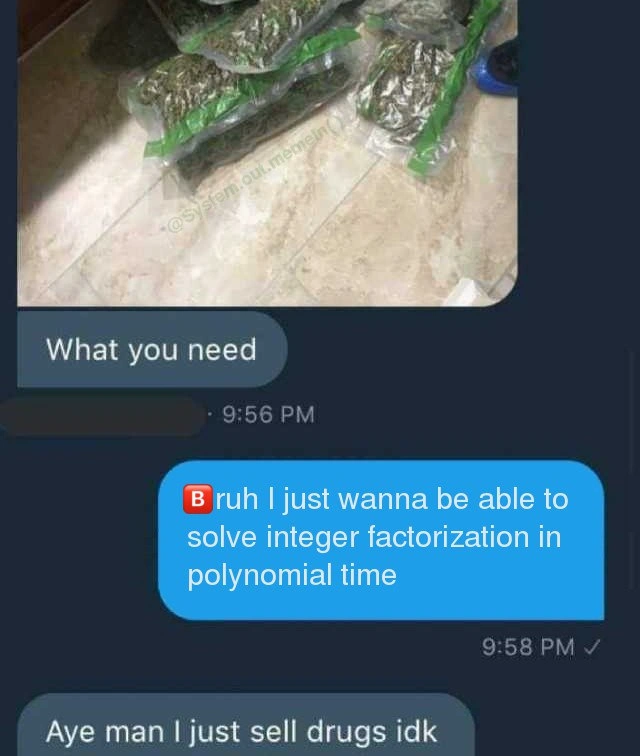
Imagine going into a store expecting to buy something ordinary, but instead you ask for something impossible. That’s what’s happening in this meme, but with a funny twist. It’s like walking up to an ice cream truck and saying, “Hey, I’ll take one ice cream... and also, do you happen to sell a machine that lets me time-travel?” The ice cream person would give you a crazy look and say, “Uh, I just sell ice cream, I can’t help you time-travel!” Here, the “store” is a drug dealer and the “impossible thing” the customer asks for is a super-secret math trick to solve a really, really hard puzzle (one that smart computer scientists have been trying to solve for years). The dealer was expecting the person to ask for drugs – something the dealer actually has – but instead the person asks for this magic math solution.

The dealer’s reply, “I just sell drugs idk,” is basically them saying, “Sorry, man, I have no idea what you’re talking about – I only have the normal stuff!” It’s funny because the customer’s request is so outlandish and mismatched. It’s as if someone went to a bicycle shop and tried to buy a rocket ship. The reaction is a mix of confusion and you’ve got the wrong place, buddy. In simple terms, the meme is joking that finding an answer to this big unsolved math problem is harder than finding illegal things. It makes us laugh because it shows just how ridiculous it would be to try and get such an answer from a random person. The dealer isn’t a magical wizard or genius – he can get you forbidden goods, but not a miracle solution to a math riddle! The contrast between what was expected (“What do you need?” – probably some weed or other drug) and what was asked for (“I wanna solve this super hard math problem”) is so extreme that it’s silly. So, the core joke is: the customer asked the wrong guy for something no one in the world has! The poor dealer is just baffled. Even if you don’t know the math, you can understand it’s a totally impractical wish. It’s this big exaggerated mix-up that makes the meme funny and memorable.

Level 2: Hard Problems and Big O

Let’s break down the technical terms and context for a less experienced developer (or an interested novice) so the joke becomes clear. First up, integer factorization: this is the task of taking a whole number (integer) and finding which prime numbers multiply together to produce it. For example, the number 15 factors into 3 × 5. That’s easy, right? For small numbers, sure – you can just try dividing by 2, 3, 4, etc., until you find the factors. But the number used in something like RSA encryption isn’t 15; it’s more like a number with 600 digits (or even more)! If I gave you a 600-digit number and asked you to find its factors, even the fastest computers using known methods would struggle immensely – it could literally take millions or billions of years. That’s because the straightforward ways to factor (and even the clever advanced methods known today) require checking so many possibilities as the number grows that it becomes impractical to do within any reasonable time.

This is where Big O notation and polynomial time come in. Big O notation is a way computer scientists describe how the time (or space) needed for an algorithm grows as the input size grows. For example, if an algorithm is O(n), that means if you double the size of the input, you roughly double the work – that’s nice and linear. If it’s O(n^2), doubling the input size makes it about four times more work (since $(2n)^2 = 4n^2$). These are examples of polynomial time complexities – the exponent (like 1, 2, or maybe 3, 4, etc.) is a fixed number, so the growth is manageable. Even $O(n^3)$ or $O(n^5)$, while slower, are considered polynomial and generally feasible for not-too-huge n.

Now compare that to something like exponential time, say O(2^n). If you double the input size in an exponential algorithm, the work might square (since $2^{2n} = (2^n)^2$). That gets out of hand fast. An algorithm that takes exponential time will become completely unusable even for moderately large inputs. Integer factorization on classical computers, with the best algorithms we currently know, grows super-polynomially (not exactly as clean as $2^n$, but for simplicity, you can think of it as essentially worse than any fixed power of n). This is why factoring a 2048-bit (roughly 600-digit) number is practically impossible with ordinary computing resources – the task is just too complex; there are too many possibilities to check in any reasonable timeframe. In fact, the difficulty of factoring is why cryptography can safely use large numbers as keys: everyone knows the public key (the big number), but only the person with the secret primes can multiply them to easily recreate it – nobody else can factor that public key easily. It’s a computational hardness assumption: we assume factoring is hard enough that no one can do it quickly, which keeps our digital secrets safe.

So when the meme’s buyer says, “I just wanna be able to solve integer factorization in polynomial time,” they’re effectively saying, “I wish I had a fast (efficient) way to do something that everyone thinks is super hard.” It’s the ultimate wish in this context – akin to saying “I want a magic algorithm that breaks cryptography.” The phrasing is very computer-science-y: “polynomial time” is the giveaway that this is about algorithm efficiency (Big O), which is why the meme is tagged with AlgorithmComplexityAnalysis and BigONotation. This contrasts with the setting of the conversation: a messaging app with a photo of vacuum-sealed bags of a leafy green substance. That photo and the dealer’s slangy question “What you need” set up the expectation of a drug deal. It’s a classic bait-and-switch humor setup. You expect the blue-text customer to reply with something like “2 bags” or “I need an ounce” – some request for those drugs. Instead, they drop a completely unrelated bombshell: a request for a breakthrough algorithm.

The red 🅱️ emoji in “🅱️ruh” is just a stylized way of saying “bruh,” which is internet slang for “bro” or “dude,” adding a casual, almost deadpan tone to the outrageous ask. So the customer is like, “dude, I don’t want drugs, I just want this insanely hard computing problem solved.” It’s funny because it’s so unexpected and out-of-place. The dealer’s final response, “Aye man I just sell drugs idk,” translates to: “Uh, hey dude, I only sell drugs; I don’t know anything about that other stuff.” “idk” means “I don’t know.” You can almost hear the confusion or exasperation in the dealer’s voice – this is presumably the first time someone’s asking them for a math solution instead of, well, marijuana.

For a junior developer or someone new to these concepts, the takeaway is: polynomial-time integer factorization is essentially the “magic solution” that doesn’t exist in our current world (except if quantum computing matures). It’s an unsolved problem that’s extremely famous in computer science. People have spent careers trying to improve factoring algorithms by even small margins. The meme jokingly suggests someone might try to “score” that solution from a sketchy dealer, which is absurd. It highlights the gap between something difficult in theory and the idea of just obtaining it like a commodity. In the real world, if you want drugs (unfortunately) you can find dealers selling them. But if you want a solution to a decades-old computer science problem, there’s no dealer for that – it’s not something money can buy off-hand. The humor is appreciated once you understand that solving factoring quickly is effectively like finding a unicorn. It’s a nod to cryptography students and programmers: “Wouldn’t it be nice if we could just buy an answer to our NP-hard problems or crypto problems? Too bad, we can’t!”

Level 3: Polynomial Peddling

From a senior developer or security engineer’s perspective, the humor comes from the sheer absurdity of treating an algorithmic breakthrough like a deal going down in a back alley. We have a drug dealer’s text message thread subverted by a request not for the usual product (some contraband leafy green packages clearly shown in the image), but for something far more scarce and valuable: a method to factor large integers efficiently. The dealer says, “What you need,” expecting an order for maybe a few ounces of weed. Instead, the customer hits them with, “bruh I just wanna be able to solve integer factorization in polynomial time.” This is the kind of line that makes any seasoned programmer or computer scientist do a double-take and then laugh out loud, because it’s such a tech humor inside-joke. It’s essentially asking, “Hey, can you hook me up with the impossible?”

Let’s unpack why that ask is comically outrageous. In the world of computational complexity (which is a core part of CS_fundamentals), problems are categorized by how their solving time grows as the input grows – that’s what Big O notation formalizes. A polynomial-time solution (like $O(n)$, $O(n^2)$, etc.) is generally considered “efficient” or at least tractable, even for fairly large inputs. On the other hand, something like integer factorization is believed to require super-polynomial time on classical machines – practically speaking, it’s insanely slow for big numbers. For context, RSA encryption typically uses numbers that are 2048 bits long (over 600 decimal digits). All known classical algorithms would take longer than the age of the universe (by astronomically many orders of magnitude) to factor such a key with brute force or even advanced techniques. In other words, if you tried to crack a 2048-bit RSA key without a new algorithmic trick, you’re not going to succeed before the Sun burns out. So when the buyer says they want to solve factorization in polynomial time, they’re basically asking for a shortcut that nobody on Earth (at least publicly) knows how to create. It’s the quintessential computational hardness problem that keeps cryptographers employed and attackers frustrated.

Now, picture a drug dealer reading that message. This is a person whose expertise is moving physical product, not navigating unsolved algorithmic complexity problems. The dealer even attached a photo saying “What you need” – presumably showing off the goods (vacuum-sealed bags full of you-know-what) to service a normal request. The blue-text response completely breaks the script. It’s as if a customer at a coffee shop asked the barista, “Can you also solve this millennium-old riddle for me real quick?” The dealer’s deadpan reply, “Aye man I just sell drugs idk,” is hilarious because it’s such an understatement in context. It’s basically, “Dude, you’re asking for something way out of my league. I have no clue about that – I literally just deal with weed.” The clash of worlds – high-end theoretical computer science vs. low-tech street commerce – creates the comedy.

For experienced tech folks, there’s an extra layer of wry humor: wouldn’t it be nice if we could just “get” a solution to our hardest bugs or unsolved problems by finding the right dealer? It lampoons the idea of looking for quick fixes to impossible problems. In reality, no amount of money (or other shady bargains) can procure a non-existent algorithmic solution. The meme also subtly nods to the security implications: if a polynomial-time factoring method were somehow floating around on the black market, it would be the hottest (and most dangerous) piece of “merchandise” imaginable – it would break almost all public-key cryptography. But the dealer’s honest ignorance (“idk” – I don’t know) reassures us this isn’t the case. This is computer science humor at its best: mixing the serious with the absurd. It pokes fun at the desperate lengths one might jokingly consider (“Psst, know anyone who can break RSA for me?”) while also highlighting just how unattainable that goal is. Seasoned devs and researchers share a collective chuckle here, because we all know someone who’s fantasized about a miraculous fix to an intractable problem – and how fanciful that hope is. The dealer’s pragmatic response is the punchline that brings us back down to Earth: some things you just can’t buy, not even in the shadiest corners of the internet.

Level 4: Intractability for Sale

At the most theoretical level, this meme references a famous unsolved problem in computational complexity theory: finding a polynomial-time algorithm for integer factorization. In plain terms, polynomial-time means an algorithm’s running time grows reasonably (like $O(n^k)$ for some constant $k$) with the size of its input, as opposed to something like $O(2^n)$ which explodes exponentially. Factoring a large integer (especially one that’s hundreds or thousands of bits long) is believed to require super-polynomial time on a classical computer – essentially intractable for large inputs. The buyer’s wish to “solve integer factorization in polynomial time” is basically asking for a mathematical breakthrough that would shake the foundations of computer science.

Why is this such a big deal? Because the difficulty of factoring large numbers underpins much of modern cryptography, especially RSA encryption. Multiplying two large prime numbers together is easy (that’s a quick calculation, even for huge primes), but factoring the resulting large composite (figuring out which primes multiply to it) is staggeringly hard without a special trick. This one-way relationship – easy to do, hard to undo – is exactly why RSA and other cryptosystems can safely lock down data. If someone discovered a polynomial-time factoring algorithm, it would mean quickly cracking RSA keys, breaking internet security as we know it. In complexity class terms, it would put a problem we suspect to be outside of P into P, potentially indicating that P = NP (or at least that this specific problem isn’t as hard as we thought). For context, P vs NP is one of the Millennium Prize Problems – a million-dollar question – and while integer factorization itself isn’t proven to be NP-complete, it lives in NP-intersect-coNP and is emblematic of problems presumed hard. A polynomial solution for it would be earth-shattering, academically and practically.

There actually is a known polynomial-time algorithm for factoring integers, but there’s a catch: it’s Shor’s algorithm and it runs on a quantum computer. Quantum algorithms belong to a complexity class (BQP) that isn’t constrained the same way classical ones are, and a large-enough quantum computer running Shor’s could factor big integers feasibly – which is why cryptographers are actively devising post-quantum encryption alternatives. But in the classical world of everyday computers and dealers on the street, no algorithm even close to polynomial-time factoring exists publicly. The best classical factoring methods (like the Number Field Sieve) are super-polynomial (sub-exponential in complexity, roughly ~$e^{(c(\log N)^{1/3}(\log \log N)^{2/3})}$ for some constant $c$). That’s far slower than any polynomial $n^k$ once numbers get large. So the buyer here is essentially asking for an algorithmic unicorn – the holy grail of algorithm complexity analysis. The meme comically frames this deep complexity conundrum as a casual transaction, as if a breakthrough of that magnitude could be picked up like contraband. It’s a tongue-in-cheek nod to how computational hardness (like the difficulty of factoring) isn’t something you can just buy off the shelf, or even on the black market.

Even the stylistic details underline the absurdity: the message uses the 🅱️ emoji in “bruh”, a bit of internet slang flair, to juxtapose an extremely advanced request with a super casual tone. It’s like a researcher dropping by a shady alley saying, “Yo, got any of that $P \neq NP$ solution?” The dealer’s baffled response (“I just sell drugs, idk”) brings us crashing back to reality – no miraculous algorithm is changing hands tonight. This level of humor resonates with those who appreciate the gulf between academic CS theory and real-world... well, reality. The meme brilliantly compresses decades of CS fundamentals into one irreverent exchange, highlighting how a solution that keeps cryptographers up at night is treated like some illicit commodity. It’s a reminder that some problems are so hard that even the darkest markets can’t supply an answer.

Description

A screenshot of a text message conversation that creates a humorous misunderstanding between two very different worlds. The first message, sent by the seller, is an image showing numerous small plastic bags of what appears to be marijuana, with the follow-up text 'What you need'. The recipient, presumably a programmer or mathematician, replies with a completely unexpected request: 'Bruh I just wanna be able to solve integer factorization in polynomial time'. The seller, clearly confused by the highly technical and abstract plea, responds, 'Aye man I just sell drugs idk'. The humor stems from the collision of street-level commerce with high-level computational theory. Solving integer factorization in polynomial time is a famous unsolved problem in computer science, the difficulty of which underpins the security of many cryptographic systems like RSA. For a senior developer, the joke is a hilarious non-sequitur that equates a world-changing mathematical breakthrough with a simple street transaction

Comments

7
Anonymous ★ Top Pick Some of us are trying to break RSA encryption, others are just trying to break bread. It's all about finding the right keys
  1. Anonymous ★ Top Pick

    Some of us are trying to break RSA encryption, others are just trying to break bread. It's all about finding the right keys

  2. Anonymous

    At this point I trust the street dealer more than the vendor demos - he’s the only one who’ll admit polynomial-time factoring isn’t on the Q4 roadmap

  3. Anonymous

    This dealer's about to learn that breaking RSA encryption is harder to deliver than any substance - though solving integer factorization in polynomial time would certainly be more valuable than anything in those bags, considering it would instantly compromise every bank's security and earn you a million-dollar Millennium Prize

  4. Anonymous

    When you're trying to break RSA encryption but accidentally text your old college connection instead of your cryptography research group. To be fair, both industries deal with 'breaking things down into smaller components' - one just has significantly different legal implications and computational complexity classes

  5. Anonymous

    If your dealer can deliver polynomial-time factoring, reclassify them as a nation-state and rotate off RSA before the receipt prints

  6. Anonymous

    Wrong plug - I needed Shor’s algorithm; if you can factor 2048‑bit RSA in polynomial time, we’ll skip the deal and trigger an emergency global key rotation

  7. Anonymous

    Shor's algorithm who? This deal breaks RSA faster than a zero-day in your keygen

Use J and K for navigation