Skip to content
DevMeme
1959 of 7435
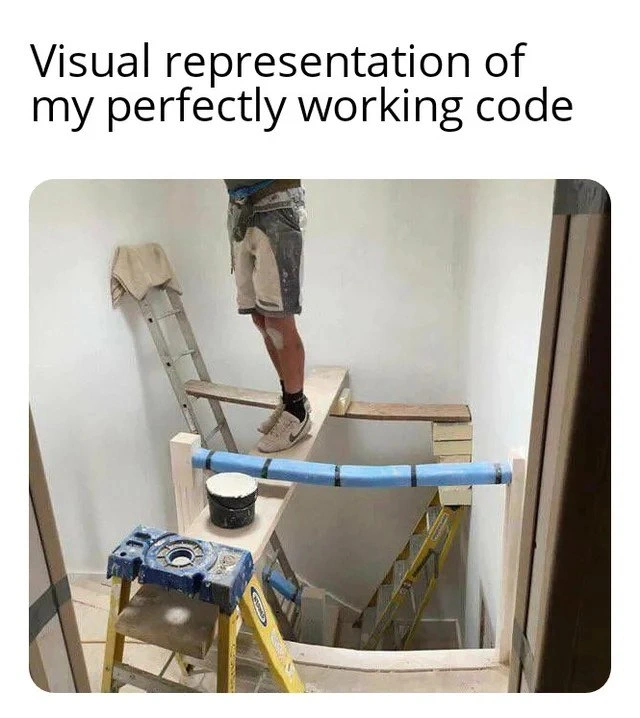
A Visual Metaphor for Perfectly Functional but Fragile Code
TechDebt Post #2179, on Oct 20, 2020 in TG

A Visual Metaphor for Perfectly Functional but Fragile Code

Why is this TechDebt meme funny?

Level 1: Wobbly Lego Tower

Imagine you build a tall tower out of random LEGO bricks, spaghetti noodles, and tape. It looks super shaky, but you manage to stand a toy figure on top without the tower falling over. You proudly say, “See? It’s perfect, it works!” even though everyone else can tell it might tumble any second. That’s what’s happening in this picture. A worker made a wobbly platform out of ladders and wood scraps to reach a high spot, and he’s acting like it’s totally safe since he hasn’t fallen (yet). In programming, sometimes people write code that just barely works – like using a bunch of bandaids and quick fixes – and say “Well, it runs on my computer!” It’s funny because, just like the wobbly LEGO tower, anyone can see that one small change or a nudge could make the whole thing crash down. The joke reminds us of that kid logic: “If it hasn’t broken yet, it must be fine!” – even when all the grown-ups (or experienced developers) are nervously watching it wobble.

Level 2: Duct Tape Solutions

For newer developers, let’s decode the humor. The phrase “works on my machine” is a tongue-in-cheek reference to when a developer insists their code is fine because it runs on their computer, even if it fails on others. It’s like saying, “The program runs perfectly for me, so any problem must be your setup, not my code.” In reality, that usually means the code has some environment-specific assumptions or fragile setup – like a hard-coded file path, an unchecked error, or a dependency only present on the developer’s PC. These are classic code quality issues: the code isn’t robust or portable, it just accidentally works in one specific case.

Technical debt is a term for the quick fixes and sloppy shortcuts we take in code that save time now but cost more time later. Just like real debt, you “borrow” time by not building something properly, but you’ll pay interest on that debt when the hacky code causes bigger problems. The meme’s makeshift platform is basically technical debt made visible: instead of constructing a safe scaffold (writing solid, maintainable code), someone slapped together a bunch of random supports to get the job done quickly. It holds up for now, but it’s risky. Every weird brace or plank in that setup is a workaround that solved an immediate problem (like “we need to reach this high spot, fast!”) at the cost of structural integrity.

Code smell is a funny term for any hint that something’s wrong in the code design. Think of a code smell as the dusty, creaking sound from that ladder — a warning sign. For example, a giant function 500 lines long, or copy-pasted code everywhere, are smells that the code might be badly structured. Spaghetti code is one kind of code smell: it means the code logic is tangled and twisted in a way that’s hard to follow, just like a bowl of spaghetti. In a fragile codebase, everything is so interconnected that if you change one thing, something else unexpectedly breaks. That’s because instead of clear, modular design, it’s built with ad-hoc pieces leaning on each other (like those two ladders holding each other up).

To illustrate, imagine a function that only works if some global variable was set by another piece of code first. That’s like needing that blue foam pole in place, but nobody explicitly told you it’s required — it’s a hidden dependency. Or consider a configuration that’s hard-coded for one machine:

def load_data():
    # This file path only exists on the developer's machine
    return read_file("C:\\Users\\Dev\\my_project\\data\\config.json")

On the developer’s computer, C:\Users\Dev\my_project\data\config.json exists, so this quick fix works on their machine. But on anyone else’s, that path might not even exist, causing a crash. This is how a “works on my machine” bug happens. A more robust approach would use a dynamic path or configuration, but that takes more effort – so the quick and dirty solution seems fine until someone else runs it.

Another common quick fix is ignoring errors instead of handling them properly:

try:
    process_transactions()
except Exception as e:
    print("All good! (ignore error)", e)  # Duct-tape fix: just pretend it succeeded

This code appears to run without issues (no crash = “it works!”), but it’s simply papering over a failure. It’s akin to stabilizing a wobbly plank with a bit of duct tape: you haven’t truly fixed the underlying problem, you just hidden it. New engineers often do this under pressure – say, catching an error so the program doesn’t halt – but without logging or correcting the cause, it creates a ticking time bomb in the code.

The meme resonates with developers because we’ve all seen code that’s a pile of workarounds on top of other workarounds. Maybe in a rush, you once hard-coded a value or copied a snippet from Stack Overflow that you didn’t fully understand – and amazingly, it worked. That temporary relief is exactly like the painter who managed to get up there and paint the wall. But if someone asks you to explain how your code works or modify it slightly, you realize everything is delicately balanced. Maintaining such a system is scary: any refactor or update feels like pulling out a Jenga block from the bottom of a shaky tower. Hidden complexity lurks everywhere; what looks like a simple solution might rely on ten unseen assumptions. This leads to a lot of technical debt that the team will eventually have to pay back: by rewriting big parts of the system properly (hopefully before an incident happens).

In short, the meme humorously highlights poor code quality practices: using ad-hoc, unsafe supports (both in construction and code) instead of solid foundations. It’s a warning wrapped in a joke – every junior dev eventually learns that “just because it runs without crashing right now, doesn’t mean it’s a good solution.” Good engineers strive to replace these duct-tape solutions with well-designed code, the same way a good builder would replace that perilous setup with proper scaffolding. Until then, we chuckle and shake our heads in equal parts horror and nostalgia, because we’ve all balanced on that ladder at least once.

Level 3: House of Cards Architecture

Picture a software system held together by a patchwork of hacks and quick fixes – that’s exactly what this meme lampoons. The developer’s "perfectly working code" is symbolized by a rickety construction of ladders and planks: a duct-tape architecture where each piece is an improvised support. In real projects, this is the kind of codebase born from looming deadlines and looming technical debt. Every senior engineer has seen something like this: a codebase so fragile that one wrong move (or one unplanned user action) could send everything crashing down, yet it hasn’t collapsed yet. It’s a comically precarious scaffolding metaphor for software that “works on my machine” but could fail anywhere else.

In the photo, the painter stands nonchalantly on a dangerously unstable platform of scrap wood and ladders. In code terms, that’s like a developer standing on spaghetti code — a tangled mess of logic and global states — acting as if nothing’s wrong because the app hasn’t crashed on their system. The humor hits close to home because this situation is a classic RelatableDevExperience. We’ve all inherited projects (or written them in our youth) where the entire program is balancing on half-baked functions, magical constants, and ingenious ridiculous workarounds. The code passes all the unit tests (just like our painter is technically reaching the wall to paint), but any engineer looking at it from the outside is cringing. The whole structure is one unhandled exception or missing config away from a free-fall into a bug abyss.

Let’s break down the absurdity: the makeshift plank bridge is analogous to a chain of functions calling each other in brittle ways (cough tightly coupled cough). The blue foam-wrapped pole wedged in as support? That’s the sneaky global variable or hidden state that everything secretly relies on – a piece of hidden complexity holding the system together in ways nobody documented. And the random ladders at odd angles are the third-party libraries and copy-pasted snippets shoved in to “just make it work.” This is engineering absurdity at its finest: things in places they were never meant to be, yet somehow the system doesn’t collapse.

Why do such code smells happen? Often it’s the “just ship it” mentality – you hear “It works now, we’ll refactor later”. But later never comes, and the scaffold codebase grows more unstable with each quick addition. Over time, these workarounds accumulate like Jenga blocks, and one day an innocuous change (like that unlucky intern climbing the ladder of legacy code) causes a production meltdown at 3 AM. The meme nails the senior perspective: it’s funny because it’s true. The code technically works in production (just like that contraption holds the painter), but any expert can see it’s one-step away from disaster. It’s a spaghettiCode Jenga tower where all the pieces are wobbling, yet someone proudly says, “See? Perfectly stable. Don’t touch it!”

Description

A meme with the caption 'Visual representation of my perfectly working code'. Below the text is a photograph of a man in shorts and sneakers standing on a highly precarious, makeshift platform over an open stairwell. The platform is an unstable assembly of wooden planks, step-ladders, and what appears to be a sawhorse, all balanced precariously. The entire setup looks dangerously unstable and one wrong move away from collapsing. This image serves as a powerful and relatable metaphor for code that, while technically functional, is built on a fragile, poorly designed foundation. It represents the concept of technical debt, where quick fixes and poor architectural decisions create a system that is difficult to maintain, risky to modify, and liable to catastrophic failure at any moment. For experienced engineers, it's the familiar sight of a production system that 'works' but that everyone is too terrified to touch

Comments

8
Anonymous ★ Top Pick It passed all the tests and QA signed off. The ticket to add comments and documentation is in the backlog, right under 'rewrite in Rust'
  1. Anonymous ★ Top Pick

    It passed all the tests and QA signed off. The ticket to add comments and documentation is in the backlog, right under 'rewrite in Rust'

  2. Anonymous

    Current state: a Python microservice perched on a shell script balanced on a cron job sitting on a legacy DB view - everything’s green in CI as long as nobody nudges the blue-foam hotfix from 2013

  3. Anonymous

    This is every senior engineer's nightmare: the critical payment processing system written in 2003 that somehow handles $10M daily, has zero tests, relies on a deprecated library last updated when MySpace was popular, and the only person who understood it retired to a beach in Thailand. We've all inherited that one service where changing a single line of CSS somehow breaks the authentication module

  4. Anonymous

    This is the architectural equivalent of 'it passed code review because nobody wanted to be the one to suggest rewriting it.' Sure, it's technically load-bearing, but so is that one 15-year-old Perl script in production that processes $2M in transactions daily and nobody dares touch because the original author left in 2009 and took all the tribal knowledge with them. The real kicker? This structure probably has better documentation than most microservices architectures

  5. Anonymous

    It works fine: adapters balanced on a deprecated API, a feature flag as the guardrail, and a 03:00 cron job holding it all together - classic load-bearing tech debt

  6. Anonymous

    Achieves 99.99% uptime - until someone merges a feature branch

  7. Anonymous

    It’s production‑ready in the same sense this scaffold is load‑bearing: a distributed monolith held together by temporal coupling and one paint‑bucket dependency - touch anything and the SLO becomes gravity

  8. @monimono 5y

    If it was funny it would be funny

Use J and K for navigation