Skip to content
DevMeme
5570 of 7435
The Brutal Economics of a Passion Project
Entrepreneurship Post #6112, on Jul 15, 2024 in TG

The Brutal Economics of a Passion Project

Why is this Entrepreneurship meme funny?

Level 1: Expensive Hobby

Imagine you have a really good job where you get a giant jar full of candy every day. It’s awesome because that candy (like a big salary of money) takes care of you and your family’s needs. Now picture one day you decide to quit that job so you can try something on your own: you spend all your time making a new kind of candy (let’s say a special cookie or a cool toy that helps people keep track of chores). You’re sure everyone will love it. You work on it for two whole years. But in the end, you manage to sell only a few pieces – you earn just enough money to buy maybe one small bag of candy with it. That’s like giving up a huge candy jar to end up with only one tiny piece of candy after a long time.

Now, your family (like your wife or mom) comes to you, very confused and concerned, and asks, “Why in the world would you do that?! You had so much candy (money) coming from your job, and now we have almost none from this project of yours.” And you look at them, a bit defensive, and all you can say is, “I was really good at making that candy (or toy).” In other words, “I did it because I’m good at it.”

This is funny because it’s such a silly trade-off. Being good at something you enjoy is nice, but giving up something huge (a big stable reward) for something super small just because you like it or feel proud of it isn’t very logical — it’s like a kid trading a big cake for a small cupcake just because they baked the cupcake themselves. The meme makes us laugh at how the dad/husband character tries to justify this bad deal with a serious face. It’s showing how people sometimes make emotional decisions that don’t really make sense money-wise, and how even a grown-up might end up saying something that sounds as odd as, “Well, I did it because I’m good at it,” when asked why they made a clearly bad trade. It’s a bit like a joke about following your passion (your dream) versus sticking with the practical choice — and how following the dream can sometimes lead to funny and painful outcomes, like earning only $20 instead of keeping a big salary.

Level 2: Indie Reality Check

Let’s break down the terms and context so a newer developer can appreciate the joke:

  • $300K job: That’s a very high annual salary, often seen in big tech companies (sometimes called FAANG – Facebook/Meta, Amazon, Apple, Netflix, Google). It implies a top-tier software engineer or managerial role. Quitting such a job means giving up a huge paycheck (and perks like stock bonuses, free food, etc.).

  • Todo list app: This is a simple application that lets users track tasks – basically a digital list of things “To Do”. It’s one of the most common beginner projects in programming tutorials (after “Hello World”). Because it’s so straightforward, there are hundreds of them out there (from Wunderlist and Todoist to the default Reminders app on your phone). In fact, devs joke that every programmer has built or attempted a todo app at some point. It’s almost a rite of passage when learning a new language or framework.

  • Made $20 in 2 years: This means the app earned virtually no money – only twenty dollars over a span of two whole years. That’s insanely low. To put it in perspective, if the developer charged a $1 monthly subscription, it means only a single user paid for maybe ~20 months, or a handful of people paid for one month and never came back. In any case, $20 is nowhere near enough to live on (it wouldn’t even pay one month’s electric bill, let alone replace a $300K/year salary). So financially, the project was a flop.

  • POV: your wife asks why…: POV means “point of view.” The meme is pretending you (the viewer) are in the situation – your spouse is questioning your decision. The wife here represents a concerned loved one or practical partner who is incredulous that you left such a high-paying job for something that’s clearly not making money. It’s a very relatable scenario: family members often act as a sanity check when someone makes a risky career move. She’s basically saying, “Explain yourself. Why would you do that?”

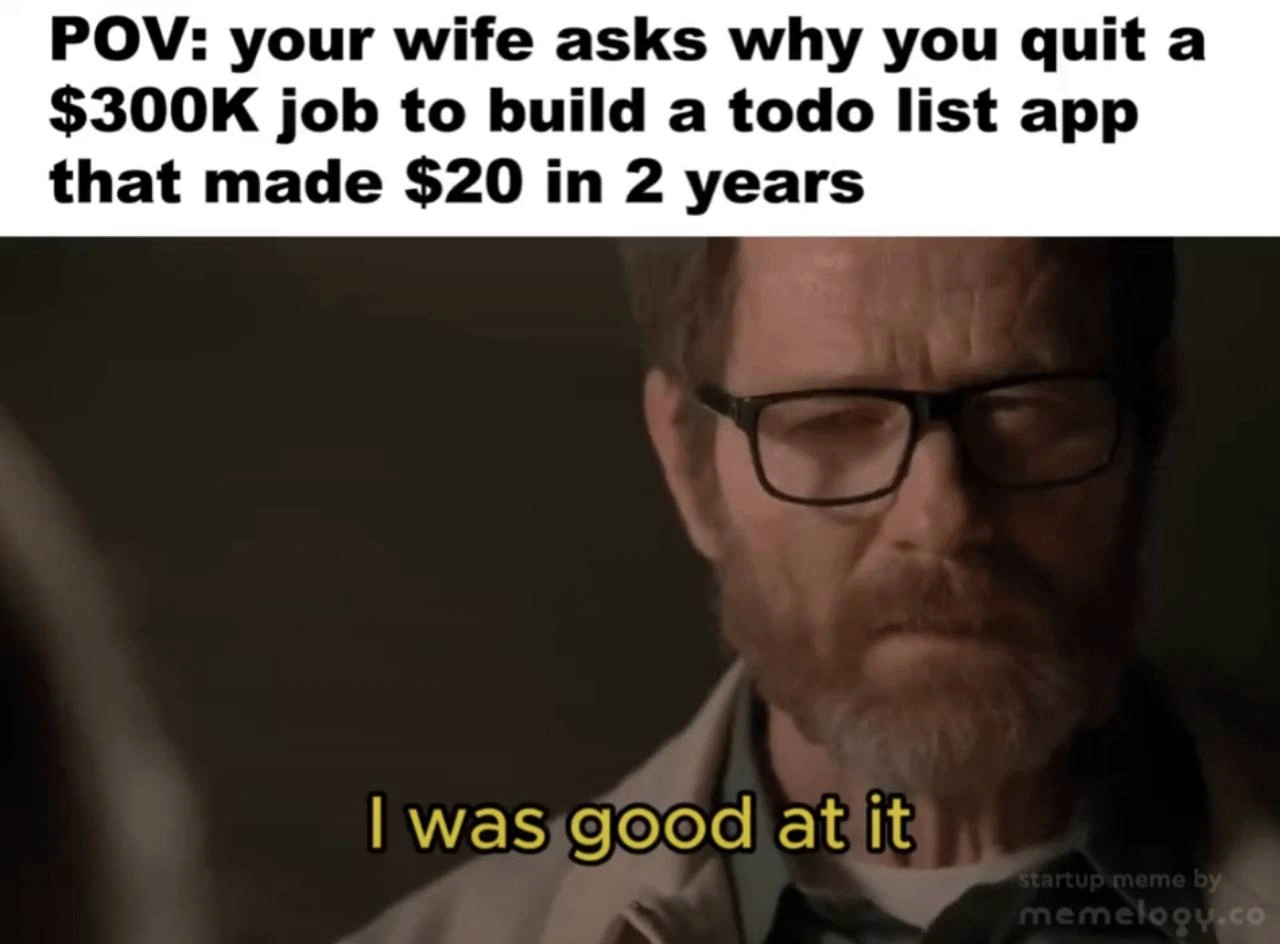
  • “I was good at it.”: This is the punchline – the husband’s reply, shown as a subtitle from a dramatic TV scene. He doesn’t say he did it for money or for a grand plan. He simply says, “I was good at it.” In context, he means he quit his job to build the app because he’s good at building apps (or at coding). It’s a pretty weak answer to the spouse’s question, and that’s intentional for the joke. It highlights a certain stubborn pride: he did it to prove himself, or because it felt satisfying to build something, even if it made no business sense. This quote is actually a reference to a famous scene from the show Breaking Bad, where the main character defends his life of crime by saying the same line. The meme borrows that serious tone to make the situation even funnier.

  • Entrepreneurship vs. Employment: Essentially, this meme contrasts the stability of working a high-paying job for someone else (employment) with the risky adventure of starting your own project or company (entrepreneurship). A lot of developers dream of building their own product or startup (StartupCulture encourages this). It can be exciting to be your own boss and chase an idea you’re passionate about. But it’s also very risky. Most indie sideProjects don’t make much money, especially not at first. Here the indie_hacker_dream refers to being an “indie hacker” – someone who builds and launches small projects independently, hoping one becomes successful. The reality (bootstrapper_reality) is often harsh: you might spend a ton of time and only get a few users or a few dollars.

  • Product-Market Fit (PMF): This is a startup concept meaning your product is something that a market (group of customers) really wants and needs, and is willing to pay for. Achieving PMF usually means your product starts basically selling itself – users love it, tell others, and growth happens. The meme implies the todo app did not have product-market fit (we might jokingly call it product_market_miss). A todo list app is not a new or unique solution; people already have plenty of options. So finding a huge enthusiastic user base was unlikely. Many first-time founders underestimate how hard it is to find that perfect alignment of product and market need. They might think, “Everyone needs to organize tasks, so my app will surely be popular!” – that’s the myth of instant success the meme mocks.

  • Opportunity Cost: This term means the value of what you give up when you choose something else. Here, the opportunity cost of focusing on the startup is the $300K job salary per year that the developer no longer earns. In two years, roughly $600,000 (plus career progress, maybe promotions, etc.) was the cost. That’s enormous when compared to the mere $20 gained. So, from a logical financial perspective, this was a terrible trade-off. The wife’s question is basically pointing out this huge lost opportunity.

  • Sunk Cost Fallacy: Although not directly named in the meme, it’s hinted by the scenario. This is the idea that when you’ve invested a lot into something (time, money, effort), you tend to stick with it even if it’s not working, because you don’t want to accept that the investment is gone. After two years of work for only $20, many people would cut their losses and get a job again. But our meme’s hero is proudly saying he was “good at it,” implying he might continue despite the poor results – a classic case of sunk cost syndrome. He’s emotionally invested in the app he built. It’s hard for him to admit it’s not succeeding.

  • Spouse’s role – reality check: The presence of the wife character in the meme adds a layer of humor because it’s an external voice of reason. Often, tech enthusiasts can get caught up in their bubble (“this app is my baby!”) and need someone to snap them out of it. The spouse is basically representing common sense, or even the concerns of family who rely on that stable income. It’s a relatable bit of CareerHumor: many in demanding tech jobs have to justify their career moves to family or partners, especially if it involves risk.

Overall, Level 2 explains that the meme is poking fun at a developer who let the StartupLife fantasy (being an independent app creator) override practical financial sense. It’s highlighting terms like opportunity cost (big loss for a dubious gain) and lack of product-market fit (building something nobody really needed another version of). The humor lands because the developer’s serious defense — “I was good at it” — doesn’t answer the real question (“…but why give up so much for so little?!”). It’s both funny and a little painful, especially for anyone who’s tried a side project or startup and faced this kind of outcome.

Level 3: The Todo Trap

This meme captures the siren song of startup culture luring a developer away from a cushy six-figure comp position. The top panel’s bold text sets the scene: “POV: your wife asks why you quit a $300K job to build a todo list app that made $20 in 2 years.” Ouch. It highlights an absurd opportunity cost – giving up a ~$300K/year salary for a side project that earned basically $20 over two years (pocket change in tech-land). The visual punchline is the bottom panel: a tense, defensive Walter White (yes, from Breaking Bad, in full dramatic flair) with the subtitle “I was good at it.” This dead-serious justification for a comically bad career move is what makes us laugh (and cringe). It satirizes the indie_hacker_dream where an engineer believes their passion project will become the next big thing, even when it’s the umpteenth todo_list_app in an oversaturated market.

In the software world, a to-do list app is practically the “Hello World” of product ideas – simple CRUD functionality, easy to build, and therefore incredibly crowded. Seasoned devs joke about YATA: “Yet Another Todo App.” Everyone’s built one at some point, whether learning a new JavaScript framework or tinkering on weekends. It’s the quintessential side project. But turning that into a profitable startup? That’s a lot harder. The meme exposes the gap between engineering skill and market reality: Just because you can build something well (the dev proudly says, “I was good at it”) doesn’t mean people will pay for it. This is the brutal truth of product-market fit (or in this case, a product_market_miss).

The humor cuts especially deep for senior engineers (“six-figure comp” implies a seasoned pro, possibly ex-FAANG). Many of us know someone who did a dramatic faang_exit– leaving Google/Amazon/etc. to bootstrap their own product. There’s a romanticized narrative in tech: quit your job, follow your passion, build the next unicorn. It’s the stuff of Hacker News legend and countless Medium posts. But reality is often closer to this meme: leaving a $300K salary to earn almost nothing, all while telling yourself it’s fine because “I’m doing what I love and I’m great at it.” The meme’s spouse character embodies the voice of cold hard pragmatism (and maybe spouse_intervention): Career_HR logic versus StartupLife dreams. She’s essentially asking, “Was it really worth it?”

This scenario also screams sunk_cost_syndrome. After sinking two years into this app (and the notional $600K of lost salary), the developer can’t turn back – psychologically, he’s all in. He clings to “I was good at it” as justification, much like Walter White admitting he did it for himself. It’s a mix of pride and the sunk cost fallacy: once you’ve poured so much time/effort (and foregone income) into a project, you rationalize that it had to be the right move. The meme brilliantly uses Walter White’s intense delivery to mock how over-the-top that self-justification can feel from the outside.

From an Entrepreneurship perspective, it skewers the fragile economics of a bootstrapper_reality. Building a product solo with personal savings (or a spouse’s patience) puts you on a ticking clock. A todo app that only makes $20 in two years clearly failed to find users. No Product-Market Fit, no viral growth, not even enough revenue to cover a month’s AWS bill. Yet the developer in the meme stubbornly focuses on the one positive – his own competence. It’s like saying, “But the code is so elegant!” while the business crumbles. This is painfully relatable SharedPain for devs who’ve launched side projects that went nowhere. You can practically hear the collective groan: Not another highly-paid engineer chasing a vanity app!

In summary, Level 3 shows the veteran dev perspective: The meme is funny (and tragic) because it’s too real. It combines a well-trodden trope (quitting a lucrative job for a doomed startup) with a splash of dark humor (Walter White’s “I was good at it” line) to highlight our industry’s blend of passion and delusion. StartupHumor at its finest, with a dose of “What were you thinking?!” reality check.

Description

This is a two-part meme using a well-known, emotionally charged scene from the TV series 'Breaking Bad'. The top section contains bold white text on a plain background that sets up the scenario: 'POV: your wife asks why you quit a $300K job to build a todo list app that made $20 in 2 years'. The bottom section is a screenshot of the character Walter White (played by Bryan Cranston) looking intense, serious, and resolute. A yellow subtitle at the bottom of the image reads, 'I was good at it'. A small watermark in the bottom right corner says 'startup meme by memelogy.co'. The humor is derived from applying Walter White's dramatic justification for his criminal enterprise to the far more common and relatable experience of a software developer pouring immense effort into a passion project, like a simple 'to-do list app,' that ultimately fails as a business. It satirizes the developer's internal drive, where the satisfaction of building and mastering a craft can overshadow all financial reason
Comments

15
Anonymous ★ Top Pick He spent two years architecting a distributed, event-sourced, globally replicated to-do list with CRDTs, only to realize the total addressable market was himself and two beta testers
  1. Anonymous ★ Top Pick

    He spent two years architecting a distributed, event-sourced, globally replicated to-do list with CRDTs, only to realize the total addressable market was himself and two beta testers

  2. Anonymous

    Sure, the ARR is only $10/year, but look at the unit economics - my AWS free tier runway is practically infinite!

  3. Anonymous

    The real tragedy isn't the $299,980 annual loss - it's that after 20 years in tech, we still think the world needs another todo app with 'revolutionary' features like drag-and-drop and dark mode

  4. Anonymous

    Ah yes, the classic engineer's journey: leave FAANG-level compensation to build the 47,392nd todo app because 'this time it'll have *real-time collaboration*.' Two years and $20 later, you've achieved what every senior engineer secretly fears - becoming a cautionary tale in someone else's 1-on-1. The real product-market fit was the stable income we abandoned along the way. At least you can put 'Founded a startup' on LinkedIn, right next to 'Seeking opportunities.'

  5. Anonymous

    Swapped an O(1) paycheck for an eventually consistent ARR; the 12-factor todo app shipped fine - the missing factor was distribution

  6. Anonymous

    Impeccable domain modeling and zero tech debt; the GTM strategy was the real legacy system

  7. Anonymous

    Two years of immaculate CQRS and hexagonal architecture for a todo app, but the only events were my own commits; LTV = $20, CAC -> infinity - turns out distribution isn't in the monorepo

  8. @Maxinator_Great 1y

    Brigade

    1. @Jeffeek 1y

      If you don't get it, you won't get it

    2. @M4lenov 1y

      Relatable. That's the whole explanation

      1. @Maxinator_Great 1y

        I so sorry 😔

    3. @batuto 1y

      Jesse, we need to code

  9. Mario 1y

    what 300k job

    1. dev_meme 1y

      Easy in Bay Area with >3 YOE

  10. @theodolu 1y

    It was a good app

Use J and K for navigation