Skip to content
DevMeme
5571 of 7435
Bitcoin Genesis Block: A 15-Year-Old Timestamp of Financial Rebellion
Blockchain Post #6113, on Jul 16, 2024 in TG

Bitcoin Genesis Block: A 15-Year-Old Timestamp of Financial Rebellion

Why is this Blockchain meme funny?

Level 1: Secret Note

Imagine you build a giant tower out of LEGO blocks with your friends. On the very first block at the bottom, the person who started the tower wrote a little secret message. As the tower got taller and taller over 15 years, that first block stayed buried at the bottom with the message still on it. Because the tower was built so strong and everyone agreed never to swap out or change any blocks, the note on that first brick never got erased. Now, 15 years later, people can still take a careful look at the base of the tower and read the secret note that the builder left. It’s like a little time capsule or hidden treasure message that’s been preserved through the years. In the same way, the very first “block” of Bitcoin has a secret note written into it by the creator, and even after all this time, that message is still there for anyone to find and read, unchanged and safe.

Level 2: Hidden in Hex

This meme is celebrating a milestone in Bitcoin and revealing a little secret hidden in its raw data. The Bitcoin genesis block is the very first block of the Bitcoin blockchain, mined on January 3, 2009 by Bitcoin’s mysterious creator, Satoshi Nakamoto. When they say “15 years since Bitcoin genesis block was mined,” they mean the first piece of the Bitcoin ledger is now 15 years old (as of early 2024). That first block is special – it had no predecessors and essentially started the whole system of Blockchain (a chain of blocks containing transactions).

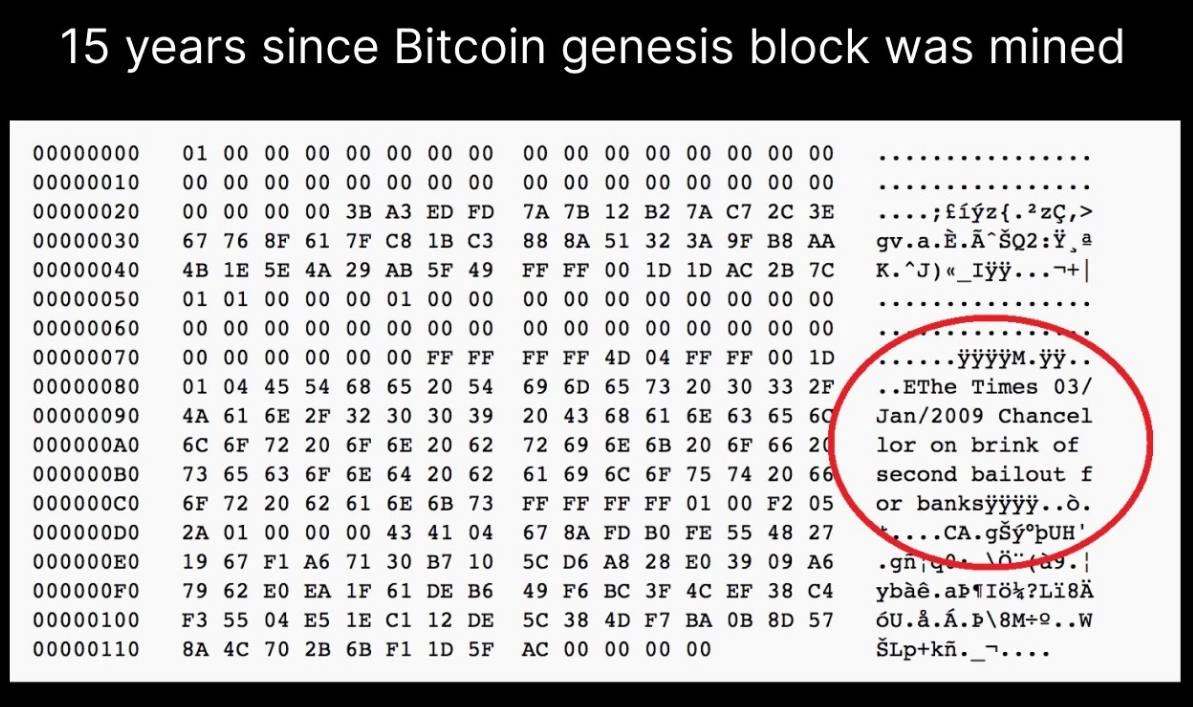
The image shown is a classic hex dump of the genesis block’s data. A hex dump is a way to display binary data in a human-readable format. Computers store information in bytes (which are 8 bits), and it’s not practical to display those in just 0s and 1s for humans. Instead, we often use hexadecimal (base-16) representation for each byte, because it’s more compact (two hex digits represent one byte). In the dump, the left column (e.g., 00000000, 00000010) shows the offset (the position in the file or data, in hex). The middle columns are the actual data bytes in hex. The rightmost column tries to interpret those bytes as ASCII characters (letters, numbers, symbols) if they correspond to printable characters; if not, it shows a dot .. This format is common in low-level programming or debugging when you need to inspect exactly what values are stored in a file or memory.

Now, in the circled part of the hex dump, you can actually read a sentence in the ASCII column: “The Times 03/Jan/2009 Chancellor on brink of second bailout for banks”. This is not a random coincidence – it was intentionally put there. That sentence is the headline from the front page of The Times (a British newspaper) on January 3, 2009. Satoshi Nakamoto included this text in the coinbase of the first Bitcoin block. The coinbase is a special field in the first transaction of a block, usually used by miners to include some arbitrary data (often people put a message or their mining pool’s name there). In the genesis block’s coinbase, instead of something mundane, Satoshi embedded this newspaper headline.

Why is that significant? For one, it serves as a timestamp. By using a known news headline (with date), it proved that the block wasn’t created earlier than that date – it’s like saying “look, this block couldn’t have existed before Jan 3, 2009, because it contains news from that day”. It’s also widely believed to be a commentary or message about the context in which Bitcoin was born. Early 2009 was during a major financial crisis, and governments were bailing out banks (“Chancellor on brink of second bailout for banks” refers to the UK’s Chancellor of the Exchequer considering a second rescue package for the banking system). By referencing that, Satoshi might have been hinting at why Bitcoin was created – perhaps as an alternative to the troubled financial system.

In tech terms, this hidden message is a classic example of an Easter egg. An Easter egg in software is a hidden feature or message placed intentionally by the creators for users to find (kind of like a fun secret). Developers sometimes hide Easter eggs in programs, games, or data files – like a programmer signature, a joke, or a quirky message – that doesn’t affect the functionality but is a treat for the curious. Here, the Easter egg is deeply meaningful: it’s not just a joke, but a piece of HistoricalContext. Satoshi left a literal time-capsule note inside the code of Bitcoin’s first block.

The meme text says the genesis block is “still flexing its hex-dump Easter egg” after 15 years. “Flexing” in slang means showing off. The joke is that even a decade and a half later, if you take the genesis block’s raw data and run it through a hex viewer, it will proudly show off that embedded headline exactly as it was in 2009. That’s thanks to blockchain immutability – once data is recorded in the blockchain, it’s virtually impossible to change it. Thousands of computers around the world have a copy of this block, and any change would be rejected as invalid. So the message persists unchanged. Tech folks find this cool because it’s like digital stone: the message Satoshi carved in block 0 is still there, embedded_headline and all, and anyone today can verify it by examining the block data. It’s a bit of nostalgia too – looking at a hex dump like this is old-school, reminding programmers of digging through raw data back in the day. So, the meme celebrates both the TechHistory of Bitcoin’s beginning and the BlockchainTechnology principle that what’s written to the chain stays on the chain – all wrapped up in that one highlighted line of text.

Level 3: Hardcoded History

Fifteen years later, that very first Bitcoin block is still showing off its hidden message, and engineers can’t help but smile. The meme highlights how the genesis block – mined on January 3, 2009 – contains a hardcoded headline from The Times newspaper. It’s circled in the image like a prized Easter egg. For seasoned developers, this hits two nostalgic notes: the early days of Blockchain history and the experience of poking around in raw hex data looking for secrets. It’s as if the blockchain’s origin story itself came with a cheeky post-it note from Satoshi, now permanently laminated into the world’s most tamper-proof notebook.

Seeing a hex dump with an ASCII column instantly transports veteran programmers to debugging sessions and digital archaeology. Many of us have spent late nights cracking open binary files or memory dumps with tools like hexdump or xxd, scrolling through pages of hexadecimal values for anything human-readable. Finding an intelligible string amidst gibberish bytes is like striking gold – whether it was a lost error message, a developer’s name, or a hidden joke in the code. Here, that gold is a full sentence: “The Times 03/Jan/2009 Chancellor on brink of second bailout for banks.” It’s not random junk; it’s a deliberate message. Senior engineers recognize this immediately as Satoshi’s Easter egg. It’s a bit of insider lore: the creator of Bitcoin left a literal newspaper headline tucked into the first block’s data, simultaneously a timestamp and a commentary on the financial crisis that inspired cryptocurrency. Talk about committing to historical context – quite literally committing, as in writing it into the blockchain’s first transaction!

The humor in the meme comes from the idea that the genesis block is “still flexing” this Easter egg after 15 years. In tech, 15 years is an eternity – languages fall out of favor, software versions sunset, and hardware becomes e-waste. Yet here we have a piece of BlockchainTechnology from 2009 that remains utterly unchanged and un-erasable. That red-circled text in the hex dump is effectively Bitcoin’s birth certificate and mission statement in one, and it’s showing no signs of fading. This is the immutability flex: no matter how much time passes, or how many terabytes of blocks get added on top, you can spin up a Bitcoin node today, query block 0, and you’ll find those exact bytes forming the famous phrase. It’s like the blockchain saying, “Checkmate – my first block is exactly as it was 15 years ago, message and all. Beat that, banks!” It gives experienced devs a kind of geeky glee, because it vindicates the design principle that what goes on the blockchain stays on the blockchain.

There’s also a bit of wry satisfaction in this for the old guard. Satoshi didn’t use a flashy UI or a giant arrow to announce the message; he left it in the coinbase data buried in the block, knowing inquisitive minds would eventually find it. Early Bitcoin adopters, running the client in 2009-2010, likely dumped the block data out of curiosity and had that “aha!” moment upon seeing the headline in plain text. Today’s meme encapsulates that discovery moment for a new generation: instead of a block explorer screenshot (which could just show the text, no fun in that), it deliberately shows a raw hex view as if you stumbled upon the secret yourself using nothing but a hex editor and some knowledge of binary. It taps into the shared experience among veteran programmers and hackers: the thrill of uncovering a secret message by delving into the bits and bytes. And after all these years, the genesis block’s hidden note remains one of the coolest “embedded_headline” easter eggs ever planted in software. It’s both TechHistory memorabilia and a permanent fixture of cryptocurrency culture, and that juxtaposition really resonates with folks who appreciate how far we’ve come since that quiet January day in 2009.

Level 4: Byzantine Beginnings

At the theoretical core of blockchain, the Bitcoin genesis block is a fascinating study in distributed trust. Imagine starting a ledger that anyone in the world can verify, yet no one had seen before – a classic Byzantine Generals problem scenario. Satoshi Nakamoto’s solution was to use Proof-of-Work and cryptographic hashing to allow decentralized consensus. The genesis block (block #0) is the root-of-trust for this entire system: its hash is hardcoded in Bitcoin clients as the starting point of the chain. In a sense, this block is to Bitcoin what an initial axiom is to a mathematical system – everything builds from it, and it cannot be derived from earlier data. By necessity, it had to be immaculately conceived (mined with no predecessors) and then accepted by all future nodes as given.

What’s genius is how Satoshi anchored this new ledger in real time. By embedding the text of a real newspaper headline – “The Times 03/Jan/2009 Chancellor on brink of second bailout for banks” – into the block’s coinbase data, he created a cryptographic timestamp. This concept has roots in prior research: early digital timestamping schemes (Haber & Stornetta, 1991) would literally publish hashes in newspapers to prove a document’s existence at a certain time. Satoshi inverted that idea by placing a newspaper reference inside the hash-chain itself. The inclusion of The Times headline is like a one-time pad for historical context; it proves the block wasn’t mined before January 3, 2009, because that news didn’t exist before that date. In terms of distributed systems theory, this was a trust anchor – an unalterable piece of the real world injected into the ledger’s genesis to assert "this is when and why our chain began."

From a low-level perspective, this block’s raw bytes are now legendary. The meme’s hex dump format (offsets on left, hexadecimal bytes in the middle, ASCII on the right) could be straight out of a forensic analysis textbook or a C programmer’s debugging session. If you interpret those bytes as characters, out pops that headline, preserved in the blockchain’s DNA. Because of cryptographic linking (each block’s hash includes the previous block’s hash), altering even a single character in the genesis block’s payload would break the entire chain’s integrity. It’s a beautiful demonstration of immutability rooted in mathematical hash functions: $H(\text{block}_0)$ is fixed forever, and every node in the Bitcoin network would reject any chain that doesn’t start with that exact hash and message. Thus, the easter egg message isn’t just a fun historical footnote – it’s embedded in the very fabric of Bitcoin’s consensus. Satoshi essentially said, “Here’s our starting signal to the world,” and cryptography ensures that signal echoes unaltered through every full node to this day.

Description

The image displays a foundational artifact of cryptocurrency history against a black background. At the top, white text reads, '15 years since Bitcoin genesis block was mined'. Below is a classic three-column hexadecimal dump: memory addresses on the left, hexadecimal data in the center, and the corresponding ASCII character representation on the right. A large red oval on the right side highlights a specific, human-readable string embedded within the raw data: '..EThe Times 03/Jan/2009 Chancellor on brink of second bailout for banks...'. This is not a meme but a direct look at the data within Bitcoin's very first block, known as the Genesis Block. The embedded text is the headline from The Times of London on January 3, 2009. It was included by Bitcoin's anonymous creator, Satoshi Nakamoto, as both an immutable timestamp and a powerful political statement on the fragility of the traditional banking system, which Bitcoin was designed to circumvent. For developers, this is a legendary piece of tech history, showcasing a 'commit message' for an entirely new financial paradigm hidden in plain sight
Comments

18
Anonymous ★ Top Pick Bitcoin's genesis block contains a burn on the banking system so deep, it's been immutably recorded on a distributed ledger for 15 years
  1. Anonymous ★ Top Pick

    Bitcoin's genesis block contains a burn on the banking system so deep, it's been immutably recorded on a distributed ledger for 15 years

  2. Anonymous

    Proof-of-work is cool, but proof-of-newspaper-headline is the original CI pipeline comment that made it to prod - and no one’s ever force-pushed over it

  3. Anonymous

    After 15 years, we've gone from embedding newspaper headlines in genesis blocks to arguing whether our distributed ledger should process JPEGs of apes - truly the financial revolution Satoshi envisioned while debugging that off-by-one error in the difficulty adjustment algorithm

  4. Anonymous

    After 15 years, we've gone from 'Chancellor on brink of second bailout' embedded in a genesis block to having entire nations put Bitcoin on their balance sheets. Satoshi's hex-encoded snark aged like fine wine - turns out the real distributed consensus was that traditional finance needed a fork

  5. Anonymous

    Satoshi's genesis coinbase: The ultimate immutable commit message, timestamped with more prescience than any enterprise RFP

  6. Anonymous

    Fifteen years on, the most reliable documentation in fintech is still a newspaper headline stuffed into a coinbase script - append‑only beats your wiki retention policy and your SIEM budget

  7. Anonymous

    That coinbase headline is the only ADR I’ve seen with quorum, replay protection, and 15 years of five-nines; our wiki can’t survive a single org reorg

  8. @s2504s 1y

    Explain pls

    1. dev_meme 1y

      Today is Bitcoin birthday, what else may need an explanation?

      1. @ZgGPuo8dZef58K6hxxGVj3Z2 1y

        Is this in the beginging- in the begindi- is this in the beginding- in the be-gin-ging of the blockchain?

  9. @ZgGPuo8dZef58K6hxxGVj3Z2 1y

    First you need a pyramid scheme

  10. @AndoroidP 1y

    Isn't bitcoin birthday on January 3rd?

    1. dev_meme 1y

      Kk, genesis block birthday :)

      1. @AndoroidP 1y

        genesis block was mined on jan 3rd https://mempool.space/block/000000000019d6689c085ae165831e934ff763ae46a2a6c172b3f1b60a8ce26f

        1. @s2504s 1y

          That's why I asked for explanation 🤷‍♂

      2. @purplesyringa 1y

        It very much says "03/Jan/2009" in the big red circle

        1. @ZgGPuo8dZef58K6hxxGVj3Z2 1y

          We need to add a red arrow to make it more obvious

  11. Felix 1y

    Children often ask for multiple birthdays. should subside with coming of age

Use J and K for navigation