Skip to content
DevMeme
6615 of 7435
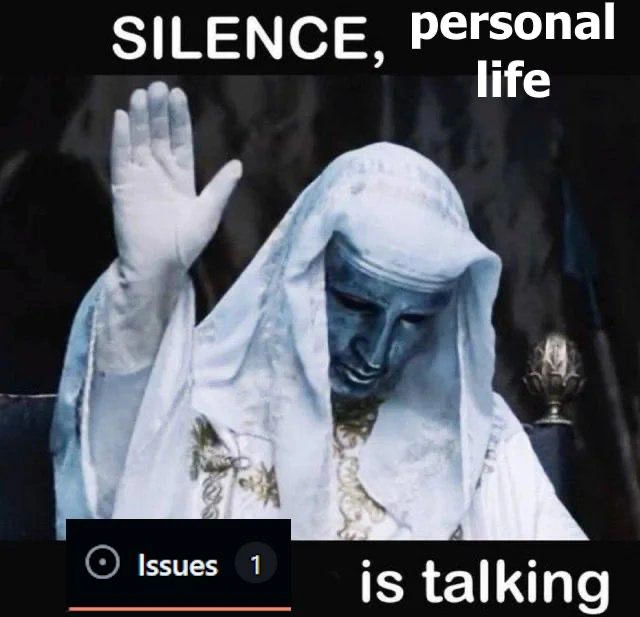
Silence Personal Life, GitHub Issues Are Talking
OpenSource Post #7248, on Oct 10, 2025 in TG

Silence Personal Life, GitHub Issues Are Talking

Why is this OpenSource meme funny?

Level 1: Playtime Is Over

Imagine you’re playing your favorite game or enjoying time with friends, and all of a sudden your mom or dad comes in and says, “Stop right now, we have an emergency!” You’d have to pause your fun immediately, right? This meme is saying the same thing, but for a grown-up who is a programmer. In their case, they might be relaxing or watching a movie (that’s their “play time”), and then a problem at work pops up and demands attention (like the parent calling an urgent time-out). Just like you’d sigh and put down your toys when a parent needs you to do something important, a developer has to drop everything when a big work issue appears. It’s funny in a truth-like way: one moment you’re having fun, and the very next moment you have to get serious. The meme shows how quickly a programmer’s free time can get shushed by work, almost like an adult version of a teacher or parent saying, “No playing now, there’s something important happening!”

Level 2: PagerDuty Calls

Let’s break down the joke in simpler terms. GitHub Issues are a built-in way to track bugs and tasks in a project on GitHub. When you see “Issues 1” with a little blue circle next to it, that means there’s one open issue (like a bug report or problem) that probably needs a developer’s attention. In the meme image, that tiny “1” notification is a big deal — it’s basically screaming “Hey, something’s broken!”

On-call duty is when a specific engineer is designated to respond if things break in production (the live app or website that real users are using). Teams often rotate this responsibility so everyone takes turns. If you’re “on call” and an urgent problem comes up – especially a critical production outage (often labeled a P0 or Sev-1 incident, meaning top priority) – you’ll get an alert, a phone call, or a text message immediately. Services like PagerDuty help with this: they automatically ping the on-call person when an alarm goes off. If the first person doesn’t respond (say they slept through it), the system will escalate to alert another person, and so on. That’s what the tag “weekend_pagerduty_escalation” hints at: if nobody answers initially, it’ll keep climbing the chain (potentially waking up multiple people) until someone takes the call. The idea is to ensure that no matter when a serious bug happens — even at 3 AM on a Sunday — someone is going to address it quickly.

Now, the meme text “Silence, personal life is talking” is joking that whenever a work issue appears, it effectively silences your personal life. In the picture, the white-robed figure with a raised hand is taken from a Lord of the Rings scene used in many memes (often captioned “Silence!”). In the original scene, a spooky character demands everyone be quiet. Here, the meme replaces the usual target with “personal life.” So it imagines that the GitHub issue (the work problem) is like that powerful character telling your personal life to shut up. Visually, it’s saying: the GitHub issue has entered the chat, so everything else needs to stop. The dramatic imagery from the movie makes it extra clear (and extra funny) how commanding that one little issue feels.

For a newcomer to software life, think of it this way: Imagine you just sat down to play a game or have dinner, and then you get a notification that there’s a bug in the app you wrote. If it’s a serious bug (for example, the app is crashing for all users), you have to drop what you’re doing and fix it right away. That sudden interruption is what we call a work-life boundary intrusion – work stuff barging into your personal time. A lot of companies and developers talk about keeping a good work-life balance, meaning you keep work and personal time separate. But an urgent issue doesn’t care if it’s the weekend or 10 PM; it needs fixing now. If this happens too often, developers can start feeling burned out – that’s the developer burnout tag – which means they’re exhausted and stressed because they never truly get to relax away from work.

So in plain terms, the meme highlights a common situation in IT: one new bug report or issue can overpower everything else. It humorously portrays that feeling when your phone buzzes with a work emergency at the worst possible time, and suddenly your fun evening goes silent. Your code has a problem, and it’s like an authority figure declaring, “No more fun right now – we have an issue to deal with!” Every developer dreads it, and that’s exactly why we find the meme both funny and painfully relatable.


Level 3: One Issue to Ruin All

There’s a special Murphy’s Law of On-Call: the moment your personal life is in full swing, a critical production problem will rear its ugly head.

# Murphy's Law of On-Call in pseudocode:
if personal_life.active:
    raise ProductionIssue("All personal plans cancelled")

This meme nails that bitter truth with dark humor. The robed figure raising a hand like an all-powerful overlord represents that one GitHub Issue notification — it's the tyrant saying “Silence!” just as your personal time is daring to speak. In other words, even a single open issue can instantly overrule your work-life balance, commanding all attention. For the seasoned engineer, that little blue Issues badge might as well be the One Ring from LOTR: One issue to rule them all – where “all” includes your evening plans, your weekend, and maybe your sanity.

Experienced developers recognize the scene immediately. It's basically an on-call war flashback: you’re on duty, enjoying a quiet night, when suddenly the phone buzzes with a GitHub issue or a PagerDuty alert. The meme is hilarious (in a painful way) because it exaggerates a scenario we've all lived through but try not to think about until it happens again. The absurdity lies in how a tiny digital badge with a “1” can feel like a royal decree. Personal life gets muted because production is "speaking" – and when production speaks, every engineer listens (or else). The image riffs on a classic Lord of the Rings template (the "Silence!" meme), which is spot-on. In the movie, an imposing figure commands silence as a display of absolute authority. Here the authority figure is a bug tracker notification. It’s an apt comparison – a high-priority bug in production demands immediate attention just like a dark lord interrupting a crowd. The humor comes from that role reversal: normally your life is important and work should wait, but in a tech emergency the bug is king, and your personal life is told to hush.

Any senior engineer reading this feels a mix of amusement and PTSD. We've all got our greatest hits of personal-life interruptions. For example:

  • Friday 5:30 PM – Code freeze was at 5, but of course a last-minute change slipped through. Fifteen minutes after you leave for the weekend, the monitoring system triggers a Sev-1 alert (highest severity). Goodbye, Friday night; hello, unexpected deployment rollback.
  • 2:00 AM Sunday – Your phone’s PagerDuty app lights up like a Christmas tree. The database cluster decided to have a replication meltdown in the middle of the night. Half-asleep, you scramble to triage the issue via an SSH session before your brain even fully boots up.
  • Vacation Day – You’re halfway through a relaxing week off when you get the dreaded “Issue #142: Production API slowdown” email. You mutter “it’s always DNS” under your breath as you tether your laptop to hotel Wi‑Fi, debugging in flip-flops.

These war stories are funny after the fact, but in the moment they’re nerve‑racking. The meme resonates because it’s a shared industry joke: we boast about agile processes and redundant systems, yet a single misconfig or untested edge case can still yank a developer out of a family dinner or deep sleep. The combination of responsibility and unpredictability makes on-call life uniquely stressful. Everyone preaches “don’t deploy on a Friday” as a best practice, but there’s always that one hotfix or database migration that just has to go out at 4:45 PM. And boom — there goes your weekend. The gap between ideal DevOps practices and real-world chaos is exactly what’s being lampooned here.

Technically, this scenario highlights how complex systems fail in surprising ways. Modern cloud architectures, microservices, CI/CD pipelines — they make deployment faster, but also mean there are more moving parts that can break. With constant changes, something will eventually break at an inconvenient time. We have fancy monitoring and alerting to catch issues early, but that just means you get notified sooner… likely at 11 PM on Saturday instead of Monday morning. At big scale, one-in-a-million bugs aren’t rare — they might happen daily when millions of users are on the system. So even with rigorous testing and SRE practices, nobody can guarantee a calm weekend. The price of rapid innovation is accepting a bit of instability, and the engineers carry the pager (or smartphone) as part of that bargain.

Organizationally, this meme pokes at the culture in many software teams where being interrupted is just part of the job. On-call rotations exist to share the load so it’s not always the same person’s life being disrupted, but it often still feels like a 24/7 tether. If you’re the only one who truly understands a certain legacy system, guess what — even if it’s not officially your turn, that Issue 1 might effectively have your name on it. This is how developer burnout creeps in: when you can never fully disconnect, you’re constantly bracing for the next “urgent issue” ping. Companies talk a lot about boundaries and send around WorkLifeBalanceTips, but when the CEO messages the team at midnight saying the site is down, those boundaries become pretty theoretical. And let’s be honest, plenty of devs also take pride in being the hero who swoops in to save the day, even if it wrecks their sleep schedule — it’s a hard habit to break.

Ultimately, this meme is both a chuckle and a grim nod. It’s funny because it’s true: the OnCallDuty life means your personal conversation or relaxation can be abruptly shut down by the stern, raised hand of a production bug. It’s the "here we go again..." feeling every seasoned dev knows too well. We laugh at the imperious tone (“Silence, personal life is talking”) because if we didn’t laugh, we might cry. In the battle of personal life vs. production issues, the bug often sits on the throne. This meme perfectly caricatures that reality — an open issue becomes the imperious ruler of your time, commanding silence from everything else. Any engineer who’s been paged at 3 AM will smirk (and maybe shudder) at how spot-on it is.


Description

A meme featuring a robed, blue-skinned mystical figure (Dark Souls/Elden Ring aesthetic) raising a hand in a commanding gesture with text reading 'SILENCE, personal life' at the top. In the bottom left corner is a GitHub 'Issues 1' badge indicator, and the bottom right reads 'is talking.' The figure dramatically silences their personal life because a single GitHub issue notification demands immediate attention, capturing the obsessive developer mindset where open source issues take priority over real life

Comments

12
Anonymous ★ Top Pick Your girlfriend says 'we need to talk' but GitHub says 'Issues: 1' and we all know which one actually gets triaged within the SLA
  1. Anonymous ★ Top Pick

    Your girlfriend says 'we need to talk' but GitHub says 'Issues: 1' and we all know which one actually gets triaged within the SLA

  2. Anonymous

    After two decades of on-call rotations I’ve learned that the only higher priority than P0 is whatever GitHub labels with a single unread issue badge - apparently even my weekend barbecue obeys that SLA

  3. Anonymous

    After 15 years in the industry, you realize the real P0 incident isn't the one paging you at 3am - it's explaining to your therapist why you check GitHub issues during your wedding vows because 'what if someone found a race condition in the payment service?'

  4. Anonymous

    The GitHub Issues tab: that one notification that transforms your peaceful Saturday morning into an impromptu architecture review of why the production database is on fire. It's the digital equivalent of your CTO materializing in your living room at 2 AM, except you can't pretend you didn't see it because GitHub already sent the email, Slack message, and probably carrier pigeon. Senior engineers know the real skill isn't fixing the issue - it's the mental gymnastics of convincing yourself that 'Issues: 1' doesn't mean 'P0: Database returning NULL for all user sessions.'

  5. Anonymous

    We keep an error budget for services; for personal life I closed the GitHub ticket as “won’t fix” - apparently that doesn’t satisfy the SLO

  6. Anonymous

    Nothing reminds you that SLOs own your calendar like a single GitHub issue badge turning Friday night into an impromptu incident review

  7. Anonymous

    Quiet, family - Issues(1) outranks your blocker status in my triage

  8. @dwtexe 9mo

    If a issue is cannot be resolved with in the first week it becomes a zombie issue

    1. @SamsonovAnton 9mo

      first decade (10 years) 👌

    2. dev_meme 9mo

      It becomes a feature with optional #wontfix tag

    3. @TERASKULL 9mo

      (gets marked as stale and closed because of an aggressive github-actions bot)

  9. @moosschan 9mo

    My body is a machine that turns ISSUES 1 Into ISSUES 12

Use J and K for navigation