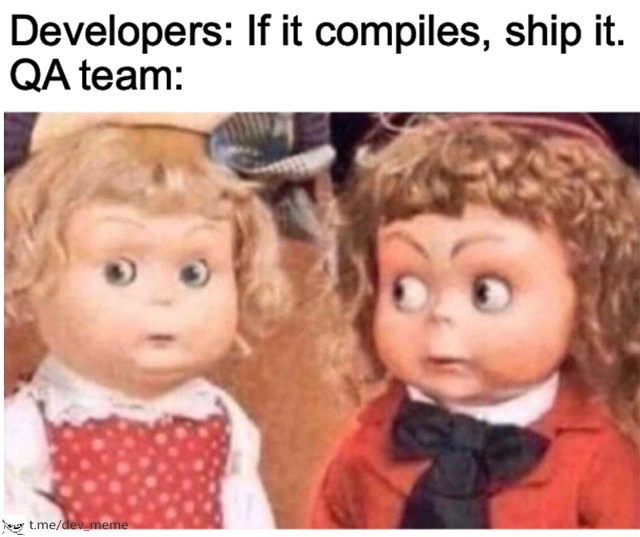
If it compiles, ship it - QA’s unamused porcelain-doll reaction
Why is this QA meme funny?
Level 1: Double-Check It
Think of it this way: imagine you’re building a toy or a model kit. You put all the pieces together and it looks like the picture on the box. You’re excited that you finished it without any pieces left over. In a hurry, you shout, “It’s done, let’s play with it!” But your friend (who is very careful) just stares at it with a concerned face, like those porcelain dolls in the picture. Why? Because just because it’s assembled doesn’t mean it’s actually ready. Maybe some pieces aren’t glued properly and it will fall apart when you really play. Maybe the wheels on that toy car you built are on backwards and you haven’t noticed because you didn’t actually try rolling it yet. Your friend is basically thinking, “Umm, are you sure this is safe/good to go?”
In the meme, the developer is you saying, “If it compiles, ship it,” which is like saying “If I finished building it, let’s use it right away.” And the QA team is like your careful friend, giving a blank, slightly creeped-out stare, meaning “I don’t trust that it’s truly ready.” They want you to double-check it. This is funny because it’s a very common feeling: one person thinks a job is finished as soon as the basic part is done, but the other person knows you should test it or check it again to make sure it really works. It’s like a kid saying, “I did my homework, I’m going out to play!” and the parent looking at them like those dolls and asking, “You’re done already? Did you check your answers?” The parent’s concerned stare and the kid’s rush to declare victory – that’s the dynamic here.
So the core idea is simple: don’t celebrate too early. In everyday life, and in coding, you should make sure something actually works correctly, not just assume it’s fine because you finished the first step. The meme makes us laugh because we’ve all seen someone be overconfident about their work being “done” when it really isn’t. The developers are basically saying, “Hey, it looks fine, let’s send it out!” and the QA team (testing folks) are quietly saying with their eyes, “This might not end well…” It’s a funny exaggeration of the need to test things and double-check, using those goofy doll faces to capture that awkward, unimpressed silence.
Level 2: But Did You Test It?
Let’s break down why this scenario hits home for many dev teams. First, what does “if it compiles” mean? When developers write code in a compiled language (like C++ or Java), they have to run it through a compiler – a program that checks the code for errors and converts it into a runnable form (machine code or bytecode). If the compiler finds no syntax errors or type errors, we say the code compiles. It’s a bit like an initial spell-check for your program – it ensures the code follows the language rules well enough to run. “Ship it” is casual slang in tech meaning “deploy the software to users” or release it. So the developer phrase “If it compiles, ship it” jokingly means, “As long as the code builds without errors, let’s release it immediately.”
Now enter the QA team – Quality Assurance engineers, often simply called testers. Their job is to test the software thoroughly to catch bugs, issues, and any deviation from expected behavior before it reaches the customer. QA teams develop test plans, click every button, input weird values, run automated test suites, and generally make sure the software actually works as intended in the real world. They are guardians of code quality and user experience, often a bit more detached (and strict) about the software than the developers who wrote it.
So why is the QA team depicted as two staring porcelain dolls with a vacant, unimpressed expression? In the meme, the top text sets up a contrast: the developers are eager and maybe a little too proud that the code compiled. Meanwhile, the QA team responds with stone-cold silence and a creepy stare. This image is a humorous way to show their reaction: basically “Are you kidding me?” or “You know that doesn’t mean the software actually works, right?” The dolls’ faces are emotionless and a bit ominous, amplifying how fed up or speechless the QA folks feel. They’re not laughing; they’re not even facepalming – they’re just staring, which in meme language often implies a judgmental or shocked silence.
This humor taps into TestingHumor that many in software development recognize. Newer developers (and certainly non-developers) might not realize that “no compile errors” doesn’t guarantee bug-free code. For example, imagine you write a program and it compiles fine. You run it and it opens up – hooray! But then you try a simple action (like clicking a save button or inputting a zero where you shouldn’t) and the whole thing crashes or gives the wrong result. The compiler’s job was only to ensure the code could run; it doesn’t check if your program does what it’s supposed to do. That’s where QA and testing come in. They’ll do things like:
- Unit tests: small tests for individual functions or pieces of code.
- Integration tests: tests that check if different parts of the system work together.
- Manual exploratory testing: a QA engineer clicking around, trying real user scenarios.
If a developer just says, “It compiled, let’s deploy it,” they’re skipping all these steps. This is obviously risky, and that risk is the butt of the joke. The QA team’s blank stare is them basically freezing in disbelief. They might be thinking: “We haven’t run a single test, and you want to send this to production?!” It’s a clash: Dev vs QA. Developers are often under pressure to deliver features quickly. QA is there to pump the brakes and ensure quality isn’t sacrificed for speed. When those two priorities clash directly, you get moments exactly like this meme: developers treating a compile as a green light, and QA reacting with quiet, almost horror-struck disapproval.
This tension is a cornerstone of CodingHumor and office jokes in tech. Everyone on a software team has some story about that one developer who was overly eager to deploy something that “seemed to work on their machine,” and the QA person who had to valiantly (or wearily) stop them. It highlights why testing is crucial: just because the code is built into an app doesn’t mean it’s ready for real users. There could be hidden bugs that only appear when you click certain sequences, or performance issues when real data is used, etc. The QA dolls in the picture, with their old-fashioned clothes and unblinking eyes, might also imply that the QA team has been around the block a long time (like an ancient guardian of quality), watching generations of developers repeat the same mistake of thinking compile = done. They’ve seen it all, and they’re not amused anymore.
In short, this meme humorously educates: compiling the code is just one step. You still have to actually test the thing! The QA team’s stoic reaction is a reminder that no, you shouldn’t deploy software right after the compiler gives the thumbs up. You need to run your test cases, check for any errors, and make sure it meets the acceptance criteria. The phrase “But did you test it?” is basically the QA team’s unspoken response here. And the reason this is funny is because so many of us have been in that situation – perhaps as a newbie developer thinking a passed compile is a victory, or as a QA engineer giving the side-eye to a rushed release. It’s a shared understanding that code quality involves more than just writing code that doesn’t immediately crash on launch.
Level 3: Compiled ≠ Complete
At a senior level, this meme pokes fun at the dangerous gap between compilation success and real code quality. The top caption – “Developers: If it compiles, ship it.” – encapsulates a rush-to-release attitude often seen under tight deadlines or sloppy culture. Sure, the code compiles without errors, meaning the syntax is correct and the program can be built into an executable. But any experienced developer knows that “compiled” is not equal to “correct”. Real life isn’t an academic programming assignment where passing the compile stage gets you most of the credit. In production, just compiling is table stakes – the bare minimum. The QA team’s deadpan porcelain-doll stare in the image embodies that seasoned disbelief: they’ve seen this movie before and it doesn’t end well.
From a veteran perspective, the humor comes from shared trauma in Dev vs QA dynamics. The developer’s line is basically a cousin of “Works on my machine!” – a sarcastic summary of devs who celebrate too early. The QA engineers, represented by those blank-eyed antique dolls, are giving the kind of unamused, thousand-yard stare that says, “Oh, you sweet summer child…” They know a successful compile is only the first step in software delivery, not a guarantee that the code works or meets requirements. In real organizations, a developer might proudly announce a build with no errors, but the QA team – responsible for Testing and Quality Assurance – is painfully aware of all the ways that “just compiled” code can still hide bugs.
We can imagine why these QA dolls look so done with everything. They’ve likely caught countless issues that compiled code had: crashing on a null pointer, failing an edge-case workflow, or obliterating some poor user’s data. They might be recalling that one overnight deployment that technically built fine but blew up in production because nobody bothered with proper QA testing. Seasoned developers and testers reading this meme will nod knowingly (if not a bit wearily): only checking that code compiles is like saying a car is safe to drive because you managed to start the engine – it completely ignores the possibility of failing brakes or missing wheels.
In fact, there’s a classic proverb among experienced engineers: “Compiling is only the beginning.” To illustrate, consider a tiny C++ code snippet that compiles without complaints:
// Compiles fine, but is it safe?
int divide(int a, int b) {
return a / b;
}
This code passes the compiler’s syntax checks effortlessly. But if b is 0 at runtime, we’re in for a nasty crash or exception. A compiler won’t warn you about that logic bomb. Only thorough testing (or a vigilant QA analyst with a suspicious mind) would catch it before it blows up production. The meme’s humor lives in this contrast: the developer attitude of “No compile errors, let’s deploy!” versus the QA team’s silent horror, knowing how many things can still go wrong.
On a broader level, the image lampoons a common anti-pattern in software teams where speed is valued over quality. It highlights the absurdity of using a clean compile as the sole release criterion – something any senior engineer recognizes as a recipe for ReleaseAnxiety. The tags like if_it_compiles_ship_it and release_without_testing capture this reckless workflow. The QA dolls’ expression is basically every tester’s face when they hear a developer downplay CodeQuality: it’s equal parts unimpressed and vaguely menacing (those doll eyes are creepy for a reason). The meme lands so well in DeveloperHumor circles because it exaggerates a truth we all know: skipping QA is a great way to invite overnight pages, angry users, and emergency hotfixes. In other words, “It compiled” is a far cry from “It’s done.”
Description
The meme has a plain white background with bold black text at the top reading, “Developers: If it compiles, ship it. QA team:”. Beneath the caption is a slightly grainy photo of two old-fashioned porcelain dolls with curly blond hair; one doll wears a white-collared red polka-dot dress while the other sports a dark bow on a red outfit. Both dolls stare forward with vacant, unsettling expressions, visually representing the QA team’s silent disapproval of developers who treat a successful compile as the only release criterion. The humor riffs on real-world engineering tension between rapid delivery and rigorous quality assurance, highlighting the gap between “it builds” and “it’s production ready.”
Comments
6Comment deleted
“‘It compiles’ just means the AST didn’t revolt; QA’s porcelain stare is the coverage report for the 3 a.m. paths you forgot existed.”
The same developers who insisted on 100% code coverage are now arguing that if TypeScript doesn't throw errors, the business logic must be correct
The classic 'green build = production ready' mentality that keeps QA engineers awake at night. Sure, the compiler didn't throw errors, but that just means your syntax is valid - not that your authentication bypass, race conditions, or that lovely SQL injection vulnerability won't make it to prod. QA's side-eye intensifies when they realize 'it compiles' is being treated as a comprehensive test suite, regression analysis, and security audit all rolled into one. Meanwhile, the deployment pipeline is already warming up
Developers: If it compiles, ship it. QA: Awesome - your retry-without-backoff compiles too; which SLO are we burning tonight?
Compilation is a liveness probe; QA cares about readiness
Devs: 'Compiles = ship.' QA: 'Hold my integration suite - prod's about to teach you CAP theorem the hard way.'