CTO vs. CPO: The Ultimate Winner is the CFO's Budget Bat
Why is this CorporateCulture meme funny?
Level 1: Mom Says No
Imagine two kids at a toy store who both want something expensive. One kid grabs a giant robot toy, and the other grabs a huge dollhouse. They start arguing really loudly about whose toy the family should buy, each kid insisting that their choice is the one that should come home. They’re like two big creatures yelling and making a scene (just like Godzilla and Kong fighting in a movie). Now, picture their mom walking up, seeing this argument. She crosses her arms and says, “No, we’re not buying either toy – they cost too much.” She takes both toys away and tells the kids it’s not in the budget. Both kids suddenly go quiet and look disappointed. The fight is over immediately because the person with the wallet (the mom) said “no.” In this story, the kids are like the CTO and CPO who were battling over what they wanted, and the mom is like the CFO who controls the money. The funny part is that the kids were so busy fighting each other, but in the end a single “no, we can’t afford that” from mom settled everything. It shows in a super simple way why the meme is funny: two big fighters can argue all they want, but the one who handles the money can stop the whole fight with one quick decision.
Level 2: Clash of the Chiefs
Let’s break down the roles and what’s happening in simpler terms:
CTO (Chief Technology Officer) – This is the executive in charge of technology and engineering in a company. The CTO cares about things like the tech stack (the programming tools and systems used), making sure the product is built on a solid technical foundation, and that the development team can work efficiently on reliable systems. In simpler words, the CTO’s focus is “how do we build this right and keep our tech running smoothly?”
CPO (Chief Product Officer) – This is the executive responsible for the product’s strategy and features. The CPO thinks about what the product should do for customers, what new features to add, how to make it more appealing in the market, and plans out the product roadmap (what improvements or new features will be worked on and when). In short, the CPO is focused on “what should we build to make customers happy and grow the business?”
CFO (Chief Financial Officer) – This is the executive who manages the money. The CFO handles the company’s finances: budgeting, accounting, and controlling spending. They track how money comes in (from customers or investors) and how it goes out (salaries, equipment, marketing, etc.). The CFO’s main concern is “are we spending money wisely and do the finances balance out?” They often have to say no to expenses that don’t fit the budget.
In many companies, these three leaders have to work together, but they sometimes end up with conflicting priorities. The CTO might want to spend money on upgrading technology, hiring more developers, or buying better tools to improve the product’s stability and performance. Meanwhile, the CPO might want to spend that same money on building new features, improving the design, or launching new product ideas to attract more users. Both of those plans require a lot of resources (time, people, and money), and the reality is you can’t always do everything at once. So the CTO and CPO might disagree on where the team’s effort and the budget should go: is it more important to fix and strengthen the tech, or to add features for users? This disagreement is the "CTO vs. CPO" conflict shown in the top image — two giant monsters facing off, symbolizing two big bosses with clashing agendas about what’s best for the company.
Now, enter the CFO, the finance boss, who holds the purse strings of the company. "Budget cuts" is a term that means reducing the money allocated to different projects or departments. In the meme’s bottom image, the CFO is humorously portrayed as the Doge dog meme holding a baseball bat labeled "budget cuts." This represents the CFO stepping in to enforce spending cuts. When the CFO swings that "budget cuts" bat in the picture, it’s like saying, “We need to save money, so we can’t fund all of these ideas.” In real life, this might happen if the company isn’t hitting its profit goals or needs to control costs; the CFO will announce budget cuts which means some projects will get less money or be put on hold. In the meme, the result of the CFO’s whack is that both the CTO’s and CPO’s big plans get knocked down a peg. In other words, neither the CTO nor the CPO fully wins the battle because the money simply isn’t there to do everything they want.
The humor (and truth) in this situation is that while the CTO and CPO were busy battling each other (like two monsters fighting over who’s in charge), the CFO can end the fight instantly by saying “no” to both of them in terms of funding. It’s a bit like two kids arguing over a game, and then a teacher comes in and says, “game over, everyone stop now.” No matter how exciting or important each of their plans was, at the end of the day the budget (how much money is available) sets the limits. This meme exaggerates it with epic movie monsters and a cute doge, but it reflects a common corporate reality: even the top bosses (tech and product) have to bow to the limits set by the finance department. For a junior developer, this is a little peek into CorporateCulture and decision making at the top. You might have already seen a project get postponed or a feature get dropped not because it was a bad idea technically, but simply because “we don’t have the budget for it this quarter.” The meme is a funny reminder that in any tug-of-war between great ideas, the side with the money (or the one watching the money) often has the final say.
Level 3: When Finance Bats Last
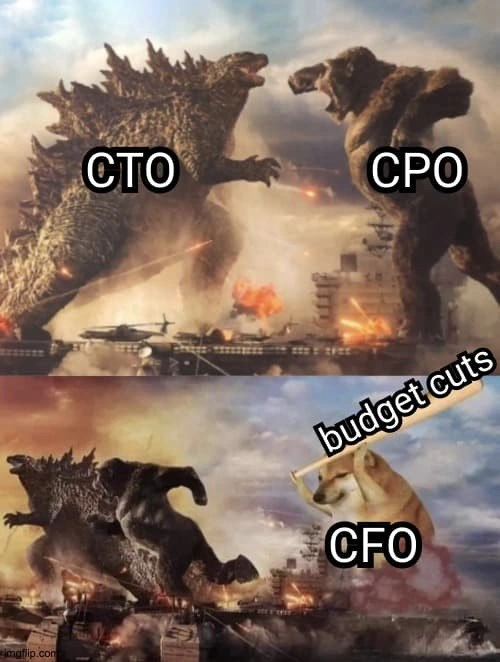
In the top panel, Godzilla vs. Kong is cast as a corporate cage match: a massive reptilian CTO (Chief Technology Officer) squares off against an equally giant CPO (Chief Product Officer). The scene is pure chaos—explosions in the sky, battleships tossed around like toys, smoke everywhere. For those who've been around the corporate block, this spectacle is hilariously on point. It's the classic turf war between technology and product leadership scaled up to kaiju-sized proportions. One titan breathes fire about platform stability and tech roadmaps, the other beats its chest about product features and market deadlines. And much like those poor battleships caught underfoot (think of them as projects or teams in the crossfire), something's bound to get wrecked when these two clash.
The CTO vs. CPO duel is a tale as old as tech companies themselves. Each side has a massive agenda: the CTO might be breathing fire about refactoring the entire codebase, strengthening infrastructure, or finally addressing that mountain of technical debt (Godzilla’s atomic breath, if you will). Meanwhile, the CPO is pounding their chest to launch flashy new features, enter new markets, and hit ambitious quarterly targets (like sales or user growth goals) (Kong's thunderous punch). Both think they're championing the company's future—just in different ways. Crucially, they're fighting over the same finite resources: engineering time, budget allocations, headcount. It's a zero-sum arm-wrestle. More fancy features might mean less time to fix the foundation, and vice versa. No wonder these two can end up at loggerheads, each a giant force unwilling to back down. In corporate terms, it's the classic collision of stability vs. speed, of engineers' ideals vs. product's demands. These battles can get heated (sometimes as fiery as Godzilla's breath) and often drag on, with lots of noise and damage but no clear winner.
Enter the CFO (Chief Financial Officer), stage right, swinging a budget cuts bat. The bottom panel delivers the punchline literally: a Doge (that familiar Shiba Inu internet meme dog) labeled “CFO” lunges in and bonk — smacks both Godzilla and Kong in one go. It's an absurdly perfect metaphor for what happens when finance decides to intervene. The CTO and CPO might have been duking it out all year, but one stern mandate from finance (picture something like, “Trim 20% off all budgets, effective immediately” or the dreaded “we need to tighten our belts”) can knock the fight out of both of them instantly. In the meme, the goofy Doge with a bat is comedic, but in reality it's the CFO wielding a spreadsheet or a budget report, delivering a blow just as decisive. This is ManagementHumor at its finest: depicting the unglamorous truth that no matter how colossal the egos or plans, the person controlling the purse strings can single-handedly floor them. As the bottom caption succinctly puts it: “Bonk.”
For the CFO, none of this is personal – it's just business math. They've got stakeholder pressure from the board and investors to keep the company’s finances healthy. All they see in the CTO vs. CPO showdown are two huge spending plans on a collision course. R&D overhauls? Expensive. New product launches? Also expensive. From the CFO's vantage point, both the CTO's skunkworks project and the CPO's feature blitz are line items contributing to overhead costs. If the combined plan doesn't fit the quarterly budget, guess what gets the chop? Both! The CFO calls it prudent cost optimization and "fiscal responsibility." To the folks in the trenches it feels more like getting whacked out of nowhere. It's funny because it's true: often the real resolution to a heated inter-departmental conflict is a mandate to cut costs across the board. Suddenly neither the CTO nor the CPO gets what they wanted. In one fell swoop, the budget constraints unify them in misery. Now they're on the same side, nursing their wounds after finance's intervention, both probably thinking, "We fought each other for nothing, and Finance won by KO."
Think of an ambitious project that was “top priority” in Q1, only to be scrapped by Q3 after a budget review – that's basically this meme. Real-world engineering leaders know the pain of pouring months into a grand plan (be it a major refactor or a shiny new product feature) only to have the CFO pull the plug due to cost concerns. It's practically a rite of passage in corporate tech: the CTO’s roadmap and the CPO’s roadmap can clash spectacularly, until the CFO quietly emails everyone about a budget freeze, effectively ending the argument. One could say the CFO is the unsung anti-hero here – preventing a financial meltdown, yes, but also crushing some dreams in the process. And to a battle-hardened dev who’s seen perfectly good projects get axed, the image of the CFO 'bonking' these warring executives is darkly funny. It's cathartic to laugh at the absurdity: all that internal drama, and in the end finance always wins.
For those who think in code, the CFO’s approach is brutally straightforward pseudocode:
# CFO algorithm: if CTO and CPO are locked in battle, apply budget cuts to both
if CTO.is_conflicting(CPO):
CFO.reduce_budget(CTO)
CFO.reduce_budget(CPO)
print("Bonk!")
In plain English, if the CTO and CPO are at each other’s throats, the CFO’s solution is to whack both with budget cuts — Bonk, problem solved (at least from Finance’s perspective).
Description
A two-panel meme illustrating corporate power dynamics. The top panel depicts a scene from 'Godzilla vs. Kong' where the two titans are roaring at each other, ready for battle. Godzilla is labeled 'CTO' (Chief Technology Officer) and King Kong is labeled 'CPO' (Chief Product Officer), symbolizing the classic and often intense strategic conflict between technology and product leadership. The bottom panel hilariously subverts this epic struggle. Both titans are shown cowering as the Shiba Inu dog from the 'Cheems Bonk' meme, labeled 'CFO' (Chief Financial Officer), hits them with a baseball bat labeled 'budget cuts.' The meme humorously captures the reality in many tech organizations where the elaborate battles between engineering and product over roadmaps, features, and technical debt are ultimately rendered irrelevant by the overriding financial authority of the CFO, whose budget decisions can neutralize any strategic plan
Comments
9Comment deleted
The CTO wants microservices, the CPO wants more features. The CFO just defunds both of their Kubernetes clusters. End of discussion
CTO: “We need multi-region Kubernetes with zero-downtime deploys.” CPO: “Ship five new AI features this quarter.” CFO (swinging the budget bat): “Great news - your new platform is a single t2.micro and a shared Google Sheet. Innovate accordingly.”
The real plot twist is when both the CTO and CPO finally agree on a strategy, only to discover the CFO already allocated the entire budget to 'AI initiatives' because that's what the board wants to hear this quarter
The eternal truth of enterprise software: you can architect the most elegant microservices platform and design the perfect user experience, but none of it matters when the CFO walks in with a spreadsheet showing your AWS bill grew 40% quarter-over-quarter. Suddenly that 'necessary' Kubernetes cluster and those 'critical' A/B testing tools become 'nice-to-haves' faster than you can say 'cost optimization initiative.'
CTO wants k8s, CPO wants velocity; CFO walks in with budget cuts and the final architecture becomes one t3.micro, a nightly cron job, and an “eventually consistent” roadmap
Nothing ends the microservices vs roadmap debate faster than a Q4 FinOps swing - after the CFO connects, MVP suddenly stands for Make Vendor Product
CTO and CPO brawling over infra vs features - until CFO deploys the ultimate killswitch: 'slashing cloud spend by 50% to achieve CAP: Consistency over Availability (of budget)'
Unbonk pls :( Comment deleted
Captain? Comment deleted