POV: Discovering You Can Do Your Own DevOps With Claude Code
Why is this DevOps SRE meme funny?
Level 1: Monkey See, Monkey Do
Imagine your little brother has never driven a car before, but a clever friend handed him the car keys and said, “Go ahead, you can drive now – just press that button to start!” Your brother is super excited because he’s seen adults drive and it looks easy on TV. He hops into the driver’s seat of a real car (yikes!), presses the start button, and the engine roars to life. He’s grinning, thinking, “I’m doing my own driving!” Now, you and I both know this is a recipe for trouble. Sure enough, he hits the gas pedal too hard and the car jumps forward, knocking over the mailbox and scaring the neighbors.
This meme is just like that, but with computers. The chimpanzee grabbing the rifle represents someone inexperienced suddenly grabbing a very powerful tool. The “clever friend” is like an AI assistant whispering the secret to using that tool (“psst, just use sudo” – which is basically an all-access pass on a computer). The developer in the story is like the little brother: they’re suddenly doing something all by themselves that usually requires a lot of practice or permission. At first it’s exciting – they feel empowered and grown-up. But because they don’t really know the safety rules, it quickly turns into a close call (or a calamity).
We find it funny in the same way we laugh (after the fact) at a kid’s wild driving attempt in a safe parking lot or a monkey unexpectedly firing a gun in a movie – no one got hurt in the meme, but wow, it could’ve been bad! It’s that mix of “I can’t believe they’re doing that!” and “Thank goodness I’m not the one dealing with the mess.” The phrase “monkey see, monkey do” fits here: someone saw a solution (the AI suggestion) and imitated it without really understanding, just like a monkey mimicking what humans do. And just as you’d gently explain to a kid why they shouldn’t drive a car without lessons, this meme gently reminds developers (with humor) that just because an AI gives you a powerful command doesn’t mean you’re instantly an expert in using it. It’s a funny way of saying, “Be careful with that power, or you might end up in a wacky blooper reel.”
Level 2: Sudo: The Magic Word
Alright, let’s break down what’s happening here in simpler terms. This meme is all about DevOps and a new shiny helper: an AI coding assistant. DevOps (Development + Operations) is the practice of taking care of the code and the servers together — in other words, making sure the software gets from a developer’s laptop out to the real-world users smoothly and reliably. It’s a bit like being both the cook and the kitchen manager in a restaurant: you not only cook the meal (develop the app) but also keep the kitchen running (the servers, deployments, and monitoring). Not every developer is a trained “kitchen manager,” which is why many companies have dedicated ops teams or SRE (Site Reliability Engineering) teams – these are specialists who focus on the health of the production systems. Production is what we call the live environment where real users are served; it’s the equivalent of the open restaurant where customers are eating, as opposed to a test kitchen. If something goes wrong in production, real customers notice (and nobody wants food poisoning or, in computing terms, a crashed app).
Now enter Claude Code – presumably a feature or mode of Claude (an AI system somewhat like ChatGPT) designed to help write code and scripts, including those for infrastructure. Think of Claude as a super-smart chatbot that you can ask questions or tasks, like “Hey Claude, how do I set up a new server?” or “Claude, my website is down, what might be wrong?” and it will reply with step-by-step instructions or code suggestions. That’s what we mean by an AI assistant here. It uses a large language model (LLM) to generate answers based on patterns it learned from tons of text and code. It’s like having a very confident, very fast junior helper who has read all the manuals – but, crucially, has never actually run a system in real life.
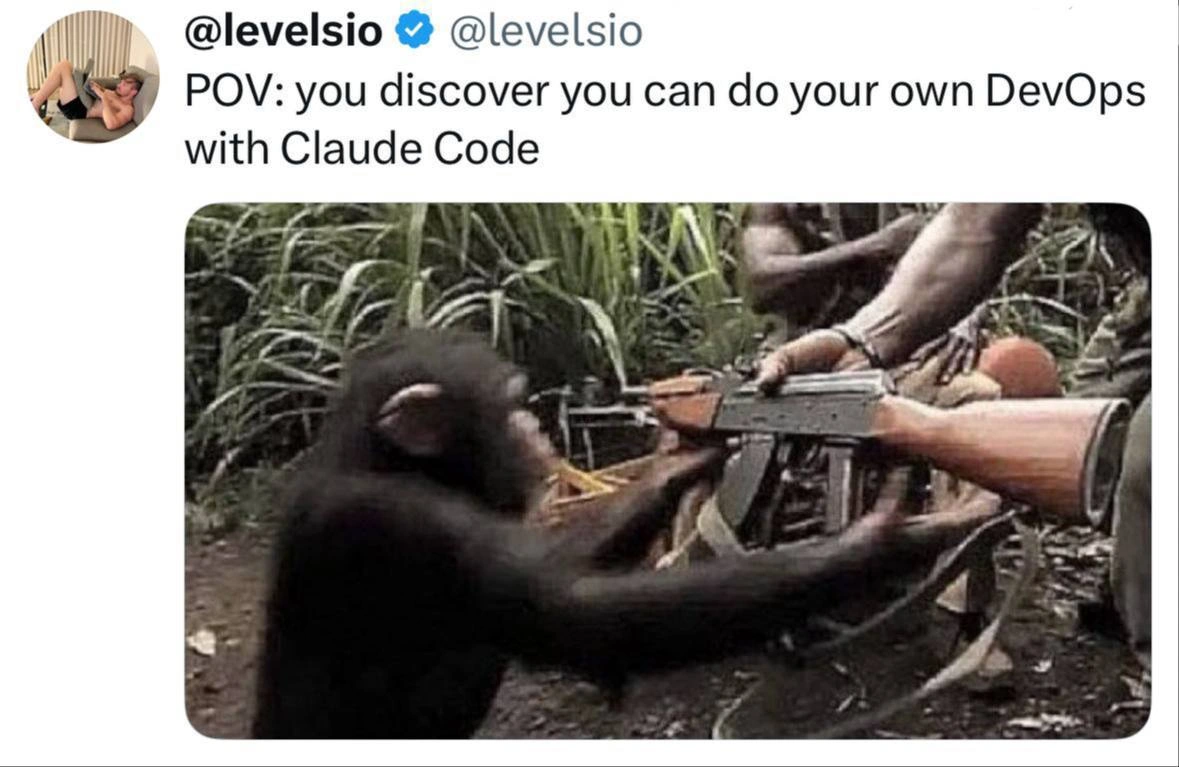
The tweet sets the stage: “POV: you discover you can do your own DevOps with Claude Code.” POV means “point of view,” so imagine this from your perspective. You realize this AI can magically handle tasks that traditionally you might have asked an expert or a teammate to help with. For example, instead of waiting for the ops team to set up a database for you, Claude can spit out the configuration and commands to do it right now. That sounds empowering, right? It’s like discovering a cheat code in a video game that lets you skip levels. The developer in the meme suddenly feels like, “Wow, I don’t need to wait or ask for help – I can do it all by myself with AI guidance!”
Now, why the chimpanzee and the AK-47? This is a visual joke. A chimp (a pretty intelligent animal but not trained in human tools) grabbing a rifle from a soldier is obviously a recipe for chaos. We inherently know that the chimp has no idea how to safely handle a gun. The soldier represents someone who does know how to handle it or at least was keeping it safe. So when the chimp snatches it, everyone watching goes “Oh nooooo…” because we anticipate something absurd or dangerous is about to happen (and indeed, in that classic clip, the monkey ends up firing the gun wildly, sending everyone running). This image is often used as a metaphor for an untrained person getting access to a powerful tool. It’s funny in a very primal way – a combination of “this shouldn’t be happening” and relief that we’re just observers, not in the line of fire.
In tech, the “powerful tool” being snatched is sudo in a production environment. Let’s unpack sudo: it stands for “superuser do.” On systems like Linux, the superuser (also known as “root”) is like the admin or the boss of the system, who can do anything. Normally, your account has limited permissions – for example, you can’t just delete system files or change other users’ passwords. sudo is the magic word that says, “I know what I’m doing, let me do this as an admin.” It’s like a master key. Because it’s so powerful, it’s usually protected – you might need to enter a password or be in an admin group to use it, and you’re expected to use it sparingly and carefully. If Claude whispers “just use sudo,” it’s telling the developer, “Hey, you can have full powers, no restrictions, to do this task.” For someone who doesn’t fully grasp the implications, that’s like a kid hearing they can have unlimited candy – very exciting, and a little dangerous.
So the developer goes ahead and grabs the “production AK-47.” Here, “production” refers to the live servers/systems (remember, where the customers are). And the AK-47 is a metaphor for a potent, potentially destructive capability – in this case, executing powerful commands on those servers. Doing your own DevOps means the dev is now performing operational tasks: deploying code, changing server settings, maybe managing databases. Normally, those come with a lot of careful steps and knowledge because a misstep in production can knock out the service or lose data. The meme suggests our developer skipped the careful part because Claude made it look easy.
Let’s make it more relatable: Many of us have been in a situation where we follow some advice or tutorial without fully understanding it, just hoping it will fix our problem. Maybe as a junior dev you found a snippet on Stack Overflow and ran it, not totally sure what it did, and then watched in horror as something unintended happened. Here, Claude is basically Stack Overflow on steroids – it might give you a very advanced solution that works, but with edge effects you didn’t anticipate. For instance, Claude might tell you how to restart a server process with sudo to fix an error. It might solve the immediate error, but maybe it also stopped other processes or it was done at the wrong time, and now users are getting disconnected – oops!
The term overconfidence bias comes into play: because an authoritative source (the AI) provides the solution, a novice might feel sure it’s correct and safe. Their confidence shoots up, but it’s an illusion – they don’t have the experience to foresee the side effects. The meme perfectly captures that dynamic: the monkey (the novice) is confident holding the rifle (the sudo command), but everyone else (the experienced folks) are picturing the disaster that might ensue.
In essence, this meme is a funny reminder about guardrails and respecting expertise. Yes, you can do a lot on your own now with AI tools like Claude Code or GitHub Copilot assisting you – things that used to require asking a senior team member. But with great power comes great responsibility (and a need for caution). Skipping the learning and safeguards can lead to chaos, just like a monkey unknowingly causing commotion with a firearm. It’s relatable to developers because many of us have had that “I got it... oh no I don’t got it!” moment. It encourages a healthy respect for the tools and for the people who know how to use them properly. And hey, if you ever do find yourself as that developer with the “production AK-47,” hopefully you’ll remember this meme, chuckle nervously, and double-check before pulling the trigger (or hitting enter on that sudo command).
Level 3: MonkeyOps Gone Bananas
To an experienced engineer, the tweet “POV: you discover you can do your own DevOps with Claude Code” immediately raises an eyebrow (or triggers war flashbacks). This scenario combines DevOps humor with a dark twist that any battle-scarred SRE or sysadmin can appreciate. Here’s the scene: a developer, possibly with minimal operations experience, suddenly feels empowered by an AI assistant (Anthropic’s Claude in "Code" mode) to handle infrastructure on their own. In other words, self-service DevOps turbocharged by an AI. The visual metaphor? That wide-eyed dev is the chimpanzee, and production infrastructure is the loaded AK-47. The soldier struggling to keep hold of the rifle represents the embattled DevOps team or the sensible protocols meant to prevent chaos. But alas, the monkey grabs the gun.
Why is this funny to those of us in the trenches? Because we’ve seen this movie before (minus the actual primate): overconfidence bias meets root privileges. A well-meaning developer learns just enough to be dangerous, now aided by an LLM that happily provides powerful commands with no understanding of the company’s context. It’s humorous in that “oh no… please don’t do that” way – like watching someone try to defuse a bomb by following a recipe they found on the internet.
# Example: Developer asks Claude how to free up disk space on a server
# Claude's recommendation (simplified):
sudo rm -rf /var/log/*
# It does free up space... along with every log file.
# Now you're blind to what happened on that server, and troubleshooting future issues is a nightmare.
We laugh (perhaps nervously) because we’ve felt that chill when a teammate says they fixed a production issue by running some unknown script. Everyone who’s been on call knows that mix of relief and dread: relief that the issue seems resolved, dread about what collateral damage might be unfolding. This is the heart of DevOps culture war stories. In our meme’s scenario, the developer’s excitement at Claude’s sudo suggestion masks a lack of understanding. It’s the classic case of a novice with a new automation toy: “It worked in one shot, so it must be fine!” Yet as veterans, we know that a command can succeed and still be the wrong thing to do. The AI might suggest something entirely valid in a generic sense, but shockingly inappropriate for your specific production. Yet a less experienced dev might think, “It deployed without errors, success!” (all while the logs are quietly filling with errors and user traffic starts dropping). At least if it all blows up, they can try blaming the AI – not that Claude will attend the post-mortem to explain itself.
The gulf between best practices and reality is where this joke lives. Best practice says: infrastructure changes should be tested in staging, rolled out carefully, and double-checked by humans. Reality per this meme: an LLM told me to do it all at once, in prod, with root privileges – YOLO! The phrase "Works on my machine" doesn’t even begin to cover it – we’ve escalated to Works on my machine, let’s YOLO it in prod.
One could say this scenario is DevOps chaos mode personified. It highlights why we put guardrails in place: things like permission controls, change review processes, and not giving out “live ammo” to untrained personnel. The tweet also slyly nods to how the hype around AI assistants in infrastructure can tempt management or developers to skip the usual safeguards. Why wait for an ops specialist when a chatbot can spit out Terraform configs or Bash scripts in seconds, right? What could possibly go wrong? Plenty, as it turns out. We’ve essentially removed the safety net. The result is a perfect storm of speed and ignorance. Picture the poor on-call engineer waking up to alerts, muttering “Who gave the intern root access?!” when they discover the trail of an AI-generated command gone awry. The meme wouldn’t be as funny if it didn’t ring so true. It’s a cautionary tale wrapped in a joke: just because you can do your own DevOps with an AI doesn’t mean you won’t shoot yourself (and your uptime) in the foot. As we often mutter after surviving such close calls: “Let’s not do that again.”
Level 4: No Root for Error
In this meme, we confront the unsettling intersection of AI-driven automation and unbounded system privileges. The image of a chimpanzee seizing an AK-47 from a soldier encapsulates a scenario that tickles seasoned engineers’ darkest fears: an unpredictable agent gaining root access in production. From a deep technical standpoint, this evokes parallels with the alignment problem in AI safety and the classic “monkey with an AK-47” metaphor for uncontrolled power. When an AI like Claude (a large language model competitor to ChatGPT) "whispers sudo," it's akin to a black-box algorithm being handed the keys to the kingdom on your servers. There's a fundamental lack of formal verification here – large language models generate commands probabilistically based on training data, without a guaranteed understanding of context or consequences. This is reminiscent of the Halting Problem, where determining a program’s effects in all cases is computationally impossible. In complex distributed systems (the dense jungle of our meme), even a small misconfiguration or command can cascade into catastrophic failure. Infrastructure as code was supposed to bring reproducibility and safety, but when that code is written by an LLM on the fly, we reintroduce a form of entropy. We can't easily sandbox or constrain an AI's suggestions within safe limits; any prompt slip and the AI might propose sudo rm -rf / as a "solution" to free up space. In formal terms, every production environment is a state machine brimming with hidden edge cases, and an AI’s unvetted intervention is a non-deterministic input. The humor here is tinged with deep technical truth: without rigorous guardrails, letting an AI-assistant manage live systems is like performing chaos engineering on yourself – it explores how the system fails, except inadvertently and perhaps spectacularly. The DevOps and SRE community half-jokes about "automated root access" and DevOps chaos mode because we know any non-trivial environment has too many variables for a naive agent to handle safely. In summary, this meme hints at a theoretical inevitability: if you give an AI sudo power without context or oversight, you’re essentially putting a probabilistic model in charge of deterministic, critical operations. It’s both an exciting and terrifying frontier, one that begs the question: can we ever fully trust an AI with production, or are we just asking for an inventive new way to test our disaster recovery plans?
Description
A tweet from @levelsio (Pieter Levels, famous indie maker) with the text 'POV: you discover you can do your own DevOps with Claude Code'. Below is an image of a young chimpanzee holding/operating an AK-47 assault rifle, with human hands guiding it. The meme implies that using Claude Code for DevOps tasks is like giving a powerful weapon to someone who doesn't fully understand it -- dangerous but exciting. It captures the current trend of non-DevOps developers using AI coding assistants to handle infrastructure tasks they'd normally leave to specialists
Comments
12Comment deleted
The chimpanzee-to-SRE pipeline: 'Claude, deploy to production.' Claude: 'Done. I also deleted the staging database, rotated all secrets, and opened port 22 to the internet. Would you like me to sketch a diagram?'
Letting a dev use an AI for DevOps is like letting it write its own `terraform apply -auto-approve` command. The infrastructure might get built, but there's a non-zero chance it achieves sentience and deletes your VPC for insubordination
Remember: just because an LLM can spit out a flawless ‘kubectl apply’ doesn’t mean you’ve instantly become an SRE - monkeys can pull triggers too, they just skip the post-mortem
Nothing says 'mature CI/CD pipeline' quite like a developer who just discovered they can kubectl apply -f * with the confidence of someone who's never had to explain a 3am outage to the board. At least when we used to break production manually, we had the decency to feel bad about it
Ah yes, the classic 'I can do DevOps now' moment - where discovering an AI can write Terraform and kubectl commands transforms you from 'works on my machine' to 'production is on fire' in record time. It's like going from never touching Kubernetes to being on-call for a multi-region cluster because Claude confidently assured you that 'this YAML looks good.' The gorilla perfectly captures that feeling when you realize you've just given yourself root access to production at 2 AM with no SRE team to call
Giving an LLM cluster‑admin is IaC for outages - the blast radius becomes a flag
Claude Code: idempotent IaC so reliable, even Darwin's finest deploys prod without drift or PagerDuty Darwinism
Letting an LLM write IAM and Terraform feels like `terraform apply -auto-approve` on prod - the commit is short, the blast radius is long
POV you need to improve this DevOps: Comment deleted
>you discover you can do your own %name% average prompt engineer ig Comment deleted
you discover you can do your own wife with ai Comment deleted
Didn't you say "wifi"? Comment deleted