Skip to content
DevMeme
3604 of 7435
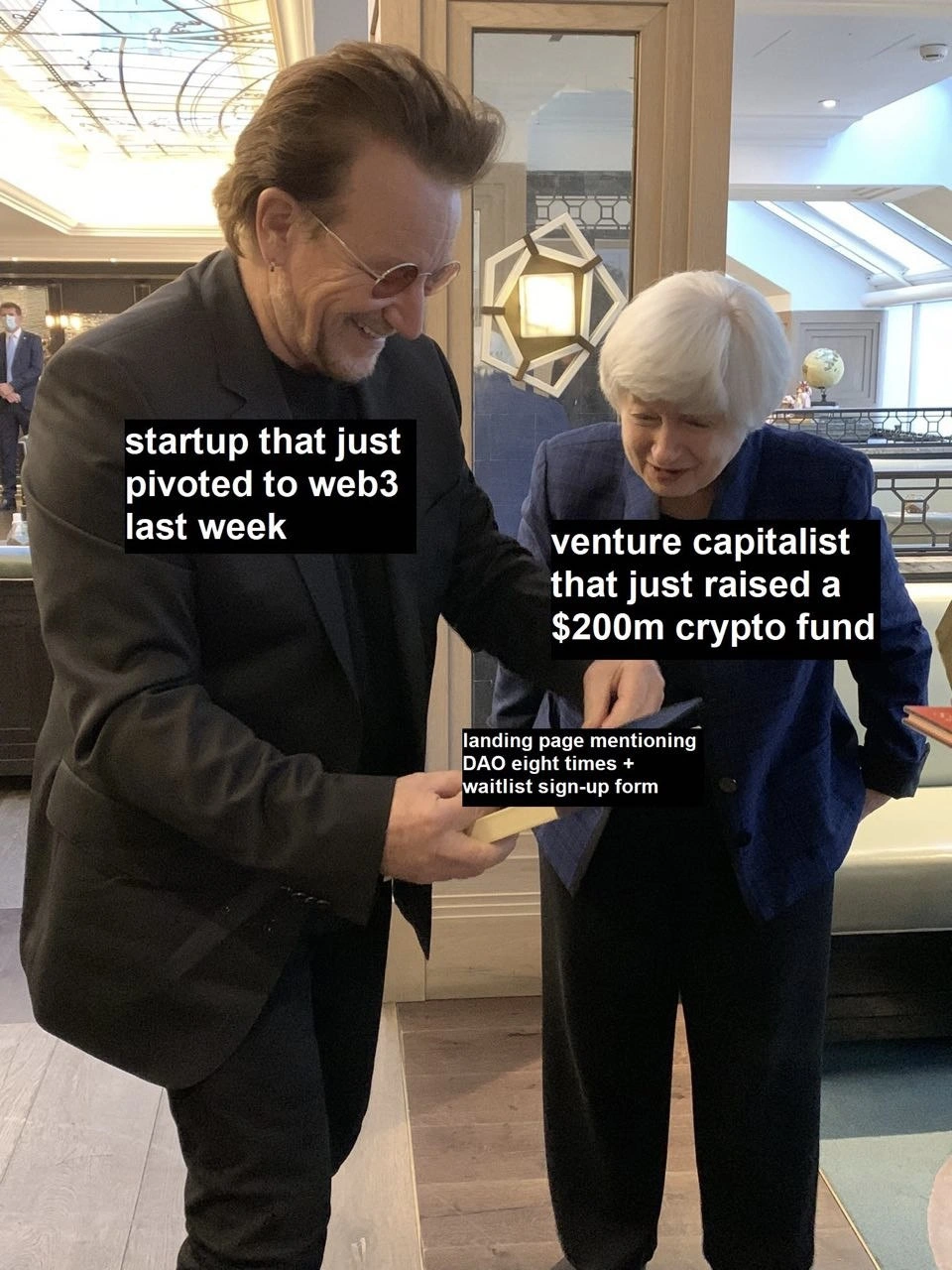
The Web3 Startup Pitch: All Buzzwords, No Product
IndustryTrends Hype Post #3941, on Nov 17, 2021 in TG

The Web3 Startup Pitch: All Buzzwords, No Product

Why is this IndustryTrends Hype meme funny?

Level 1: Magic Words Pay Off

Imagine you learned that grown-ups get really excited when they hear certain special words. Let’s say all the adults right now are crazy about the word “dragon.” If a kid says they have a project about dragons, the adults give them lots of attention and maybe even goodies. Now picture a child who was originally drawing a simple castle for a school project. At the last minute, they hear that everyone is into dragons. So they quickly start telling everyone their project is about a magical dragon castle, and they scribble the word “DRAGON” all over their poster. They don’t actually have a dragon, and the castle drawing hasn’t changed much, but they keep saying that magic word. Then a rich uncle (who just set aside a bunch of prize money for dragon-related projects) walks by. He sees “dragon” written everywhere on the poster and gets super excited. The kid is grinning, pointing at the poster saying “See, it’s a dragon castle, it’s all about dragons!” and the rich uncle happily says, “Wow, a dragon project! Here’s your prize money!”

In this silly story, the kid’s “magic word” was dragon. In the meme’s world, the startup’s magic word is DAO (and Web3, which are just fancy new tech ideas that some investors love). The startup is like that kid, quickly changing their story to include these magic words because they know the investor (the rich uncle) really wants to hear them. And just like the uncle was ready to hand out prize money for anything with dragons, the investor is ready to give money for anything with those trendy tech words. It shows how sometimes people can get so caught up in a new trend that just saying the right buzzword is enough to impress them, even if nothing real is behind it. That’s why this is funny: it’s like using “open sesame” to unlock a treasure chest – only here the treasure is venture capital funding, and the magic words are these tech buzzwords.

Level 2: Decoding the Buzzwords

Let’s break down what’s happening in simpler terms, especially for those newer to these concepts. The meme’s text is filled with buzzwords, so here’s what they all mean and why they’re relevant:

  • Web3: You might have heard of Web 1.0 (the early internet with static websites) and Web 2.0 (the modern internet with interactive platforms and user-generated content). Web3 is a term for a potential next phase of the internet that is decentralized and built on blockchain technology. Instead of big companies running websites and controlling user data (as in Web 2.0), Web3 envisions internet services powered by networks of computers that no single entity owns. In Web3, things often involve cryptocurrency or tokens, so that users can have ownership stakes or voting power. It’s a broad, hype-y concept – basically saying “the future internet will be powered by crypto.” In 2021, Web3 was the hot trend; everyone was talking about using blockchain for everything from finance to art to communities.

  • Pivot: In startup lingo, a pivot means changing your business strategy or product in a significant way. Startups pivot when they realize their current approach isn’t working or when they spot a new opportunity. For example, a company might start as a photo-sharing app and later pivot to a messaging platform if they find people use it more for messaging. Here, “pivoted to Web3 last week” implies this startup completely changed direction to focus on Web3 only a week ago. That’s a really short time – basically, they heard about the Web3 hype and immediately said, “Okay, drop everything, we’re a blockchain company now!” It often takes much longer to truly shift a company’s product and tech stack, so saying they pivoted last week highlights that this change is extremely sudden and likely superficial. It’s like a bakery deciding today to become a pizza shop by tomorrow – you can change the sign that fast, but can you really learn to make good pizza overnight?

  • DAO: This stands for Decentralized Autonomous Organization. It’s a big phrase, but the idea is pretty cool: a group or organization that’s run by rules encoded as computer programs (smart contracts) on a blockchain, rather than by managers or a central leader. Decentralized means no single person or company controls it – control is spread out among the community or members. Autonomous means it can operate on its own according to those pre-set rules (for example, automatically executing decisions if certain votes pass). Organization just means it’s a group of people working together (like a club, company, or co-op). In a DAO, members often hold tokens (like shares) that let them vote on proposals. For instance, imagine an online investment club that pools money to fund projects, and all decisions on where to invest are made by members voting digitally with tokens – that could be set up as a DAO. It’s a concept that became popular with the rise of cryptocurrencies and smart contract platforms (like Ethereum) because it promises more democratic, transparent organization management. In practice, DAOs are hard to set up and manage (just coordinating people and making sure the code has no bugs is tough). But during the Web3 hype, everyone was slapping the DAO label on ideas to seem forward-thinking. In the meme, the startup’s landing page mentions DAO eight times! That’s clearly poking fun at how some startups overuse the term. If you see someone repeating a buzzword that many times, it can be a red flag that they’re just using it as fluff.

  • Landing page: This is usually the one-page website that gives an overview of a product or service. It’s often the first thing people see about a startup – kind of like a digital flyer or pitch. A typical startup landing page will have a big headline, some marketing slogans, maybe a couple of screenshots or illustrations, and a call to action (like “Sign up for our waitlist” or “Contact us for more info”). It’s meant to generate interest or collect emails, not necessarily to explain everything in detail. In the meme, the landing page specifically mentions DAO repeatedly and has a waitlist sign-up form, which is a field where you put your email to “get early access” or “join the beta when it’s ready.” Having a waitlist usually means the product isn’t available yet – they’re gauging interest or building a list of potential users to show they have traction. It’s common for brand-new startups to do this: they pitch an exciting vision on a landing page and see how many people sign up. But here it’s implied the landing page is all they have to show. In other words, they might not have a real product built, just a concept and a mailing list form.

  • Venture Capitalist (VC): This is an investor who provides money (capital) to startups, especially high-risk, high-reward ones. They usually manage large funds of money collected from institutions or wealthy individuals (these providers of capital are called Limited Partners or LPs). A crypto fund in this context means the VC fund is dedicated to investing in crypto-related ventures (like blockchain startups, cryptocurrency projects, etc.). When it says the VC “just raised a $200m crypto fund,” it means this investor recently secured $200 million to invest specifically in cryptocurrency or Web3 companies. Venture capitalists often have specific focuses or theses – in 2021, a lot of VCs were launching crypto-focused funds because of the huge buzz and the success of early crypto companies. Now, if a VC has that much money earmarked for crypto, they need to find promising crypto startups to invest in. Otherwise, the money just sits there, and they might miss the wave. This can make VCs pretty eager or even desperate to find startups that fit the mold. It also might make them a bit more forgiving about the details; they might invest in a “rough around the edges” company if it ticks the right boxes of being in the crypto/Web3 space.

  • Startup that just pivoted: To put it plainly, this startup likely was doing something else and wasn’t originally a crypto or Web3 company. Maybe they were a fintech app doing normal banking stuff, or a social network app, or really anything. But seeing how much enthusiasm (and money) there is in the Web3 space, they decided to change their focus to ride that wave. Startups pivot all the time – for example, YouTube started as a video dating site before pivoting to general videos, and Twitter began as a podcast platform before pivoting to microblogging. But those pivots were based on observing user behavior or finding a better use case. A pivot purely to follow investor hype (like “Web3 is hot, let’s pivot to Web3 so we can get funded!”) is a bit cynical. It suggests the motivation is funding, not necessarily a genuine belief in the technology or a well-thought-out plan. The meme highlights that by the phrasing “last week” – implying it was super sudden and reactive.

So, putting it all together in a narrative: There’s a startup that until recently was doing something non-crypto, and then last week they decided, “We’re a Web3 startup now!” They hastily put together a new landing page filled with Web3 buzzwords like DAO (mentioned over and over to really drive the point home that they’re all about decentralization). They add a waitlist sign-up form to show they’re collecting users (even if nothing is built yet). Now they’re meeting a venture capitalist who has tons of money ready to invest in crypto projects. The VC just raised a big fund for that purpose, so they are excited to find teams doing Web3 stuff. The startup founder is literally showing the VC their phone or tablet with this landing page, essentially pitching their new Web3 idea. Both look happy: the founder because they have an interested investor, and the investor because they found a startup that fits their investment theme. The humor (and sarcasm) here comes from knowing that the startup really only decided to do Web3 a week ago and doesn’t have much more than a webpage of slogans. It’s making fun of how, during hype cycles, that can actually be enough to get funding.

In late 2021, this scenario resonated because many people saw startups rebranding themselves as “Web3” or launching token-based projects out of the blue. Likewise, many new crypto-focused VC funds were aggressively hunting for deals. The meme is basically a caricature of that climate: a hype-chasing startup meets an eager crypto VC, and thanks to the magic of buzzwords (like DAO, Web3, blockchain), they both think they’re onto the next big thing — even though at that moment there’s not much of a real product. For a junior developer or someone new to tech, the key takeaway is: sometimes in tech, just using the latest trendy words can momentarily open doors that substance might not. It’s a pointed joke about the difference between real technology and hype.

Level 3: Minimum Viable Hype

From a senior developer’s perspective, this meme nails the pattern of hype-driven pivots in startup culture. We’ve all seen it: a company with a floundering product suddenly rebrands itself around whatever technology is in vogue. In this case, our intrepid startup did a pivot to Web3 literally last week. One week! That timeframe is absurd if you consider the engineering effort normally required to integrate blockchain or build a real DAO platform. But in a hype frenzy, you don’t actually build the thing – you just loudly claim to. The meme text on the left character (“startup that just pivoted to web3 last week”) is practically dripping with yeah, you totally became a blockchain expert overnight, sure. It mocks the superficiality: the startup likely was doing something entirely unrelated (say, a regular Web2 app or a mediocre SaaS product), and after seeing crypto headlines or investor tweets, they scrambled to reposition their story. Maybe they swapped out their database logo for a blockchain icon on their slide deck, and voilà, they’re a Web3 company now. It’s buzzword-driven development at its finest (or worst).

On the right, we have the venture capitalist who “just raised a $200m crypto fund.” This implies the investor is under pressure to pour money into anything that smells like cryptocurrency or blockchain. Venture funds dedicated to a theme (especially one as hyped as Web3 in 2021) create a kind of FOMO-fueled frenzy. The partners have to justify that $200 million by finding the next big Web3 thing, and fast. So the normal scrutiny might be lowered – it’s the Tech Hype Cycle at work. During the BlockchainHype of that era, war stories abounded of VCs throwing cash at half-baked ideas: a slick landing page and a fancy whitepaper could snag multi-million dollar seed rounds. Here, the meme exaggerates it to great effect: the startup’s demo isn’t a working app or a prototype; it’s literally a landing page mentioning DAO eight times + waitlist sign-up form. That’s it – the “product” is effectively just marketing copy and an email capture form! The image shows the founder gleefully showing this minimalist deliverable on a phone, while the VC smiles, seemingly impressed. It’s a comical scenario, but not far from reality at the height of Web3 mania.

Why is this so funny (and painful) to seasoned devs? Because it rings true. We remember past bubbles where startups would invoke the hot buzzword du jour to unlock funding:

  • Dot-com Bubble (late ’90s): Add “.com” to your company name or claim you’ll do e-commerce, and investors throw money at you. (There’s a famous anecdote of a company adding “.com” and its stock price skyrocketing overnight.)
  • Web 2.0 / Social Media Boom: In the late 2000s, everyone needed a social angle. If you pitched “the Facebook of X” or “a social network for Y,” you got attention, even if all you had was a rough app and some user sign-ups.
  • AI/Big Data Hype (mid-2010s): Companies sprinkled machine learning or Big Data into their pitches. Suddenly your boring analytics tool became an “AI-powered platform leveraging big data” – cue the VC checkbooks.
  • Blockchain/ICO Craze (2017): This was a direct precursor to the Web3 boom. Back then, startups were pivoting to “blockchain” similarly. We saw juice companies and iced tea companies literally add “Blockchain” to their name to spike stock prices. Startups would publish a token whitepaper instead of a business plan and raise millions in an Initial Coin Offering without a single working product.

By 2021, the label had evolved to Web3, and specifically DAOs were a trendy concept within that. Everyone was talking about decentralizing everything: governance via tokens, communities running themselves, cutting out centralized intermediaries – basically the future of the internet packaged in a utopian ideal. In practice, many projects were nowhere close to that vision, but they marketed as if they were. The meme captures a typical satire: a startup founder knows the VC has a mandate to invest in Web3, so they stuff their pitch with DAO buzzwords like an over-optimized SEO page: “decentralize”, “community-owned DAO”, “DAO-driven insights”, “DAO-powered platform”, etc., repeated ad nauseam. We see “DAO” eight times on the landing page – that’s an absurd amount of repetition, clearly a joke about how these pitches start sounding like buzzword bingo. It’s reminiscent of spam or sketchy sites that repeat keywords to rank higher in Google, except here it’s for impressing investors, not search engines.

The landing page + waitlist sign-up is the cherry on top. In legit startup practice, a landing page with a waitlist can be a way to gauge user interest before building something – a lean startup approach to test demand. But here it’s implied the startup has little beyond that page. maybe a flashy logo that says “SomethingDAO”, a tagline “Revolutionizing X with Decentralized Y”, and a prompt: “Join our waitlist to be part of the future!” It’s essentially vaporware – promises and no product. The VC’s gleeful reaction in the meme suggests even that is enough during a bubble. Seasoned engineers recognize this scenario and likely cringe-smile because they know how it goes: If the funding comes through, the dev team will then be under the gun to somehow “add blockchain” to a previously normal product, all because the company promised it in a pitch. Cue the technical scramble and possibly some technical debt or downright smoke and mirrors implementations. It’s the cart before the horse – selling the sizzle before you’ve cooked the steak.

We also get a whiff of the StartupCulture absurdity: the relentless optimism and fake-it-till-you-make-it approach. In moderation, pivoting and trying new things is normal. But cynics (and experienced devs who’ve endured hype waves) will note how comical it is when a pivot is clearly opportunistic. A startup that was doing, say, a sports app last week and is now a DecentralizedSportsDAO on Blockchain™ this week probably hasn’t magically solved decentralization of sports management in a few days – they’ve just rebranded. And the VC with a fresh $200M crypto fund might be just technical enough to get excited by words like DeFi, DAO, NFT without digging deeper. They fear missing out on the next Coinbase or the next Ethereum, so they’d rather place a lot of bets. That dynamic – investor FOMO and startup buzzword theater – is exactly what the meme is poking fun at.

To illustrate the parody, imagine what that landing page might look like in code:

<!-- Hypothetical landing page snippet for the pivoted startup -->
<h1>Welcome to SportsDAO – The Web3 Revolution in Sports</h1>
<p>We are building a <strong>decentralized autonomous organization (DAO)</strong> 
   to disrupt the sports industry. Our DAO platform empowers fans through 
   <strong>DAO</strong>-driven decisions, leveraging the power of <strong>Web3</strong> and community governance.</p>
<p><strong>DAO</strong> membership grants you exclusive benefits in our ecosystem. 
   Together, through our <strong>DAO</strong>, we will redefine sports management 
   using blockchain and <strong>DAO</strong> principles.</p>
<!-- Yes, we really said DAO this many times -->
<a href="/waitlist" class="button">Join the DAO Waitlist</a>

Notice the overuse of DAO – it’s in nearly every sentence here. This is a tongue-in-cheek exaggeration, yet not far off from some real pitch sites that were live during the Web3 craze. The HTML comment even lampshades it: “we really said DAO this many times”. The waitlist button is there because, of course, the product isn’t live; they’re just collecting sign-ups (proof of market interest, or more cynically, a way to show investors “look, X thousand people signed up!” without having a real product yet). The senior folks reading this likely chuckle, having been through cycles of tech hypecycle mania where form often outshines substance temporarily. We know that eventually reality catches up – investors will later demand real traction, users will want an actual working platform, and many hype-pivoted startups will crumble under the weight of trying to bolt on complex tech they don’t truly understand. But in that euphoric moment in the lobby (like in the photo), it’s all smiles: the founder’s got the right buzzwords, the investor’s got a mandate to invest in Web3Concepts, and everyone’s acting like they’re on the cusp of the next big thing. The meme wryly captures that fleeting, almost absurd moment of mutual delusion — and it’s hilarious to those in the know because we’ve all either witnessed it or been unwitting players in similar scenes.

Level 4: Proof-of-Buzzword Consensus

At the deepest technical level, this meme hints at the dissonance between blockchain’s complex underpinnings and the superficial way it’s marketed during hype cycles. A DAO (Decentralized Autonomous Organization) isn’t just a trendy acronym; it’s built atop serious distributed systems concepts. In theory, a DAO operates via smart contracts on a blockchain like Ethereum, using cryptographic consensus algorithms (think Proof-of-Work or Proof-of-Stake) to ensure everyone agrees on the organization’s state and rules without a central authority. This requires solving classic distributed computing challenges – much like the Byzantine Generals Problem, where participants must agree on a strategy even with some traitors in their midst. Real DAOs leverage cryptographic primitives (digital signatures, hash chains) and consensus protocols to enforce trustless cooperation. They rely on decentralized governance models: decisions encoded in smart contracts, votes tallied via tokens, and outcomes executed automatically. It’s a cocktail of game theory, cryptography, and network engineering.

However, implementing these systems is non-trivial. Writing secure smart contracts demands rigorous thinking (one logic bug can lock up or steal millions, as happened in The DAO hack of 2016). Ensuring eventual consistency and fairness in a decentralized network often means accepting trade-offs – e.g., blockchains sacrifice speed and efficiency to achieve trust in a trustless environment. The humor here is that none of this profound complexity is evident on a mere landing page crammed with buzzwords. The startup’s site repeats “DAO” eight times as if it’s casting a magic spell, but behind the scenes there’s likely no actual distributed consensus algorithm, no audited smart contract governing an organization, perhaps not even a single line of Solidity code. The meme underscores how absurd it is to invoke Web3 concepts (decentralization, crypto-economics, autonomous governance) without any of the heavy engineering that makes those concepts real. It’s like claiming you’ve built a new self-driving car by just saying “AI” a bunch—real AI involves linear algebra, sensor fusion, and model training, just as real Web3 applications involve intricate peer-to-peer network protocols and cryptographic verification.

In essence, the “proof-of-buzzword” here replaces proof-of-work: the startup is doing the bare minimum computational effort (throwing jargon on a page) to convince the network of investors that it’s part of the legitimate blockchain world. It satirically calls to mind an imaginary consensus mechanism where repeating DAO enough times convinces all the venture nodes to reach agreement (“Yes, this is worth funding!”). Of course, actual consensus in blockchain is about math and protocols, not marketing. By starting our analysis with this deep technical lens, we see the comedic tension: the Web3 and DAO ideas being pitched are backed by extremely sophisticated technology in reality, yet the pitch here is all form and no substance. The startup counts on the venture capitalist’s excitement over the concept of decentralization, while sidestepping the actual engineering complexity needed to truly pivot a product into a decentralized FinTech platform in just a week. It’s an inside joke for those who understand that building real cryptocurrency or decentralized finance (DeFi) systems cannot be done justice by a hastily made landing page – unless you believe in tech fairy dust.

Description

This is a meme using a photograph of U2 singer Bono showing something on a small piece of paper to U.S. Treasury Secretary Janet Yellen. Text labels have been added to create a satirical scenario about the tech industry. Bono is labeled 'startup that just pivoted to web3 last week'. Yellen is labeled 'venture capitalist that just raised a $200m crypto fund'. The small paper they are looking at is labeled 'landing page mentioning DAO eight times + waitlist sign-up form'. The meme humorously critiques the venture capital funding frenzy around Web3 and cryptocurrency during its hype cycle. It suggests that even a startup with minimal substance - just a hastily made landing page stuffed with buzzwords like 'DAO' - could attract significant interest from venture capitalists who had raised massive funds specifically for that sector and were eager to deploy capital, regardless of the venture's actual viability or technical depth
Comments

9
Anonymous ★ Top Pick The fastest way to get a Series A in 2021 was to have a landing page, a whitepaper that mentioned 'decentralization' a dozen times, and a five-minute meeting with a VC who had more money than due diligence time
  1. Anonymous ★ Top Pick

    The fastest way to get a Series A in 2021 was to have a landing page, a whitepaper that mentioned 'decentralization' a dozen times, and a five-minute meeting with a VC who had more money than due diligence time

  2. Anonymous

    Web3 pivot recipe: ship a Vercel-hosted landing page that repeats “DAO” eight times, call the whole thing “decentralized,” then let a $200 M fund centralize your cap table

  3. Anonymous

    The real smart contract here is getting funded before anyone realizes your 'revolutionary DeFi protocol' is just a CRUD app with MetaMask login and a Discord server you're calling a DAO

  4. Anonymous

    The real innovation here isn't the DAO - it's discovering that 'Ctrl+F "blockchain"' on your existing pitch deck counts as a pivot strategy. Eight DAO mentions is the new minimum viable product; nine gets you a term sheet, ten gets you a TechCrunch feature. The landing page's waitlist form is doing more distributed consensus than their actual smart contracts ever will, assuming those exist beyond a Figma mockup and a Solidity tutorial bookmark

  5. Anonymous

    Pivoted to web3 last week; CI/CD replaced by PR/IR - “DAO” repeated until the landing page hits Byzantine quorum, and the $200m VC fund supplies consensus. Proof-of-fund > proof-of-work

  6. Anonymous

    $200M for a DAO landing page: because nothing says 'decentralized governance' like unvalidated email signups on Vercel

  7. Anonymous

    Nothing like a Series FOMO where the only thing on-chain is the cap table, but the fund still wires because 2% management fee waits for no smart contract

  8. @illia_sahaidak 4y

    worked for a couple of those, it is just way too accurate

  9. @Magilarp 4y

    both are disgusting parasites

Use J and K for navigation