Skip to content
DevMeme
4731 of 7435
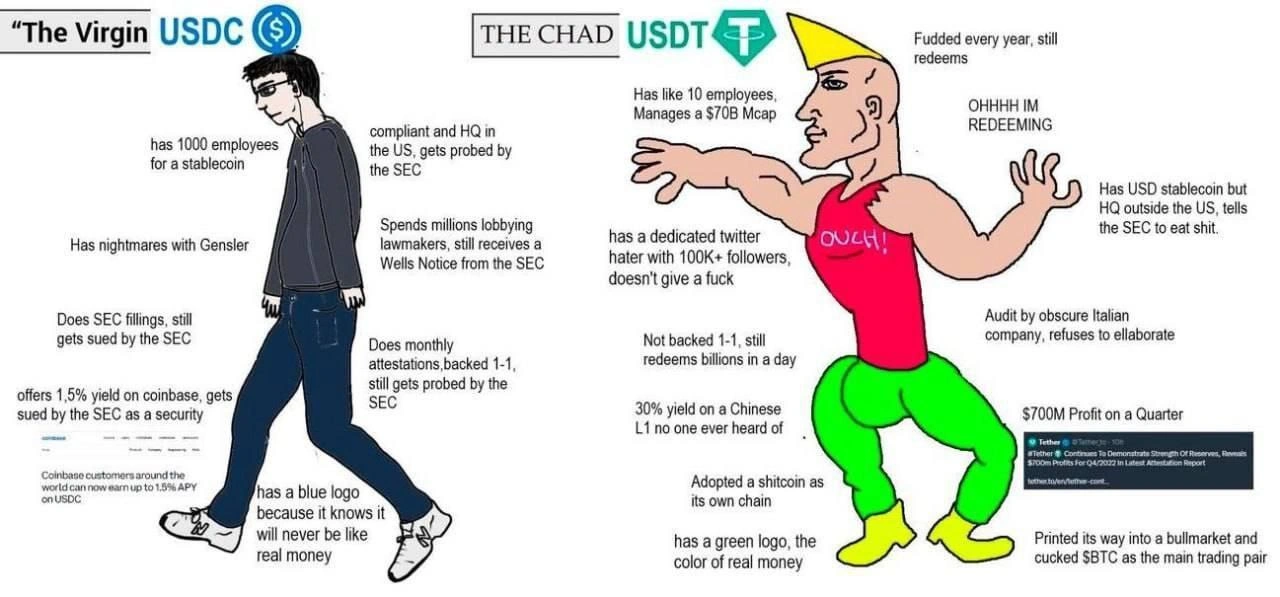
Virgin vs Chad stablecoin meme: USDC compliance angst versus USDT regulatory defiance
Blockchain Post #5185, on May 9, 2023 in TG

Virgin vs Chad stablecoin meme: USDC compliance angst versus USDT regulatory defiance

Why is this Blockchain meme funny?

Level 1: Nice Guys Finish Last

Imagine two kids running lemonade stands. Kid A is super careful: he uses the best ingredients, gets permission from his parents and the neighbors, and even reads about local rules to make sure he’s allowed to sell lemonade. He sets up his stand properly, charges a fair $1 a cup, and keeps his area clean. But then a grumpy neighborhood rule-keeper comes by and says, “Hey, do you have a permit for this? You might be breaking the rules!” Poor Kid A did everything right, yet he still gets in trouble and has to shut down early, feeling frustrated and worried he did something wrong.

Across the street, Kid B has a different story. He just plops down a table wherever he wants and shouts, “Lemonade, $1 here!” He didn’t ask anyone’s permission. In fact, maybe he’s selling it right by a “No Vending” sign. He uses whatever lemons he found (who knows if they’re the best) and doesn’t really care about rules or permits. Neighbors gossip, “That kid’s not following the rules… is his lemonade even legit?” But guess what – people still buy from him all day. Kid B makes a ton of money, packs up whenever he feels like it, and never gets caught or punished. He might even brag about how well he did, completely unfazed by those rumors about his lemonade.

This is funny because it feels upside-down: the kid who followed all the rules ended up with nothing but stress, while the kid who broke the rules cruised to success. In the real world of crypto money, USDC is like the careful Kid A (playing nice but getting hassled) and USDT is like the daring Kid B (breaking rules and still coming out on top). It’s a tongue-in-cheek way to show that sometimes, “nice guys finish last.” The humor comes from how unfair and absurd it is – yet everyone kind of nods and laughs because, well, that’s how it often feels in this crazy tech world.

Level 2: Stablecoin Showdown

Let’s break down what’s going on for those newer to the crypto scene. This meme uses the popular “Virgin vs Chad” format – an internet meme trope that contrasts a timid, beleaguered character (the “Virgin”) with an exaggerated confident winner (the “Chad”). Here, the two characters represent the two biggest stablecoins (cryptocurrencies pegged to real-world money like USD): USDC (USD Coin) and USDT (Tether). Both are supposed to always be worth $1.00, but they take very different approaches in how they’re managed and regulated.

  • USDC (The “Virgin” side): USDC is run by a U.S. company (Circle, in partnership with Coinbase) with over a thousand employees. It’s the straight-laced stablecoin that plays by the rules. Being based in the U.S. means USDC’s folks have to deal directly with U.S. regulators like the SEC (Securities and Exchange Commission). They try to be fully compliant:

    • USDC holds $1 in actual cash or U.S. Treasury assets for every 1 USDC issued (this is what “backed 1-1” means). They even publish monthly attestation reports from reputable accounting firms to prove those reserves exist.
    • Circle has spent millions on lobbying lawmakers to get clear guidelines for crypto. They even filed paperwork with the SEC (since Circle intended to become a public company and is under a lot of scrutiny). In other words, USDC is like the student who does all their homework and also helps the teacher after class.
    • Despite all this good behavior, USDC keeps getting into regulatory trouble. The meme references a Wells Notice – that’s essentially a warning letter from the SEC saying “we’re likely to take enforcement action against you.” (Coinbase got one of those for a planned USDC savings product that would pay users 1.5% interest; the SEC was not amused and considered it an unregistered security offering). USDC’s parent company gets investigated and even sued by regulators, which seems unfair given how transparent they are. As the meme jokes, USDC executives probably have nightmares about SEC Chair Gary Gensler because he keeps them up at night with new questions and probes.
    • USDC even offered a very conservative interest (1.5% APY) through Coinbase for people who hold it, trying to stay competitive yet lawful. But that only drew more ire from the SEC (the SEC basically said “even a modest yield makes it look like a security”). No break for the good guy!
  • USDT (The “Chad” side): Tether’s USDT is like the rebellious cousin operating outside the U.S. It’s managed by a much smaller team (the meme says ~10 employees, which is an exaggeration but it’s true Tether has a very lean operation compared to Circle). USDT’s strategy is essentially avoiding U.S. regulators:

    • Tether is incorporated in offshore jurisdictions (like the British Virgin Islands and Hong Kong). Being outside the U.S. means the SEC and other American regulators have less direct authority. It’s as if USDT is saying, “We have a USD stablecoin but no U.S. headquarters – you can’t easily touch us, regulators.” The meme bluntly captions this as Tether telling the SEC to “eat shit” (i.e., they couldn’t care less about SEC’s approval).
    • Unlike USDC, which provides detailed breakdowns of its reserves, Tether has historically been opaque about what’s backing USDT. They claim USDT is fully backed, but for years skeptics have pointed out questionable assets. At one point Tether admitted not all reserves were cash – some were in things like loans or commercial paper. The meme highlights that Tether’s audits are done by an “obscure Italian company” and that the company “refuses to elaborate” on details. In simpler terms: USDT doesn’t undergo the kind of strict, transparent audit you’d expect; it uses smaller firms to attest that reserves exist without giving full transparency. This would be unacceptable for a U.S. company, but offshore Tether gets away with it.
    • FUD and critics: USDT has been the target of yearly FUD (Fear, Uncertainty, and Doubt). For example, a well-known Twitter user (with 100k+ followers) has made it a personal mission to accuse Tether of fraud or insolvency every year. Yet, Tether’s approach is mostly to ignore the haters (“doesn’t give a ****”, as the meme says) and carry on. Every time there’s panic and many people cash out (“redeem” USDT for real dollars), Tether has managed to honor those redemptions—sometimes processing billions of dollars in a day—and USDT maintains its $1 peg. This consistent survival in the face of doom predictions has made it look invincible to its supporters.
    • Yield and risk-taking: The meme mentions “30% yield on a Chinese L1 no one ever heard of.” In crypto boom times, there have been obscure blockchains (Layer-1 networks) or DeFi platforms, often overseas, that offer insanely high interest rates on stablecoin deposits. Tether doesn’t itself guarantee 30%, but USDT holders could park their tokens in these risky schemes. The point is USDT flourishes in the wild west of crypto, where a stablecoin can flow into experimental projects all over the world. By contrast, USDC’s attempts to offer even a tiny 1.5% return in a regulated setting got slapped down. It’s like USDT lives in the casino where anything goes, while USDC is stuck in the bank lobby filling out forms.
    • Blockchain adoption: “Adopted a shitcoin as its own chain” refers to Tether launching USDT on the Tron blockchain (among many others). Tron is a blockchain platform that some in the West consider low-quality or scammy (“shitcoin” is a derogatory term for a crypto project with little value). Yet, Tether didn’t discriminate – Tron’s network became a huge rail for USDT, especially for users in Asia, because it’s cheap and fast. USDT is now on multiple chains (Ethereum, Tron, Solana, etc.), basically wherever liquidity is needed. USDC, being more cautious, stuck initially to major reputable chains (Ethereum, Algorand, etc.). Tether’s aggressive expansion even into sketchy territories shows that growth > purity in their book.
    • Market dominance and profits: Tether’s approach has made USDT the #1 stablecoin by market cap (~$70B at the time, whereas USDC was second with maybe half that). More USDT in circulation also means more reserves held – which generates big profits. The meme cites “$700M profit in a quarter,” referencing Tether’s public report of earning $700 million in one quarter (likely from interest on all those billions in reserve assets). USDC’s company Circle also makes interest revenue, but USDT’s head start and larger size give it a bigger payday. The meme even has a tiny screenshot of a tweet for that profit, showcasing how Tether can boast about its success.
    • Trading pair king: A big ironic point in the meme: USDT “printed its way into a bull market and cucked $BTC as the main trading pair.” In plain language, this means Tether’s massive issuance (some suspect they printed lots of USDT during bull runs, fueling crypto prices) helped drive crypto market growth. And as a result, USDT became the primary currency for trading cryptocurrencies, overtaking Bitcoin’s role. Nowadays, instead of buying altcoins with BTC, traders often use USDT (because it’s stable and easier to measure gains). So in a twisted way, this centralized, unregulated token became more pivotal in daily trading than Bitcoin itself. The slang “cucked” is edgy internet lingo implying that Bitcoin was usurped or humiliated as the dominant base currency by USDT. It’s a provocative way to say stablecoins now run the show in crypto trading.

In summary, USDC is like the straight-laced, transparent stablecoin that does everything by the book and expects to be rewarded for it – but instead it’s constantly under the regulatory microscope in the U.S. USDT is the bold, opaque stablecoin that plays by its own rules, fending off doubters with surprising success and reaping huge rewards. The meme exaggerates their attributes (“1000 employees” vs “10 employees”, blue logo vs green logo) to drive home the contrast. It’s funny to crypto folks because it rings true: sometimes in this industry the “good citizen” gets hassled, while the “rogue” who skips the line ends up owning the playground. This compliance humor reflects a real frustration and trend in the blockchain world – regulations are harshest on those who try to cooperate, while the ones operating in grey areas often become the biggest players. It’s an industry irony that makes for a perfect punchline in a meme like this.

Level 3: Compliance vs Defiance

This meme hilariously captures a stablecoin industry paradox that seasoned blockchain developers and fintech veterans know all too well. On the left, USDC is the goody-two-shoes of crypto dollars: a fully-reserved stablecoin by Circle (and Coinbase) that dotingly follows every rule in the book. It’s compliant to a fault – registering in the US, filing forms with the SEC, hiring an army of lawyers and accountants, and even lobbying Congress for clearer regulations. And what does it get for all that effort? Regulatory arbitrage heartburn. The meme’s bullet points list USDC’s woes: despite 1:1 dollar backing with monthly attestation reports, despite bending over backwards to cooperate, USDC still gets grilled by regulators. The SEC sends them Wells Notices (prelude to a lawsuit), Gary Gensler (SEC Chair) is basically their boogeyman, and even a modest 1.5% interest offering on Coinbase earned a threat of “this looks like a security, see you in court.” It’s bureaucratic absurdity: the stablecoin that plays by the rules ends up with nightmares about the rule enforcers.

On the right, USDT (Tether) is depicted as the carefree rebel—a “Chad” stablecoin that seemingly laughs in the face of regulators. With headquarters far outside U.S. jurisdiction, a skeleton crew of maybe a dozen running a $70+ billion empire, Tether has mastered the art of regulatory defiance. The meme highlights outrageous facts (that aren’t far from truth): Tether’s team is tiny and elusive, it’s never done a full Big Four audit (just “attestations” by a more obscure firm in the Cayman Islands or Italy), and it has been repeatedly accused of not having every Tether token fully backed 1:1 by real dollars. Yet, when push comes to shove, USDT has weathered every storm. Crypto crashes, bank runs on stablecoins, years of Twitter FUD (Fear, Uncertainty, Doubt) from a dedicated hater with a six-figure following – none of it has wrecked Tether. The meme gleefully notes that even if Tether wasn’t fully backed at times, it still processed billions in redemptions in short order, maintaining its $1 peg when it really mattered. It’s as if Tether operates on sheer confidence and momentum: the ultimate anti-hero that regulators can’t easily touch.

The humor here comes from stark industry irony. We have two USD-pegged stablecoins aiming to be the digital dollar of crypto markets. One (USDC) takes the “please like me, regulators” approach: U.S. headquarters, transparent reserves, cooperation with law enforcement – essentially trying to merge fintech with traditional finance compliance. The other (USDT) chooses the “catch me if you can” strategy: operate offshore, offer jaw-dropping yields on shady chains (30% APY on some obscure Chinese Layer-1? Sure, why not), adopt any blockchain (even ones considered outright shitcoins by purists) if it boosts circulation, and respond to inquiries with either silence or a figurative middle finger (“tells the SEC to eat 💩,” as the meme crudely puts it). The result? The rule-follower is constantly under fire, while the rogue gets ever more entrenched as an indomitable cornerstone of the crypto economy. It’s a classic case of “no good deed goes unpunished.” The developers and traders in the trenches can’t help but smirk at this upside-down reality: in the wild world of crypto, playing nice often gets you burned, and playing wild – somehow – pays off.

Description

Two-panel “Virgin vs Chad” meme compares USD-denominated stablecoins. Left panel is titled “The Virgin USDC” above a slouched, thin man in a dark hoodie; surrounding captions read: “has 1000 employees for a stablecoin”, “compliant and HQ in the US, gets probed by the SEC”, “Has nightmares with Gensler”, “Spends millions lobbying lawmakers, still receives a Wells Notice from the SEC”, “Does SEC filings, still gets sued by the SEC”, “Does monthly attestations, backed 1-1, still gets probed by the SEC”, “offers 1.5% yield on coinbase, gets sued by the SEC as a security”, a small screenshot saying “Coinbase customers around the world can now earn up to 1.5% APY on USDC”, and “Has a blue logo because it knows it will never be like real money”. Right panel is labeled “THE CHAD USDT” above a muscular mohawk-sporting figure in a red tank top marked “OUCH!”, green pants and yellow shoes; captions read: “Has like 10 employees, Manages a $70B Mcap”, “has a dedicated twitter hater with 100K+ followers, doesn’t give a fuck”, “Not backed 1-1, still redeems billions in a day”, “30% yield on a Chinese L1 no one ever heard of”, “Adopted a shitcoin as its own chain”, “has a green logo, the color of real money”, “Fudded every year, still redeems”, “OHHH IM REDEEMING”, “Has USD stablecoin but HQ outside the US, tells the SEC to eat shit”, “Audit by obscure Italian company, refuses to elaborate”, and “$700M Profit on a Quarter” with a tiny tweet screenshot. The meme humorously highlights regulatory burden, SEC scrutiny, reserve attestations and yield strategies, contrasting Circle’s heavily regulated USDC with Tether’s offshore, opaque but dominant USDT - topics familiar to blockchain engineers and fintech professionals

Comments

6
Anonymous ★ Top Pick USDC is that 1,000-dev Java monolith obsessing over SOC 2 binders and monthly attestations, yet still catching a Wells notice; USDT is a two-file PHP script scp’ed to a mystery server in Lugano that redeems billions from a Bash prompt - and every time finance asks for “proof of reserves,” it just replies: `# TODO`
  1. Anonymous ★ Top Pick

    USDC is that 1,000-dev Java monolith obsessing over SOC 2 binders and monthly attestations, yet still catching a Wells notice; USDT is a two-file PHP script scp’ed to a mystery server in Lugano that redeems billions from a Bash prompt - and every time finance asks for “proof of reserves,” it just replies: `# TODO`

  2. Anonymous

    USDT is basically the MongoDB of stablecoins - everyone says it shouldn't work in production, the documentation is questionable, yet somehow it's handling more transactions than your perfectly architected, fully compliant solution ever will

  3. Anonymous

    USDC: 1000 employees, monthly attestations, full SEC compliance, still gets Wells Notices. USDT: 10 employees managing $70B, audit by 'some Italian firm,' tells regulators to pound sand, somehow redeems billions daily. It's the ultimate demonstration that in crypto, regulatory arbitrage and strategic opacity can be more valuable than a thousand compliance officers - proving that sometimes the real innovation isn't in the technology, it's in the jurisdictional engineering

  4. Anonymous

    Stablecoins as distributed systems: USDC does 2PC with the SEC as coordinator (enjoy your global aborts), while USDT runs leaderless gossip with “eventual reserves” - terrible invariants, phenomenal uptime

  5. Anonymous

    USDC: ACID reserves, fully audited. USDT: BASE-d on FUD survival - eventually consistent, infinitely scalable

  6. Anonymous

    USDC treats regulators like a strongly typed dependency; USDT treats them like a flaky upstream service - retry with exponential backoff until redemption SLOs pass

Use J and K for navigation