Zod Creator Ironically Promises to 'Check Out' His Own Library
Why is this DevCommunities meme funny?
Level 1: That Awkward Moment
Imagine you excitedly tell a famous writer about a really great book you just read — "You have to check out this story, it's amazing!" — only to realize they wrote that book. 😅 It’s that same kind of oops moment. The writer would probably smile and say, “Thanks, I’ll look into it,” even though they know every word by heart. In this meme, a developer unknowingly did the same thing with a coding tool and its creator. It’s funny and a bit embarrassing – like accidentally giving an expert advice about their own work. But everyone laughs, and you both find it funny in the end.
Level 2: Zod to the Rescue
To understand this meme, you need to know what TypeScript and Zod are, and what happened in that Twitter exchange. TypeScript (TS) is a programming language that adds static type checking to JavaScript. Static means it happens at compile time – basically in the build step, before the code runs. The TS compiler (tsc) will complain if you try to do something like pass a string where a number is expected. However, once your TS code is compiled to plain JavaScript and actually running, those type checks disappear. This is fine when you're calling functions within your own code (the compiler caught any mistakes you made), but what about data coming from the outside world, like user input or an API response? That’s where runtime type checking becomes important: you might need to verify while the program is running that the data is the right shape and type.
Zod is a popular library in the TypeScript ecosystem for doing exactly that: runtime schema validation. A schema is like a blueprint for data – it defines what fields should exist and what type each field should be (string, number, etc.). With Zod, you create a schema and then you can check any JavaScript object against it at runtime. If the object doesn’t match the schema, Zod will throw an error (or return an error result) to let you know the data isn't what you expected. The neat part is that Zod plays nicely with TypeScript’s static type system – it can even infer TypeScript types from your schema. In simpler terms, you define the shape of data once, and Zod makes sure real data fits that shape and lets TypeScript know about that shape for compile-time safety. Pretty cool, because it saves you from writing your data definitions twice! Here’s a quick example of Zod in action:
import { z } from "zod";
// Define a schema for a Person object:
const PersonSchema = z.object({
name: z.string(),
age: z.number(), // age must be a number
});
// Imagine we get this data from an API (runtime input):
const dataFromApi = { name: "Alice", age: "30" }; // oops, age is a string, not a number
try {
const person = PersonSchema.parse(dataFromApi);
// Zod checks dataFromApi. If types don't match the schema, it throws an error.
console.log("Valid person data:", person);
} catch (err) {
console.error("Validation failed:", err.errors);
}
// We can even create a TypeScript type from the schema for compile-time use:
type Person = z.infer<typeof PersonSchema>;
// Person is now the TypeScript type { name: string; age: number }
In the code above, if dataFromApi.age is "30" (a string) instead of a number, PersonSchema.parse() will throw an error at runtime. TypeScript alone couldn’t catch that problem, because at compile time dataFromApi might be coming in as an any (unknown data from outside). Zod acts as a safety net once the program is running, ensuring the data actually meets the expectations.
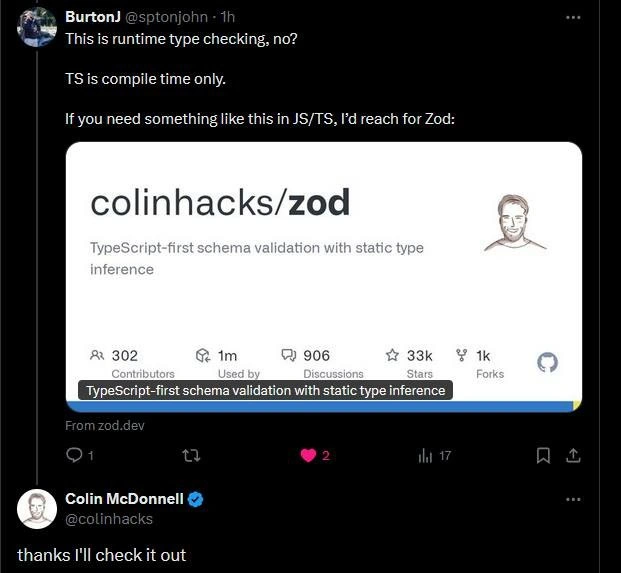
Now, here’s what happened in the Twitter thread: one developer was explaining this idea to another. He basically said, “TypeScript only checks types at compile time, so if you need to validate data at runtime in JS/TS, I’d reach for Zod.” He even shared a link to Zod’s GitHub page (which shows how popular it is, with tens of thousands of stars). This is great advice in the JavaScript/TypeScript world. The funny twist is that the person he was telling this to was Colin McDonnell (@colinhacks), the guy who wrote Zod in the first place! Colin replied back with a polite, “thanks I’ll check it out,” as if he’d never heard of it.
For a newer developer, the humor might not be obvious until you realize Colin is the library’s author. It’s like accidentally recommending someone their own creation. The first dev had no idea who Colin was – on the internet, a famous open-source maintainer can look just like any other user with a handle. So when Colin says “I’ll look into it,” he’s just having a bit of fun. He already knows it inside-out (he built it!), but he’s acknowledging the suggestion graciously. It’s a friendly, tongue-in-cheek response. The awkwardness comes from the realization: whoops, you just earnestly explained a solution to the exact person who invented that solution. But no harm done – Colin played along, and the rest of the developer community got a good chuckle out of this wholesome mix-up. The takeaway for a junior dev is a gentle lesson: sometimes the person you’re trying to help might literally have written the book (or code) on the subject!
Level 3: Preaching to the Choir
In this meme, two worlds collide: the perennial TypeScript vs. runtime type-checking debate and the hilarious anonymity of online dev communities. An earnest developer on Twitter (X) confidently recommends the library Zod for runtime type validation—completely unaware that the person they're replying to is Colin McDonnell, the very author of Zod. It's a classic case of preaching to the choir: giving a passionate sermon about type safety to the person who literally wrote the book (or in this case, the code) on it.
TypeScript offers static typing, catching type errors at compile time, but those guarantees vanish once the code runs. The TS compiler essentially erases all the types when it transpiles your code to plain JavaScript. Experienced TypeScript users know that if you want to ensure data is valid at runtime—especially when parsing JSON from an API or handling user input—you need an additional check in place. In other words, the compile-time safety is great, but it doesn't protect you from unexpected data that shows up when the program is actually running. Seasoned devs often use schema validators (like Zod) as a safeguard for those real-world scenarios. In fact, pulling in a trusted dependency like Zod for validation is a pretty standard practice when building robust TypeScript apps.
The first developer in the meme is doing exactly that: they point out “TS is compile time only” and suggest using Zod as the solution for runtime checks. It’s solid advice. Every senior dev has probably had to explain this exact compile-time vs. runtime gap to a junior colleague at some point. There's even a bit of pride in seeing someone recommend a good tool like Zod to help avoid those sneaky production bugs.
The punchline? The "fellow dev" on the receiving end of this well-meaning explanation is actually the creator of that solution. Colin (whose handle is @colinhacks) cheekily replies:
"thanks I’ll check it out"
He's playing along as if he’s never heard of the library. For veteran developers, this is both amusing and painfully relatable. It’s reminiscent of a newbie enthusiastically recommending Git to Linus Torvalds, or explaining a Python quirk to Guido van Rossum. In large dev communities, you often don’t realize when you’re talking to a legend. The flat nature of platforms like Twitter means the guru and the newcomer look pretty much the same in a thread. So here we have the library’s incognito author getting a front-row look at how his work is being promoted by users — an open-source maintainer’s secret joy (and a mild moment of second-hand embarrassment).
Beyond the social gaffe, this meme gives a nod to the endless static vs. dynamic typing discussions in programming. TypeScript fans know that while the compiler is a great safety net, it’s not a runtime guardian angel. Libraries like Zod exist precisely because even robust compile-time checking has limits in a dynamic world. The humor is amplified by the fact that the person who understands those limits best (because he built an entire library to address them) is being given a tutorial on it. Instead of pulling rank with “Uh, I am the guy who wrote Zod,” Colin responds with gracious good humor. That kind of reaction is a hallmark of dev culture: even when someone inadvertently explains your own invention to you, you just smile, nod, and maybe share the laugh with your team. After all, it’s pretty flattering to see your tool recommended with such earnest enthusiasm — even if the recommendation lands squarely in your own inbox.
Description
A screenshot of a Twitter interaction that contains a meta developer joke. The top tweet from user BurtonJ explains the need for runtime type checking in TypeScript, which is compile-time only, and recommends the library Zod for this purpose. The tweet includes a link preview to the 'colinhacks/zod' GitHub repository, described as 'TypeScript-first schema validation with static type inference'. The humor comes from the reply below it: Colin McDonnell, the creator of Zod (handle @colinhacks), replies with a deadpan 'thanks I'll check it out'. This is a deeply ironic and self-aware joke, as the creator of a widely-used library (1M+ dependent projects, 33k stars) pretends to be unfamiliar with his own work. It's a classic example of dry, in-the-know humor prevalent in developer communities on platforms like Twitter

Comments
24Comment deleted
The final stage of open-source success is when your library is so ubiquitous that you can ironically reply 'sounds neat, I'll check it out' to a recommendation for it, and people aren't sure if you're joking
Recommending Zod to @colinhacks is peak TypeScript - great type inference, zero identity inference
When you've spent so long evangelizing runtime validation that even the library's creator pretends not to know about it - the ultimate form of dogfooding is forgetting you cooked the meal
When the creator of your runtime validation library responds to your recommendation of said library with 'thanks I'll check it out' - that's the TypeScript equivalent of Linus Torvalds saying 'interesting, I should look into this Linux thing.' The real joke here isn't just the self-aware humor, but the fundamental truth it highlights: TypeScript's types evaporate at runtime like your architectural decisions after the third pivot, which is precisely why Zod exists - to validate what TypeScript promises but can't deliver when the rubber meets the production road
Peak Tech Twitter: someone explains TS is compile-time only and recommends Zod for runtime validation - to colinhacks - who gracefully returns a 200 OK with “thanks I’ll check it out.”
TS whispers sweet type promises at compile-time; Zod enforces them at runtime, lest your API payloads descend into 'any' purgatory
Explaining that TS types vanish at runtime and recommending Zod - to the account named after the repo - is peak Dev Twitter: strong type inference, weak user inference
Explain like I'm 12 in gen alpha slang Comment deleted
Haha! In the screenshot, someone suggests using Zod, which is a library created by Colin McDonnell (the author himself!). The funny part is, Colin responds saying "thanks I'll check it out," as if he’s discovering his own library for the first time. It’s kind of a humorous moment where someone unknowingly recommends the creator’s own tool back to them! In Gen Alpha terms: "Bruh, they really told the Zod dude to use Zod, and he’s like, 'Bet, I’ll peep it.' 😂" Comment deleted
Max Rizz Comment deleted
True rofl bruh Comment deleted
Chatgpt answers are the new "Google it" huh Comment deleted
Slay Comment deleted
They just told the author of the library to check out his own library Comment deleted
sauce? Comment deleted
https://x.com/colinhacks/status/1836536889589063778 Comment deleted
Be an ehrenmann chnage the domain to fxtwitter/fixupx Comment deleted
I thought these are some kind of alt frontends, but they just redirect? then why not just twitter.com? it also redirects the same way... Comment deleted
Fx twitter adds more preview content for telegram Comment deleted
Insta-view/link preview Comment deleted
https://www.ddinstagram.com/reel/C-pzaPSghyw/?igsh=YWg1ZGI1Mmdjb3Zh Comment deleted
If it was a skin I would assume its a data/cred grabber💀💀💀😭 Comment deleted
https://fxtwitter.com/videosinfolder/status/1837174985028210867 Comment deleted
https://fxtwitter.com/colinhacks/status/1836536889589063778 Comment deleted