Skip to content
DevMeme
5021 of 7435
Screen Distance Advice: 90s vs. Today's AR/VR
AR VR Post #5495, on Sep 22, 2023 in TG

Screen Distance Advice: 90s vs. Today's AR/VR

Why is this AR VR meme funny?

Level 1: TV Glasses

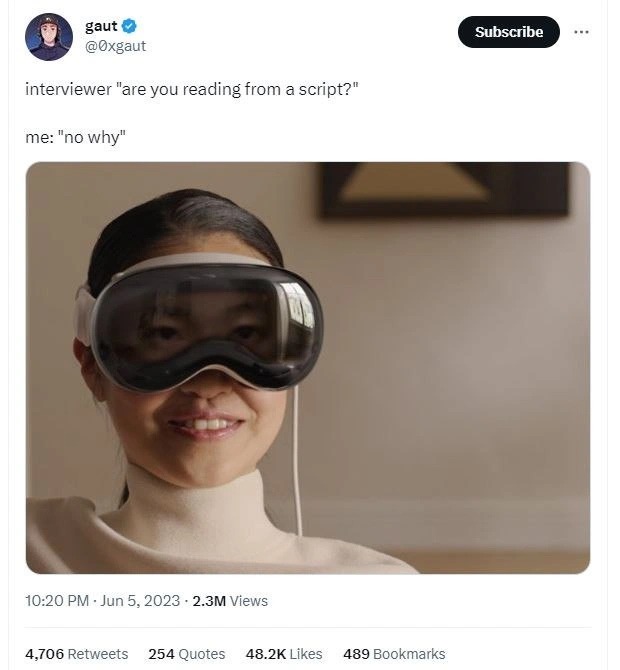
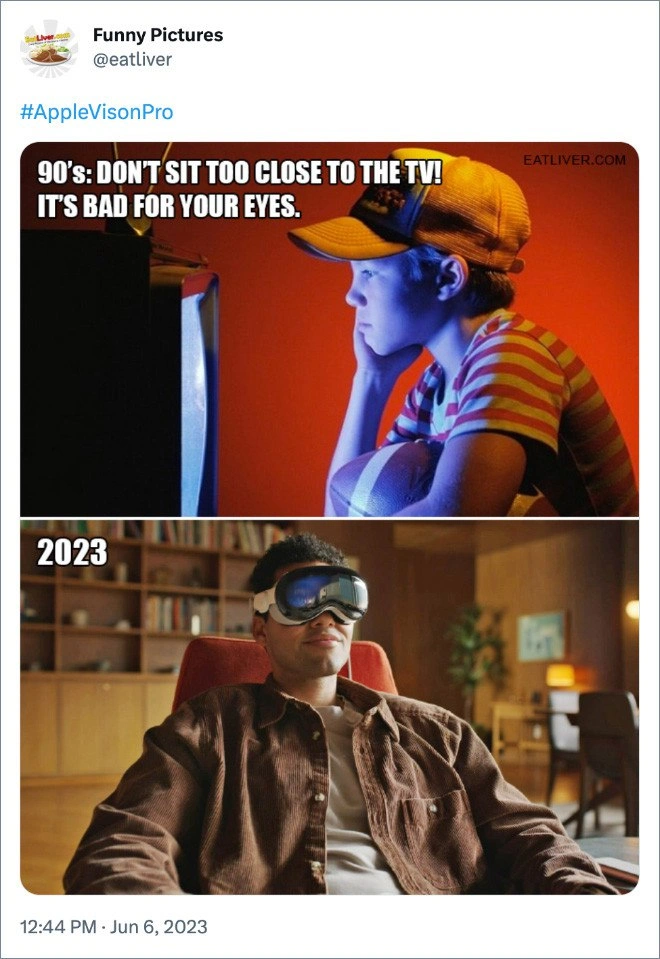
Imagine your parents once told you, “Don’t sit too close to the TV, it’ll hurt your eyes!” That was solid advice back in the day – TVs were big, bright boxes, and being right up next to one felt intense. Now jump to today: we’ve basically created a TV you wear on your face like a pair of super high-tech glasses! 😄 The meme is funny because it’s showing this exact contrast: in the 90s a kid is inches from a TV and getting scolded, while in 2023 an adult proudly relaxes with a screen strapped to his eyes (the Apple Vision Pro headset). It’s like the world turned that old rule upside-down. The core humor is that something our moms and dads used to forbid is now literally a product we buy on purpose. It’s as if we went from “stay back from the screen!” to “bring the screen even closer!” and everyone just laughs at how times have changed. So basically, the meme is saying: remember when getting too close to a screen was bad? Well, now we’ve made it the cool thing to do! It’s a playful way to show how technology can change what “normal” looks like in our lives.

Level 2: Up Close & Personal

The meme highlights how dramatically our technology – and attitudes – have changed between the 1990s and today. In the top panel (labeled “90’s”), we see an old CRT television. CRT stands for Cathode Ray Tube, which was the dominant display tech back then. These TVs were big, boxy, and used electron beams to light up the picture. People were often cautious with CRTs: sitting too close for long was believed to be bad for your eyes (the screen’s brightness, slight radiation, and flicker could cause eye strain or headaches). Parents would literally pull children back from the TV set and say things like, “You’ll ruin your eyesight!” if they sat a foot away. It became common-sense advice: keep some distance from the screen, and don’t watch TV for hours on end. This was part health concern and part good-old parental instinct to moderate a kid’s screen time.

Now look at 2023: the bottom image shows a man wearing the Apple Vision Pro headset. This is Apple’s newly announced AR/VR device (sometimes they call it a “mixed reality” headset). AR means Augmented Reality, where digital images are overlaid on the real world (imagine information or 3D objects appearing in your living room through the glasses). VR means Virtual Reality, a fully immersive experience where you’re shut off from the real world and see a completely simulated environment. The Vision Pro can do both: it’s like ski goggles filled with ultra-high-resolution screens inside, plus loads of sensors and cameras. It literally puts two small 4K displays right in front of your eyes – but uses special lenses so you can focus and see a single cohesive image that feels like it’s floating in front of you. The result? You perceive a huge “virtual screen” or even an entire 3D scene, all while the device is comfortably strapped to your head. In the photo, the man is lounging casually, probably watching a movie on what feels like a 100-foot wide screen only he can see, or maybe coding with virtual monitors around him. It’s a far cry from the kid craning toward a 27-inch CRT to be “immersed” – now immersion comes to you.

This contrast is where the humor comes from: back then, being inches from a screen was a big no-no; today, one of the hottest tech gadgets basically requires it! The hashtag #AppleVisionPro (trending around the time of the device’s announcement) shows how much buzz there is. It’s part of a larger industry trend: tech keeps pushing boundaries, and sometimes our habits flip around. The “Tech Hype Cycle” is a term that describes how we get really excited about new technologies (like AR/VR headsets) – and indeed, every few years there’s hype that this will change entertainment, work, and life. In the 2010s, for example, VR headsets like the Oculus Rift and HTC Vive got popular among developers and gamers. Now Apple, a huge mainstream company, is jumping in with a polished (and expensive) device, which suggests they believe this tech is ready for everyday people, not just tech enthusiasts. Apple’s entry has supercharged the hype again – suddenly AR glasses are on the front page of websites, and everyone’s imagining a future where we might replace our TVs, computers, and phones with something we wear on our face.

For someone starting out or who didn’t live through CRT days, let’s clarify a few key points and terms:

  • Cathode Ray Tube (CRT): An old type of TV/monitor (think thick, heavy box) that creates images with electron beams. They had a characteristic flicker and a “warm” glow. Sitting too near one could make your eyes feel tired, similar to staring at a bright lightblink. By the late 90s and 2000s, CRTs were replaced by flat panels (LCD, then LED screens) which have a steadier image and no radiation emissions.
  • Eye strain: This is when your eyes get tired from intense use – like focusing on small text or bright screens for too long. Symptoms include dryness, soreness, maybe a headache. Both old CRTs and modern devices can cause eye strain, though for slightly different technical reasons. It’s why even with modern screens, you might hear advice like the “20-20-20 rule” (every 20 minutes look at something 20 feet away for 20 seconds) to rest your eyes.
  • Apple Vision Pro: A cutting-edge device (expected in 2024) that’s basically a computer you wear on your face like goggles. It has two internal screens with extremely high resolution (Apple says each eye sees a screen with more pixels than a 4K TV!). Using this, it can project apps, movies, or 3D objects into your view. You can watch a film, play a game, or work on a huge virtual display that only you can see. It also has external cameras, so it can pass-through the real world to you on those screens (that’s how AR is achieved – it’s like seeing the world through a live camera feed with digital images mixed in). And interestingly, it has an external front screen on the headset that shows an image of your eyes to people around you, so they know when you’re paying attention to the real world. Apple is positioning it not just as a toy, but as a “spatial computing” device – meaning you might use it for work, communication, and more, sort of like how we use laptops and phones, but in a more immersive way.
  • AR vs VR: Augmented Reality adds digital elements to your real world (e.g., imagine Pokémon creatures appearing on your coffee table through your phone’s camera – that’s AR, like Pokémon Go game did). Virtual Reality shuts out reality entirely and replaces it with a fully virtual scene (like being inside a 3D video game world). Some devices do one or the other; the Vision Pro can transition between both (hence “mixed” reality).
  • Why so close? The reason devices like Vision Pro put screens so close is to fill your field of view. To feel like you’re in a movie theater or a virtual world, the screen needs to cover where your eyes look. The simplest way to do that is to bring a small screen right up to your eyes with magnifying lenses – that makes it appear huge in your vision. (Think of holding a phone an inch from your face vs at arm’s length – up close it fills your sight.) The technology is designed to make this comfortable: the optics make the content look like it’s at a natural distance, and the image quality is super high so your eyes can relax and just enjoy the scene. It’s still recommended to take breaks now and then (no one wants tired eyes or VR dizziness), but overall it’s considered safe in moderation, much like any screen time.

So in summary, the meme is pointing out a bit of generational irony and tech humor: The very thing we were told not to do (have a screen in our face) is exactly what new tech gadgets encourage us to do – albeit with much better displays and design. It’s a lighthearted take on how technology changes our behaviors over time, and it resonates with both older folks who recall the old warnings and younger folks excited about the new toys.

Level 3: Retina Display, Literally

Don’t sit too close to the TV, you’ll ruin your eyes!” – if you grew up in the ’80s or ’90s, this was practically a household mantra. The meme’s top panel captures this iconic parenting warning, showing a kid glued to a glowing CRT screen. Every seasoned techie remembers that one kid who would park themselves a foot away from the family TV during a Sega or NES marathon, only to be sternly relocated to the couch by a concerned adult. Fast-forward to today: that admonished generation has become the innovators and early adopters strapping on devices like the Apple Vision Pro, which is essentially a cinema screen glued to your face. The bottom image – an adult lounging with Apple’s $3499 AR headset – is the ultimate punchline. A Retina display used to mean a phone or laptop screen so sharp your retina can’t discern pixels; now Apple’s taken it to its literal extreme, putting “Retina” images directly in front of your actual retinas! The meme humorously highlights this whiplash in advice: what was once tech taboo (face-to-screen proximity) is now a selling point of cutting-edge Apple gear.

It’s funny because it’s true – the tech industry often flips yesterday’s worries into today’s features. Parents fretted about eye strain and “square eyes” back when TVs were fuzzy and possibly hazardous. Today, companies boast about immersive, wrap-around visuals that require screens to be inches away. The shared experience (and mild trauma) being satirized: many of us were scolded for behaviors that are now not only common, but commercialized. There’s a collective chuckle (tinged with “Can you believe this?”) among veteran developers and IT folks: we’ve lived through the full cycle. In the early 2000s, bulky CRT monitors gave way to LCDs, and warnings about distance faded – screens got larger and clearer, so you didn’t need to nose up to them. Yet here we are in the 2020s eagerly embracing a device that basically mounts the screen directly on our eyes. Why? Because it offers something new – immersive AR/VR experiences – that in theory outweigh the old fears. The TechHypeCycle is on full display: skepticism gives way to excitement as technology improves. Apple’s marketing machine has convinced us that wearing a computer on our face is not only safe, but the future of personal computing (rebranded as “spatial computing”). It’s a wild cultural shift. Consider that Apple Vision Pro even outwardly displays a digital view of the user’s eyes (“EyeSight” feature) – literally a screen for others to see your eyes – layering screen upon screen in ways a 90’s kid could hardly imagine.

Real-world scenarios cement why this meme hits home. Think about the average office worker or developer today: we already spend 8+ hours staring at monitors, then relax by looking at smartphone screens up-close – effectively doing exactly what mom warned, just with sleeker devices. The Vision Pro is pitched as a productivity gadget, offering virtual multiple-monitors floating in your view. An onlooker from 1990 would think we’ve gone insane: “Instead of one TV too close, you now have five virtual TVs wrapped around your head?!” The truth is, as technology mitigated the old issues (no more heavy radiation or low refresh headaches), the collective concern about proximity diminished. Remember the early VR headsets of the 90s (like the Nintendo Virtual Boy in 1995)? That red-and-black goggles device literally came with health warnings about eye strain and advised frequent breaks. It flopped, in part because the world wasn’t ready to strap in so close. Fast forward to Oculus, HTC Vive, and now Apple Vision Pro – each iteration normalized the idea a bit more. We’ve gone from external caution to internalized “this is fine”, largely trusting that Apple and modern tech have figured it out. It’s a classic case of generational role reversal: yesterday’s forbidden fruit is today’s designer smoothie.

To really drive home the contrast, consider this tongue-in-cheek comparison:

1990s Parental Wisdom 2023 Tech Enthusiast Reality
“Keep a safe distance from the TV.” “Strap a high-res screen directly on your face.”
Concern: Eye damage and radiation Concern: Battery life and Wi-Fi signal
Limit screen time to avoid strain All-day wearable computing (why stop?)
TVs weighed 50 lbs and sat in the living room Headset weighs 1 lb and goes wherever you go

The meme strikes a chord because it spotlights this comedic inversion of common sense. IndustryTrends have a habit of doing that: what was once unthinkable becomes normal. Engineers and developers who’ve been around a while can’t help but smirk – we spend our careers solving yesterday’s problems, sometimes so well that we create new ones. Sure, we’ve banished the static and fuzz of CRTs, but now we wrestle with VR motion sickness and digital eye fatigue from 4K micro-displays. The net effect: it’s hard to say if we’ve simply traded one kind of eye strain for another more high-tech kind. But one thing’s certain – if you told a 90’s kid playing SNES that in 30 years he’d literally wear the TV while playing immersive 3D Mario, his parents might’ve had a heart attack on the spot. And that delightful absurdity is exactly what this meme is poking fun at.

Level 4: Pixel Proximity Paradox

In the 1990s, CRT (Cathode Ray Tube) televisions beamed electrons at a phosphor screen to produce images. This analog tech came with very real physical constraints – and a bit of radiation. Parents’ warnings to “sit back from the TV!” weren’t just folklore; early color CRTs emitted low-level X-rays (prompting safety regulations by the late 20th century) and had noticeable flicker at 60Hz that could strain eyes at close range. On a CRT, pixels (actually glowing phosphor dots) had limited resolution and dot pitch. If you pressed your nose up to the glass, you’d see the scan lines and perhaps feel eye fatigue from the flicker and glare. The human eye’s accommodation (focusing mechanism) also works harder at short distances – children who sat inches away were forcing their eye lenses to continuously flex, which over long periods might contribute to near-sightedness. In short, clinging to a CRT was a visually and biologically suboptimal experience.

Fast-forward to 2023 and we’ve engineered our way around many of those old hazards – only to create a new optical irony. The Apple Vision Pro mixed-reality headset uses twin micro-OLED displays with such high pixel density that, even when placed millimeters from the pupil, the image is crystal-clear and spans a wide field of view. Advanced collimating lenses in the headset ensure your eyes aren’t actually focusing a centimeter away; instead, the optics virtually project the image out to a comfortable focal distance (often effectively a couple of meters). This optical trick addresses the pure accommodation issue – your eyes relax as if viewing a faraway scene, mitigating the immediate strain of proximity. However, it introduces the notorious vergence–accommodation conflict: your eyes may converge (angle inward) to track a virtual object that appears close, while their focus remains fixed at the lens’s set distance. This unnatural mismatch is a paradox of immersion in VR/AR systems – your brain is being fooled, but not perfectly. Prolonged use can cause eye fatigue or headaches as the brain resolves conflicting depth cues. Modern headsets try to minimize this via high refresh rates (90–120Hz to eliminate CRT-style flicker), careful ergonomics, and even foveated rendering (only high-res where you’re directly looking) to reduce processing and possibly reduce visual stress. And unlike the old CRTs, micro-OLEDs emit no X-rays or magnetism – just visible light – and use spectrum control to reduce harsh blue light. Essentially, technology solved many physical risks of sitting too close, yet the pixel proximity paradox remains: to achieve totally immersive, wide-FOV visuals, the display must be right up against our eyes, creating new optical challenges that engineers continuously seek to overcome. We’ve eliminated the electron gun’s glow, but now we’re wrestling with the nuances of human vision and perception itself.

Description

A two-panel meme comparing screen usage advice. The top panel, labeled "90's," shows a young boy sitting extremely close to an old CRT television, with the text "DON'T SIT TOO CLOSE TO THE TV! IT'S BAD FOR YOUR EYES." The bottom panel, labeled "2023," shows a man comfortably wearing an Apple Vision Pro headset, which places screens directly over his eyes. The meme humorously contrasts the parental warnings of the past with the present-day reality of immersive AR/VR technology, where the interface is literally inches from the user's eyeballs. It's a commentary on technological evolution and how our relationship with screens has fundamentally changed
Comments

7
Anonymous ★ Top Pick In the 90s, we were worried about CRTs burning images into our retinas. Now, we willingly pay thousands to strap two 4K displays directly to our corneas. Progress is just finding more expensive ways to ignore old advice
  1. Anonymous ★ Top Pick

    In the 90s, we were worried about CRTs burning images into our retinas. Now, we willingly pay thousands to strap two 4K displays directly to our corneas. Progress is just finding more expensive ways to ignore old advice

  2. Anonymous

    Proof that after decades of UX research we finally solved eye-strain warnings by moving the entire render pipeline directly onto the cornea - just don’t forget to npm install eye_drops

  3. Anonymous

    We went from worrying about electromagnetic radiation from CRT monitors to voluntarily strapping two 4K displays with eye-tracking cameras directly to our retinas, then wondering why our deployment pipeline keeps failing while we're 'working from home' in virtual Tahiti

  4. Anonymous

    We've gone from 'don't sit too close to the screen' to literally strapping 4K displays millimeters from our retinas and calling it innovation. The Apple Vision Pro represents peak engineering irony: solving the problem of screens being too far away by eliminating distance entirely, then charging $3,500 for the privilege. At least when the 90s kid got too close to the TV, they didn't need to worry about battery life, spatial computing APIs, or whether their passthrough latency was under 12ms

  5. Anonymous

    90s: CRT radiation panic. 2023: Foveated rendering in Vision Pro - eyes optimized for selective burnout

  6. Anonymous

    We spent a decade moving compute to the edge; Apple shipped edge-of-nose computing - dual 4K micro‑OLEDs with a 12 ms R1 pipeline, so distance-to-display now equals epsilon

  7. Anonymous

    We solved "don't sit too close to the TV" by moving the TV into a head‑mounted edge node and calling it spatial computing; now the acceptance test is motion‑to‑photon under 20 ms so you don't segfault your vestibular system

Use J and K for navigation