Trading an iPad Addiction for a Spatial Computing One
Why is this AR VR meme funny?
Level 1: Bigger Toy, Same Problem
Imagine a little boy who loves candy so much that he eats it all the time, even during dinner. His parents are worried because he won’t eat his real food – he just wants candy. Now, picture the parents trying to fix this by taking away his small bag of candy and giving him a huge chocolate cake to eat at the dinner table instead. Do you think that would help him eat his vegetables and have a normal dinner conversation? Of course not! He’d be even more obsessed with the cake, and dinner would still be all about sweets. In this meme, the iPad was the “candy” – the kid was glued to it. The parents’ silly “solution” was like the giant cake – they gave him an even more absorbing gadget, a big fancy Apple headset that covers his eyes. It’s funny because anyone can see that just gives him a bigger distraction instead of solving the problem. It’s as if the parents said, “Our child was too hooked on this screen, so we found an even bigger screen and now everything is fine.” 😅 Obviously, that’s ridiculous – the kid is still not paying attention to his family, just like a kid with a face full of cake isn’t listening at dinner. The joke makes us laugh because the parents in the meme are pretending they’ve fixed things, but they really just made the screen obsession even more extreme. It’s a playful reminder that sometimes grown-ups do silly things too, especially when it comes to technology!
Level 2: Dinner Table Tech Glossary
Let’s unpack what’s going on in this meme in simple terms, especially if some of these buzzwords and devices are new to you:
Apple Vision Pro – This is Apple’s recently announced high-end AR/VR headset. Think of it like a powerful computer you wear on your face, kind of a super-fancy pair of ski goggles but with screens inside. Apple calls it a “spatial computer” because it lets you see apps and digital things all around you in your physical space. It hasn’t even hit the market yet (planned for 2024) and it’s very expensive (around $3,500). In the meme, the kid at the table is wearing what looks like a Vision Pro headset instead of holding an iPad. The device covers his eyes completely with a curved glass front – that’s how these headsets look.
iPad addiction – The tweet jokes about a kid’s “debilitating iPad addiction.” iPad is Apple’s popular tablet (basically a touchscreen computer the size of a book). Many kids love iPads for games, videos, and apps. Screen addiction is a real concern for a lot of parents; it means the child is so hooked on the screen that they won’t put it down, even at dinner or bedtime. “Debilitating” is exaggeration for comic effect, implying the addiction to the iPad was really severe (the kid just can’t function without it). So originally, the family’s problem was that their kid was always staring at the iPad screen and not interacting with them during meals.
“Cure” with Vision Pro – Now here’s the ironic twist. The tweet says they “cured” this addiction thanks to Apple Vision Pro. Of course, giving someone a bigger, even cooler screen isn’t a real cure. This is sarcasm. The idea is that the parents replaced the kid’s tablet with this futuristic AR headset. In reality, that’s like curing a candy obsession by giving the kid a whole chocolate cake – it’s probably going to make the obsession worse, not better! The tweet is joking that now they can have “normal family dinners again,” while the picture clearly shows anything but normal: the child still isn’t making eye contact or talking; he’s just eating with a computer strapped to his face. The joke is that nothing has been solved at all – if anything, it’s more extreme.
AR vs. VR (Augmented Reality vs. Virtual Reality) – These are two related tech terms. VR (Virtual Reality) means you put on a headset and you’re completely immersed in a virtual world – you typically can’t see the real world around you. Everything you see are computer-generated images (like being inside a video game or simulated environment). AR (Augmented Reality) means you still see your real environment, but with digital images overlaid on top of it. A popular example of AR is the game Pokémon Go on your phone, where you see a live view from your camera but digital Pokémon characters appear on your screen as if they’re in the real world. Now, Apple Vision Pro is a bit special: it’s a mixed reality device, which can do both AR and VR. Most of the time it will function as AR – it has external cameras that pass through a view of the real world to the screens in front of your eyes, then it can overlay apps, 3D objects, or movies into that view. So the kid in the meme, wearing the Vision Pro at the dinner table, would be able to see a video feed of his dining room and family plus whatever digital content he’s watching. Apple likes to say you’re “present” in your space while using it (unlike older VR where you’re blind to the outside). However, even if technically you can see your family through the headset, you might still be pretty distracted by whatever’s on those giant virtual screens! So practically, it might not be much different from an iPad in terms of distraction – that’s part of the joke.
Normal family dinners – This phrase just means a typical dinner where the family sits together at the table, eats, and talks about their day without distractions. A lot of families have a rule of “no devices at the dinner table” for this reason. In the tweet, the parents claim they’re having normal dinners thanks to the Vision Pro cure. That’s clearly satirical, because a dinner where your kid is wearing a computer headset is anything but normal. The child might be physically at the table, but if he’s engrossed in the headset, he’s not really mentally present in the family conversation. The phrase “normal family dinners again” mocks how we sometimes fool ourselves that everything is fine if it superficially looks fine. Here, the parents “solved” the arguing over the iPad by giving in – now the kid isn’t fighting them since he’s got an even cooler device. From the parents’ view, maybe that feels like peace at the table, but it’s a hollow peace since the underlying issue (screen time during dinner) remains.
Fireship’s tweet – The meme is actually a screenshot of a tweet. The account is “Fireship” (@fireship_dev), who is known in the developer community for making short, witty explainer videos about programming and tech topics. He often shares tech jokes and commentary on Twitter. This particular tweet was posted on June 6, 2023 at 4:41 AM (likely right after Apple’s big presentation of the Vision Pro on June 5). Because the Vision Pro was the hot topic among tech folks at that moment, Fireship’s satirical take took off. The tweet combines a one-liner joke with an attached photo for comic effect. The photo, showing the kid with the Vision Pro, really drives home the joke visually. Even if someone didn’t watch Apple’s event, the humor is there: you can tell it’s a high-tech Apple gadget on the kid’s face (Apple’s sleek design kind of gives it away, plus the tweet text mentions it).
AR headset at the dinner table – This idea in itself is funny because it’s not something you see every day. AR/VR headsets are mostly used for gaming, simulations, or maybe work tasks – usually solitary activities or specialized cases. Seeing one used casually by a kid at a family dinner crosses wires in our brain, and that incongruity makes us laugh. It’s like seeing someone using a jetpack to go to their mailbox – technically possible (if jetpacks were widely available) but socially over-the-top. The meme exaggerates to make a point: sometimes the tech industry (and us gadget-loving folks in it) may resort to crazy solutions in pursuit of convenience or harmony, when in fact it might be overkill.
Device substitution – This isn’t a formal term, but it’s an idea the meme plays with: swapping one device for another. Instead of removing the iPad (which was causing the issue), the “solution” was to substitute it with the Vision Pro headset. This is humorous because it’s clearly not a real fix, just a substitution. Often, in tech or even in parenting, people might try to replace one habit with another and claim victory prematurely. Here that concept is blown up to comedic proportions by choosing a ridiculously high-tech substitute.
In summary, this meme is all about the contrast between what’s ideal and what’s actually happening. The ideal: technology liberates us and improves our family time (no more iPad zombie kid!). The reality (as joked here): we just end up with a more expensive zombie. The tags like TechHumor and TechSatire apply because it’s making fun of our tendency to hope the next gadget will solve problems that the last gadget created. And even if some of these terms were new, the scenario is very relatable once explained: a kid too absorbed in a device at dinner, and the parents’ “solution” only making it look even sillier. It’s a light-hearted caution not to let fancy new tech cloud our common sense – delivered in a way that both techies and non-techies can chuckle at once they get the context.
Level 3: Mixed Reality, Mixed Results
The humor here hits seasoned techies right away: solving a screen addiction by strapping a larger, pricier screen to the kid’s face is a textbook case of satire on gadget culture. This tweet from Fireship – a popular developer educator known for spicy tech humor – dropped barely a day after Apple’s big Apple Vision Pro announcement in June 2023. That timing is key. The tech world was buzzing about Apple’s foray into AR/VR (augmented/virtual reality), hyping it as the dawn of “spatial computing.” Apple’s slick promos showed people wearing the $3499 Vision Pro while doing everyday things – sitting in a living room, interacting with family, even capturing photos at a child’s birthday. Many developers and tech veterans raised an eyebrow at those use-cases. Is a family member in futuristic ski goggles really going to fit in at dinner? Fireship’s tongue-in-cheek answer: Sure – if your idea of a normal family dinner is everyone isolated behind their own devices!
At its core, this meme is poking fun at the industry hype cycles we’ve all seen. Every few years there’s a hot new gadget that promises to revolutionize daily life. Here, that gadget is the Vision Pro, heralded as an AR breakthrough that will finally replace our screens. The tweet wryly implies we’ve heard this before. Today’s spatial computing hype echoes yesterday’s VR and Google Glass hype: bold promises of integrating technology seamlessly into our lives, met with the reality that it can look pretty absurd. The device_addiction_irony in the tweet is golden: the parents had a serious problem (a kid glued to the iPad at dinner) and their “solution” was to give the kid an even more immersive device. It’s like curing insomnia with espresso. Everyone in tech recognizes this pattern of over-engineering a fix – it’s the classic “if all you have is a hammer, every problem looks like a nail” syndrome, except the hammer is a shiny new Apple gadget.
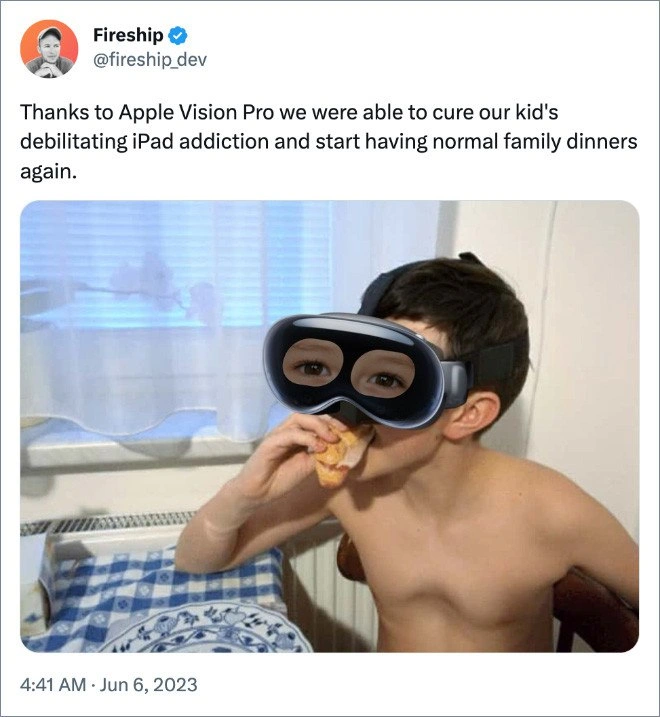
Let’s break down the scene. A youngster (face considerately blurred for privacy) is sitting shirtless at the dinner table, mid-chew, wearing the Vision Pro headset which completely covers his eyes. The image is absurd on purpose. Family dinners are traditionally about face-to-face interaction – talking about your day over a meal. But in this tableau, the poor kid’s eyes are obscured by a mixed reality goggles unit, and presumably he’s not looking at Mom or Dad; he’s probably watching YouTube or playing an AR game on a 100-inch virtual screen only he can see. The tweet text drips with sarcasm: “Thanks to Apple Vision Pro we were able to cure our kid’s debilitating iPad addiction and start having normal family dinners again.” Normal, indeed – if your norm is having a child physically present but mentally in another dimension. By using Apple’s marketing language (“Vision Pro” and “normal family dinners”) in one sentence, Fireship jabs at the spatial_computing_hype: Apple wants us to think this tech will enhance our daily life, but here it’s just redirecting the kid’s attention from one screen (the iPad) to another (the Vision Pro). The irony is palpable to any developer parent who’s struggled with screen_time_management for their kids. We know how hard it is to get kids to put down the tablet and engage with the family. This tweet jokingly suggests a sci-fi escalation: Can’t pry the iPad away? Fine, slap on a $3500 AR headset! Problem solved, right?
Of course, the experienced engineers and tech leads reading this will also recall the unspoken truth: tech companies often market new devices as solutions to problems that older devices created. The iPad itself was once sold as a tool for education and creative play (which it is), but many families found it quickly became a digital pacifier – the kid gets hooked on endless cartoons and games. Now along comes Apple’s Vision Pro, which they pitch as a more immersive and flexible computing device – essentially a whole computing platform on your face. The meme lampoons the notion that throwing cutting-edge hardware at a kid’s overuse of screens will do anything but double down on the issue. It’s a commentary on digital_parenting in the age of AR: sometimes parents (especially tech-savvy ones) might be tempted by an expensive high-tech fix, when the real fix might be simply setting boundaries (the not-so-fun solution). The joke lands especially well with developers who’ve witnessed hype wave after hype wave. We can’t help but chuckle at how this scenario distills a common tech industry folly: addressing a people problem with a tech solution.
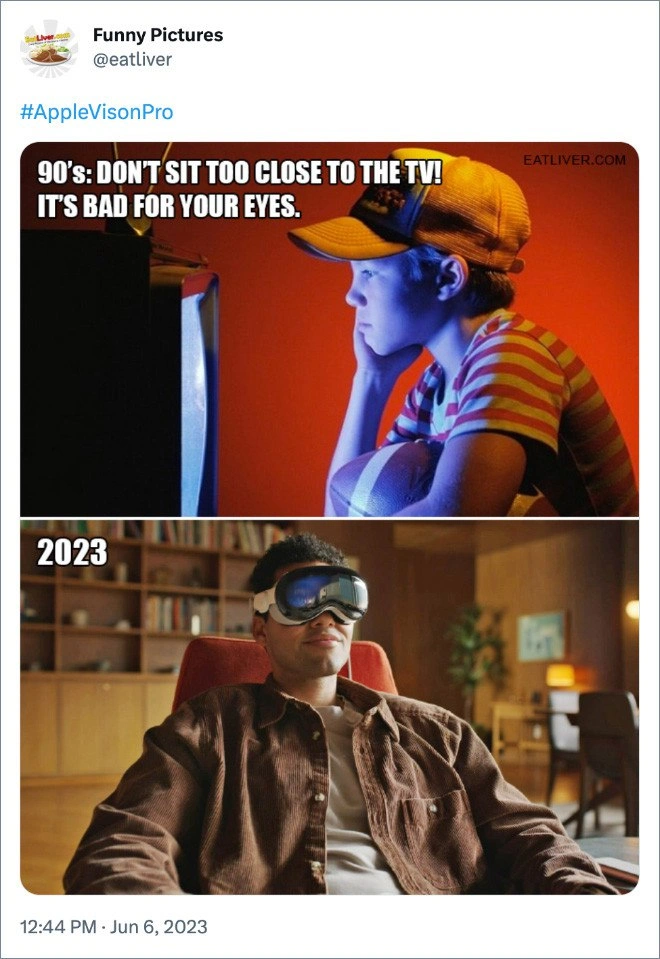
One funny aspect here is just how extreme the “solution” is. The iPad that the kid was addicted to is a flat tablet; at least the family could see his face (well, the top of his head) while he used it. Now with the Vision Pro, the parents can’t even make eye contact with him at dinner – only eye-to-goggle contact. Apple anticipated that concern by adding that outward-facing EyeSight display that shows the wearer’s eyes, but as devs we know it’s a bit uncanny valley. In the meme photo, the large glossy front of the headset dominates the scene, a far cry from a device that fades into the background of family life. It’s hilarious because it highlights the gadget overkill: it’s like using a sledgehammer to crack a nut (or rather, using a spatial computer to solve a straightforward parenting challenge). The family dinner table – with its modest tablecloth and everyday setting – contrasts sharply with the ultra-futuristic headset. That visual juxtaposition is intentional comedy: the mundane meets the cutting-edge. Senior engineers might even be reminded of earlier tech intrusions into family time (remember when everyone worried TV would kill dinner conversation? Then it was smartphones – now it’s AR headsets!). It’s a cycle: new technology emerges, promises to improve life, ends up introducing new quirks.
To sum it up, this meme is a wink to the developer community about tech industry satire and hype realism. It says, “We love new tech (heck, Fireship and all of us are excited by Vision Pro), but we’re not blind to how ridiculous it can get.” The joke lands because it’s grounded in truth: you can’t buy your way out of screen addiction easily, and sometimes the latest solution is just a fancier flavor of the original problem. It’s equal parts TechHumor and cautionary tale. You might even call it a modern “Emperor’s New Clothes” moment for AR – calling out that despite all the innovation, we’re still grappling with the same old issues of attention and balance. The developer crowd sees both the brilliance of the tech and the absurdity of the situation, and that contrast is exactly what makes this meme chef’s kiss funny.
// A quick pseudo-code interpretation of the meme's logic:
if (kid.addiction === 'iPad') {
kid.addiction = 'Apple Vision Pro';
console.log("Problem solved?"); // sarcasm: just swapped addictions
}
To drive the point home, consider this tongue-in-cheek comparison:
| Before Vision Pro (Problem) | After Vision Pro (Solution?) | Outcome |
|---|---|---|
| Kid glued to an iPad during dinner | Kid strapped into Vision Pro at dinner | Still glued to a screen, but in 3D |
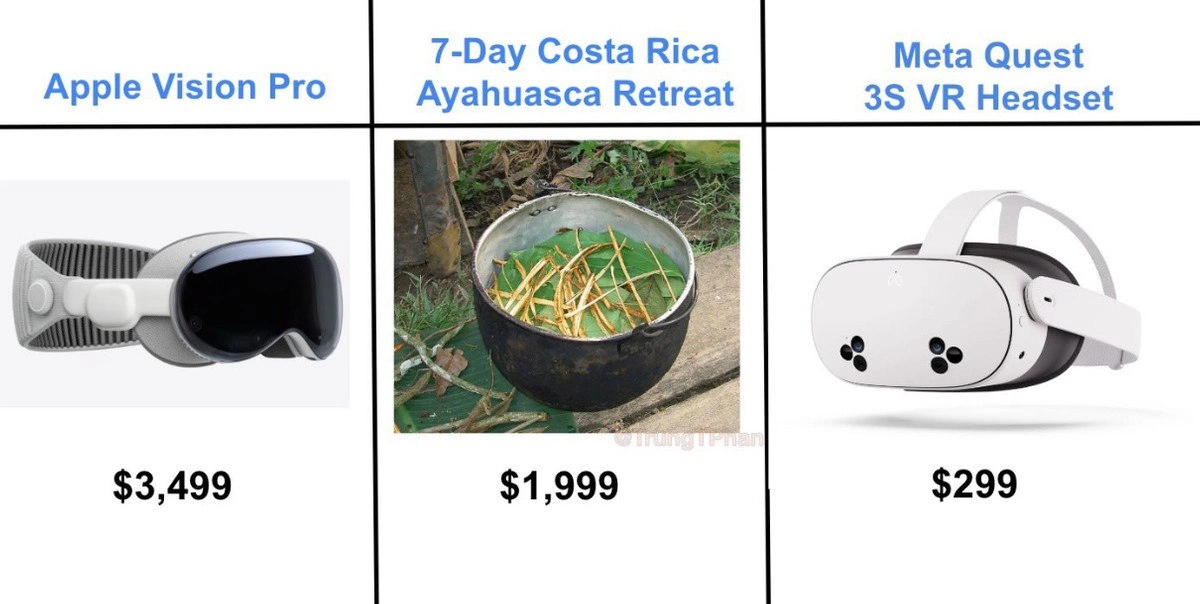
| Relatively cheap distraction (~$300) | Ultra-premium distraction ($3499) | Far pricier tech dependency |
| Parents can say “no devices at table” | Parents now say “just one device” | Device still dominates dinner |
It’s device_addiction_irony in a nutshell: the form factor changed, the addiction remained. The senior dev perspective appreciates how this meme layers commentary about hype (the latest AR gadget) on top of a relatable real-world struggle (managing a kid’s screen time). It’s a lighthearted reminder that, despite our amazing new AR tools, the hardest problems in tech often aren’t technical at all – they’re human.
Level 4: The Realities of Mixed Reality
At the cutting edge of spatial computing, Apple's Vision Pro represents a bold step along the reality–virtuality continuum – the spectrum between the completely real and the completely virtual. Technologists have long envisioned Augmented Reality (AR) devices that seamlessly blend digital content with the physical world. The Vision Pro is essentially a wearable high-performance computer, packed with advanced sensors and computer vision algorithms that map your surroundings in real-time. It uses an array of cameras and the dedicated R1 processor to capture and render the world with astonishingly low latency (on the order of milliseconds), enabling digital objects to appear anchored to real space without lag. In theory, such mixed-reality goggles could let you eat dinner while browsing infinite screens – merging virtual interfaces with your kitchen table. However, this meme humorously exposes a fundamental social paradox of AR: even as the device augments the child’s visual reality with dazzling imagery, it arguably diminishes the shared reality of the family meal. The Vision Pro’s outward-facing display (which shows a simulated image of the wearer’s eyes) is a direct attempt by Apple to keep the wearer connected with people nearby – a nod to decades of human-computer interaction research about maintaining presence. Yet, the image of a kid mid-bite behind glossy goggles suggests that despite all the technical wizardry, genuine human connection might be getting algorithmically sidelined. This satirical scenario underscores a deep truth studied in both engineering and ethics: technological solutionism – the idea that complex human problems (like screen addiction) can be “solved” by more technology – often backfires. It’s as if we’ve applied a recursive fix: treating an overdose of digital stimuli with an even more sophisticated delivery mechanism. The result is an augmented dinner in the technical sense, but a diminished reality in the human sense. By playfully colliding Apple’s futuristic mixed-reality hardware with the age-old tradition of a family meal, the meme highlights how even the most advanced AR systems ultimately run up against the latency of human habits and social norms. In the end, no amount of next-gen optics or silicon can fully resolve that very analog tension between our physical togetherness and digital temptations.
Description
This image is a screenshot of a tweet from the popular developer news account 'Fireship' (@fireship_dev). The tweet text sarcastically reads: "Thanks to Apple Vision Pro we were able to cure our kid's debilitating iPad addiction and start having normal family dinners again." Below the text is a photograph of a shirtless young boy sitting at a dinner table and eating a piece of bread or a sandwich. A large Apple Vision Pro headset has been crudely photoshopped onto the boy's head, with a pair of cartoonish eyes visible on the front display of the goggles. The humor is deeply ironic, satirizing modern parenting and tech addiction. It suggests that the problem of screen time isn't solved but is merely replaced by a more expensive and immersive technology, while humorously framing it as a return to normalcy
Comments
7Comment deleted
They've successfully upgraded the dependency from a single-threaded tablet UI to a full-blown spatial OS. That's not curing addiction, that's just a major version bump with breaking changes to family interaction
If your OKR says “cut tablet minutes by 90%,” just strap a $3.5k head-mounted display to the kid - metrics green, finance calls it innovation
It's like migrating from a monolithic iPad app to a microservices architecture - technically more advanced, exponentially more expensive, and now the kid needs a dedicated DevOps team just to eat dinner
Ah yes, the classic engineering solution: replace your child's $500 iPad addiction with a $3,500 face computer during dinner. It's like migrating from MongoDB to a blockchain-based distributed ledger to fix a simple data consistency issue - technically impressive, absurdly expensive, and completely missing the point. At least with the Vision Pro, they can't see the disappointed looks on their parents' faces anymore. Peak spatial computing: being physically present but mentally in a different reality. Ship it to prod!
Vision Pro: iPad addiction's ultimate upgrade - swapping 10-inch retina for face-strapped spatial immersion
Classic enterprise fix: we didn’t reduce screen time, we replatformed it to a head‑mounted single‑tenant microservice - engagement up, family SLOs still failing, and the vendor lock‑in now literally strapped to the user
We cured iPad addiction by migrating it to visionOS - classic enterprise pattern: wrap the monolith in a head-mounted microservices facade, add pass-through UX, and declare the incident closed