The Inversion of the Turing Test
Why is this TechHistory meme funny?
Level 1: The Tables Have Turned
Imagine a game long ago where the big challenge was: can a robot pretend to be a real person and fool the humans? That was like a robot dressing up and trying to act just like one of us so we wouldn’t notice. Now think about how it is today: it’s as if we have a robot guard at the door asking us questions. Every time you click “I’m not a robot” on a website, it’s like that computer guard is saying, “Prove you’re a real person and not just a robot in disguise.” See how the situation flipped around? It used to be the robot trying to pass as human, and now it’s humans having to pass a little test to show we’re not robots. That role reversal is the joke — the tester became the one giving the test. We went from testing robots to now the robots testing us, and that’s why it makes people smile.
Level 2: I'm Not a Robot
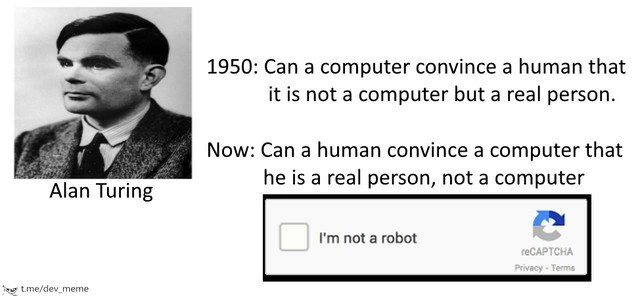
On the left side of the meme is Alan Turing (his face is blurred in the image, but he’s identified by name). Alan Turing was a pioneering computer scientist (and WWII codebreaker) often called the father of artificial intelligence. In 1950, he introduced the idea of the Turing Test. The Turing Test is basically an experiment or game where a human talks with two hidden players – one is a person, one is a computer – and tries to figure out which one is the machine. If the human judge can’t tell the difference after a lot of questions, then the computer is said to have passed the test by acting indistinguishably like a real person. This was a big question back then: “Can a computer think, or at least act like a human?”
Now look at the right side of the meme: there’s that familiar reCAPTCHA checkbox saying “I'm not a robot.” If you’ve used the internet, you’ve probably seen this pop up on forms and signup pages. A CAPTCHA is a tool websites use to make sure the user is actually a human being and not a computer program (not a bot). Fun fact: the word CAPTCHA is actually an acronym standing for Completely Automated Public Turing test to tell Computers and Humans Apart. (Tech folks love quirky acronyms!) In practice, a CAPTCHA might ask you to check a box or identify objects in pictures (like “click all the images that have a traffic light”) before you can continue. When you do that, the site gains confidence that you’re not an automated script (i.e. not a bot) trying to cause mischief. reCAPTCHA is just a popular version of this tool provided by Google, used on tons of websites today.
The text in the meme spells out the contrast plainly. In 1950, the challenge was “Can a computer convince a human that it’s a real person?” But now, the challenge is “Can a human convince a computer that they are a real person?” It’s pointing out a role reversal. Back then, humans were testing computers (to see if machines could act human). Now, computers are testing humans (to confirm we’re not machines). It's a funny turnaround when you think about it: the examiners and the examinees swapped roles!
Why do we even need to convince a computer that we’re human? It’s because of bots. A “bot” is just a program that runs automated tasks – sometimes for helpful reasons, but often for annoying or bad reasons (for example, a bot might try to flood a site with spam or create a bunch of fake accounts). Websites use CAPTCHAs as a gate to stop these bad bots. The idea is that only a real person should be able to pass the test easily, while a bot will likely fail or get slowed down. It’s a way to protect websites and users from automated abuse.
Of course, making humans prove they are human adds a bit of inconvenience for us real users. It’s a trade-off between security and usability. On one hand, you want to keep out the troublemakers (that’s the security part). On the other hand, you want genuine people to have a smooth, easy experience (that’s the usability part). So, a CAPTCHA is like a tiny speed bump on a website: it slows down the bad bots, but it also means the rest of us have to tick a box or solve a quick puzzle now and then. The meme highlights that trade-off in a light-hearted way. It’s kind of absurd (and amusing) that we humans have to perform these little tasks just to prove to the computer that we’re legit, all because some robots out there caused problems.
In short, this meme mixes tech history with our everyday internet experience. Alan Turing’s theoretical question from 70 years ago – about machines acting human – has a new twist today with CAPTCHAs. Now we’re the ones saying to the computer, “Hey, believe me, I’m not a robot!” It’s a clever illustration of how things have come full circle in the world of AI and web security, and that reversal is exactly why it makes us grin.
Level 3: Reverse Turing Test
1950 vs Now – The meme sets up two scenarios side by side, highlighting a clear role reversal. In 1950, the big question was whether a machine could convince a human that it was a real person (the classic Turing Test challenge). Today, the everyday question is whether a human can convince a computer that they’re not a machine (the reCAPTCHA challenge). Essentially, we’ve gone from “Can an AI fake being human?” to “Can a human prove they aren’t a bot?”.
For clarity, compare the two situations in a nutshell:
| 1950 – Turing’s Test | Now – CAPTCHA |
|---|---|
| Machine tries to appear human to a human judge. | Human tries to prove human to a machine judge. |
| Human is the evaluator; Machine is being tested. | Machine (algorithm) is the evaluator; Human is being tested. |
| Purpose: gauge AI intelligence. | Purpose: protect security by blocking bots. |
| Setting: rare lab experiment (AI research). | Setting: routine web step (user verification). |
This juxtaposition is humorous because it’s true. Those of us working in tech have seen this role reversal play out in real life. The original Turing Test was a theoretical experiment about AI capability; modern CAPTCHA is a practical tool to keep out bots. The meme makes us chuckle because it connects those dots directly: the lofty 20th-century AI experiment and the trivial 21st-century web checkbox are actually inverse forms of the same concept.
Anyone who has deployed a web application knows the Security vs Usability dilemma here. CAPTCHAs add friction to the user experience, but without them, your site can be overrun by spam bots, fake accounts, and other automated abuse. It’s a necessary evil in many cases. We all recognize that little checkbox or the “select all images with traffic lights” prompt. It’s a shared experience in the developer community: implementing a CAPTCHA to stop a flood of bogus requests, and then fielding complaints from users about that extra hurdle.
The humor also taps into personal experience. How many times have you muttered, “I swear I’m human,” while squinting at a blurry CAPTCHA or carefully picking out every square with a bus in it? It’s a trivial inconvenience, yet it’s universally recognizable and just a bit absurd. And ironically, sometimes we (the humans) fail these tests! That moment when you get the CAPTCHA wrong and half-jokingly think, “Wait, am I a robot?!” is both frustrating and comical. The meme plays on that shared moment of exasperation: after decades of striving to make computers act human, we now have moments where humans feel pressured to prove we’re not computers.
From a senior developer’s perspective, this situation is a little meta and definitely ironic. We spend years pushing the boundaries of AI to behave more like humans, and simultaneously we have to devise new hurdles to trip up AI that’s pretending to be human. It’s an ongoing tug-of-war. Spammers program their bots to behave more like real users, and security teams respond by making CAPTCHAs more nuanced (or even invisible and detection-based). It’s a classic AI vs security arms race: each side keeps innovating. reCAPTCHA itself has evolved through versions: from distorted text, to image grids, and now to behind-the-scenes behavioral analysis. Each iteration tries to stay one step ahead of the bots.
There’s an inside nod here too: CAPTCHAs often turn the labor of security into something productive. Early CAPTCHAs helped digitize old books (every time you deciphered a scanned word, you helped teach an OCR system). New image CAPTCHAs help train vision algorithms (when you identify bicycles or streetlights, that data can improve self-driving car AI). So we have this weird scenario where, to prove we’re human, we perform micro-tasks that make machines smarter. We’re literally helping the AI while declaring “I am not AI.” It’s a nerdy irony that folks in AI/ML chuckle about.
In the end, this meme resonates because it condenses a huge shift in computing into one savvy comparison. It’s saying: Look how the tables have turned! The profound question Alan Turing asked — “Can a machine act human enough to fool us?” — has led to the everyday puzzle of “Can you (a human) convince our machine that you’re legit?”. It’s funny, a bit absurd, and a little thought-provoking. We laugh at the meme, but we also nod, recognizing that this is the world we live in now: we have to click a checkbox to reassure an algorithm that we are, in fact, human and not one of the very robots we’ve been busy building.
Level 4: The Imitation Game, Inverted
"I propose to consider the question, 'Can machines think?'"
— Alan Turing, 1950
Alan Turing’s famous question laid the groundwork for what we now call the Turing Test. In his 1950 paper, he described the Imitation Game: a scenario where a human judge engages in a text conversation with two hidden participants — one is a person, the other a computer. If the judge cannot reliably tell which is which, the computer is said to have demonstrated human-like intelligence. This was a foundational milestone in AI (artificial intelligence) history — an early formalization of the quest to build machines that can think or at least act human.
In an ironic twist of digital evolution, the meme highlights how that concept has flipped on its head in modern times. Fast-forward to the internet age: instead of a human testing a machine’s humanity, we have machines testing a human’s humanity. The right side of the meme shows a modern reCAPTCHA prompt with the phrase “I'm not a robot.” This is no coincidence: CAPTCHA itself stands for Completely Automated Public Turing test to tell Computers and Humans Apart. In other words, it’s literally an automated Turing Test — essentially a reverse Turing Test — with the roles reversed. Here, a program (the CAPTCHA service) is the interrogator, and the subject is us, the human users, who must prove we aren’t bots. The examiner and examinee have swapped places.
From a theoretical standpoint, this inversion raises fascinating points. The original Turing Test was a thought experiment about a machine’s ability to exhibit intelligent behavior indistinguishable from a human’s. Today’s CAPTCHAs are practical Turing tests used as a security measure. They exploit tasks that are easy for human brains but hard for algorithms. For example, deciphering distorted text or picking out objects in images leverages the sophistication of human pattern recognition. These tasks are often considered AI-hard problems: trivial for real people, but inherently difficult for traditional algorithms (at least until AI catches up). The assumption is that an average person can identify a stop sign in a photo or read skewed letters, whereas a malicious bot would struggle or fail at the same task.
This has led to a kind of arms race between AI and security. As algorithms (especially in machine learning and computer vision) become more advanced, they get better at solving these once-impossible challenges. Optical Character Recognition, for instance, has improved dramatically — text CAPTCHAs that stumped computers in 2000 can often be cracked by today’s neural networks. In response, CAPTCHA challenges have evolved: from warbled text, to picking images of traffic lights, to invisible behavior-based tests. Modern reCAPTCHA can sometimes decide you’re human just by the way you move your mouse or how you navigate a page, without even showing you a puzzle. It’s almost spooky — an algorithm sniffing out your "humanness" in real time based on subtle cues.
If an AI can consistently pass these reverse Turing tests, it signals a new milestone: machines achieving parity with human perception in that domain. And indeed, advanced bots now use machine learning to crack CAPTCHAs, while some spammers even outsource CAPTCHA solving to cheap human labor. It’s a classic cat-and-mouse dynamic. Every time bots get smarter (mimicking human behavior or solving puzzles), the tests get more elaborate to stay a step ahead. This is the essence of the AI vs security arms race: each side — bot creators and security engineers — continuously upping their game. It echoes Turing’s original theme in a new way: at what point can a machine’s behavior fool not a person, but another machine designed to detect fakes?
For the historically inclined, it’s striking to see how a concept from the dawn of computing has morphed into an everyday web hurdle. In 1950, Turing imagined a future where a computer might trick us into thinking it’s human. In 2020, millions of ordinary users each day have to check a box or solve a puzzle to prove their humanity to a computer. One could almost imagine Turing smirking at the irony. The meme captures this 70-year journey in one glance: from the Turing Test to reCAPTCHA, we’ve gone from “Can a computer pretend to be a person?” to “Please convince our computer that you’re a person.” It’s a perfect illustration of how far AI has come — and how the challenges have evolved in unexpected ways.
Description
A two-part meme contrasting the past and present of human-computer interaction. On the left, there is a black and white portrait of Alan Turing, with his name printed below. On the right, two statements are presented. The first reads, '1950: Can a computer convince a human that it is not a computer but a real person.' This refers to the original Turing Test. The second statement below it says, 'Now: Can a human convince a computer that he is a real person, not a computer'. Directly under this text is a screenshot of a standard Google reCAPTCHA checkbox with the text 'I'm not a robot'. A small watermark for 't.me/dev_meme' is visible in the bottom left corner. The meme humorously points out the ironic reversal of the Turing Test in modern life, where humans must constantly prove their own humanity to automated systems to access information and services
Comments
7Comment deleted
The original Turing test was about sophisticated conversational AI. Now we just have to prove we can identify all the traffic lights in a blurry 3x3 grid to a machine that's probably driving a car
1950 asked if silicon could fool carbon; 2024 asks if a Staff+ can spot every 12-pixel traffic light before the OAuth nonce expires - because the only real robot now is the CAPTCHA in our deployment pipeline
The real Turing Test isn't whether AI can convince us it's human anymore - it's whether we can click enough traffic lights, crosswalks, and motorcycles to convince Google's neural networks that we're not the sophisticated bots their own engineers are building at the office next door
We've come full circle from Turing asking 'Can machines think?' to Google asking 'Can you prove you're not a machine?' - and somehow clicking pictures of traffic lights has become the gold standard for human consciousness. Alan Turing proposed a test where machines would try to pass as human; seventy years later, we're the ones failing to convince algorithms we're not bots. The real kicker? Modern CAPTCHAs are actually training ML models while making us prove our humanity - so we're simultaneously validating our consciousness AND teaching the machines that will eventually make us obsolete. Turing would either be fascinated or deeply concerned that his philosophical thought experiment has devolved into 'select all squares with bicycles.'
Turing tested if machines could pass as human; now reCAPTCHA ensures even battle-hardened SREs fail at 3AM incident response
Modern Turing test: convincing a risk‑scoring ML you aren’t Selenium - while the real bots spoof navigator.webdriver, reuse warm cookies, and tick the box for you
The Turing Test got inverted: you’re human only if your browser leaks a canvas fingerprint, renders WebGL, keeps third‑party cookies, and jiggles the mouse just right - privacy looks like a bot