Homelander Advises Developers to Suffer in Silence Like Real Engineers
Why is this MentalHealth meme funny?
Level 1: Better Together
Imagine you're trying to carry a really heavy box of toys all by yourself. It's so heavy that your arms hurt, and you're stumbling around. You don't want to ask your friend to help because you think, "I must be strong and do it alone. Asking for help would mean I'm weak." So you keep struggling. You carry it alone until you trip, and the box falls and all the toys spill out. Ouch! That obviously didn't go well, right?
Now, think of what would have happened if you had simply asked your friend to help from the start. Together, you both could have lifted that big box easily, carried it to where it needed to go, and none of the toys would have spilled or broken. You wouldn't be hurt or tired, and the job would be done faster too. There's nothing "cowardly" about that – it's smart and safe.
The meme is joking about a situation like the first one: it pretends to give advice that says "never ask for help, just struggle alone and make it worse." It's like someone telling you to carry the box alone no matter what. When we hear it in a regular situation, we can tell that's silly advice. We laugh at the meme because we know the right thing to do is ask for help when something is too much to handle alone. Just like carrying a heavy box or solving a tough puzzle, some problems are easier when you don't try to be a lone hero. Real heroes know when to say, "Hey, can I get a hand here?" It's always better (and more brave!) to work together than to suffer all by yourself.
Level 2: Code of Silence
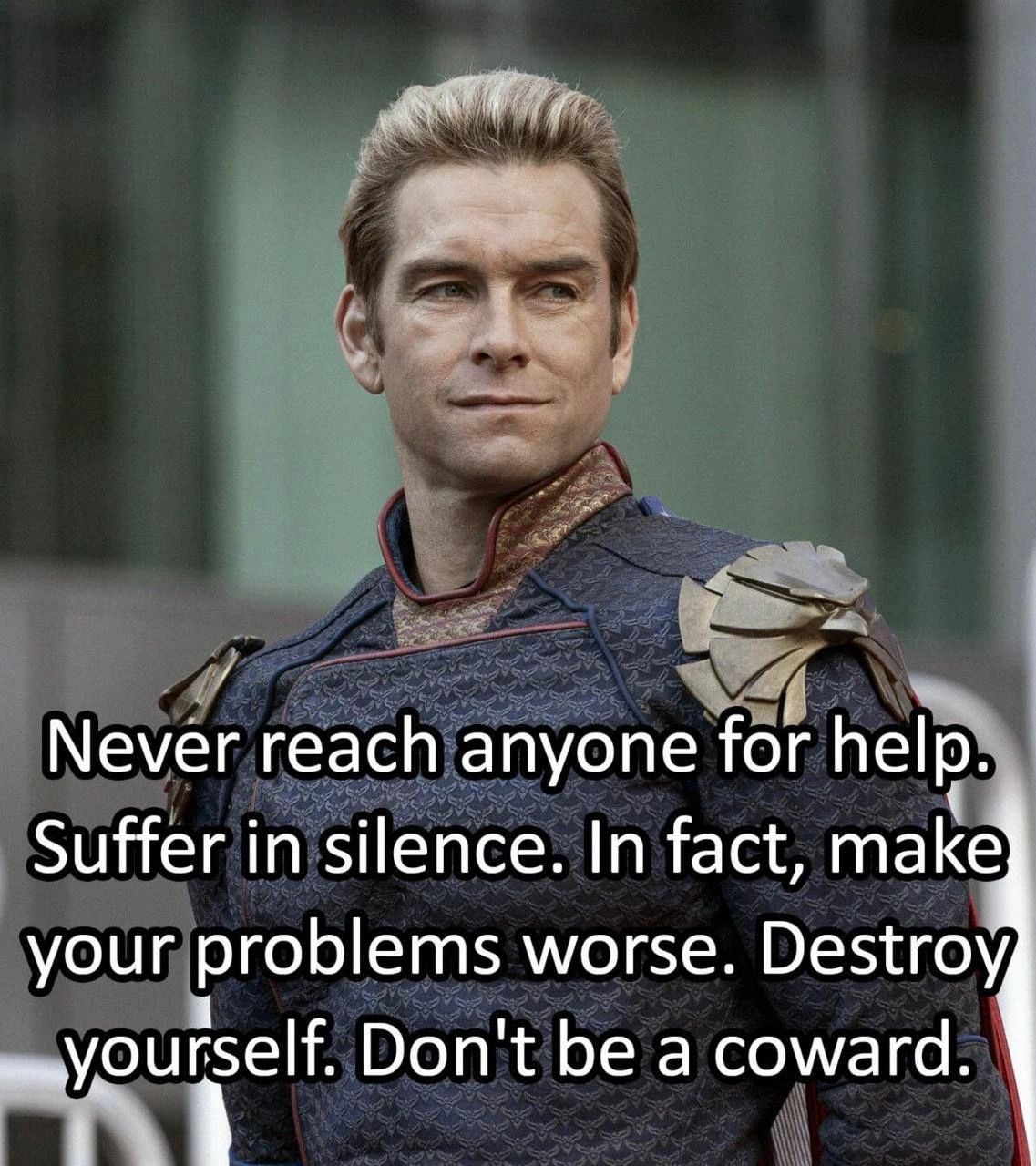
This meme is highlighting a problem in developer culture using heavy sarcasm. It basically says: "If you're struggling with a problem, never ask anyone to help you. Just stay quiet, make things worse, and work yourself into the ground. Only cowards ask for help." Of course, this is not serious advice – it's mocking the idea that asking for help is a weakness. The text is placed over an image of a superhero (Homelander from a show called The Boys), who looks confident. That contrast — a confident hero figure delivering terrible advice — is meant to be funny and point out how ridiculous that mindset is.
Let's break down some terms and ideas here:
git blame: This is a command in Git (a version control system that developers use to track code changes).git blameshows you who last edited each line of a file. Teams might use it when debugging to see who wrote a particular piece of code that's causing an issue. The meme title jokes that the team considers usinggit blameas "courage." In other words, they'd rather you find out who to blame for a bug (using a tool) than actually ask that person for help or clarification. It's a backwards attitude: blaming is seen as brave, while asking for help is seen as cowardly. Healthy teams usually don't think like this — in fact, many teams promote blameless culture (focusing on fixing issues, not personal blame). Some even jokingly aliasgit blametogit praiseto avoid a blame-game mindset. But in the dysfunctional scenario being parodied, blame is the default and communication is absent."Never reach anyone for help. Suffer in silence.": This phrase means "don't contact or ask anyone when you have a problem; just deal with it alone quietly." A CommunicationGap is implied here — the person has a problem but isn't talking to the team about it. In a normal situation, if you're stuck on a coding bug or the server is crashing, you'd at least notify others or ask a senior dev for pointers. "Suffer in silence" is exactly the opposite of teamwork. The meme exaggerates it to show how silly it is when people do this. Sadly, some developers do hesitate to reach out. Maybe they're afraid of looking inexperienced or bothering others. This meme is calling out that behavior as a kind of flawed "bravery."
"Make your problems worse. Destroy yourself.": This is the meme sarcastically saying "mess things up even more and burn yourself out." In reality, if you never ask for help and keep digging alone, you might indeed make the problem worse. For example, you could misdiagnose a bug and introduce new bugs trying to fix it without checking with the team. "Destroy yourself" is hyperbole for working yourself to exhaustion (what we call DeveloperBurnout). It refers to someone staying up all night, stressing out, and harming their MentalHealth over a problem – all because they refused to seek help. No sane advice would tell you to do this! The meme presents it as if it's a heroic thing to do, which is the joke. In reality, destroying yourself for a job is never healthy or smart. A developer who's burnt out or extremely tired will likely produce worse code and might even collapse.
"Don't be a coward.": Here the meme implies that if you do ask for help or admit you can't solve something alone, you're a coward. This plays on a toxic idea that pride or ego can take hold in engineering teams: some people might tease or think less of someone who needs help, which is wrong. A good team knows that software development is a collaborative effort. No one knows everything, and asking questions is how we learn. The meme is basically parodying a toxic boss or senior who might have said something like this in real life ("What, you need help? Don't be a coward, figure it out yourself."). It's highlighting a CorporateCulture issue where being overworked is seen as a badge of honor and needing assistance is seen as weakness. This is an unhealthy dynamic that can lead to isolation and mistakes.
Toxic bravado: This phrase means a fake or harmful show of bravery. "Bravado" is like a swaggering, I'll handle it myself attitude. When it's toxic, it means it's actually hurting you or the team. In tech, toxic bravado could be a developer refusing to admit they are stuck, or someone taking crazy risks alone to prove themselves. The meme lists behaviors full of toxic bravado (never asking for help, suffering in silence) as if they were virtues. It's basically saying, "See how stupid this looks? It's not truly brave at all." True courage would be acknowledging the problem and rallying others to help solve it.
Developer isolation: This is when a developer works in isolation without interacting or communicating with teammates. The meme scenario is exactly that: one person isolating themselves with their problem. This often leads to DeveloperBurnout (feeling exhausted and depressed from overwork) and also poorer results, because you're not leveraging your team’s knowledge. The tags like DeveloperIsolation and MentalHealthInTech hint that this meme is about the negative impact on a developer's well-being. Isolation can make a person feel alone with their stress, which is mentally taxing. If the workplace culture makes people too scared to ask for help, it can create a lonely, anxious environment.
Peer-help vs peer-blame: The meme contrasts two approaches:
- Peer-help would be when you reach out to a colleague ("peer") for assistance, feedback, or just another set of eyes on a tough issue.
- Peer-blame (not an official term, but implied by
git blame) is when you only reach out to point a finger after the fact or quietly find someone to fault for a bug. The team in the joke favors the latter, meaning they'd rather find a scapegoat than actually collaborate on a solution. This indicates a fear-driven culture. Developers might be scared to ask for help because they don't want to be seen as that scapegoat or as unqualified. It's the opposite of a supportive team environment.
Production fire hero complex: Breaking this down:
- "Production fire" is slang for a production issue or outage that is urgent, like a server being down or a critical bug affecting users. We often say "X is on fire" to mean "X is broken and needs immediate attention."
- "Hero complex" means someone feels the need to be the hero who saves the day. In a software context, a person with a hero complex during a production fire might refuse to involve others, hoping to single-handedly fix everything and later be praised as the hero. It's called a "complex" because it's more about feeding their ego or fulfilling a self-image than about the best outcome for the team or system.
The meme advice feeds the hero complex: "Don't ask for help, just suffer and fix it alone" is exactly what a hero-complex engineer would think. But this often goes wrong. In real incidents, the best practice is to communicate widely ("Hey team, production is having a problem, let's fix it together"). Having multiple people involved usually resolves the incident faster and more safely. The hero complex approach might lead to delay or mistakes because one person can overlook something or become overwhelmed. Plus, if they fail, no one else was ready to step in, so the damage is worse.
Homelander parody: The image choice adds another layer of meaning. Homelander is a character who pretends to be the perfect hero in public but is actually very selfish, dangerous, and doesn't care about others. Using him is a parody because it suggests that the kind of "heroic stance" in the meme is just as fake and harmful. In other words, someone who acts like this at work (never asking for help, acting invincible) might seem tough, but it's ultimately bad for everyone and a bit of a facade. It's saying: this is not real heroism, it's just posing. For anyone familiar with the show, that makes the meme even funnier, because Homelander giving terrible advice fits his character.
Why do juniors or any devs sometimes fall into this? Often it's fear and DeveloperCulture signals. Maybe you're new and think asking questions will annoy people or reveal that you're not "good enough." Or perhaps you've seen a team lead praise someone for pulling a crazy all-nighter, calling them a "rockstar," while ignoring quieter collaborative effort. These signals can trick you into thinking you're supposed to endure problems alone. But know that this meme is emphasizing the absurdity of that. In reality, even the best developers ask each other for help regularly. It's how complex software is built — nobody knows everything, and another perspective can save hours.
Mental health angle: There's a strong mental health message here. Constant stress, thinking you must solve everything on your own, can lead to anxiety and burnout. If a developer is struggling and feels they can't talk to anyone, it can even lead to depression. The meme wording "Destroy yourself" might sound extreme, but it hints at self-destructive behavior we sometimes see: like neglecting sleep, skipping breaks, or not telling anyone you're overwhelmed until you collapse. It's a dark joke, but it shines light on a real problem: tech workers need to communicate and support each other, not suffer in isolation.
In summary, this meme uses satire to tell us: Don't actually follow this advice! It's highlighting the kind of unspoken rule that should be broken. If you ever feel pressure to "not be a coward" by not asking for help, remember this meme. The truly strong developer is not the one who silently struggles, but the one who knows when to reach out and collaborate. As the post caption suggests, you might even share this meme with colleagues who are afraid to ask for help, as a tongue-in-cheek way to encourage them to speak up earlier. It's a humorous reminder that in tech (and anywhere), teamwork beats toxic pride, and there's nothing cowardly about getting a helping hand.
Level 3: Cowboy Coder Cult
In this meme, a glorified superhero (the character Homelander from The Boys, known for his facade of heroism masking a toxic ego) is delivering deliberately awful advice. It's a biting satire of the "hero developer" mentality. In some warped CorporateCulture, working through the night alone and refusing to ask for help is perversely admired. Here, the meme cranks that toxic bravado up to 11: "Never reach anyone for help. Suffer in silence. In fact, make your problems worse. Destroy yourself. Don't be a coward." Experienced engineers recognize this as a dark parody of a very real anti-pattern.
At its core, this meme skewers the hero complex that haunts many tech teams. The title jokes about a team that calls using git blame courage and calling a teammate for assistance cowardice. For context, git blame is a version control command that shows who last modified each line of code – often misused in panic to find who wrote a bug rather than why the bug exists. In a healthy environment, you'd simply ask the teammate who wrote the code for context or help. But in a Cowboy Coder Cult environment, a developer might think it's more "brave" to run git blame in secret, identify a colleague to silently blame, and then toil away solo, rather than ping that colleague on Slack. It's an absurd inversion of logic: scapegoating and suffering alone are seen as heroic, while collaboration is seen as weakness. The meme text reads like a deranged motivational speech pushing exactly those destructive values, which is why it's funny and painfully true to seasoned devs.
Why is this funny to veterans? Because we've been there, and we know it's a tragedy dressed as a joke. The meme exaggerates real behaviors we've witnessed during high-pressure Debugging_Troubleshooting sessions and crunch times. Ever seen a developer assigned to a production outage at 3 AM who refuses to call the on-call teammate for help, even as the servers melt down? They might think waking someone or admitting they're stuck would make them look incompetent. Instead, they slog alone for hours, perhaps making a frantic hotfix that introduces a worse bug (thus "make your problems worse"). By morning, they're exhausted and the problem might be even bigger – the exact scenario this meme mockingly endorses. DeveloperPainPoints like this come from a help-aversion culture, where asking for assistance is stigmatized. The text "Destroy yourself. Don't be a coward." hits on the unspoken attitude in such toxic environments: that working yourself into burnout is somehow valiant, and needing help is "cowardly." It's obviously horrific advice, which is why it's captioned over a smug superhero – the meme is dripping with irony.
This also touches on MentalHealth and DeveloperBurnout. The phrase "destroy yourself" is an extreme way to describe burnout. In some teams, developers literally ruin their health and personal lives by constantly operating in crisis mode, too afraid to ask for relief. The meme lampoons that macho, stoic archetype who suffers in silence. Veterans laugh (perhaps bitterly) because we recall times we ground ourselves down unnecessarily. The humor has a dark truth: valuing pride over wellbeing is a recipe for disaster. It's like the meme is the voice of that toxic inner monologue too many devs have had: "If you were strong, you'd fix this yourself without bothering anyone. Real engineers don't ask questions, they just know what to do." Seeing it stated so bluntly exposes how ridiculous and harmful that thinking is.
Let’s also consider the Communication aspect. "Never reach anyone for help" and "Suffer in silence" point to a major CommunicationGap. In a collaborative team, when a tough bug appears or production is on fire, you're supposed to reach out — whether it's escalating to senior engineers or simply rubber-duck debugging with a peer. Good DevOps culture preaches blameless post-mortems and early communication: share knowledge, ask questions, swarm on problems. But the environment being satirized does the opposite. It might even reward the lone wolf behavior: e.g., celebrating the guy who pulled an all-nighter to fix an outage (while ignoring that if he had signaled the issue earlier, the whole ordeal might have been avoided or mitigated in an hour). This backward incentive system creates the production fire hero complex — people who almost want a crisis so they can swoop in and "save the day" single-handedly. The meme’s faux-inspirational tone ("Don't be a coward") mimics how such individuals might actually frame things: they see themselves as courageous firefighters, when in reality they're often DeveloperIsolation cases who didn't need to go it alone.
The SelfDeprecatingHumor here resonates with engineers who have learned these lessons the hard way. DeveloperCulture historically had a bit of a "cowboy coder" mythos – the genius who works in isolation and magically produces results. Modern thinking has been shifting away from that, but traces remain. This meme is essentially a scathing critique of that old-school macho coding culture. The image choice of Homelander is perfect: he's a parody of a superhero – shiny and confident on the outside, but his judgement and morals are way off. Likewise, the advice sounds like a rah-rah tough hero stance, but it's actually terrible and unethical to encourage self-destruction and blame. The meme is implicitly advocating the opposite of what it says. By laughing at it, experienced devs are acknowledging the absurdity of suffering alone, and implicitly encouraging each other to do the healthier thing (ask for help, collaborate, be honest about issues) even if their past selves or current culture sometimes push them not to.
To highlight the contrast, compare the meme’s "heroic" advice with reality:
| "Heroic" Advice (Meme) | Sane Team Practice (Reality) |
|---|---|
| Never ask for help – go it alone. | Ask for help when you're stuck; it's efficient, not weak. |
| Suffer in silence with the bug. | Communicate early. Share that you're facing a problem so others can assist or at least be aware. |
| Make your problems worse by hacking blindly. | Contain the issue, get another pair of eyes. Two heads are better than one for troubleshooting. |
| Destroy yourself with all-nighters and stress. | Take breaks, get rest. A burnt-out dev will likely introduce more bugs. |
| Don't be a coward – equate seeking help with weakness. | Real courage is admitting when you need help so the team can succeed together. |
The table above spells it out: the meme's "advice" is a blueprint for DeveloperBurnout and failure, whereas the right side is what any sane, modern development team would actually encourage. Communication, teamwork, and knowledge sharing are the true heroic traits in software engineering, not masochistic solo crusades.
So, seasoned engineers chuckle (or groan) at this meme because it rings true in a painfully familiar way. It satirizes that one colleague (or past version of ourselves) who internalized the "no help" doctrine and became a cautionary tale. The humor comes with a wink of camaraderie: we all know this is the wrong approach, yet many of us have felt the pressure to act this way. By framing it as absurd superhero counsel, the meme gives us permission to laugh at the stupidity of suffering alone — and maybe to recognize the importance of doing the exact opposite on our next tough day. It's a dark joke with a hopeful subtext: Don't actually do this. In real life, no matter the pressure, asking for help isn't cowardice; it's often the smartest, bravest move.
Description
An image of Homelander from 'The Boys' TV series (played by Antony Starr) in his superhero suit with a smug, confident expression. The bottom text reads: 'Never reach anyone for help. Suffer in silence. In fact, make your problems worse. Destroy yourself. Don't be a coward.' The meme satirizes the toxic developer culture of refusing to ask for help, glorifying suffering through impossible debugging sessions alone, and the machismo around solving problems without assistance. Homelander's villainous persona perfectly embodies the absurdity of this mindset
Comments
9Comment deleted
Homelander's engineering philosophy: never read the docs, never ask in Slack, debug by staring at the code until it confesses. If the build fails, that's the build's problem, not yours
The fastest way to turn a 15-minute question on Slack into a 3-day solo debugging marathon that ends with force-pushing to main at 2 AM
Sure, skip the Slack SOS - real heroes let the memory leak escalate until Grafana writes their eulogy
This is basically the unwritten job description for every 'rockstar 10x developer' who's been debugging the same race condition for three weeks, has seventeen Stack Overflow tabs open from 2019, and still insists the problem is 'almost solved' during standup while their git history shows increasingly desperate commit messages at 3 AM
Ah yes, the 'Homelander Debugging Method' - where you spend three days silently wrestling with a race condition in production, refuse to ping the team Slack, gradually introduce more bugs trying to fix it, and then finally merge a 'quick fix' at 3 AM that takes down the entire service. Because asking 'has anyone seen this deadlock pattern before?' would be admitting weakness. Real 10x engineers debug alone in the dark, slowly descending into madness while the incident timer ticks up and SRE wonders why you haven't escalated yet
Leadership calls it 'ownership'; SRE translates it: MTTR > PTO, bus factor = 1 - turns out psychological safety scales better than hero mode in distributed systems
Senior dev wisdom: Skip the PR review, merge solo, and scale your regret to production - true single-threaded resilience
Blameless postmortem takeaway: “Don’t be a coward” isn’t a runbook - optimize MTTA by sharding your ego across the team
"don t be a pussy" better, i think Comment deleted