The QA Resource Hunger Games
Why is this QA meme funny?
Level 1: Checking The Bridge
It is like building a bridge and having one team complain they only have five inspectors, another team saying they have two, another saying the builders inspect it themselves, and the last team saying, "Wait, you do not just let cars drive over it first?" The joke is funny because each answer gets more dangerous, but someone has clearly decided that danger is cheaper.
Level 2: Testing Needs Time
QA means quality assurance. QA people help check whether software behaves correctly before users rely on it. They may test features manually, design test cases, find edge cases, verify fixes, and help prevent old bugs from coming back.
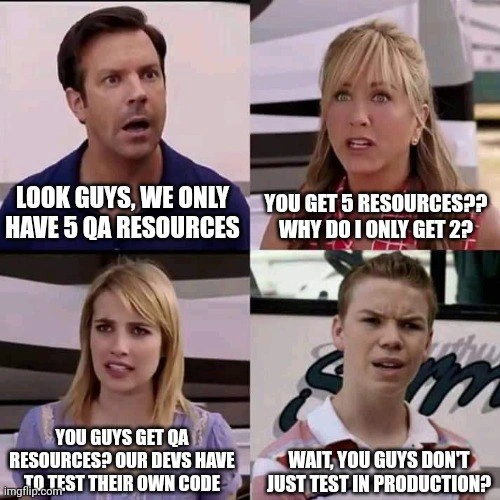
The meme is funny because each panel reveals a worse testing situation. One team complains about having only five QA people. Another has two. Another has no dedicated QA, so developers test their own code. The last one does not even seem to test before release and instead finds problems in production.
Production is the real live system users interact with. Bugs there can affect customers, data, money, trust, and sleep schedules. That is why testing in production is a scary phrase when it means "we skipped proper testing." Developers can and should test their work, but good software usually needs multiple safety layers: unit tests, integration tests, manual checks, review, staging, monitoring, and rollback plans.
Level 3: Quality As Budget Dust
The four panels escalate through a grim little hierarchy of testing privilege:
LOOK GUYS, WE ONLY HAVE 5 QA RESOURCESYOU GET 5 RESOURCES?? WHY DO I ONLY GET 2?YOU GUYS GET QA RESOURCES? OUR DEVS HAVE TO TEST THEIR OWN CODEWAIT, YOU GUYS DONT JUST TEST IN PRODUCTION?
The format works because each character thinks they are describing deprivation, only to discover someone else is operating with even less support. The final panel is the punchline and the warning label: the organization at the bottom has normalized discovering defects only after users encounter them. Every senior engineer has seen some version of this slide, usually presented in more professional fonts and called "lean delivery."
The meme is really about resource allocation disguised as quality assurance. QA is often treated as a headcount line item instead of a risk-management function. When budgets tighten, test engineers vanish first, then automated testing becomes "nice to have," then developers are told to move faster and own quality, then production becomes the only environment with enough realism to reveal the truth. By the time bugs reach customers, management can act surprised, because surprise is cheaper than staging infrastructure.
There is a legitimate version of testing in production: canary releases, feature flags, shadow traffic, observability, rollback plans, synthetic monitoring, and gradual exposure. That is engineering with guardrails. The meme is not about that. It is about the reckless version where "production" means "the first place this path has ever been exercised by a real user with real data and real impatience." That is not a strategy; it is an incident queue wearing a release badge.
The developer self-testing panel is also painfully accurate. Developers absolutely should test their own code, but they are poor substitutes for an independent quality function when incentives are misaligned. The person who wrote the feature tends to test the path they meant to build, not the weird edge case the user will find in six seconds. Good QA brings adversarial curiosity, domain memory, regression instincts, and the blessed ability to ask, "What happens if I click this twice?" before a customer does it on a Friday.
Description
A four-panel reaction meme from the "We're the Millers" format shows increasingly surprised characters comparing testing support. The captions read: "LOOK GUYS, WE ONLY HAVE 5 QA RESOURCES", "YOU GET 5 RESOURCES?? WHY DO I ONLY GET 2?", "YOU GUYS GET QA RESOURCES?? OUR DEVS HAVE TO TEST THEIR OWN CODE", and "WAIT, YOU GUYS DONT JUST TEST IN PRODUCTION?" The joke captures the sliding scale from dedicated QA teams to developer self-testing to the most reckless anti-pattern: discovering defects only after release.
Comments
8Comment deleted
Every org eventually discovers that production has perfect test data and terrible rollback semantics.
Quality Assurance ? Comment deleted
for a long time I thought of QA as Questioning & Answering Comment deleted
QA = kwa, the frog sound Comment deleted
incorrect, that's the sound ravens make. https://youtu.be/25xj0FFiddI Comment deleted
in Russian it's "ква" (kwa) and "кар" (kaar) Comment deleted
Its "قار" in persian (Qar) Comment deleted
You're close, Q&A is questions n answers Comment deleted