When the data center racks turn into an unsortable spaghetti cable nightmare
Why is this Infrastructure meme funny?
Level 1: Tangled Noodles
Imagine you have a big box of cords and you just keep throwing more and more cords into it without ever untangling them. One day, you need to find the other end of a specific cord in that giant knot – it’s almost impossible, right? This meme picture is funny because it’s like someone cooked way too much spaghetti and dumped it into a cabinet, except the “spaghetti” is actually hundreds of computer wires all jumbled up. It looks silly and overwhelming, even to people who don’t know anything about computers.
Think of it like trying to untangle a bunch of holiday lights that were carelessly tossed into storage. If you’ve ever seen a really messy toy box or a drawer full of tangled earbuds, you know it’s a headache to sort out. In the picture, the people who run those computers now have a big mess on their hands. If one wire goes bad or needs to be changed, they have to play a crazy game of follow-the-string to even find it. It’s funny in a “oh no, what a mess!” kind of way – you laugh a bit because it’s so ridiculously tangled, but you also feel a little sorry for whoever has to fix it. The joke is basically: the wires are as messy as a bowl of noodles, and just like it’s hard to pick out one noodle from a pile, it’s super hard to work with cables when they’re all snarled up like this.
So even without knowing tech details, you can see why this is humorous. It’s the kind of situation anyone can understand: when things that should be organized get completely out of control, it’s both funny and frustrating. The people in charge probably learned a lesson – just like you learn to roll up your earbuds neatly next time – and the rest of us get to chuckle and think, “Yikes! Glad that’s not my job to untangle!”
Level 2: Cable Jungle 101
If you’re a newer developer or just starting in IT, this image might look just like a bunch of wires gone wild – and that’s exactly what it is. Let’s break down why this chaotic tangle is such a big joke (and headache) in the Infrastructure and Networking world:
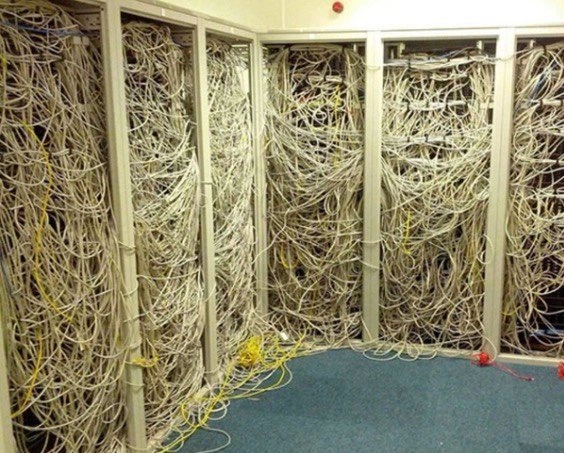
- Server Racks and Ethernet Cables: Those tall metal frames in the photo are server racks, basically shelves that hold servers, switches, and other network equipment in a data center. Each server needs to connect to the network, and it does so with Ethernet cables (the common networking cords, often Category 5e or Cat6, that plug into ports like a thicker version of your home internet cable). In a well-run server room, these cables are usually run along the sides or in cable trays, bundled neatly, and often color-coded or labeled so you know which cable goes where. Here, instead, we have a wild spaghetti of gray and yellow cables hanging everywhere. It’s like plugging in a bunch of devices and tossing all the wires in a pile – but on an industrial scale.
- What is Cable Management?: Cable management is the practice of organizing and handling all those cords so that everything stays tidy, traceable, and safe. Good cable management means labeling both ends of each cable (so you know, for example, this cable connects Server A to Switch B, port 42), bundling related cables together with Velcro straps or guides, and cutting cables to proper length so there’s not a ton of slack. The goal is that if something needs fixing, you can quickly identify and follow the correct cable. In the meme image, cable management has completely broken down. None of the cables are bundled or labeled (at least not visibly), and they’re all overlapping. It’s basically the worst-case scenario you learn to avoid in IT.
- Why is Spaghetti Cabling Bad?: Beyond just looking messy, it creates real problems. Imagine you’re a junior admin asked to find why Server X can’t talk to the network. In a tidy setup, you could trace its one labeled cable from the server’s network card to the correct switch port in minutes. In this spaghetti scenario, you’d see 100 identical gray cables disappearing into a tangle. You might gently tug a cable to see which one moves on the other end – but tug the wrong one and you might unplug something by accident (oops, there goes the database server!). It’s also super time-consuming – something that should take 5 minutes can take hours as you sort through the mess. And hardware-wise, piles of cables can block airflow around machines, which can cause overheating as mentioned. So it’s not just an aesthetic issue; it can break stuff and make fixes much harder.
- Technical Debt in Hardware: You might have heard of technical debt in code – like when developers write quick-and-dirty code that later becomes a big problem to maintain. This picture is that concept applied to hardware. Each unorganized cable was probably added in a hurry (“I need to get this new server online ASAP, no time to route it nicely!”). Each time someone said “I’ll clean it up later,” they never did, and the mess grew. Over years, those decisions accumulate into a tooth-gnashing tangle. Just like a new programmer eventually has to rewrite a messy legacy codebase, an IT team eventually has to spend a ton of effort cleaning up a spaghetti cabling situation. It’s a MaintenanceNightmare because you can’t fix it little by little easily – it’s so interconnected and messy that you almost have to schedule a big project to redo it. And until you do, every day it’s a risk.
- Relatable Newbie Experience: Even if you haven’t managed a data center, you might have some relatable smaller-scale experiences. Ever pull out the wrong plug under your desk because all the cords were tangled and looked the same? Or struggle with a bunch of charging cables in a drawer that somehow tie themselves into knots? That’s the same concept. In IT support, a rite of passage is walking into a company’s network closet or server room and finding something like this – wires everywhere. It’s overwhelming at first. You quickly learn why people stress “label everything!” and “one change at a time!” If you intern or start as junior IT, one of your early jobs might be to literally help clean up a mess like this, untangling and labeling cables. It’s not fun, but boy do you learn fast why good practices matter. And when you see a photo like this online, you laugh a bit, because you know somewhere an IT team is dealing with it and muttering under their breath.
In summary, this meme is popular in OpsHumor circles because it highlights a universal truth in tech: neglecting the “boring” stuff like organizing cables can lead to epic problems. Beginners might not think about cable organization when dreaming of tech jobs, but it’s an important part of running real systems. The image is funny (in an eye-rolling way) because it’s such an exaggerated failure of basic networking hygiene that you can’t help but chuckle and be glad you’re not the one dealing with it – or resolve that you’ll never let anything you manage get that bad! It’s a classic cautionary image shown in IT talks and forums: “Don’t be this guy.” Now you know why.
Level 3: The Gordian Network
"Spaghetti servers that handle your spaghetti code"
The meme’s caption cleverly links spaghetti code – a term for tangled, unstructured software – to this nightmarish tangle of network cables. Any seasoned engineer who’s walked into a data center immediately cringes at this sight: a cable management catastrophe spanning four server racks. Instead of neatly bundled lines, we see an impenetrable web of gray and yellow Ethernet cords spilling over everything. This is infrastructure TechnicalDebt incarnate – years of quick fixes and ad-hoc adds, all knotted together in a legacy data center that time (and documentation) forgot. It’s the physical equivalent of maintaining a decade-old monolithic app with global variables everywhere: chaotic, fragile, and one false move from disaster.
From a senior ops perspective, this scene is more horror than humor because we know exactly what could go wrong:
- Troubleshooting Hell: When a server is down or a switch port fails, finding the right cable in this rat’s nest is a nightmare. Without clear labels, you’re stuck tugging on cables to see which blinking port flickers – a high-stakes game of Cat5 Twister. Hours can vanish tracing one connection. In outages, the pressure is intense: it’s 3 AM, everything’s on fire (figuratively… hopefully), and you’re waist-deep in spaghetti hoping you unplugged the correct gray wire (not the database server!).
- Overheating & Airflow Risk: All those tangled cables aren’t just a tripping hazard – they’re choking off ventilation. Data center servers run hot, and they rely on front-to-back airflow. This spaghetti cabling baffle blocks the fans like a dense jungle, so heat gets trapped. Ever had a server mysteriously throttle or reboot? Surprise! It wasn’t poltergeists, it was suffocation by cable. Experienced infrastructure folks will tell you messy cabling can literally bring down hardware by cooking it slowly.
- Accidental Unplugs: In a properly managed rack, each cable is secured and runs a tidy path. Here, everything’s draped and dangling. One wrong tug and you’ll rip out cables you didn’t intend to touch. Need to replace a bad cable? Good luck – you’ll inevitably jostle five others and knock critical systems offline. The meme hits home because this “cascade of chaos” is OpsHumor legend: the moment you gingerly pull one cable, half the rack’s connections wink out. It’s like a cruel magic trick in legacy Networking setups.
- Maintenance Nightmares: Adding or removing equipment in this setup is a last-resort operation. Nobody wants to be the poor soul provisioning a new server in Rack #3, because there’s literally no clean path to run the network cable. Over years, every “temporary” patch cord that was supposed to be replaced later just stayed put, buried under newer layers. The result is a LegacyInfrastructure nightmare that’s practically a shrine to neglect. Seasoned techs joke that the only solution is to grab the nearest machete (or giant wire cutters) and mercifully cut the whole Gordian knot, then re-cable from scratch during a marathon downtime. It’s a dark joke – referencing how Alexander the Great solved an impossible tangle by slicing it apart – because we know in reality you can’t just sever everything without a colossal outage. But at some point, extreme mess leads to extreme measures.
This meme is funny because it’s too real. Anyone who’s done on-call server maintenance or walked into an old server room has felt this mix of horror, frustration, and grim laughter. It’s the déjà vu of inheriting someone else’s long-neglected mess. The photo likely triggers war stories: “Remember that closet in Building 5 where we found 20-year-old coax jammed under a floor tile?” or “I spent an entire weekend labeling cables after one like this caused a day-long outage.” The humor has a bite: we laugh, shaking our heads, because we’ve learned the hard way that neglecting basics like documentation and cable hygiene will absolutely come back to bite you. And of course, these fiascos tend to surface at the worst possible moment – often right when Production is on the line. There’s an old sysadmin quip, “It’s never DNS… except when it is.” In a mess like this, we amend it to: “It’s never the cable… except it’s always the $@#% cable.”
Ultimately, the meme resonates on an almost traumatic level for senior IT folks. It’s a satirical reminder that in tech, the smallest overlooked tasks (like neatly routing a wire) can snowball into monstrous problems. The image is absurd, yes, but not unimaginable – that’s the punchline. This is a monument to TechnicalDebt in physical form, a cautionary tale told with a grim chuckle. We’ve seen pristine data halls and we’ve seen spaghetti nightmares, and we’d take a labeled, well-managed rack any day. But when faced with a Gordian network like this, veteran engineers will quote another darkly funny adage: “Good documentation is for when you leave – a messy cabling job is for when you plan to never, ever leave… or you really hate your successor.” 😈
Description
The photo shows four tall open server racks packed edge-to-edge with an overwhelming tangle of gray, white, and occasional yellow Ethernet cables that spill across every vertical space - no labeling, no bundling, just an impenetrable web. The floor is blue carpet, and a few loose red and yellow patch cords snake onto it, hinting at recent frantic plugging-in. No textual labels, screens, or equipment are visible; the wiring obscures any hardware that might be inside the racks. Technically, this illustrates catastrophic cable-management failure, creating troubleshooting chaos, airflow problems, and a physical manifestation of networking technical debt that every infra or on-call engineer dreads. It’s a classic “spaghetti cabling” meme that resonates with infrastructure, networking, and ops teams who have inherited legacy server rooms

Comments
7Comment deleted
Conway’s Law, but make it physical: after three org reorgs, the network diagram turned into four racks of recursive patch cables - now on-call has to run Dijkstra just to locate port 80
This is the server room where every cable is critical, but nobody knows which one, so we just added observability by making them all visible at once
This is what 'we'll document the network later' looks like after fifteen years of later
This is what happens when your network topology documentation strategy is 'the cables will remember.' Every senior engineer has inherited one of these - a Lovecraftian horror where pulling the wrong cable could take down systems that haven't been documented since the Clinton administration. The real nightmare? Somewhere in that tangle is a critical production link, and the only person who knew which one retired in 2003. It's not technical debt, it's technical bankruptcy with compound interest
Postmortem: MTTR scales with a depth-first search over an unlabeled Cat5e graph, because our Layer 1 implements spaghetti-driven networking
Cable management so bad, it's the physical twin of a microservices mesh with zero service discovery
Our dependency graph rendered at Layer 1 - incident response is BFS with a flashlight, and MTTR scales linearly with knots per meter