Skip to content
DevMeme
4423 of 7435
Recruiter meme shows full-stack dev expected to fill every tech role
Career HR Post #4845, on Sep 5, 2022 in TG

Recruiter meme shows full-stack dev expected to fill every tech role

Why is this Career HR meme funny?

Level 1: One-Person Band

This meme is funny because it’s like expecting one person to do every job all at once, which we know is silly. Imagine a small restaurant where one person is asked to be the cook, the waiter, the cleaner, the cashier, and even the manager all at the same time. 🍲 Could one person really handle making the food, taking orders, washing dishes, handling the money, and running the whole restaurant alone? Of course not – they’d be completely overwhelmed and the service would be terrible! In the same way, the meme jokes that a company wants one “full-stack developer” to do many different specialized jobs (from art design to writing code to fixing computers to doing legal work). It’s a humorous exaggeration that makes us laugh because it’s obvious one person can’t do everything well. The core of the joke is about being asked to wear too many hats: anyone would feel stressed and confused if they had to be an entire team by themselves. So the stick figure in the picture looks blank and stunned, just like we would if someone expected us to be a whole company’s worth of experts in one body. The meme makes a point in a simple way: asking one person to do everyone’s job is just crazy – and that’s why it’s funny.

Level 2: Wearing Many Hats

For a newer developer or someone early in their career, let’s break down why this meme’s scenario is so over-the-top. A full-stack developer by definition is someone who works on both the frontend and backend of an application. The frontend is the part of the software that users directly see and interact with – think of a website’s buttons, layout, and design in the browser, created with languages like HTML, CSS, and JavaScript. The backend is the behind-the-scenes part on the server – it’s where the business logic lives, handling things like database queries, user authentication, and server-side operations (often written in languages like Python, Java, Node.js, etc.). Being “full-stack” means you can do both of these. That already requires learning two different domains (user interface vs. server logic), which is a big ask but fairly common in web development roles.

Now, the joke is that this meme’s version of a “Fullstack developer” is expected to wear many more hats beyond those two. The stick figure has arrows labeling a whole array of jobs that are usually separate specialties. Here’s what each of those roles means in real life:

  • UI/UX Designer – Short for User Interface / User Experience designer. This person plans out how the app should look and feel, designing layouts, choosing colors, crafting the style of buttons, and ensuring the product is easy and pleasant to use. It’s a creative role, often involving tools like Figma or Adobe XD, and not necessarily coding.
  • Graphic Designer / Icon Designer – These roles focus on creating visual artwork: logos, icons, images, and other graphics. If an app or website needs custom illustrations or a distinctive logo, a graphic designer does that. It’s an art/design field requiring talent with drawing or design software like Photoshop or Illustrator. (It’s quite different from writing code!)
  • Social Media Manager – That’s a marketing role. This person handles the company’s presence on social platforms (Twitter, Facebook, LinkedIn, etc.), writes posts, engages the community, and builds the brand online. It’s nowhere near the role of a software developer – it’s more about communication and marketing strategy. The meme including this in a developer’s job description is highlighting how some companies absurdly expect tech folks to handle marketing duties “since you’re good with computers.”
  • IP Lawyer – This stands for Intellectual Property lawyer, a legal professional who deals with patents, trademarks, and copyrights. Becoming an IP lawyer requires going to law school and specializing in tech or patent law. It’s a completely different profession from coding. By including “IP lawyer” in the list, the meme is using hyperbole (exaggeration) to make it obvious that the job description has gone off the rails. No software engineer is also going to draft patents and handle legal disputes as part of their dev job – that’s what actual lawyers do.

On the right side of the figure, we have roles more related to what happens behind the scenes in tech and IT:

  • Network Manager – A person responsible for the computer networks in an office or datacenter. They set up and maintain routers, switches, and ensure that all the computers and servers can communicate. Think of the folks who make sure the office Wi-Fi and VPN are running securely. It’s a specialization within IT. In smaller companies, sometimes a backend dev might dabble in this, but it’s typically a separate role (often called a network admin or engineer).
  • System Architect – This is a senior technical role where someone plans the overall structure of a software system. They decide how all the pieces (frontend, backend, databases, external services) fit together. They’re looking at the “big picture” of the software design. It’s the kind of role you grow into after years of experience, focusing on high-level design rather than day-to-day coding of every piece.
  • Hardware Maintainer – The person who takes care of physical machines. If a server’s hard drive fails or more memory needs to be installed in a server, a hardware maintainer (or hardware engineer) handles it. This role could also include maintaining employee workstations or any physical tech equipment. It’s more hands-on with actual devices and hardware parts.
  • Pen Tester – Short for Penetration Tester, which is a cybersecurity role. A pen tester tries to hack into their own company’s systems (with permission) to find vulnerabilities and weaknesses before real attackers do. It’s a specialized job requiring knowledge of security tools, hacking techniques, and lots of caution. Again, it’s quite separate from writing application features or designing a UI.
  • DevOps – This term is a blend of “Development” and “Operations.” A DevOps engineer sets up and maintains the infrastructure that developers use to deploy and run their applications. They create automated pipelines for testing and deployment (CI/CD), manage servers or cloud services, handle scaling, monitoring, and ensure the app stays running smoothly after it’s launched. In many companies, DevOps is its own specialized position, because it involves expertise in things like Docker, Kubernetes, cloud platforms, and monitoring tools. Some full-stack devs do dabble in DevOps (especially in small teams), but larger organizations often have dedicated DevOps teams.
  • Office IT Guy – This is the go-to technical support person in an office. Have a laptop issue, need an email account setup, the printer is jammed, or the conference room projector isn’t working? You call the IT support guy/gal. It’s a role focused on helping colleagues with day-to-day tech problems and maintaining office systems. While any tech-savvy person can do some of this in a pinch, being the official IT support is a whole job in itself.
  • Server Monitoring – This isn’t so much a job title as a responsibility, often part of DevOps or IT operations. It means keeping an eye on servers to catch problems early. It involves using monitoring software to track things like server load, memory usage, error rates, and uptime. If something goes wrong (like a server going down at 3 AM), the monitoring system alerts someone on call to fix it. In big companies, a Network Operations Center (NOC) team or SRE (Site Reliability Engineering) team might handle this.

Reading that list, you can probably see how each one of these bullet points is a significant role. People build entire careers specializing in just one or two of those areas! That’s why it’s so amusing and absurd that the meme’s “Fullstack developer” is supposedly doing all of them. For a junior developer, this highlights an important point: no single person is realistically an expert in all of these things at once. You might learn a bit of each over a long career (and it’s great to be flexible and pick up new skills), but job postings that demand everything under the sun are notorious red flags. They either indicate the employer doesn’t understand what they need, or they expect one person to do the work of an entire team.

If you’re early in your career, you might not have encountered this yet, but trust me – at some point you’ll see a job ad or a recruiter email that looks like the meme’s text. It might say something like: “Wanted: Full-Stack Developer. Must be proficient in React, Node.js, PHP, Photoshop, UI/UX, SEO, network security, AWS, Kubernetes, mobile app development, and have 8+ years experience in each.” 😅 When you’re new, you might wonder “Do I really have to know all that?!” The answer is no – nobody does. Even experienced engineers giggle (or groan) at those requirements. The meme is a way for developers to commiserate about this skillset_overload phenomenon. It’s poking fun at how the term “full-stack” can be misused to mean “basically do everything, please.”

Many of us have actually been in a situation like the stick figure, especially in smaller companies or startups. For example, I remember as a junior dev at a tiny startup, one day I was coding the website frontend, and the next day I was asked to help design a product logo and troubleshoot why the office internet was down. 😬 It was baptism by fire, but it taught me the hard way that “other duties as assigned” can cover an awful lot! This meme takes that idea to cartoonish extremes. Its message to a junior engineer is: don’t take these crazy all-in-one job descriptions too seriously. Real software development jobs usually have a more reasonable scope (or at least, everyone knows you’ll be learning some of those skills on the job, not arriving as an expert in all). If you ever feel overwhelmed seeing a “must know everything” listing, remember this meme and realize even veteran developers think it’s ridiculous. A full-stack developer is generally a well-rounded coder who can handle both ends of an application – not an actual superhero who’s simultaneously a coder, designer, hacker, sysadmin, and lawyer!

Level 3: Jack of All Stacks

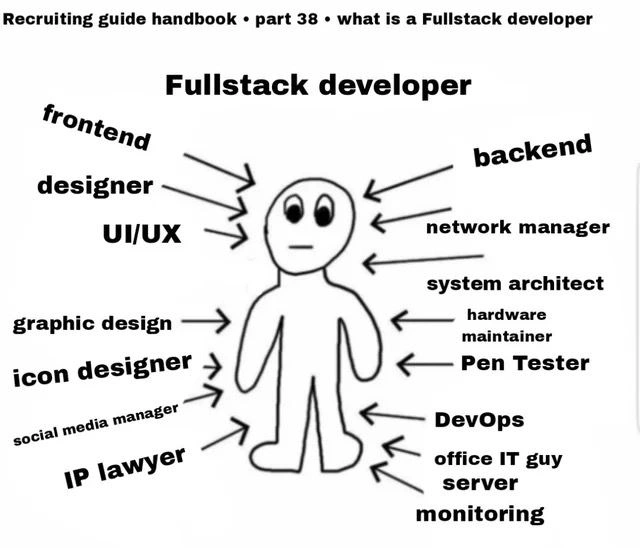
In the meme’s black-and-white cartoon, a wide-eyed stick figure labeled “Fullstack developer” stands surrounded by arrows pointing in from every direction. Each arrow is tagged with a different job title or responsibility: on the left side we see labels like frontend, UI/UX, graphic design, social media manager, even IP lawyer; on the right side, labels for backend, system architect, hardware maintainer, Pen Tester, DevOps, office IT guy, and more. It’s a comically absurd recruiter checklist of skills. The humor hits experienced devs right away: this stick-figure FullStackDevelopment hero is expected to be a jack_of_all_trades — essentially a one_person_it_department on legs. Anyone who’s been around the tech industry recognizes this as savage TechIndustrySatire of real job postings that try to cram an entire team’s duties into one role.

Why is this so funny (and painful) to seasoned developers? Because we’ve all encountered those unrealistic job listings that read like a wish-list for a unicorn. The meme exaggerates it perfectly: the “Fullstack developer” here isn’t just doing front-end and back-end coding (which is already a lot), they’re also the designer, the network admin, the legal counsel for intellectual property, and apparently the social media manager for good measure. Sure, why not also ask them to mop the floors and brew coffee while they’re at it? 😏 This dark humor reflects a real CorporateCulture problem: some companies (or non-technical recruiters) either don’t understand specialization or just don’t want to hire enough people, so they write an ad for a mythical “all-in-one” developer. The result is a laundry list like the one in the meme, where Full Stack Developer implicitly means “will handle literally everything technical (and then some).” Experienced engineers read that and roll their eyes, because they know it’s an impossible expectation — a classic DeveloperPainPoints moment.

The arrows in the image underscore just how overloaded the term “Fullstack” has become. Originally, a full-stack developer meant someone comfortable with both frontend (building the user interface of an app or website) and backend (the server, database, and logic behind the scenes). That alone requires multiple skill sets. But this meme’s tongue-in-cheek definition of full-stack ballooned into “full everything.” It’s poking fun at the way recruiters keep tacking on more skills: first you needed to do web design and server code; then and manage the servers (hello DevOps); oh, also be a Pen Tester to secure it; and might as well do UI/UX design because why hire a separate designer; and hey, if you can do UI, you can probably make our graphics and logos (graphic/icon designer); and since you know computers, you’ll also fix the office Wi-Fi (office IT guy) and maintain hardware. The meme even tosses in IP lawyer sarcastically, as if to say, “We basically expect this one developer to even handle legal patents and copyright issues.” That one is so absurd it’s hilarious — no tech job should require a coding guru who’s also passed the bar exam. The presence of IP lawyer in the list is a wink to every dev who’s seen job requirements spiraling out of control. It’s the meme’s way of shouting, “See how ridiculous this is? Companies sometimes act like a ‘full-stack dev’ means literally every skill under the sun.”

This resonates strongly with veteran developers because it’s too real. Many of us have war stories of interviews or job descriptions where we were expected to be a Swiss Army knife developer. Perhaps a startup wanted a single hire to build the website front-end, code the back-end system, set up the AWS servers, monitor them 24/7, design the UI graphics, run A/B tests, manage the database, and also run the company Twitter account. The meme captures that overstuffed expectation perfectly in one image. It’s funny because it’s true: the tech industry does have a habit of looking for “rockstar” or “ninja” developers who supposedly can do it all. This HiringHumor highlights the disconnect between Career_HR fantasies and reality. Experienced devs know that software projects are a team sport with specialized positions for a reason. When a recruiter or manager treats one person as an entire engineering department, the result is usually burnout, bugs, and unmet expectations. As the cynical joke goes, “We’re looking for a junior developer who codes like a senior, designs like an artist, tests like a security expert, and manages systems like an admin — all for an entry-level salary.” 😅 It’s laugh or cry, so we choose to laugh via memes like this. In short, FullStackDevelopment is a broad skill area, but this meme jokes that some companies interpret it as “full*-*stack-of-everything”. The absurdity makes experienced folks chuckle knowingly (and maybe forward the meme to their tech friends with a sigh).

Description

Black-and-white cartoon meme titled “Recruiting guide handbook • part 38 • what is a Fullstack developer”. A blank, round-headed stick figure stands center with the bold heading “Fullstack developer” above it. Arrows point inward from all directions, each labeled with a job or responsibility: on the left side “frontend”, “designer”, “UI/UX”, “graphic design”, “icon designer”, “social media manager”, and “IP lawyer”; on the right side “backend”, “network manager”, “system architect”, “hardware maintainer”, “Pen Tester”, “DevOps”, “office IT guy”, and “server monitoring”. The visual joke highlights how some job listings treat a single full-stack engineer as an all-purpose designer, network admin, security tester, and even lawyer. Technically, it satirizes unrealistic hiring requirements and the broad ambiguity of the term “full-stack”, resonating with experienced engineers who have encountered overloaded role descriptions
Comments

9
Anonymous ★ Top Pick “Full-stack” now translates to: design the Figma, write the React, shard the Postgres, babysit the k8s cluster, pentest the pipeline, rewrite legal’s NDA - then sprint downstairs to fix the CEO’s printer… all for “competitive” stock options that vest the day after end-of-life
  1. Anonymous ★ Top Pick

    “Full-stack” now translates to: design the Figma, write the React, shard the Postgres, babysit the k8s cluster, pentest the pipeline, rewrite legal’s NDA - then sprint downstairs to fix the CEO’s printer… all for “competitive” stock options that vest the day after end-of-life

  2. Anonymous

    After 20 years in tech, I've finally discovered the true definition of 'fullstack': it's the height of all the hats you're expected to wear simultaneously before the entire thing topples over during your next standup

  3. Anonymous

    Ah yes, the fullstack developer - a mystical creature who can simultaneously debug a React component, optimize database queries, design pixel-perfect UIs, configure Kubernetes clusters, conduct penetration tests, manage social media campaigns, and provide legal counsel on intellectual property... all while fixing the office printer. Recruiters expect you to be the entire engineering org, design team, security department, and IT helpdesk rolled into one - naturally for a mid-level salary with 'competitive' equity that vests over four years. The real kicker? They'll still ask for five years of experience in a framework that's been around for two

  4. Anonymous

    Fullstack dev: the human monolith that owns every layer from HTML to HVAC, until the first OOM kill

  5. Anonymous

    'Fullstack' here is Conway's Law expressed as cost optimization: one FTE to ship the UI, run the backend, own SRE, pen test the release, babysit the network, and defend the patents

  6. Anonymous

    Definition of “full‑stack” at enterprise scale: an org‑wide microservice that violates the Single Responsibility Principle and scales via burnout, not autoscaling

  7. Deleted Account 3y

    salary: x1.3 of a FE developer

  8. @GLXBX 3y

    OMG, IP lawyer Fucking bureaucrats, they are everywhere

    1. dev_meme 3y

      Well, that's just real life :(

Use J and K for navigation