The Literal Code Easter Egg
Why is this DevCommunities meme funny?
Level 1: Egg With Code
Imagine someone hears the phrase "Easter egg in the code" and decides to write the word "CODE" on a real Easter egg. That is all the joke needs. It is funny because it turns a computer phrase into an actual object you could pick up from an egg carton.
Level 2: Easter Egg Terms
For a newer developer, there are two puns to untangle. First, a software Easter egg is a hidden joke or surprise inside a program. It might appear after a secret key combination, a special command, or an unusual interaction. It is called an Easter egg because users "hunt" for it.
Second, shellcode is a security term for small code used as part of an exploit. It is not normally about egg shells. In the meme, though, the green egg has a shell and the word CODE on it, so the phrase becomes literally true in the dumbest possible way.
That is why this fits CodingHumor, VisualPuns, and DeveloperMemes. It does not require a complicated architecture failure or production outage. It only requires knowing that programming is full of words that also mean normal physical things. Once you see an egg marked CODE, your brain supplies the rest of the joke.
Level 3: Shellcode, Literally
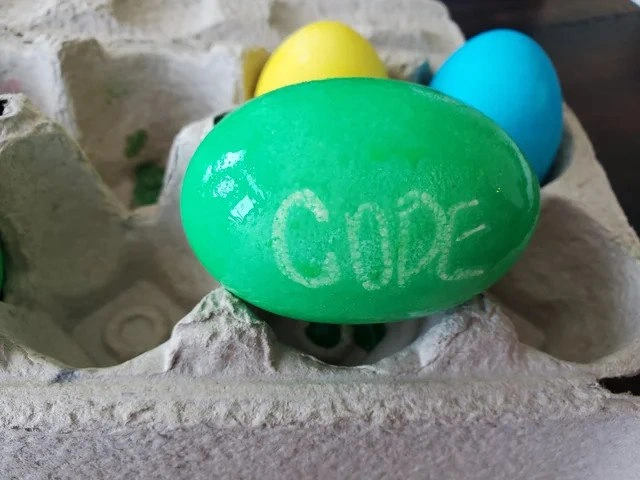
The image is a close-up of dyed eggs in a carton, with the front green egg labeled:
CODE
The post text adds, "Shellcode code or something, I'm not SecOps," which gives the simple visual pun a developer-security flavor. A real shellcode payload is code used in exploitation contexts, historically named because it could spawn a command shell or otherwise give an attacker control. This image takes the word apart like a dad joke with syntax highlighting: an egg has a shell, and the shell has CODE on it. Therefore, shellcode. Please alert the incident commander immediately; brunch has achieved arbitrary execution.
The humor is mostly LiteralismInTech. Developer culture is packed with terms that sound absurd when pulled out of their technical habitat: Easter egg, shell, daemon, fork, pipe, socket, cookie, wrapper. Put CODE on an actual Easter egg and the metaphor collapses into a physical object. The joke is not that the egg is doing anything computational. It is that a software phrase has been rendered with the least abstract implementation possible.
There is also a small TechHistory layer. "Easter egg" in software usually means a hidden feature, joke, credit, animation, or surprise placed inside an application. Older software and games famously hid secret screens or playful commands that users discovered by accident or word of mouth. Modern teams are more cautious because hidden behavior can create maintenance risk, security review questions, accessibility gaps, or confused users. Still, the phrase survived because developers like hiding little signatures in systems that otherwise try very hard to look professional.
The image is funny because it combines two kinds of hiddenness: the cultural idea of an Easter egg in code, and the physical egg that literally says CODE. It is the rare codebase artifact with perfect documentation. Unfortunately, it still has no README.
Description
A close-up photo shows a gray cardboard egg carton holding bright dyed eggs, with a large glossy green egg in front. The green egg has the word "CODE" written across it in pale chalky letters, while yellow and blue eggs sit behind it. The meme works as a literalized developer pun: a real Easter egg labeled as code, nodding to hidden features, in-jokes, and surprises buried inside software.
Comments
5Comment deleted
Finally, an Easter egg in the codebase that doesn't require decompiling a decade of commit history.
No one has commented till now, looks like I'm not the only one who didn't understand 😐. Comment deleted
No I got it XD Comment deleted
Сука, ты уже доебал со своими ослами Comment deleted
القانون لا يحمي المغفّلين. Comment deleted