Skip to content
DevMeme
2854 of 7435
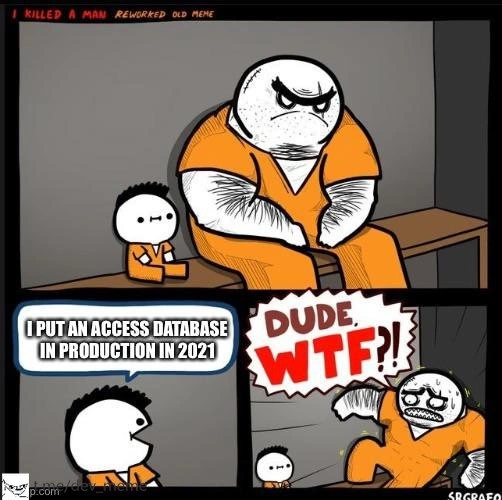
Prisoner confesses shipping Access DB to prod, cell-mate erupts in disbelief
Databases Post #3152, on May 22, 2021 in TG

Prisoner confesses shipping Access DB to prod, cell-mate erupts in disbelief

Why is this Databases meme funny?

Level 1: Stuck in the Past

Imagine if your friend proudly said, “Hey, I built our school’s new high-speed internet network using old telephone dial-up modems!” and you know today everyone else is using super-fast fiber Wi-Fi. You’d probably shout, “What are you thinking?!” in shock. That’s basically what’s happening in this meme, but with computer stuff. One character admits they used a really old tool (a Microsoft Access database – kind of like an old toy) to do an important modern job. The other character can’t believe it – it’s like someone driving a horse-and-buggy on a highway full of race cars. Of course the friend is upset and surprised: using such an outdated solution in today’s world is obviously a bad idea. The humor comes from treating this tech mistake as if it’s a huge crime. In simple terms, it’s funny because one person did something so old-fashioned and risky that the other reacts with an exaggerated “Dude, what the heck?!” Just like anyone would laugh (and cringe a little) if someone tried to solve a 2021 problem with a tool from the 1990s, we laugh at this comic. It’s saying: even a kid knows you shouldn’t use an old, flimsy solution when you have much better options today!

Level 2: Production Penitentiary

Let’s break down why the big guy in the orange jumpsuit is so outraged. Microsoft Access is an old-school desktop database system, part of Microsoft Office, that stores all its data in a single file (often with an .mdb or .accdb extension). Think of it like a glorified spreadsheet or a mini database you might use for a small personal project or a one-person task. Back in the late 90s and early 2000s, small businesses and non-programmers used Access to build simple apps (like tracking inventory or contacts) because it was easy – no server setup, just a file you could open. It’s the definition of LegacyTechnology now. By 2021, hardly any professional software uses Access for serious applications. Instead, we have modern databases like MySQL, PostgreSQL, or Microsoft SQL Server which run as dedicated services and can handle many users at once, large datasets, and heavy traffic. These modern databases are designed for production environments – meaning the live systems real customers or users interact with, where stability and performance are crucial.

So why is putting an Access DB in production such a facepalm moment? Because it’s a bad production practice on multiple levels:

  • Scalability: Access isn’t built to handle a website or app with dozens or hundreds of concurrent users. It’s more for maybe a couple of people opening a file. A file-based system chokes when too many people knock on its door. Imagine everyone trying to edit the same Word document at once – it’s going to get messy. Similarly, too many simultaneous requests to one Access file can cause it to lock up or slow down dramatically.
  • Reliability: Proper databases (like PostgreSQL) have strong mechanisms to keep your data safe (transaction logs, recovery tools, robust ACID compliance). Access is much more fragile. If the application crashes or the network blips while writing to that .mdb file, you could end up with a corrupted database. That’s as scary as it sounds – your production data could become unreadable. In tech terms, that’s a one-way ticket to a 2 AM ProductionIssue trying to salvage data.
  • Concurrency: Modern DBs allow many queries/transactions at the same time. Access uses file locks – essentially saying “only one (or very few) person can change data at a time.” If your website or service gets even moderate traffic, an Access DB becomes a bottleneck. It’s like a single-lane bridge on a busy highway.
  • Maintenance and Tools: Today’s databases have lots of tools for backup, replication, monitoring, etc. With Access, you’re pretty limited. It doesn’t play nicely in a distributed or cloud environment. Need to scale up? Too bad – you can’t easily cluster an Access file or split load between servers. It was never meant for that.

The meme is set in a prison because it’s using a popular format often captioned as “I killed a man” meme (here it’s a reworked version). In the original style, one prisoner brags about a crime to look tough, and the other prisoner is either shocked or unimpressed by something. Here, the crime confessed is tech-related: “I PUT AN ACCESS DATABASE IN PRODUCTION IN 2021.” The humor is that to developers, this is comically horrifying – it’s an exaggeration, of course, but it taps into a shared understanding that this is a huge no-no. The big cellmate’s reaction – “DUDE, WTF?!” – is exactly how a fellow developer or a system admin might react if a teammate admitted they deployed an Access .mdb as the company’s live database. It mixes real-world logic with developer logic: normally a jail inmate would freak out over serious crimes, not computer stuff, but in developer culture, using a file_based_database like Access in an important system is shockingly poor form.

Let’s define a few terms and concepts for clarity:

  • Production: This refers to the live environment where an application or website is running for real users. For example, a company’s website when it’s live on the internet is “in production.” Mistakes in production are costly because they affect real customers and data. Developers usually have testing or development environments to iron out issues. Something that "works on my machine" but fails in production is a classic problem. Here, using Access in production implies the live system depends on that Access file.
  • Legacy System/Technology: This means old, outdated technology or systems still in use. Often they’re kept because they still work (if it ain’t broke, don’t fix it mentality) or because migrating away is hard. Microsoft Access is considered a legacy tech for multi-user database needs – it’s been around for decades, and modern systems have largely moved on. If you find Access running something critical at a company in 2021, that’s legacy with a capital L.
  • Technical Debt: Think of this like taking a shortcut in coding or architecture that saves time now but causes problems later (you incur a “debt” you’ll have to pay back with interest). Using a quick-and-dirty solution like Access for a production database is a prime example of tech debt. It might have been the fastest way to get something working initially (no need to set up a real database server, just use a file!), but down the road it’s going to cost a lot of pain to maintain, fix, and eventually replace. The longer you delay fixing it (paying off the debt), the more “interest” you accumulate (bugs, crashes, limitations).
  • Microsoft Access: Specifically, this is a product that provides a GUI and engine to create databases, queries, forms, and reports – all in one file or project. It uses the Jet/ACE database engine under the hood. You don’t need a separate server – the trade-off is limited multi-user capability and robustness. In contrast, something like PostgreSQL or MySQL is a standalone database server that you install and it runs continuously, clients (your app) connect to it over a network. These can handle many simultaneous connections and large amounts of data efficiently. By 2021, open-source databases and cloud database services are so powerful and readily available that choosing Access would be very unusual except for very small-scale needs.
  • “I killed a man” meme format: This refers to the comic style used. The meme typically has a small figure and a big intimidating figure in prison. The small one says something (often a dramatic or shock-value statement), and the big one reacts. Meme creators replace the dialogue with different scenarios. In this case, a developer-oriented twist is used: the little guy confesses to the “crime” of deploying Access to production. The big guy’s over-the-top reaction is the punchline. It’s funny to us because deploying an Access database is not literally illegal, but to IT professionals it feels like such a grievous misjudgment that the exaggerated response feels earned. It’s a form of DatabaseHumor where only those in the know get why it’s outrageous.

In summary, the comic highlights database choice regret. The offender likely took an easy path (sticking an Access file in the app) instead of doing it “properly,” and now they’re being called out. It underscores a generational shift too: older tech like Access doesn’t belong in a modern environment without inviting trouble. The year 2021 in the confession emphasizes just how late in the game this mistake is – it’d be like someone saying they used dial-up internet to host a Zoom meeting in 2021; you’d be incredulous. The meme exaggerates reality to make a point: some shortcuts are so bad that they’re practically offenses in the developer world. And judging by the big inmate’s reaction, this one’s a whopper.

Level 3: File-Based Felony

Deploying a Microsoft Access database to a modern production environment in 2021 is the kind of tech sin that makes veteran engineers' eyes twitch. This meme nails that absurdity by treating it like a prison-worthy offense. The smaller inmate calmly confesses, "I put an Access database in production in 2021," as if admitting to a heinous crime, and the burly cellmate explodes in rage: "DUDE, WTF?!". To seasoned devs, this reaction is hilariously relatable – using Access in prod is practically a crime against software. Why so extreme? Because Microsoft Access is a relic file-based database, the sort of thing that had its heyday in the 90s but has no business in a modern stack.

In an enterprise setting, relying on a single .mdb/.accdb file instead of a proper client-server database (like PostgreSQL, MySQL, or SQL Server) is begging for trouble. It’s TechDebt of the highest order – a quick-and-dirty solution from yesteryear that becomes a ticking time bomb in your infrastructure. Experienced devs have seen this horror story play out: some small department or old app started with Access because it was cheap and easy, and years later that ad-hoc solution is still somehow running core production data. It’s like discovering the company bank ledger is an Excel file named final_final_USE_THIS_v2.xlsx: terrifying and all too real. The meme’s prison interrogation setting and over-the-top shock capture how egregious this is – as if the dev admitted to something unspeakable. In our circles, "I shipped an Access DB to prod" elicits the same aghast silence as confessing a mortal sin.

Why is it such a big deal? For one, Access is a file-based database, meaning the entire dataset lives in a single file on disk. There's no dedicated server process managing connections like a real database engine. When multiple users or an application hit that file at the same time, you get nightmares like file locks, slow I/O, and corruption. It’s the opposite of what a scalable Production system demands. By 2021, best practices and common sense say: use a robust RDBMS or cloud database for any serious application. The fact someone still leaned on Access (an old technology in a modern stack) suggests a stew of LegacySystems pain and perhaps desperation. It’s a textbook bad production practice that triggers every senior engineer’s fight-or-flight response. We’ve all heard war stories of some critical system inexplicably running on Access or other outdated tech, and how it caused sleepless nights. The meme resonates because it exaggerates a common anxiety: the lurking legacy component that could bring the whole system down.

Let’s talk real scenarios: imagine you’re on-call and at 3 AM the site goes down. You trace the issue and… surprise! The “database” is a \\shared-folder\prod-db.accdb file on a network drive, and it’s locked or, worse, the file got corrupted under load. ProductionIssues galore. Now you’re scrambling to restore a backup (if one even exists) or coax the file to repair itself. Been there, done that, got the scars. A cynical veteran will sarcastically say, “It’s always the Access database, isn’t it?” – a dark twist on "It's always DNS". The meme’s humor lies in this shared PTSD: the large inmate’s furious disbelief mirrors how a senior DBA would react upon hearing this confession in a code review or postmortem meeting. It’s funny because it’s true – not that it happens often nowadays, but when it does, it’s unforgettable. Using Access in prod is essentially volunteering for a LegacySystemsAndModernization case study; sooner or later you’ll have to modernize that mess, likely under duress. The inmate’s “WTF?!” is exactly what any of us would shout, albeit after we pick our jaw up off the floor. This comic pokes fun at DatabaseHumor and TechnicalDebt by showing an extreme violation of database best practices as if it’s a literal crime. After all, in developer culture, shipping a clunky Access file to production is tantamount to treason against the software gods – and the only fitting punishment is the disapproval (and jokes) of your peers.

Description

Three-panel illustrated comic in the "I killed a man" prison meme style. Both characters wear orange jumpsuits inside a grey jail cell; the smaller inmate calmly sits on a bench while the larger, muscular inmate looms nearby. In the second panel, a speech bubble from the small inmate reads, "I PUT AN ACCESS DATABASE IN PRODUCTION IN 2021" in bold white text with a blue outline. The final panel shows the large inmate standing up furiously, shaking a fist, and shouting "DUDE, WTF?!" in large red block letters, conveying shock at the technological misdeed. The joke pokes fun at deploying a legacy Microsoft Access file-based database to a modern production environment, highlighting tech-debt, poor architecture choices, and database best-practice violations that horrify experienced engineers

Comments

13
Anonymous ★ Top Pick Rolling an Access .mdb to prod in 2021 is chaos-engineering over SMB - whoever in Finance opens it first becomes the primary node, and everyone else gets a master class in eventual inconsistency
  1. Anonymous ★ Top Pick

    Rolling an Access .mdb to prod in 2021 is chaos-engineering over SMB - whoever in Finance opens it first becomes the primary node, and everyone else gets a master class in eventual inconsistency

  2. Anonymous

    The real crime here isn't using Access in production - it's that somewhere, there's probably a critical financial system running on an Excel spreadsheet with 65,000 rows of VLOOKUP formulas that the entire company depends on, and the only person who understands it retired in 2019

  3. Anonymous

    Deploying Access to production in 2021 is the database equivalent of running a Fortune 500 company's financial system on an Excel spreadsheet stored on a network share - technically possible, but the moment you hit concurrent users or need actual ACID guarantees, you're one corrupted .mdb file away from explaining to the board why the entire business ground to a halt. Even the prisoner, who presumably committed actual crimes, recognizes this crosses a line that no amount of 'but it works on my machine' can justify

  4. Anonymous

    Access in prod? That's not a database deployment, it's a denial-of-service attack via inevitable MDB corruption

  5. Anonymous

    Deploying Access to prod is the only architecture where your availability zone is Finance’s Z: drive and incident response starts with, “who has the .mdb open?”

  6. Anonymous

    Access in prod: the consensus algorithm is SMB file locks, the shard key is the network path, and DR is 'copy the .mdb and pray.'

  7. @chupasaurus 5y

    That's criminal, yeah.

  8. @SuperiorProgramming 5y

    Send this guy to db jail.

    1. @bommelhopser 5y

      Sandbox?

      1. @dugeru42 5y

        Heroku, free tier

        1. @dugeru42 5y

          Everything is reset to after build state daily

      2. @SuperiorProgramming 5y

        database

  9. Deleted Account 5y

    Paradox forever

Use J and K for navigation