The Tech-to-Horticulture Career Pipeline
Why is this MentalHealth meme funny?
Level 1: Work Hard, Garden Happy
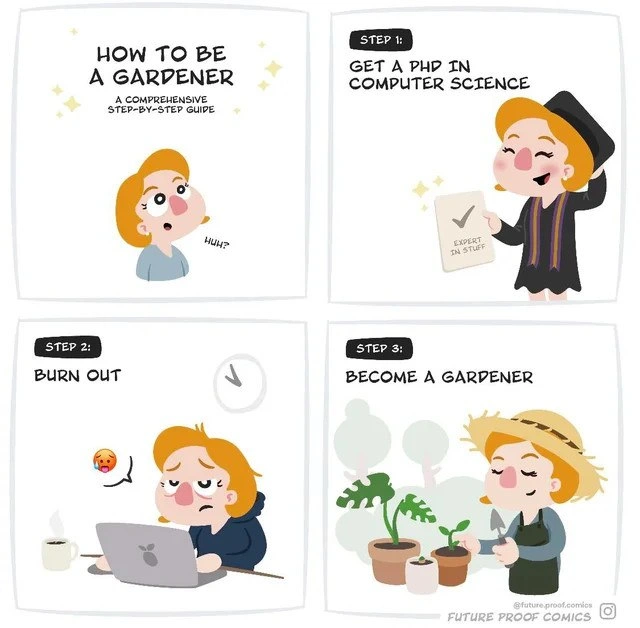
Imagine someone spending years doing an incredibly hard job or schoolwork – so hard that it makes them super tired and sad. In this funny comic, a person studies computers so much (even getting a big fancy degree called a PhD) that they completely wear themselves out. They’re shown feeling sick and exhausted, up late at night with a computer and an empty coffee cup. It’s like when you stay up too late doing homework every night and eventually you feel awful.
So what do they do next? They decide to do something totally different that makes them feel happy and calm: they become a gardener! 🌼 That means instead of typing on a computer, now they’re planting flowers and trimming plants in the sunlight, with a big smile on their face. It’s a huge change, kind of like if you got so tired of playing a really hard video game that you went outside to draw with chalk on the sidewalk instead. The idea is cute and silly because normally you don’t need to do the hardest computer work in the world just to end up watering plants. But it shows that after working too hard, sometimes people realize they should do something simpler that they really enjoy. The meme is funny and sweet: it teaches us that being happy can be more important than being super successful, and sometimes touching grass (garden plants!) is the best way to feel good again.
Level 2: Burn Out, Start Fresh
This four-panel cartoon breaks down a silly “guide” for becoming a gardener, and it’s clearly poking fun at the crazy path the character takes. Let’s explain each step in plain terms and why it’s humorous:
Step 1: Get a PhD in Computer Science. A PhD in CS is the highest academic degree in computer science. It usually means spending 5+ years after college doing deep research on some niche tech topic (like artificial intelligence, algorithms, or computer theory). People with a PhD are experts in a very specific area; the comic even jokes by showing the diploma labeled “EXPERT IN STUFF” – as if after all that work, the fancy certificate just says you know “stuff.” 😄 It’s an absurd first step for a gardening guide because obviously, you don’t need a doctorate to grow tomatoes or trim roses. This exaggeration sets up the humor: the character massively overachieves academically for a goal that normally requires no such thing. It highlights the stereotype of an overeducated person feeling unfulfilled or choosing an unexpected path.
Step 2: Burn Out. Burnout means total exhaustion and loss of motivation, usually after working too hard for too long. In the second panel, the cartoon character looks completely drained: heavy-lidded eyes, slumped posture, and a sickly pale face. They’re at a laptop late at night (the wall clock in the background suggests it’s very late or even early morning). The coffee mug is full of cold coffee (implying they’ve been at that computer so long the coffee got cold). There’s a little dizzy or unwell emoji near their head, indicating they feel awful – maybe headache, stress, or burnout symptoms. This is a super relatable image in tech: developers often stay up late debugging code or IT professionals might be on-call fixing server issues through the night. PhD students similarly pull all-nighters writing research papers or coding experiments. Over time, that lifestyle can wreck your MentalHealth – you get tired, irritable, lose passion for the work, and just feel “burned out,” like a candle that’s used up. The comic straightforwardly makes burnout Step 2, as if it’s an unavoidable part of the journey after doing the PhD. It humorously implies that extreme schooling or intense computer jobs will lead you to burn out as a matter of course.
Step 3: Become a Gardener. After hitting rock bottom with burnout, the character does a complete career_change: they switch to being a gardener. In the last panel, the person is wearing a straw hat (typical gardener attire for sun protection) and looks happy, tending to potted plants. There are green leaves and plants drawn around, giving a sense of a calm, natural environment. “Become a gardener” here symbolizes choosing a simpler, more peaceful job or hobby. Gardening is often seen as relaxing and gratifying in a very different way than coding or research – you work with your hands, you’re outside in nature, and it’s low stress compared to managing complex computer systems. The comic implies that after the intense mental strain of a tech career or PhD, the person just wants a down-to-earth life, literally! This stark contrast is funny because it’s sodramatic: going from cutting-edge computer science to literally cutting branches and pruning bushes.
The whole “step-by-step comic format” is drawn in a minimal, instructive style (like a simple guide). Panel 1 even says “HOW TO BE A GARDENER – A COMPREHENSIVE STEP-BY-STEP GUIDE,” which sets us up to think we’ll see normal gardening steps (like “buy seeds, plant them, water them”). Instead, Step 1 and 2 take us on a wild detour through academic and tech life! This subverts our expectations for comedic effect. It’s a form of AcademicHumor and CareerHumor rolled together – showing how an overly ambitious path (PhD in CS) might ironically lead someone to abandon it all for a basic, content life. The phrase “unexpected roadmap” in the title captures that irony perfectly.
This comic also touches on the theme of MentalHealthInTech in a lighthearted way. It’s widely recognized now that jobs in tech or intensive study programs can lead to high stress. People sometimes cope by finding hobbies like gardening, or in extreme cases, they quit the tech career altogether. Gardening here represents healing and simplicity. It’s almost symbolic: planting seeds and watching them grow slowly could feel more fulfilling than staring at a screen full of code or dealing with academic politics. The character’s bright smile in the last panel versus the frown in the burnout panel says it all: they found happiness by stepping away from the computer.
By including the phd_in_cs and tech_burnout context, the cartoon is specifically referencing those in the computing field who invested a lot in their education/career and hit a wall. The joke is especially appreciated by folks who have either gone through grad school or worked in tech long enough to fantasize about a simpler job. (It’s not uncommon to hear a junior dev jokingly say, “If this project fails, you’ll find me farming alpacas somewhere.”) This comic just illustrates that feeling literally.
In simpler technical terms: think of the character’s journey as a “system reset.” They pushed their “CPU” (brain) to 100% for too long and overheated. The only fix was to shut down and reboot in safe mode – the safe mode being a calm gardening life. 😄 The step-by-step guide format makes it humorous by pretending this is a logical, straightforward plan, when in reality it’s portraying a personal crisis and recovery. It’s both a joke and a gentle reminder that chasing the highest levels of achievement isn’t for everyone, and it’s okay to choose a path that makes you happy and healthy.
Level 3: Terminal to Trowel
At first glance, this comic reads like an overengineered life plan – it’s a satirical “how-to” that starts in the ivory towers of Computer Science academia and ends in the humble dirt of gardening. The humor hits seasoned tech folks immediately: why on earth would Step 1 to becoming a gardener be “Get a PhD in Computer Science”? 😅 It’s an absurdly overqualified path to a simple life, highlighting a bitter truth in the tech world: intense academic achievement or high-powered developer careers can drive people to dream of escaping to something low-tech and grounding.
In the tech community, it’s almost cliché how often burned-out engineers joke about quitting to open a bakery or start a farm. Here, gardening stands in for that idyllic, stress-free antidote to tech burnout. The meme’s core is a shared experience: DeveloperBurnout. We see the character transform from a starry-eyed PhD graduate (with a diploma reading “Expert in Stuff” – a cheeky nod to how a doctorate confers expertise, albeit sometimes hilariously narrow or impractical) into a bleary-eyed, coffee-fueled zombie hunched over a laptop at 2 AM. That second panel, “STEP 2: BURN OUT”, is painfully relatable to senior devs and researchers: the late-night coding, the cold coffee, the dizzy tired emoji floating above – it’s basically an average week during crunch time or the final months of a dissertation. The wall clock shows time slipping away (late nights turning into early mornings), a scene every tech veteran knows too well.
This comic also pokes at AcademicHumor and the academic career trajectory. The path “PhD ➜ Burnout ➜ Gardener” exaggerates how disillusionment can set in after chasing advanced degrees. Many PhD students in CS dive in with passion (dreaming of AI breakthroughs or becoming the next Turing Award winner), only to hit the reality of publish-or-perish pressure, endless debugging of experiments, advisor meetings, paper rejections – a grind that can sap the love of Learning right out of you. It’s implying, with dark humor, that after becoming an “expert in stuff” (a tongue-in-cheek way to say “I’ve studied so much, but what do I really know or what did it get me?”), the reward might just be burnout. And burnout can lead to yearning for an entirely different lifestyle.
For seasoned developers in industry, the pattern is just as familiar. Pulling late nights fixing production bugs or chasing impossible sprint deadlines can extinguish one’s joy for coding. The MentalHealthInTech crisis is real – high stress, constant learning curves, imposter syndrome, and lack of work-life balance. This cartoon encapsulates that by showing an extreme outcome: the character abandons the keyboard for a gardening spade. It’s a career_change 180° turn that resonates because many have at least fantasized about it. In tech circles, “I’m going to quit and become a gardener” is the new “I’ll go live on a farm with no internet” – an exaggerated escape fantasy that underscores how badly the pressure can get to us.
Why is this funny? It’s the incongruity and the nugget of truth. Step-by-step guides are usually straight to the point (e.g., how to actually plant seeds). Here we have an ironically complex, three-step guide for something simple: the heavy, intellectual detour (CS PhD) -> the crash (burnout) -> the peaceful resolution (gardening). The character’s journey is drawn in a minimalist cartoon style (credit to Future Proof Comics for the relatable art) which contrasts with the heavy topic. The final panel is almost utopian: our ex-academic wears a straw sun hat, happily trimming a plant, surrounded by calming green silhouettes of nature. The expression on their face in Step 3 is pure contentment, the opposite of the stressed-out face in Step 2. It’s a visual punchline: after all that high-tech hustle, the ultimate “future-proof” move for happiness was tending to actual plants.
On a deeper level, experienced folks see commentary on the tech and academic culture: we often overvalue extreme achievement (like a PhD or climbing the corporate ladder) without acknowledging the toll it takes. The meme cleverly compresses an entire career reflection into one short comic. The AcademicVsIndustry tag is quietly referenced: whether you slog in research or in a coding job, burnout looms if you don’t take care of yourself. Both academia and industry can be hamster wheels – running and running until you’re exhausted – so the idea of stepping off that wheel to do something completely different (and seemingly peaceful) is darkly humorous. It’s saying: “After all those algorithms and late nights, you might find true bliss in something as analog as gardening.”
There’s irony in the skills mismatch too. PhD candidates immerse themselves in highly abstract problems (proving theorems, developing new algorithms, wrangling big data), which couldn’t be further from watering plants and pruning leaves. But here’s the punch: after burnout, the complexity is no longer appealing. The character likely had to reach the pinnacle of complexity (a doctorate) and then break down, to appreciate the simple joys. It’s a bit like a software project that became so over-engineered it collapsed under technical debt, leading the developer to say “screw it, let’s rewrite this from scratch in the simplest way possible.” In life terms: “screw it, I’m gonna go live a simple life.” The CareerReflection angle is that sometimes the most logical fix for burnout is a hard reboot – quitting and restarting in a fresh, unrelated field.
For veteran coders, there’s also an inside joke about “planting seeds” – a PhD is supposed to plant seeds of knowledge, a career is supposed to grow, but if you water those seeds with only caffeine and all-nighters, you get wilted motivation. Ultimately, tending real seeds in a garden yields more happiness than tending bug tickets or publication citations. The final panel’s happy gardener face says, “I found peace out here.” It’s funny and a little tragic – many of us see a bit of ourselves in that progression, even if we haven’t gone full-green-thumb (yet).
In summary, the meme uses AcademicHumor and CareerHumor to highlight a serious tech-world truth with a smirk: Burnout is real, and sometimes the most unexpected career roadmap (CS doctorate ➜ utter exhaustion ➜ gardening) is what it takes for a brilliant mind to rediscover simplicity and sanity. It’s a reminder (wrapped in a joke) that no achievement is worth your happiness – and yes, sometimes the ultimate 1337 hack is to close the laptop and go touch grass (literally 🌱).
Description
A four-panel cartoon comic by 'future.proof.comics' illustrating a cynical guide titled 'HOW TO BE A GARDENER'. In the first panel, an orange-haired character looks confused by the title. The second panel, labeled 'STEP 1: GET A PHD IN COMPUTER SCIENCE', shows her happily graduating, holding a diploma that reads 'EXPERT IN STUFF'. The third panel, 'STEP 2: BURN OUT', depicts her looking exhausted and miserable in front of a laptop, with a stressed emoji floating above her head. The final panel, 'STEP 3: BECOME A GARDENER', shows her peacefully tending to plants, wearing a straw hat and an apron. The comic satirizes the intense pressure and high burnout rate within the tech industry and academia. It humorously suggests that the ultimate end-goal of a highly stressful, intellectually demanding career in computer science is to abandon it entirely for a simple, manual, and more fulfilling life, a sentiment that resonates deeply with many experienced developers fantasizing about a 'life after tech'

Comments
14Comment deleted
Turns out the most robust, self-healing system with zero downtime wasn't a Kubernetes cluster; it was a Monstera deliciosa
After a decade proving Paxos liveness, I quit - tomatoes reach eventual consistency without a single peer review
After 20 years of debugging distributed systems and explaining CAP theorem to VCs, you realize plants follow simpler protocols: water, sunlight, and no Jira tickets. The only merge conflicts are when two vines compete for the same trellis
The most realistic career path in tech: spend 5-7 years getting a PhD optimizing algorithms by microseconds, then spend the next 5-7 years optimizing your mental health by touching grass - literally. At least in gardening, when you plant something and it dies, you can just blame the weather instead of a race condition in production at 3 AM
After the PhD I finally picked a distributed system with sane failure modes - plants prefer availability, partitions are literal pots, and incidents resolve with H2O instead of a postmortem
After a CS PhD and a decade of on-call, I switched to gardening - same root cause analysis, fewer stakeholders, containers actually hold dirt, and Terraform finally does what the name promised
From proving halting undecidable to pruning dead leaves: finally a problem set with guaranteed termination
Bachelor is not enough I think sjsjjsjs Comment deleted
Sure. In this case, you will not be educated enough for considering another way. Comment deleted
I did not get actually link between gardener and PHD in science but idk Comment deleted
oh, it's PHD and not PHP Comment deleted
I had the same issue, needed to read it 3 times before seeing PhD, I'll better sleep and leave the php for tomorrow Comment deleted
Same here....shit Comment deleted
loladsadas Comment deleted