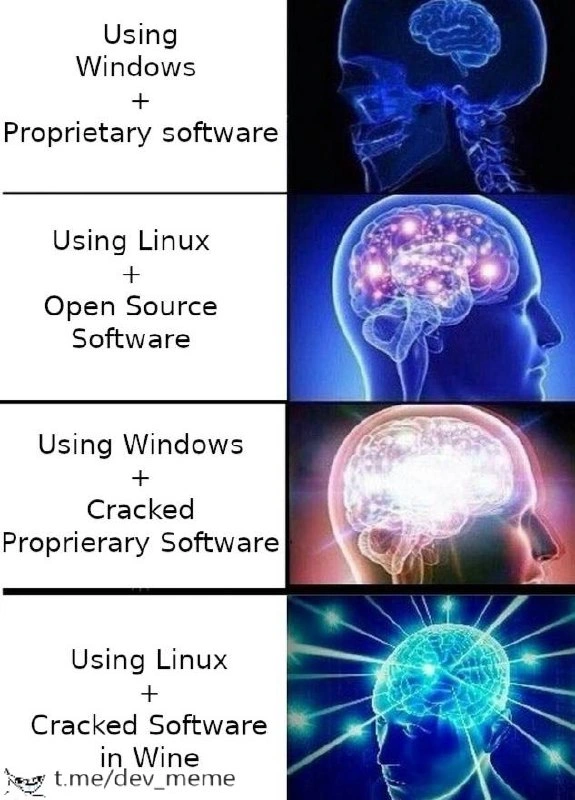
Expanding-brain hierarchy of Windows vs Linux and software licensing choices
Why is this OperatingSystems meme funny?
Level 1: Different Ways to Play
Imagine you really want to play a certain video game. There are a few ways you could do it, from the normal way to some very creative (or sneaky) ways:
The normal way: You have a game console (let’s say an Xbox). You buy the game for it and play it. This is like using Windows and paying for the software you need. It’s straightforward – you follow the rules, pay money, and it works as expected. No fuss, no extra steps.
The open and free way: Instead of using an Xbox, you use a PC that runs a free system and you find a similar game that’s free to download. Maybe it’s not the exact same game, but it’s an open and free game that anyone can use. This is like using Linux with open-source software – you might not use the popular paid program, but you use a free alternative. You don’t spend any money, and it’s all legal and out in the open. It might take a bit of learning to use, but you feel good about it because it’s free for everyone.
The sneaky “stealing” way on the normal system: You still use the Xbox to play that game, but you didn’t buy the game – you got a copied (pirated) version. Maybe you found a way to download it illegally or used a hacked copy. This is like using Windows but with “cracked” software – you didn’t pay for an expensive program, you found a way to get it free, even though you’re not really supposed to. It’s against the rules (just like stealing a game would be), but you got what you wanted without paying. People sometimes do this to save money, even though it’s wrong. In the meme’s joke, doing this is depicted as an even “bigger brain” idea – it’s naughty and risky, but it’s a kind of clever trick.
The ultimate creative (and craziest) way: You use your PC, but you make it pretend to be an Xbox to play that pirated game. For example, you install a special program on your computer that can emulate an Xbox, so that the Xbox game (which you didn’t pay for) will run on your PC. This is a pretty complicated trick – you’re basically fooling the game into running on a system it wasn’t designed for, and you’re doing it with a game copy that you didn’t buy! This scenario is like using Linux (the PC in our analogy, instead of the Xbox) and running cracked Windows software through Wine (the special program that pretends to be Windows, like an emulator for the game console). It’s the most creative and tricky way: you refuse to use the normal device or pay for the game, and instead you build a whole contraption to get it for free on your own device. It’s kind of impressive, because you have to be very tech-savvy to pull it off, but it’s also really overcomplicating things just to avoid the normal route.
The meme finds humor in this escalation. It’s like saying: the more out-of-the-box and convoluted your method, the more “galaxy brain” you are. In everyday terms, it’s funny because the person in the last scenario is going to ridiculous lengths to have things their way. They won’t pay, and they won’t even use the usual system – they’re doing double backflips to achieve the goal. It’s as if someone wanted to eat a pie, but instead of buying it or baking one normally, they built a whole new oven from scratch and snuck ingredients out of a factory to make it. That’s both genius and kind of silly!
So the core joke is about cleverness vs. practicality. The first way (Windows + paid software) is simple and normal. The second way (Linux + open-source) is principled and smart in its own way, doing things for free and openly. The third way (Windows + pirated software) is breaking the rules to save money, a bit like stealing. And the fourth way (Linux + pirated via Wine) is like a grand heist and magic show combined – breaking rules and inventing a whole new setup to do it. It makes us laugh because it’s cartoonishly extreme, showing a kind of mischievous brilliance. The meme is basically winking and saying: “Some people will do anything just to use software on their own terms!”
Level 2: From Windows to Wine
Stepping back a bit, let’s explain the terms and scenarios in this meme for those newer to the tech world. The meme uses the “expanding brain” format – each panel shows a brain that’s more activated (glowing, electric, etc.) than the previous, paired with a caption. This format jokingly implies that each step up is a higher level of thought or enlightenment (though often it’s used ironically, as in this case). Here are the four scenarios depicted, along with what they mean:
Using Windows + Proprietary Software: This means running the Windows operating system (the one made by Microsoft, e.g. Windows 10) and using proprietary software – which is software that is owned by someone (a company), usually costs money, and does not share its source code with the public. For example, Microsoft Office, Adobe Photoshop, or most commercial video games are proprietary. You typically have to buy a license or pay for these, and you can’t legally copy or modify their code. This is the most common setup for everyday computer users. In the meme, it’s shown as the smallest, dimmest brain – implying it’s the standard way, nothing extraordinary or “mind-expanding” about it.
Using Linux + Open Source Software: Here, one switches to Linux as their operating system and uses open-source software on it. Linux is an OS like Windows or macOS, but it’s free and open-source. That means its code is openly available, and it’s developed by a community (Linux was originally created by Linus Torvalds and is maintained by developers worldwide). There are many versions (called “distros” or distributions) such as Ubuntu, Fedora, or Arch Linux. Open-source software means anyone can inspect the code, contribute to it, and usually you can use it for free. Examples include the LibreOffice suite (instead of MS Office), GIMP (instead of Photoshop), Firefox browser (instead of something like Internet Explorer back in the day), or the VS Code editor (which actually is open-source, despite being from Microsoft). In this panel, the brain is glowing and more complex-looking – the meme suggests that using Linux and open-source tools is a sign of greater brain engagement. This reflects a common sentiment in the dev community that exploring Linux and OSS is a smart, perhaps intellectually rewarding move, because it often requires learning how things work under the hood and gives you more control.
Using Windows + Cracked Proprietary Software: Now we have a twist – still on Windows, but using “cracked” versions of proprietary software. Cracked software refers to software that normally you’d have to pay for, but someone modified (cracked) it to remove the copy protection. Essentially, it’s a pirated version that you didn’t buy, often obtained from shady corners of the internet. Using cracked software is illegal (it’s copyright infringement), but it’s something that happens – people do it to avoid paying high prices. For example, instead of buying Photoshop for hundreds of dollars, someone might download a cracked copy that runs without a license. In the meme, this scenario’s brain is even brighter, which is a humorous choice. It’s like saying “hacking the system to not pay for software is an even bigger brain move” – clearly this is meant as a joke, highlighting the audacity or cunning of doing this. The presence of a typo “Propriary” (instead of proprietary) in the meme’s caption might be just a meme-y mistake, but perhaps it subtly hints that by the time someone is doing hacks like this, spelling is the least of their concerns! 😁 In any case, the idea is that this user is tech-savvy enough to find and run pirated software, which some might cheekily consider a clever (if unethical) trick.
Using Linux + Cracked Software in Wine: This final one combines the previous extremes. You’re on Linux, but you have some Windows software that you want to use – and not just any Windows software, a cracked version of a proprietary program. How do you run a Windows
.exeon Linux at all? That’s where Wine comes in. Wine is a special program (an open-source project) that allows Windows applications to run on Linux as if they were native. The name Wine stands for “Wine Is Not an Emulator” (a bit of humor from its creators), because it doesn’t fully emulate a PC like a simulator; instead, it provides alternative implementations of Windows libraries and system calls on Linux. In simpler terms, Wine tricks the Windows program into “thinking” it’s running on Windows by providing all the expected responses and environment, but under the hood it’s translating those into Linux operations. Running Wine can be a bit technical – sometimes you have to tweak settings or install additional components for specific apps. Now, doing all that for a cracked piece of software means this person is really going out of their way. They’re mixing open-source OS with pirated closed-source apps. The meme shows the brain at full supernova here, satirically suggesting this is the biggest brain idea of all. It’s both a jab and a celebration of the extreme lengths a techie might go to: refusing to pay, refusing to leave Linux, so finding a route to have their cake and eat it too. This is definitely an unusual setup in real life, but it does happen (think of gamers or professionals who love Linux but might run a cracked game or Adobe product via Wine because there’s no Linux version and they don’t want to dual-boot Windows).
All these combinations can be understood in terms of operating system choices and software licensing choices. Here’s a quick comparison of the scenarios:
| Scenario | Operating System | Software Source | Cost | Legality |
|---|---|---|---|---|
| Windows + Proprietary Software | Windows | Official licensed (closed-source) | Usually $$$ | Legal (with license) |
| Linux + Open Source Software | Linux | Community/open-source (FOSS) | $0 (Free) | Legal |
| Windows + Cracked Proprietary | Windows | Pirated copy (closed-source) | $0 (Free) | Illegal |
| Linux + Cracked Win Software (Wine) | Linux (Wine layer) | Pirated Windows app (closed-source) | $0 (Free) | Illegal |
In simpler terms: the first two options are legit (one costs money, the other is free and open), and the last two involve piracy (free but illegal, and one of them is on a non-Windows platform). The meme humorously implies that each step up requires more “brain power” (technical know-how or boldness):
- Going from Windows to Linux means you need to learn new things and be more hands-on, hence “bigger brain.”
- Using cracked software involves knowing where to get it and how to possibly troubleshoot it (and a bit of daring), so that’s also seen as a sort of cunning move.
- Doing both (Linux + cracked via Wine) is the most convoluted, hence it’s shown as this pinnacle of enlightenment, but of course it’s tongue-in-cheek because it’s arguably the most impractical path too.
For a junior developer or someone newer to IT, this meme is basically poking fun at how developers often debate and joke about Windows vs Linux and open-source vs proprietary. There’s a long-standing culture war (/banter) between using Windows (which is user-friendly, popular, but closed-source and corporate) and using Linux (which is seen as geeky, powerful, community-driven, and open). Many devs start on Windows but “graduate” to Linux when they learn more, feeling proud of using the OS that runs servers and is built by the community. At the same time, the meme introduces the idea of software licensing: “proprietary” meaning you’re supposed to pay, versus “open source” meaning it’s freely available to use. And then “cracked” which basically means “I didn’t pay even though I was supposed to.”
By showing an expanding brain for the cracked software steps, the meme is being sarcastic. It’s not truly saying piracy is smarter; it’s poking fun at the cheeky attitude of “Why pay or stick to rules when you can hack your way around them?” Developers often appreciate this kind of dark humor, even if they don’t endorse the behavior. It’s relatable because many have at least seen or tried these things, especially when younger or experimenting:
- Using Linux and open source: maybe your first dual-boot or running a server taught you a ton.
- Using cracked software: maybe you couldn’t afford an expensive tool as a student, so you tried a “free” version from the internet just to learn or get by.
- Using Wine: maybe you love Linux but needed that one Windows-only program, so you wrestled with Wine to avoid spinning up a full Windows machine.
The combination of Linux + cracked in Wine is basically the “I’ll do whatever it takes to use what I want on my terms” scenario. It showcases an extreme DIY mentality – something a lot of developers can admire for the ingenuity while also laughing at the absurd complexity of it.
In summary, the meme’s hierarchy goes from normal usage to increasingly hacky and unconventional setups. It’s contrasting the straight path (just use Windows normally) with the road less traveled (use open-source, or use piracy, or both). The humor comes from recognizing each stage as a familiar trope in tech circles, and exaggerating the last one as the ultimate “galaxy brain” move, even though it’s arguably the craziest. Junior devs looking at this can learn a bit about the landscape: what Linux and open source are, what cracked software implies, and what Wine is – all wrapped in a jokey format that also reveals a bit about developer subculture and our playful jabs at each other’s choices.
Level 3: The FOSS Pirate Paradox
For seasoned developers, this meme’s hierarchy is hilariously relatable and ironic. It’s riffing on the spectrum of behaviors we’ve seen in tech culture – from straight-laced Windows users who buy all their proprietary software, to idealistic Linux devotees who insist on pure Open Source Software, and then to the edgier crowd that lives by hacks and torrents. The expanding brain format is being used ironically here: normally you’d expect the “most enlightened” stage to be something unequivocally wise (like using Linux and open source would typically be seen as a cerebral, freedom-loving move). Instead, the meme flips expectations by suggesting that an even higher plane of genius is running pirated Windows apps on Linux using Wine. It’s a classic example of dev humor where the most absurd, convoluted solution is jokingly portrayed as the most enlightened. This is funny because it satirizes how tech folks sometimes pride themselves on ridiculously complicated setups, just for the bragging rights or out of stubborn principle.
Let’s break down each panel through an experienced developer lens:
“Using Windows + Proprietary software” (Small brain): This is the baseline – basically the status quo. Most non-dev people and plenty of developers too just run Windows (perhaps Windows 10 or 11 nowadays) and use mainstream proprietary applications (Microsoft Office, Adobe Photoshop, maybe Microsoft SQL Server, you name it). It’s depicted as the tiniest brain, implying this is the most mundane or unimaginative approach. In dev culture, there’s often gentle ribbing of Windows users by Linux enthusiasts, casting Windows as the OS for the masses who don’t know better. The meme leans into that stereotype: if you’re just using Windows and paying for software like everyone else, there’s nothing “galaxy brain” about it. It’s the ordinary, default path – reliable, but not noteworthy from a hacker standpoint.
“Using Linux + Open Source Software” (Glowing brain): Ah, the next rung – switching to Linux and embracing open-source tools. For many developers, this represents an enlightened mindset: you’ve broken free from the Microsoft ecosystem, you’re possibly dual-booting Ubuntu or running Arch on your laptop, and you use FOSS (Free and Open-Source Software) alternatives for everything. Instead of MS Office, maybe you use LibreOffice; instead of Photoshop, you try GIMP; you write code in VS Code or Vim rather than something like Visual Studio (or if you do use VS Code, you comfort yourself that Microsoft open-sourced it, mostly). This panel glows brighter to show that “thinking with an open-source mindset” is a level-up in tech savviness (at least in the eyes of the open-source community). Developers who take this path often tout the ideological benefits (“I can inspect or change the code of my tools!”) and practical perks (“It’s free and I can script everything on Linux”). The meme is acknowledging that, yes, many in the dev world see moving to Linux and OSS as leveling up your game – your brain’s got some galaxy sparkle now. There’s also a hint of self-satire here: the open-source crowd sometimes has a bit of a superiority complex about being more enlightened users compared to those stuck on Windows, and the meme plays into that notion by literally showing a bigger brain.
“Using Windows + Cracked Proprietary Software” (Even bigger brain, with a typo “Propriary”): Now things get spicy (and the brain image is getting intense). Here we veer into software piracy territory. “Cracked” software means you didn’t pay for that expensive program – you’re using a version that had its copy protection removed by some cracker or via a leaked license key. Running cracked proprietary apps on Windows is almost the opposite philosophy of the previous panel: you’re still on Windows, still using closed-source apps, but now you’re bypassing the rules (and the fees). It’s pretty comical that the meme rates this as more enlightened than simply using Linux with open-source. Why would that be? This is where the joke’s irony shines: it’s poking fun at a certain mindset where being clever and saving money beats being principled. From a cynical dev perspective, you might say: “Sure, open-source is cool, but you know what’s big-brain? Not paying $3,000 for Photoshop by using a crack.” It’s a tongue-in-cheek celebration of the scrappy hacker ethos – the kind of person who knows how to find and run keygens, apply cracks, and feels savvy for dodging licensing fees. There’s also an undercurrent of reality here that seasoned devs recognize: plenty of us in our early days (especially students or at small startups) have seen or used pirated software because budgets were zero. That “cracked software” brain image could evoke memories of running a torrented copy of an IDE or game and feeling like you “beat the system.” The meme giving it a brighter brain glow is essentially laughing with us about this guilty pleasure. (Side note: The misspelling “Propriary” in the meme is likely just a typo, but adds to the humor – as the brain expands, spelling seems to deteriorate, LOL.) The irony of positioning piracy as more enlightened than ethical open-source is a deliberate comedic inversion. It’s like saying: Who needs moral high ground when you have ******* on your side? (That’s sarcasm, of course!). Experienced devs see the absurdity: we all know piracy is illegal and frowned upon, yet we also know how common it’s been, which makes this panel a hilarious “dark side” level-up.
“Using Linux + Cracked Software in Wine” (Galaxy supernova brain): Here we reach the meme’s final form – an electric-blue brain with lightning bolts, implying an almost god-tier level of “enlightenment.” This scenario is a mashup of everything: you’ve got Linux (yay, open-source OS!), but you’re running cracked proprietary Windows software on it, using Wine as a compatibility layer. This is presented as the ultimate cleverness, and it’s dripping with irony and nerd humor. Essentially, this person said: “I refuse to use Windows or pay for software, but I still want to run that exact Windows-only app I didn’t pay for.” It’s such an over-the-top workaround that it earns the final galaxy-brain slot. Why would anyone do this? Well, for one, it might be the challenge and geek cred. Getting a Windows application to run on Linux via Wine can be a fiddly process – you have to deal with configuring Wine, maybe installing Windows DLLs in Wine’s prefix, possibly encountering bugs or performance hits. It’s way more complex than just double-clicking an installer on Windows. So if you manage it, you feel like a 1337 hacker 🏆. Secondly, sometimes people genuinely prefer Linux as their main OS (for stability, customization, or philosophy), but there’s that one app or game that only runs on Windows (say, Adobe Premiere or a particular video game with anti-cheat). Rather than compromising by booting into Windows or foregoing the app, the truly stubborn (or resourceful) will try to make it run through Wine. Now throw a crack in there because perhaps that app is expensive or requires an online activation that Wine complicates – using a pirated copy that’s been made offline-friendly might actually be the path of least resistance (aside from legality) to get it working on Linux. To an experienced developer, this scenario screams: “This person has way too much time and determination!” It’s hilarious because it’s unnecessarily complicated and violates about every rule in the book (both licensing rules and, arguably, Occam’s razor). The meme is lovingly mocking that contrarian, hacker spirit: the kind of dev who’s so devoted to open-source/Linux pride that they will contort reality to avoid using Windows – even if it means running Windows apps in an emulator-like layer and pirating them to boot.
In essence, the meme takes a playful jab at the extremes of developer behavior. It resonates with senior devs because we’ve seen all these archetypes in the wild: The enterprise employee who just uses Windows and whatever tools the boss bought; the open-source purist who evangelizes Linux; the crafty pirate who boasts about never paying for software; and that one ultra-hacker friend who runs Arch Linux with a custom kernel and somehow has AutoCAD or the latest Call of Duty running through Wine with some crack from a sketchy forum. It’s a shared comic reality. Each ascending panel is like leveling up the “rebel” factor:
- Level 1: Rule Follower (uses mainstream OS and pays for stuff).
- Level 2: Idealist (switches to open-source everything, rules be damned if it’s closed source).
- Level 3: Outlaw Cheapskate (sticks to mainstream OS but refuses to pay, breaking rules to get freebies).
- Level 4: Mad Scientist (throws rules and logic out the window, concocting a crazy blend of everything to run whatever they want, free-of-charge, on their own terms).
The humor is amplified by how the “enlightenment” seems to increase as the behavior becomes more convoluted and arguably more questionable. It’s a nod to the kind of dark humor in developer culture where we both laugh at and secretly admire the lengths techies will go to customize or circumvent systems. After all, a true geek doesn’t just accept limits – they’ll find a way (bonus points if it’s overly complicated). We find it funny because it’s so true and yet so absurd. This meme captures the FOSS vs piracy paradox and the cross-platform shenanigans that are legend in IT circles. It’s essentially saying, with a wink: “The ultimate power user is a Linux guru who pirates Windows software and makes it run where it was never meant to run – behold the glory!”
To someone steeped in developer humor, this juxtaposition is pure gold – it satirizes the one-upmanship mentality (who’s the more elite user?) and the cognitive dissonance we sometimes have (open-source principles vs using proprietary stuff when convenient). It’s that shared laugh of recognition: we all know at least one person who’d do this, or maybe we were that person once. (No judgements… well, maybe a little 😅.)
Level 4: Cross-Platform Contraband
At the deepest technical level, this meme highlights some serious software hackery and cross-OS wizardry. The final panel’s scenario (Linux + cracked Windows software via Wine) is like an apex feat of reverse engineering. To understand why this is galaxy-brain territory, consider how radically different Windows and Linux are under the hood.
Operating System Internals: Windows software is built for the Windows API and system calls provided by the Windows NT kernel. A .exe program expects to load Windows-specific libraries (like kernel32.dll, user32.dll for GUIs, etc.) and use Windows system calls that simply don’t exist on a Linux kernel. Linux, on the other hand, typically runs ELF binaries that rely on POSIX system calls and libraries (libc, X11/Wayland for GUI, etc.). Normally, you cannot run a Windows .exe directly on Linux because the binary format and system interfaces are incompatible. This is where Wine comes in. Ironically named Wine Is Not an Emulator, Wine is a compatibility layer that reimplements much of the Windows API in open-source form. It’s essentially a massive collection of Windows-equivalent libraries that translate Windows function calls into Linux system calls. For example, when a Windows program calls a graphics function from DirectX, Wine may translate that into an OpenGL call on Linux. Unlike a full virtual machine, Wine doesn’t emulate a CPU – it runs Windows programs at native speed, but intercepts their calls to the OS and handles them in a way Linux can understand. This is a hugely complex undertaking: the Wine developers have painstakingly reversed-engineered countless Windows APIs so that many Windows applications (even complex ones like Photoshop or MS Office) can happily run on Linux. It’s like teaching a Linux system to fluently respond when spoken to in Windows’ language. No virtualization, no Windows kernel – just clever API alchemy. If that sounds difficult, it absolutely is – Wine’s codebase is enormous, and it’s been a multi-decade labor of love by open-source developers. The meme’s top-tier “enlightened” brain is tongue-in-cheek recognizing the technical bravado of someone who leverages this abstruse tech: running cracked proprietary apps through Wine is basically pulling off an OS-level inception trick that most casual users wouldn’t even attempt.
Reverse Engineering & Cracks: Now add the cracked software to this mix. A crack for proprietary software typically involves reverse-engineering the program’s binary to bypass license checks or activation. This is no trivial task either – it means someone disassembled or debugged the original program (often in machine code or assembly) to remove or neutralize its protection. For instance, a typical proprietary program might contain logic like:
if (!licenseIsValid()) {
exitProgram("Please purchase a license.");
}
startFullVersion();
A cracker will identify that check and patch the binary so the software doesn’t quit, effectively disabling the copy protection. In a cracked executable, the logic might be altered to simply skip the exitProgram call (often by replacing it with harmless no-op instructions). The end result is the app thinks it’s always authorized. This process requires knowledge of program binaries, assembly language, and debugging – truly the realm of advanced software wizards. So when the meme puts “cracked proprietary software” at a higher brain level, it’s cheekily nodding to the sophistication (albeit illicit) involved in defeating DRM or license checks. It’s humorously suggesting that figuring out how to run something like a pirated Adobe Photoshop on your system is a kind of big-brain, hacker achievement.
Free vs. Free (Licensing Ideology): On a more philosophical note, the meme satirizes the convoluted extremes people go to in pursuit of “free” software. There’s a famous distinction in open-source circles between “Free as in beer” (gratis) and “Free as in speech” (libre). Open Source Software (like Linux itself) is free in the freedom sense: its source code is open for anyone to inspect, modify, and distribute, and it’s usually free of charge as well. Proprietary software, by contrast, is closed-source and comes with usage restrictions – you must pay for a license (not free as in beer), and you certainly can’t legally modify or share it (not free as in speech). Pirated (cracked) software is a curious loophole: it’s free of charge (you didn’t pay for that Photoshop license), but it’s definitely not legally free to share or modify – it’s actually illegal and violates copyright. Hardcore proponents of open-source (the true believers in software freedom) would argue that using cracked proprietary software is not enlightened at all – it’s just theft, and it doesn’t grant you any rights to the code or foster communal improvement. In fact, famous free-software advocates like Richard Stallman would probably cringe at someone thinking they reached “the enlightened state” by pirating software; Stallman would much prefer you stick to a truly free alternative or write your own tools. The meme, however, isn’t a moral lesson – it’s playing with the irony that in developer culture, doing something extreme and clever (even if illicit) can be seen as a galaxy-brain move. It’s the paradox of valuing freedom and openness, yet still being willing to tinker with closed software in an unauthorized way to get what you want without paying. There’s a comedic hypocrisy here: after touting Linux and open-source as the high ground, the ultimate “enlightenment” is portrayed as frankensteining proprietary software into Linux through Wine, and doing so via piracy. It’s like the meme is winking and saying: “Why settle for just being a law-abiding open-source user when you can ascend to the next plane of existence by also becoming a mad scientist pirate?”
In summary, the top tier of this expanding brain meme packs in a lot of advanced tech concepts: cross-OS compatibility hacks via Wine, binary-level patching, and a dash of licensing philosophy. The humor lands because it absurdly frames this convoluted, rule-bending setup as the most enlightened choice. It’s a joke that celebrates the crazy lengths some developers will go to bend systems to their will – mixing open-source savvy with pirate-like cunning – all for the thrill of saying, “Ha! I got it to work my way.”
Description
Four vertically stacked "expanding-brain" panels compare operating-system and licensing combinations. Panel 1 shows a small, dim blue brain silhouette and the caption “Using Windows + Proprietary software.” Panel 2 shows a brighter, galaxy-like brain with the caption “Using Linux + Open Source Software.” Panel 3 shows an even brighter, pink-white glowing brain beside the caption “Using Windows + Cracked Propriary Software,” preserving the meme’s misspelling. Panel 4 shows a radiant, electric-blue brain with lightning emanating outward and the caption “Using Linux + Cracked Software in Wine.” The meme humorously suggests ever-increasing “galaxy brain” enlightenment as users progress from standard proprietary Windows usage to running pirated Windows applications under Wine on Linux, poking fun at developer culture around open-source ideology, software piracy, and cross-platform hacks
Comments
17Comment deleted
Architect mode: deploy a Kubernetes DaemonSet of Wine containers so finance can brag about an “all-Linux estate” while each pod quietly runs the cracked Win-only reporting tool and violates three EULAs at 60Hz
The ultimate enlightenment: spending 47 hours configuring Wine to run cracked Photoshop CS6 instead of just using GIMP, because sometimes the most complex solution is the one that proves you can
The ultimate galaxy brain move: spending 40 hours configuring Wine, debugging DirectX translation layers, and wrestling with registry emulation just to avoid paying for software you could've compiled from source in 5 minutes - because principles matter more than productivity, and nothing says 'I value my time' quite like running cracked Windows binaries through compatibility layers on a system that already has superior native alternatives
Peak enlightenment is replacing vendor lock‑in with legal lock‑out: running the Windows‑only tool cracked under Wine on Linux so compliance, security, and procurement are all simultaneously unhappy
Peak architecture: Linux monolith stability + Wine middleware + cracked props, outscaling any k8s cluster
Windows + proprietary is lock-in, Linux + OSS is sanity, Windows + cracked is a lawsuit, and Linux + Wine is realizing the only thing truly cross-platform about that vendor tool is the compliance risk
zeroth Comment deleted
Loool Comment deleted
using linux + decompiled recompiled cracked software natively Comment deleted
Using your own Linux distro + decompiled recompiled cracked software natively integrated directly into it Comment deleted
Using BSD, writing your software yourself (reverse engineering) Comment deleted
Using your own OS + your own software made from scratch UPD: *Written in Scratch Comment deleted
using an apple silicon mac plus emulating a x86 virtual machine and running windows on it Comment deleted
Using Windows software via Wine emulator inside x86 Linux environment via x86-to-e2k application-level binary translator inside native e2k Linux running in a Qemu/KVM virtual machine on an Elbrus computer with native e2k Linux as host system. 😜 Comment deleted
🇷🇺 💪 Comment deleted
Most common me and adobe Comment deleted
The latest i mean Comment deleted