Skip to content
DevMeme
3501 of 7435
Expanding Brain Hierarchy of Programming Tutorials and Developer Learning Preferences
Learning Post #3837, on Oct 19, 2021 in TG

Expanding Brain Hierarchy of Programming Tutorials and Developer Learning Preferences

Why is this Learning meme funny?

Level 1: Crank Up the Volume

Imagine you’re learning something new, like how to bake a cake. At first, you might watch a normal cooking video on YouTube. The chef talks clearly, step by step, and it’s easy to follow – this is like the first part of the meme, a regular tutorial. Now, suppose the next way you try to learn is with a chef who has a strong Italian accent, and he speaks really passionately. You have to listen a bit more carefully because of the accent, but his energy makes it fun and you somehow pay more attention – the cake might even come out better! That’s similar to the meme’s second part: the accent makes the learning experience feel a bit “boosted” or special.

Finally, imagine the most extreme way to learn baking: you watch a fast-motion video of someone making a cake in total silence, with loud techno music blasting in the background. The person cracks eggs and mixes flour super-fast, with flashy edits and no explanations, just boom, boom, boom music. It’s crazy and exciting – like a baking music video. You’re not really getting detailed instructions, but it’s so intense that you can’t look away. This is what the meme’s last part is like for coding: somebody typing code in a plain notepad window at lightning speed while techno music pumps. It’s a wild way to “learn” – more for excitement than understanding.

So why is this funny? It’s because normally, the quiet step-by-step lesson is the best way to learn, right? But the meme jokes that the crazier the method, the more enlightend your brain becomes. It’s like saying: the louder and weirder the learning, the smarter you feel! That’s upside-down from common sense, and that silliness makes us laugh. The meme is basically winking at us: of course you won’t become a genius just by watching a frantic techno-fueled coding video – but it feels hilariously grand to imagine that. It’s a joke about how we sometimes crave more excitement when we learn because it keeps us awake and interested. By the end, your brain is shown practically exploding with light, as if you attained ultimate knowledge from that wild techno-notepad session.

In simple terms, the meme is funny because it shows a learning rollercoaster: from normal and easy-going, to a bit quirky, to completely over-the-top. It exaggerates how far people might go for the sake of feeling like they’re learning more. Even if you’re not a programmer, you can relate: it’s like studying for a test by reading quietly, versus studying with a funky foreign teacher, versus cramming while listening to loud dance music – the last one sounds crazy to call “the best,” and that’s the joke. The humor is all about taking something ordinary and cranking up the volume to absurd levels, and that big glowing brain at the end is a playful way to say, “Yep, this is ridiculously mega-brain stuff!”

Level 2: Accent Advantage

Let’s break down the meme’s elements in simpler terms, connecting them to real Learning experiences in developer communities:

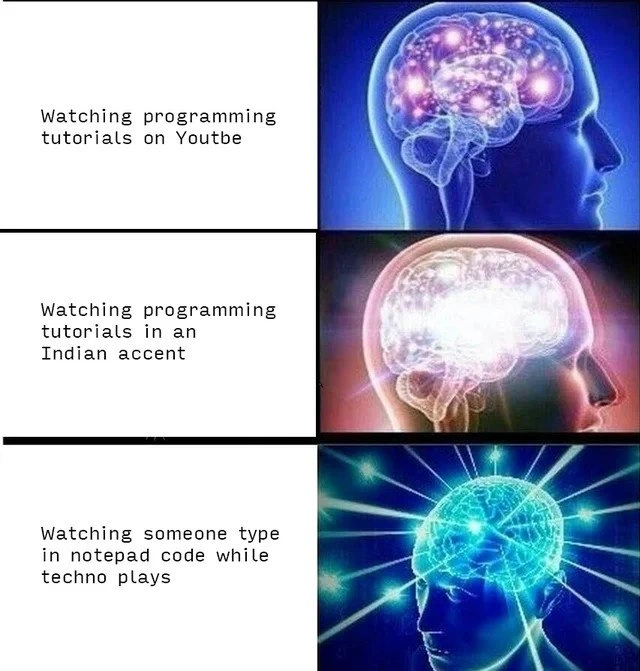
  • Expanding brain meme format: This is a popular MemeCulture template with images of a human brain at increasing levels of activation or “enlightenment.” Each step up usually labels a more advanced or exaggerated idea. In our context, it humorously ranks programming tutorial styles. The brighter the brain, the more “galaxy-brain” (genius or enlightened) the method is jokingly claimed to be. It’s a visual way to say “good, better, BEST!!!” – except the “best” is often a silly or extreme twist.

  • “Watching programming tutorials on YouTube”: This is the most common way people learn coding nowadays. YouTube tutorials are videos where an instructor explains a programming topic or builds a project, and you follow along. If you’re a junior dev or just starting out, you’ve probably searched “How to make a website in HTML” or “Python tutorial for beginners” on YouTube. It’s an easy, passive learning method – you watch, listen, and maybe code along. In the meme, this entry-level approach is represented by the dimly lit brain. It’s the foundation, but nothing mind-blowing yet – essentially Learning 101 for developers. Everyone can relate to this: when documentation feels too dry or a book too heavy, you fire up a video and let someone show you how it’s done.

  • “Watching programming tutorials in an Indian accent”: Here the meme adds a twist that’s very inside-joke for dev communities. Many well-known coding tutorials and help videos feature instructors who are Indian or of Indian origin, hence speaking English with an Indian accent. This reflects the global nature of programming – lots of skilled contributors from India share knowledge online. The meme’s second tier implies that a tutorial might somehow be more effective or intense if delivered in an Indian accent. Why would that be a thing? It’s not that the accent itself has magic, but it’s a playful stereotype born from many personal experiences: you search a tough programming error on Google or YouTube, and the most straightforward, no-nonsense explanation is often by someone with an Indian accent. It’s become a fond cliché: “the Indian tutor” is almost an archetype in coding communities, representing reliability and thoroughness (and sometimes a super-fast teaching pace!). For a newer developer, this line of the meme might be their first exposure to that inside joke. In plain terms: some of the best, most memorable instructional videos many devs have watched happened to be taught by people from India. Over time, this created a funny association that if you hear that accent in a tutorial, you perk up because you expect to learn something good. The meme bumps the brain power up for this, meaning the community “recognizes the advantage” – you’re leveling up your learning experience from the basic one.

  • “Watching someone type in notepad code while techno plays”: Now the meme goes fully tongue-in-cheek. This describes a tutorial style that’s quite unorthodox. Imagine a video where there’s no spoken explanation at all. The person is just writing code in real-time in a plain Notepad window. Notepad (on Windows) is a super simple text editor application – it’s like using a paper and pen of coding: just text, no colors or fancy features that specialized code editors or IDEs (Integrated Development Environments) have. Using Notepad to code on a tutorial signals “I don’t need any help or visuals, I’m doing this raw.” And on top of that, techno music is playing in the background, often fast electronic beats. Techno gives an energetic, almost hypnotic vibe. So this kind of video is basically pure visual code + energetic soundtrack. There’s a niche genre of programming videos like this, sometimes seen in speed-coding demos or time-lapse coding sessions set to music.

    For a learner, this is a radically different experience. There’s no narrator saying “now we do X, now we do Y.” You’d have to watch carefully and maybe pause a lot to figure out what the person is typing. It’s more like watching a performer than a teacher. Why would anyone do this? Well, often it’s not meant for step-by-step learning – it could be for showcasing how quickly something can be built, or just for fun, to see code in action with a cool beat. It could be appealing if you already know a bit of the topic and just want to see a quick implementation, or if you’re bored of slow explanations and want entertainment with a hint of learning.

    In the meme, this is the ultimate brain expansion stage – which is ironic because logically this method gives you less guidance than any other! The humor is saying: “Look, by the time you’re so advanced, you don’t even need words or proper tools; you osmose knowledge directly from watching raw code in a trance.” Of course, that’s exaggerated silliness. But it taps into a real feeling: after you’ve been coding for a while, sometimes you do prefer just seeing code (cut the chatter, show me the diff!). Also, developers often joke about doing things in the most hardcore way possible. What’s more hardcore than Notepad (the simplest editor) and learning by pure observation? It’s like the final boss of tutorial formats.

  • Why the brain is ultra-bright on this last one: The expanding brain meme usually reserves the biggest, glowing, cosmic brain for something ridiculous yet humorously presented as genius. Here, the image has lightning bolts and an aura, suggesting a mind completely blown or transcended. It’s the meme’s way to signal “this is peak” – though tongue-in-cheek. In reality, if you gave this learning method to a beginner, they’d be totally lost! But the meme isn’t giving study advice; it’s bonding over a community joke that what we claim to prefer (when we’re trying to be funny or edgy) is this intense, over-the-top scenario.

Connecting to developer experience: As a junior developer or someone learning, you might actually go through a progression:

  • At first, you need structured help (well-explained YouTube videos, documentation, etc.).
  • Later, you get used to certain accents or styles and they don’t bother you; you might even appreciate a faster pace that some tutors use.
  • Finally, when you’re more experienced, you might skip video tutorials entirely for many topics. Watching someone’s screen quickly for hints, or scanning a code snippet with some upbeat music in the background while you hack away, might be more engaging to you than a slow walkthrough.

So the meme is relatable at different stages of learning. It also reflects how online communities share knowledge in various forms: from formal tutorials to fun live-coding sessions. The tags like programming_tutorials, accent_preference, and speed_coding_videos all point to these styles. And the tag tutorial_escalation is exactly what’s shown – a joking escalation of tutorial intensity.

In community forums or social media (think Reddit’s r/ProgrammerHumor or similar), you’ll see comments like, “I was stuck until I found a video of a guy with a thick accent explaining the solution – then everything clicked,” or memes about banging your head to techno while coding through the night. This expanding brain meme combines those threads into one narrative. It’s saying: We developers sometimes measure how hardcore or desperate we are by how wild our learning source is. It’s relatable because many of us have indeed gone from calmly watching a 30-minute tutorial to eventually scrubbing through a 2-minute silent code demo set to “Sandstorm” by Darude at 2x speed, just to get that last tidbit of info.

In summary, at Level 2 we see clearly what each panel means in real-life terms:

  • Plain YouTube tutorial = common, beginner-friendly learning via video.
  • Tutorial with Indian accent = a nod to the prevalent and effective content from Indian devs – a step up in our humorous “learning power” scale.
  • Notepad + techno coding = a wild, minimalist approach to showing code, more for thrill or advanced quick learning – portrayed as the ultimate level for comedic effect.

Each step up is both a real phenomenon in dev learning culture and a step deeper into meme territory. This is why developers find it funny and tag it as CodingHumor and RelatableDeveloperExperience. It exaggerates reality just enough that we recognize the truth behind it and laugh at the hyperbole.

Level 3: Techno Transcendence

At the highest level, this meme pokes fun at how developer learning methods can escalate into absurdity, using the famous expanding brain meme format. Each row represents a more "enlightened" (and increasingly exaggerated) state of learning:

  • Row 1 – YouTube tutorials: The left side says "Watching programming tutorials on YouTube" next to a dimly glowing brain. This is the baseline – a normal developer learning method. It’s common for beginners (and pros at 3 AM) to hit play on a YouTube tutorial when learning a new framework or debugging an issue. It’s passive and familiar: someone coding on-screen with voice-over guidance. Every developer community member knows the routine of scrubbing through a 20-minute video for that 5-line fix. The humor builds from this mundane starting point.

  • Row 2 – Indian accent tutorials: The caption upgrades to "Watching programming tutorials in an Indian accent", and the brain image glows brighter with a halo. This riffs on a lighthearted DevCommunity trope: many high-quality coding videos and answers come from developers with Indian accents. It’s a nod to reality – countless programmers have learned Data Structures, cracked the LearningCurve of a new library, or fixed a bug thanks to an Indian tutor on YouTube or Stack Overflow. The meme implies that adding an Indian accent somehow supercharges the learning. It’s a playful acknowledgement of how prevalent and valuable these tutorials are. Seasoned engineers smile here because they’ve likely shared jokes about “the real Stack Overflow MVPs” being those low-key channels or blog posts from the subcontinent that just work. Some even joke that they trust a solution more if the explanation comes with "Hello guys!" in a friendly Indian voice – a sign they’re about to witness some straight-to-the-point coding. The humor is partly self-aware: we know an accent doesn’t magically improve content, but it reflects our gratitude (and a bit of meme-ish exaggeration) for those contributors. There’s also a grain of truth that when you listen to a tutorial in a less familiar accent, you might focus harder, effectively engaging more brainpower to follow along. It’s learning by way of novelty and concentration – thus a brighter brain in the meme.

  • Row 3 – Notepad + techno coding: Finally, the meme reaches cosmic enlightenment with "Watching someone type in Notepad code while techno plays" next to a radiant, lightning-filled brain. This is a comedic leap into developer absurdism. Imagine a tutorial with zero narration: just a person furiously typing code in Notepad (the most bare-bones text editor, no syntax highlights, no auto-complete, old-school DeveloperExperience minimalism) accompanied by high-BPM techno music. It’s essentially a programming trance video. Why would this be the ultimate learning mode? Of course, logically it isn’t – it’s hilariously unhelpful for actual instruction. But the meme leans into the ridiculous: the sheer intensity of watching raw code being blasted out to a techno beat is portrayed as the galaxy-brain way to absorb knowledge. It satirizes the idea that some developers crave ever more extreme stimuli to stay engaged. Seasoned devs read this and chuckle because it resonates with that late-night coding delirium vibe – when you’re past normal tutorials and you’ll try anything to jolt your brain into understanding, even if it means watching a code EDM remix. The lightning brain suggests a tongue-in-cheek “instant enlightenment” from this chaotic method. It’s like achieving coding nirvana through sensory overload.

Underneath the humor, there’s a reflection of real developer culture: as we gain experience, many of us do skip the hand-holding. A senior engineer might skim documentation or source code directly rather than sit through a slow tutorial. The meme blows this habit up to comedic proportions – why not skip words entirely and just vibe with the code? It also parodies those speedy “Watch me build X in 5 minutes” videos where music plays and code magically appears. They’re more entertainment or inspiration than instruction, but they feel impressively brainy to watch.

The RelatableDeveloperExperience here comes from everyone’s learning journey. We start simple, then seek more engaging or challenging material. Online developer communities often joke that after you’ve seen enough tutorials, you require increasing doses of dopamine: maybe an instructor with an energetic accent or a quirky style, and ultimately something wild like a code rave, to keep things interesting. The meme format exaggerates that progression perfectly, implying a hierarchy of enlightenment:

  1. Basic understanding (normal YouTube video, calm brain glow),
  2. Heightened focus (uncommon accent tutorial, brain brighter),
  3. Transcendent coding prowess (no guidance, just code+techno, brain electrified).

Experienced devs find it funny because it’s both absurd and a clever meta-joke on how we consume content. We’ve all joked about the random 10-hour techno coding live streams or that one super-cut video of code flying by – content that would confuse a newbie but somehow mesmerizes veterans. It’s humor via contrast: the more impractical the tutorial format, the more “big-brained” you must be to get anything out of it. And claiming you learn best with a hardcore method is a classic tongue-in-cheek flex in developer circles.

To put it in code, the meme suggests something like:

brain_expansion = 0

# Level 1: Basic YouTube tutorial 
if tutorial.platform == "YouTube" and tutorial.voice_over:
    brain_expansion += 1  # baseline learning, normal engagement

# Level 2: Tutorial with Indian accent (engaging novelty)
if tutorial.voice_accent == "Indian":
    brain_expansion += 2  # increased focus and trust (meme logic)

# Level 3: Notepad + techno = Galactic knowledge?
if tutorial.editor == "Notepad" and tutorial.background_music == "Techno":
    brain_expansion = 9001  # OVER 9000! Ultimate enlightenment achieved

In reality, blasting techno while code scrawls in Notepad probably isn’t the best way to learn. But the meme rides on ironic hyperbole. It’s laughing at how developers sometimes gravitate to bizarre learning experiences (or at least joke that they do). It highlights the colorful subculture of online coding tutorials: from the straightforward to the eccentric. For a senior engineer, it’s a knowing laugh at their own past – remembering nights learning from any video they could find – and at the community’s running jokes (like the unofficial respect for “YouTube University, School of Indian Programming Gurus”).

Ultimately, “Expanding Brain” memes like this thrive on the contrast between expected wisdom and actual behavior. Here, the expected wisdom is “more informative detail = better learning,” but the meme’s “actual behavior” is “nah, crank up that techno and just show me code – my brain will handle the rest!” That reversal is what makes it funny and sharable among developers. It’s an over-the-top tribute to the idea that sometimes the weirdest ways of learning can feel the most epic.

Description

Three-row expanding-brain meme split into left text boxes and right brain images of increasing luminescence. Row 1 shows a dimly glowing brain beside the caption "Watching programming tutorials on Youtbe". Row 2 upgrades to a brighter, haloed brain next to "Watching programming tutorials in an Indian accent". Row 3 culminates in a radiant, lightning-filled brain beside "Watching someone type in notepad code while techno plays". The meme humorously ranks escalating forms of developer education, poking fun at how engineers chase ever more intense stimuli - from passive YouTube videos to hypnotic speed-coding sessions accompanied by techno beats

Comments

12
Anonymous ★ Top Pick True enlightenment is skipping the tutorial altogether, tail-f-ing prod logs over techno at 3 AM and letting the 500s teach the architecture straight to your frontal lobe
  1. Anonymous ★ Top Pick

    True enlightenment is skipping the tutorial altogether, tail-f-ing prod logs over techno at 3 AM and letting the 500s teach the architecture straight to your frontal lobe

  2. Anonymous

    The real enlightenment comes when you realize the guy typing in Notepad with techno music actually ships more production code than the developers watching $200 Udemy courses on their third monitor while their PR sits unreviewed for two weeks

  3. Anonymous

    The real galaxy brain move is watching someone debug a production incident in Notepad at 3 AM while their pager alarm plays dubstep - because nothing says 'senior engineer' quite like the raw, unfiltered chaos of zero syntax highlighting, no autocomplete, and the existential dread of manual memory management set to a sick drop

  4. Anonymous

    If passive learning had a CAP theorem, YouTube optimizes for availability and partition tolerance - consistency arrives only when you open your own editor

  5. Anonymous

    Peak tutorial is 240p Notepad with techno - no narration, just enough keystroke entropy to reverse‑engineer the API and confirm the docs were lying

  6. Anonymous

    Indian accent: O(n²) parse errors. Techno notepad: O(1) dopamine, zero tests

  7. @TadeusTaD 4y

    009 Sound System - Dreamscape starts playing

    1. @nic11 4y

      Wow, someone actually remembers it

  8. @sepehr_rajabi 4y

    I too, watch programming tutorials on youtbe

  9. @staze 4y

    Read manuals while chiptune (keygen music) playing

    1. @RiedleroD 4y

      perfection

  10. @azizhakberdiev 4y

    Last guys, who still keep almost forgotten, but important knowledge cannot pass it to the next generation, because their tutorials are awful impossible to understand ehhmmm, how can I say...

Use J and K for navigation