Skip to content
DevMeme
2199 of 7435
Superior Vim Knowledge in a Socially Awkward World
IDEs Editors Post #2452, on Dec 12, 2020 in TG

Superior Vim Knowledge in a Socially Awkward World

Why is this IDEs Editors meme funny?

Level 1: Secret Exit Trick

Imagine you’re at a party and you know a secret trick that nobody else there knows. For example, think about a tricky door that almost no one can figure out how to open. You found out a special way to open that door – maybe a hidden button or a special key – so you feel proud inside because it was hard to learn. Now, everyone else at the party is just having fun, dancing and talking, and they don’t even realize this “door problem” exists. They don’t need that trick and have no idea about it. It’s kind of funny because you’re standing there feeling special for knowing this secret way out, but it really doesn’t matter to anyone else at that moment. That’s what’s happening in the meme: the person at the party knows a special way to exit a program (a nerdy computer thing), and he’s quietly proud that he knows it while everyone else around him has no clue (and wouldn’t care anyway). The joke is about feeling like you have a cool secret that makes you special, even though it’s only useful in a totally different situation.

Level 2: Vim Escape 101

Let’s break down what’s going on for someone new to this joke. Vim is a popular text editor that runs in a terminal (a Command Line Interface, or CLI, environment). Unlike using a modern text editor or IDE where you can just click menus or an “X” button to close, Vim is controlled entirely by the keyboard. It’s a bit old-school and has something called modal editing. This means the editor has different modes for different tasks. For example, in one mode you’re writing text, and in another mode the keys you press are interpreted as commands (like “delete this line” or “move cursor”). This is powerful once you know it, but very confusing if you don’t realize what mode you’re in.

One famously confusing part is how to exit Vim. If you open Vim and you’re done editing, pressing the typical keys to close a program (like Ctrl+Q, Alt+F4, or even the Escape key) won’t immediately quit Vim. Many new users have sat there scratching their heads because nothing they try is closing the darn thing! In Vim, you actually have to issue a quit command. Usually, you press the colon key : (which puts you in a command prompt at the bottom of Vim), then type q for quit and hit Enter. If you made changes to the file and want to save before quitting, you’d type :wq (write and quit). There’s also :q! to quit without saving changes. These are not obvious to someone who hasn’t learned Vim, which is why “How do I exit Vim?” became such a common question (and an inside joke among developers).

Now, the meme specifically mentions "Shift+ZZ". This is a shorthand for a quicker way to exit Vim: by pressing the Shift key and the letter Z twice in a row (with no newline or Enter needed). In Vim’s normal mode, hitting Shift+Z Shift+Z (which appears as capital Z then another Z) will save the file and exit the editor immediately. Think of it as a keyboard shortcut for the :wq command, just faster. It’s a handy trick if you use Vim a lot, because it saves a few keystrokes. But if you’ve never used Vim or never learned this shortcut, you wouldn’t magically know it. Most beginners only learn the :wq method (or they panic and close the whole terminal window as a last resort!). So, Shift+ZZ is a bit of extra knowledge that more experienced Vim users know.

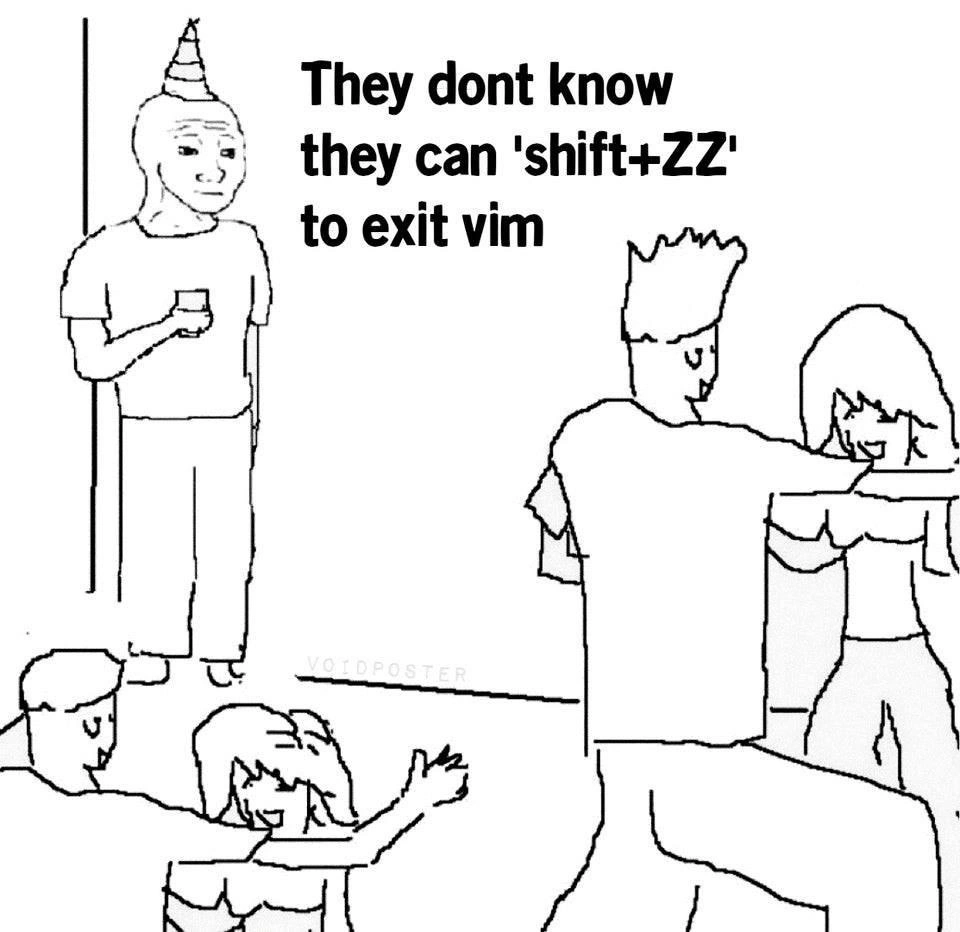
In the image, we see a simple black-and-white drawing of a party. On the left, there’s a sad-looking guy with a party hat holding a drink, and on the right, a bunch of other people are happily dancing and talking. This format is a known meme template often called the “Wojak party” meme. The lone guy is thinking something like, “They don’t know [some fact]”, implying he has knowledge that others don’t. Here the fact is “they can Shift+ZZ to exit Vim.” The humor comes from the clash between a social situation and an extremely niche tech tip. The developer at the party feels secretly proud that he knows this obscure vim shortcut to quit the editor, while everyone around him likely doesn’t even use Vim or care about such things at all. It’s like he’s at a dance but thinking about a programming problem and solution that is irrelevant to the party. That contrast is what makes it funny.

This also touches on something we call developer humor or an inside joke in the tech community. If you’re a programmer, especially one who has used the command line, you probably know or have heard about the struggle of leaving Vim. It’s almost a cliché – so many people have gotten stuck in Vim that it unites us in sympathy. We laugh when we see references to it because we remember feeling a bit dumbfounded the first time it happened to us. Knowing how to quickly exit Vim (like using Shift+ZZ) becomes a little point of pride after you’ve been through that confusion. There’s even a light-hearted rivalry in the programming world known as editor wars, where developers playfully debate which text editor is the best (Vim vs Emacs is a classic feud, and now there’s VS Code and others). In those jokes and debates, Vim users often brag about how efficient they are with keyboard shortcuts, while others tease that Vim is so archaic you can’t even quit it. So this meme is referencing that culture. It portrays a typical “Vim enthusiast” who has mastered the program, quietly patting himself on the back at a party because of that mastery. For a junior developer or someone new to coding, the main takeaway is: Vim is powerful but weird to use at first – even quitting it requires learning a special command like :wq or the shortcut Shift+ZZ. And developers love to poke fun at this fact.

Level 3: Terminal Party Trick

At first glance, this meme perfectly captures a mix of command-line nerdiness and social awkwardness that seasoned developers find hilarious. The scene: a lonely figure at a party quietly reveling in esoteric Vim knowledge while everyone else dances obliviously. The caption "They don't know they can Shift+ZZ to exit Vim" is dripping with insider humor. Why is that funny? Because exiting Vim has long been an almost mythic struggle in programming culture. It’s a shared pain: many new developers (and even experienced ones under pressure) have found themselves stuck in the Vim editor, frantically mashing keys to no avail. Here, the lone developer at the party is quietly smug because he knows one of Vim’s secret escape combos. It’s a terminal party trick that only impresses those in the know – and that’s the joke: he’s mentally flexing a niche tech skill in a completely unrelated social setting.

This image riffs on the well-known fact that quitting Vim isn’t as straightforward as closing a typical app. In a modern GUI or IDE, you’d just click a close button or hit a common shortcut like Ctrl+W. But Vim lives entirely in the CLI and uses modal editing, which baffles newcomers. In Vim’s normal mode, keys don’t directly insert text – they trigger commands. So hitting the usual suspects like the Escape key or Ctrl+C won’t instantly quit the program (Escape just switches modes in Vim). The result? Countless developers have panicked or Googled “how to exit vim” when they accidentally open it. It’s practically a rite of passage in programming. In fact, the question “How do I exit Vim?” has become a running joke on Stack Overflow and forums because so many people have asked (often after getting stuck editing a commit message or config file with Vim). The meme leans into this bit of programmer folklore: knowing the arcane sequence to quit Vim is treated like high wisdom.

Now, what’s the deal with Shift+ZZ specifically? Vim actually offers multiple ways to quit. The classic way is to enter command mode (by pressing :) and type an ex command like :q (quit) or :wq (write and quit). But seasoned Vim users have faster shortcuts. Pressing Shift+Z twice (shorthand shown as Shift+ZZ) is an equivalent of :wq – it instantly saves the file (writes any changes) and exits Vim, all with two keystrokes in normal mode. It’s a neat little shortcut, but only if you’ve read the manual or had a mentor show you. A newcomer would hardly stumble on “press capital Z twice” as a way to leave an editor! So in the meme, the lone developer’s quiet boast is that he possesses this obscure knowledge. He’s effectively thinking, “Ha, these people don’t realize there’s a slick vim shortcut to leave the editor instantly. I do.” It’s the ultimate inside joke because to everyone else at that party, Shift+ZZ is gibberish – it might as well be a secret handshake from an alien language.

Beyond the literal key combo, the meme pokes fun at a broader cultural trope in tech: the pride some developers take in mastering old-school, hard-to-use tools. Vim is revered by many as a powerful, efficient editor – but it’s also infamous for its steep learning curve (with quitting the editor being the punchline example of its cryptic design). This has fueled endless EditorWars debates and good-natured ribbing in the community. Vim devotees wear tricks like Shift+ZZ as badges of honor, proof that they’ve climbed the mountain that is Vim without falling off. Meanwhile, users of other editors (or new devs) might roll their eyes or chuckle, “Why not just use an editor that doesn’t require a secret exit code?” The meme’s humor comes from exactly this contrast: the lone Vim aficionado feeling superior about something so technically trivial yet socially irrelevant. Everyone else at the party is just enjoying the music, unaware of (and unaffected by) this arcane bit of knowledge. The image exaggerates a real phenomenon: a developer in a non-tech social setting still thinking about code, proud of something like knowing a keyboard escape sequence that has zero importance to the people around him.

Notably, there’s an ironic layer here that senior devs especially appreciate: many of us have been that new person stuck in Vim, and later perhaps became the person proud of mastering it. The meme is a gentle jab at ourselves. It underscores how Developer Experience (DX) and usability in tools have evolved – most modern tools avoid such unintuitive pitfalls – yet in developer culture, overcoming a clunky interface like Vim’s is seen as a rite of passage. There’s a saying among experienced engineers whenever someone struggles: “Don’t worry, everyone has to learn to exit Vim the hard way.” So when we see a partygoer internally gloating about Shift+ZZ, we laugh because it’s both absurd and relatable. He’s basically flaunting a solution to a problem everyone else at the party doesn’t even know exists. It’s a perfect cocktail of nerd pride, tech meme culture, and the classic joke that “vim is easy to enter, hard to leave”. In short, the meme resonates as a satire of the inside jokes programmers share about mastering tricky tools – and how silly it looks to boast about that mastery outside our little developer bubble.

Description

This meme uses the 'They Don't Know' / 'I Wish I Was at Home' format, which features a sad Wojak character in a party hat standing alone in the corner of a room while others dance and socialize. The character's internal monologue is displayed as text: 'They dont know they can 'shift+ZZ' to exit vim'. The humor stems from the classic developer struggle of exiting the Vim text editor, a notoriously difficult task for beginners who often resort to frantically trying commands like ':q!', ':wq', or even closing the entire terminal. The 'shift+ZZ' command is a lesser-known, more efficient shortcut to save and exit. The meme hilariously captures the feeling of possessing niche, superior technical knowledge while being completely isolated and unable to share it in a social setting
Comments

11
Anonymous ★ Top Pick The main difference between :wq and ZZ is that one saves and quits Vim, while the other saves your last two keystrokes before you inevitably Google 'how to exit Vim' again
  1. Anonymous ★ Top Pick

    The main difference between :wq and ZZ is that one saves and quits Vim, while the other saves your last two keystrokes before you inevitably Google 'how to exit Vim' again

  2. Anonymous

    I’ve learned to stop explaining Shift-ZZ at parties - the same way I stopped explaining eventual consistency: watching them struggle is the only path to convergence

  3. Anonymous

    After 20 years in the industry, I've seen entire microservices architectures built and deprecated in less time than it takes a junior to accidentally open vim and figure out how to exit - though I still keep a separate terminal open just in case I need to killall -9 vim

  4. Anonymous

    Ah yes, the classic developer party flex: standing alone in the corner, smugly knowing that while everyone else is frantically Googling 'how to exit vim' for the thousandth time, you've ascended to the enlightened plane of Shift+ZZ users. It's the text editor equivalent of knowing the secret menu at In-N-Out, except instead of animal-style fries, you get the quiet satisfaction of saving 0.3 seconds and the social isolation that comes with caring deeply about modal editor efficiency. Meanwhile, the Emacs users aren't even at the party - they're still configuring their init.el to automatically RSVP

  5. Anonymous

    Senior Vim lore: :wq for calm days, ZZ for incidents, and ZQ for when you realize that SSH session wasn’t staging

  6. Anonymous

    Shift+ZZ equals :x; the real boss fight is exiting vim running inside less inside tmux over SSH in a kubectl exec

  7. Anonymous

    Shift+ZZ: because after 20 years, ':wq' feels like training wheels on a low-level escape sequence

  8. @sarveshxv 5y

    What is vim?😶

    1. @soulstorms 5y

      ... baby don't hurt me don't hurt me no more

  9. @obuyadude 5y

    It's also a pretty decent detergent

  10. @stansmolin 5y

    So related

Use J and K for navigation