Skip to content
DevMeme
4956 of 7435
The Seductive Power of Advanced Git Commands
VersionControl Post #5423, on Sep 13, 2023 in TG

The Seductive Power of Advanced Git Commands

Why is this VersionControl meme funny?

Level 1: Bob’s Big Words

Think of it like a teacher telling a student, “You can’t title all your homework ‘Stuff’ – give it a real title next time!” Now, the next day, the student hands in an assignment titled “What is life if full of care, if we have no time to stand and stare?” 😮. The teacher wanted a simple, clear title about the homework, but the student wrote a deep poem instead. It’s silly because the student did use big important words, but those words don’t actually say what the homework is about. In the meme, Bob is that student – he was always labeling his code changes as “small changes” (like saying “Stuff” for everything). When told to use meaningful words, he jokingly went overboard and wrote a line about the meaning of life. It’s funny and a bit mischievous: Bob followed the rule in such an extreme way that it completely missed the point. The feeling is the same as if you asked someone to be a bit more serious, and they responded with an over-the-top dramatic speech. 🤷‍♂️ Everyone laughs because Bob’s big fancy message is so unexpected in a place where you usually see simple, practical notes.

Level 2: No More "Small Changes"

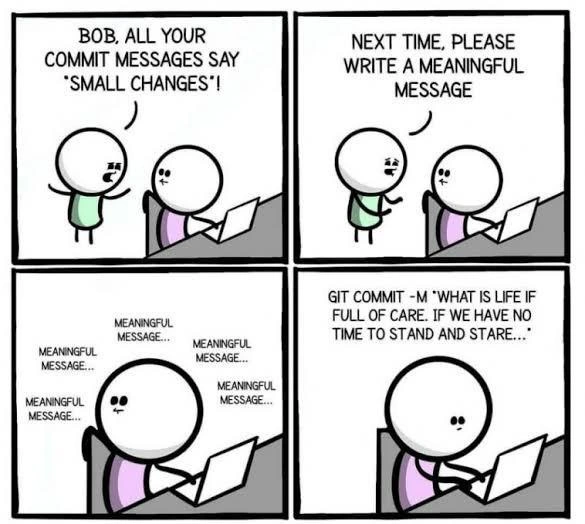
In this comic, a developer named Bob keeps writing the same unhelpful phrase for every commit: "small changes". A commit in Git is like a saved checkpoint of your code, and a commit message is a short description you attach to that checkpoint. Good teams value clear commit messages because they tell everyone what was changed and why. Imagine looking at a project’s history and seeing ten commits in a row all labeled “small changes” – you’d have no clue what each one did! That’s why Bob’s teammate (the reviewer standing behind him) is upset. In the first panel the reviewer shouts, “Bob, all your commit messages say ‘small changes’!” They want Bob to use descriptive messages that actually explain his code updates. In the second panel, the reviewer instructs, “Next time, please write a meaningful message.” This means Bob should summarize his code change in clear terms (for example, “Improve login validation” or “Fix crash on save”). Many projects have rules or guidelines for this, sometimes using tools (like commitlint) to enforce message formats for better CodeQuality. It’s all part of VersionControl best practices and making CodeReviews easier—when a teammate reviews your code, a good message provides helpful context.

Now the funny twist comes in panels 3 and 4. We see Bob sitting at his laptop, staring at the screen while the words “meaningful message… meaningful message…” echo around him. He’s clearly overthinking what a "meaningful" commit message should be. Instead of simply describing his code change, Bob decides to get cheeky. In the last panel, he types a Git command with a very unusual commit message:

git commit -m "WHAT IS LIFE IF FULL OF CARE, IF WE HAVE NO TIME TO STAND AND STARE…"

Here, git commit -m "<message>" is how you make a commit in Git with a message provided right after the -m. Bob’s message is actually a line from a poem about the meaning of life. He basically wrote existential poetry as his commit note! This is humorous because it’s technically a “meaningful message” in the English language sense — it’s deep and philosophical — but it’s totally meaningless with respect to the code changes he made. It doesn’t explain anything about the code at all! The team wanted descriptive commit messages, and Bob delivered something meaningful in a completely unexpected way. It’s like he followed the rule in the wrong dimension: meaningful to life, but not to the code. Developers find this funny because it exaggerates a real workplace scenario. Often junior devs or people in a rush write one or two-word commit messages (“update”, “changes”, “fix bug”), and seniors will insist on more detail. Bob’s response is a playful exaggeration of messing up that request by doing something absurd. The tags like VersionControlHumor and GitCommands apply here because the joke centers on using a Git command in a silly way. And since commit messages are part of code reviews and project documentation, this falls under CodeQuality humor as well. In short, Bob turned a simple request for better commit notes into a chance to drop some poetry – and the contrast between what was asked and what he did is what makes it funny.

Level 3: Poetically Committed

At the heart of this meme is a code review clash over commit message etiquette. The reviewer is basically enforcing a meaningful commit message policy: no more lazy git commit -m "small changes" please! In professional VersionControl systems like Git, commit messages are treated as important metadata. They’re the historical record of why and what changed in the codebase. Seasoned engineers know that a commit labeled "small changes" tells you nothing useful when you’re spelunking through git log at 2 AM trying to debug a regression. So teams institute guidelines (or even commit hooks and commitlint_enforcement) to ensure messages are descriptive. They want Bob to write something like "Fix payment rounding error in checkout" rather than the infamous vague commit logs that drive everyone crazy.

The humor detonates when Bob takes that rule way too literally – or rather, literarily. Instead of providing a concise technical summary, he goes full poetic: git commit -m "WHAT IS LIFE IF FULL OF CARE, IF WE HAVE NO TIME TO STAND AND STARE…". This line is actually a snippet from a real poem (W.H. Davies’ “Leisure”) about the meaning of life. Bob delivers a philosophical stanza as his commit message, technically complying with the “use meaningful words” mandate but in the most facetious way possible. It’s a brilliant bit of DeveloperHumor: he obeys the letter of the law while utterly defying its spirit. For anyone who’s enforced commit guidelines, this scenario is hilariously relatable – it’s a parody of how well-intentioned CodeQuality rules can backfire when a dev decides to troll the system.

Under the hood, this is poking fun at the tension between meaningful metadata and practical brevity that senior devs often debate. We champion CodeReviews requiring precise, Conventional Commits style messages (e.g. feat: add user validation or referencing a JIRA issue) to make our VersionControl history useful. But overly rigid rules can breed resentment or creative rebellion. Bob’s poetic commit is a tongue-in-cheek protest: if he can’t say “small changes,” fine – he’ll wax existential instead. It’s the kind of cheeky move a developer might daydream about after a frustrating review comment. Plus, in a darkly funny way, Bob’s commit still isn’t helpful for the codebase. Future devs doing git blame on that change will see a commit message pondering life’s meaning and be thoroughly confused (or amused!). Senior engineers recognize here a classic pattern: when you force a process without explaining the why, you might get compliance… but you might get creative compliance. The meme exaggerates it to absurdity, making us laugh and nod knowingly at the same time.

Why is this so spot-on? Many of us have seen commit histories full of “minor tweaks”, “fix stuff”, or “WIP” – essentially the version control equivalent of junk food. They provide no nutritional value to future readers. The reviewer in the first panel represents that battle-scarred lead engineer who’s spent one too many afternoons reconstructing a deployment timeline from cryptic commit logs. They’re laying down the law: commit messages should be meaningful_commit_guidelines compliant. Perhaps they even installed a pre-commit Git hook or a CI step to reject messages like “update” or “small changes” (common in commitlint_enforcement setups). Bob’s response cleverly slips through any automated filter: it’s definitely not “small changes” – in fact, it’s a big philosophical quote! It likely passes the linter’s length check and any regex for banned phrases. 🤣 In essence, Bob ironically follows the new rule in a way that highlights its rigidity. This is a conventional_commits_parody in action: instead of “feat: X” or “fix: Y”, Bob commits pure existential poetry. The situation lampoons the sometimes absurd lengths developers might go when process overtakes practicality. It’s a senior-level joke about how well-meaning CodeQuality measures can result in Monty Python-esque outcomes if people don’t buy in. And let’s be honest: after reading countless commits like “typo fixes” or “small changes”, seeing one that asks “What is life if full of care?” would be as jarring as it is comical. It’s a relief valve of humor for anyone who’s ever sighed and typed a commit message while thinking, “Does this even matter?”

Description

This image uses the popular 'Distracted Boyfriend' meme format to illustrate a developer's tool preference in Git. The boyfriend, labeled 'me', is turning his head to look admiringly at a passing woman labeled "git log -S'a piece of code'". His shocked and disapproving girlfriend is labeled 'git blame'. The meme humorously captures the developer's temptation to use a more powerful and sophisticated command (`git log -S`, which searches for the introduction/removal of a specific string in the entire commit history) over the more straightforward and common tool for the job (`git blame`, which simply shows who last modified a line). It's a relatable scenario for experienced engineers who often prefer a deeper, more investigative approach to understanding code history rather than just identifying the last person who touched it
Comments

10
Anonymous ★ Top Pick `git blame` is for finding who to forward the Jira ticket to. `git log -S` is for finding the original sin that started this whole mess six years ago
  1. Anonymous ★ Top Pick

    `git blame` is for finding who to forward the Jira ticket to. `git log -S` is for finding the original sin that started this whole mess six years ago

  2. Anonymous

    Conventional Commits said "type(scope): message" - Bob heard "victorian(poetry): existential reflection" and now the changelog requires a literature PhD to grep

  3. Anonymous

    After 15 years of reviewing PRs, I've learned that developers write commit messages in three modes: 'fix', 'WIP', or suddenly channeling their inner Shakespeare when called out - because nothing says 'I fixed the race condition in the payment service' quite like existential poetry about the human condition

  4. Anonymous

    Ah yes, the classic evolution from 'small changes' to existential poetry in commit messages - because when your tech lead asks for 'meaningful,' they clearly want W.H. Davies quotes instead of 'Fixed null pointer in UserService.authenticate()'. Nothing says 'helpful git blame session' quite like philosophical musings about leisure time. At least future archaeologists debugging production at 3 AM will appreciate the literary merit while they curse your name trying to figure out which 'meaningful' commit introduced the bug

  5. Anonymous

    When git blame outsources fault to a 1911 poet, you've achieved peak commit zen - rebase optional

  6. Anonymous

    Asked for meaningful commit messages; now the changelog reads like a poetry anthology, and I still can’t tell which squash merge broke pagination

  7. Anonymous

    Ask for meaningful commits and Bob ships a poem; time to add commitlint and Conventional Commits before the git log turns into an anthology

  8. @SmirnGreg 2y

    git commit -m "MEANINGFUL MESSAGE"

  9. @Araalith 2y

    "PBI 37164"

  10. @Netaro 2y

    To be fair, seeing how verbose linux kernel commit messages are and how shit some big open source project's commit messages are, If i were a team lead I would force as much verbosity as possible

Use J and K for navigation