Skip to content
DevMeme
2382 of 7435
The Ultimate Full-Stack Workout: One Push Per Line Change
VersionControl Post #2648, on Jan 21, 2021 in TG

The Ultimate Full-Stack Workout: One Push Per Line Change

Why is this VersionControl meme funny?

Level 1: Too Many Push-ups

Imagine you have a friend who wants to get really strong. Every time this friend does anything, even something small like picking up a pencil, they drop to the floor and do one push-up. So if they write a short sentence, they do maybe five push-ups (one for each word!). If they write a whole page, oh boy, that's hundreds of push-ups – one after every word they put down. Pretty soon, your friend is boasting that they did a million push-ups! They’re super muscular from all those tiny exercises, and they wear it like a big badge of honor.

Now, at first you might think, "Wow, a million push-ups, that's amazing!" But then you realize, they took forever to actually write that sentence or finish that page because they kept stopping to do push-ups. And showing off that huge number doesn’t really tell you if the story on the page is any good – it only tells you they did something repetitive a zillion times. In fact, if you were waiting for them to finish the story, you'd probably be frustrated because of all the unnecessary stops.

This is just like the silly situation in the cartoon: a developer is treating every little code change like a huge event. Instead of doing a bunch of changes and then saving them all at once, they save after each tiny change. It’s funny because it’s an extreme way of working – kind of like doing push-ups after every single bite of food. The result might be a record-breaking number (of push-ups or saves), but it’s obviously a crazy way to go about it, and everyone else can only shake their head and laugh, saying something like, “Goodness gracious, that’s over the top!”

Level 2: Push-Per-Line Practice

Let’s break down what’s happening here in plain technical terms. Git is a popular distributed version control system, which means it's a tool developers use to track changes in code over time. In Git, a commit is like a save point or snapshot of your code at a certain moment, often accompanied by a message describing the change. When you have some commits ready and want to share them with others (or just back them up on a server), you push those commits to a remote repository (for example, on GitHub). The normal workflow is to make a set of related changes, commit them locally, and periodically run git push to upload those changes to GitHub.

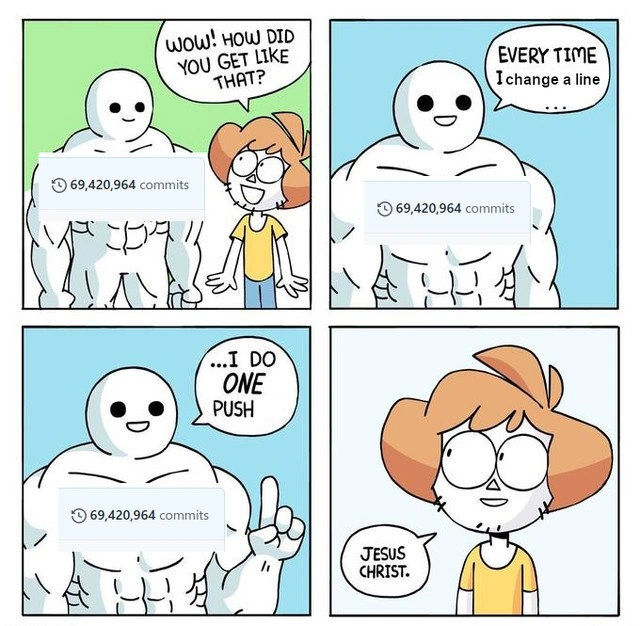
In the meme’s story, the huge musclebound figure is bragging that "Every time I change a line, I do one push." In Git terms, this person is making a commit for each single line they edit, and immediately running git push for that commit. So if they added or modified 100 lines of code, they'd end up with 100 separate commits and 100 push operations – instead of maybe one or a few commits grouping related changes. The commit count shown (69,420,964 commits) is a visual gag, mimicking a GitHub badge or repository stat. On a repo’s page on GitHub, you often see something like "128 commits" indicating how many commits are in the main branch. Here it's blown up to over sixty-nine million, implying this individual has an insane number of commits because of their one-line-at-a-time habit.

Let's clarify some terms for newer developers:

  • Commit: In Git, to commit is to record a set of changes with a descriptive message. It’s like writing in a logbook: “On this save, I changed X, Y, and Z.” Commits are usually meant to encompass a logical chunk of work – maybe fixing a bug or adding a new function – often touching multiple lines or files.
  • Push: To push means to send your local commits to a remote repository (like pushing your local changes up to GitHub so others can see them). You might do this after you've made a few commits locally. Doing a push for every tiny change is unusual because it continuously sends updates to the remote server, creating a very noisy update history.
  • Commit History: This is the sequence of all commits made in the repository (usually on a branch). It lets you see what changes were made over time. A healthy commit history reads like a series of meaningful progress points in the project. If someone uses a single_line_pushes approach, the history will contain a huge number of ultra-fine-grained commits. Scanning that history would be tedious – you'd see perhaps thousands of entries like "Update file X" for every slight edit.

Now, why is doing one commit per line generally frowned upon? For one, it’s not efficient. Every commit you make should ideally serve a purpose, like grouping related changes or documenting a specific fix. If you commit after every line, you’re probably not giving future readers of the history any useful context – many of those commits likely say things like “minor change” or have almost identical messages. It’s like if you wrote an essay and hit the save button after every word; you'd end up with hundreds of versions of the document for no good reason. Also, pushing each of those commits immediately means your team (or anyone watching the repo) gets bombarded with updates: "Alice pushed a commit... Alice pushed another commit..." dozens of times in a short span. It can be frustrating and distracting.

This meme exaggerates the situation to highlight the concept of commit hygiene – which is maintaining clean and meaningful commit practices. Good commit hygiene means you make commits that are intentional: maybe you changed five lines that all relate to fixing a spelling error across a document, so you commit them together with a message "Fix typo in documentation." In contrast, our buff friend here would commit each corrected letter of the typo separately, which is overkill. The phrase “When every single line change earns its own git push and commit badge” from the title is essentially describing this overzealous workflow. They call it a "badge" because on platforms like GitHub, those commit counts are displayed like badges of honor. But as any developer learns, a high number of commits isn't inherently a badge of quality – what's more important is what those commits contain.

For a junior developer or someone new to Git, it might not be immediately obvious why you wouldn't push each little change. After all, you might think “I want to save my work constantly, and share it immediately so nothing gets lost.” Indeed, committing frequently (locally) is fine – even a good idea to avoid losing work – but you can stage multiple small edits into one commit before you push. Git even lets you choose specific lines or "chunks" to commit together (using git add -p for example). The idea is to combine changes that make sense together. Pushing every single line is like uploading a new version of a text document every time you type a word – technically possible, but not practical.

Finally, imagine cloning or downloading the repository where someone has done millions of one-line commits. Git can handle a lot, but you'd be waiting a long time for all those commit objects to transfer, and tools like GitHub might struggle to display such a bloated commit list cleanly. It's just not a version control best practice. The meme humorously captures this as an absurd scenario, making even newcomers think, "Yeah, that seems like overkill." It’s a light-hearted lesson: use Git smartly – commit often, sure, but not that often. Group related changes, write good messages, and don’t treat the commit count like a high score in a video game!

Level 3: Overcommitment Issues

At first glance, this meme is poking fun at extremely granular version control usage. The buff figure proudly sporting a GitHub-style commit badge of 69,420,964 commits is an absurd exaggeration of what we might call bad commit hygiene. In software Version Control (especially with Git), there's an old joke: "commit early, commit often." But here, that mantra is taken to a ludicrous extreme – every single line change results in a new commit and a git push to the remote repo. The result? A ridiculously oversized commit history that would make any seasoned developer spit out their coffee.

Consider the implications of this push_per_line_practice: if a developer literally commits each line change, they end up pushing dozens or hundreds of tiny commits in the time another dev might make one single well-organized commit. It's like measuring Developer Productivity by commit count alone – a completely flawed metric. Historically, inexperienced devs (or overzealous ones) sometimes equate more commits with more work, just as old-school managers mistakenly equated more lines of code with more productivity. In reality, Code Quality is not measured in commit quantity. Fifty micro-commits with messages like "fix typo," "fix typo again," "oops undo typo fix" don't equal better code; they equal a messy project history.

From an experienced perspective, this scenario triggers a mix of amusement and mild horror. We've all seen commit logs where someone stacks trivial changes:

  • Fix spelling
  • Fix spelling (again)
  • Remove extra semicolon
  • Add semicolon back

These come one after another in rapid succession. Now imagine millions of such commits. 😂 The meme’s giant muscle-bound character essentially brags:

Buff Dev: "EVERY TIME I change a line... I DO ONE PUSH."

He's treating each commit like a rep in a workout routine, pumping up that commit count. The humor lands because seasoned devs know no real project would benefit from 69 million single-line commits – it's a satirical portrayal of poor practice. In a real-world scenario, having that many commits would bog down tools and humans alike. For instance, running git blame or git log on a file with thousands of one-line changes is a nightmare: you'll scroll through countless near-duplicate entries just to find a meaningful change. Code reviews become exhausting, because the diff for each commit is minuscule but the overall change might be scattered across dozens of commits.

There's also the continuous integration chaos: if you have a CI/CD pipeline triggering on each push, someone doing “one push per line” would flood the pipeline queue. Imagine the build server grinding through 100 builds for 100 one-line commits instead of a single build for a 100-line change – it's hilariously inefficient. Not to mention, each commit should ideally represent a coherent state of the code. If you're committing after every line, you might be committing code that doesn’t even compile until the following lines are added in subsequent commits. This is definitely commit_history abuse and not how Git is intended to be used.

Why do veteran developers find this so comical (and cringe-worthy)? Because it satirizes the antics of either a newcomer who doesn’t understand sane workflow or an engineer chasing vanity metrics: perhaps someone who wants a high commit count showing on their GitHub profile as a badge of honor. GitHub does show the number of commits in a repository and highlights your contribution graph (those green squares) for daily contributions. Some folks gamify this, doing tiny commits to inflate those stats. The meme blows this up to epic proportions – 69,420,964 commits is a tongue-in-cheek number (it sneaks in "69" and "420" for extra internet humor). This commit count is so high that it dwarfs the commit history of Linux or any massive project on earth. It's clearly mocking the idea that quantity of commits could ever trump quality.

From an architectural or historical standpoint, earlier centralized version control systems (like SVN or CVS) made it inconvenient to commit ultra-frequently – every commit was a network operation locking the repo. But with Git’s distributed model, developers can commit locally as often as they want. This is usually a good thing (you can work in small increments), but taken to the extreme shown here, it becomes a farce. Modern workflows encourage small, logical commits, yes, but also encourage using tools like interactive rebase or squash merging to combine trivial commits into one before sharing with the team. No team lead wants to see 500 commit badges on a pull request that say nothing useful! The buff character in the meme either ignored that memo or is intentionally living the joke.

In summary, the humor resonates on a senior level because it exaggerates a real anti-pattern: focusing on the wrong metric (commit count) and abusing version control with an excessive, almost ritualistic process. It's the inverse of best practices, and every experienced dev immediately recognizes the absurdity – and perhaps recalls reviewing a colleague’s 20-commit PR where half the commits were basically noise. The meme is a lighthearted caution: just because you can push every line doesn't mean you should. Instead of a lean, meaningful commit history, you end up with a grotesquely buff but functionally ridiculous one – much like our comic’s lovable muscle-bound commit monster.

Description

A four-panel comic strip meme illustrating a conversation between a regular person and an extremely muscular character. In the first panel, the regular person, with orange hair and a yellow shirt, asks the buff character, 'WOW! HOW DID YOU GET LIKE THAT?'. Over the muscular character's chest is a grey box resembling a GitHub commit counter, showing an absurdly high number: '69,420,964 commits'. In the second panel, the buff character explains, 'EVERY TIME I change a line...'. In the third panel, he continues, '...I DO ONE PUSH'. In the final panel, the orange-haired person stares in horror, exclaiming, 'JESUS CHRIST.'. The meme satirizes terrible version control hygiene by taking the concept of frequent commits to an illogical extreme. Pushing every single line change would create a nightmarishly cluttered commit history, spam the CI/CD pipeline, and make code reviews utterly impossible, highlighting a complete misunderstanding of atomic commits and proper Git workflow

Comments

16
Anonymous ★ Top Pick The pull request contains 69,420,964 commits. The reviewer left one comment: 'Can you squash this?'
  1. Anonymous ★ Top Pick

    The pull request contains 69,420,964 commits. The reviewer left one comment: 'Can you squash this?'

  2. Anonymous

    "Atomic commits are great - until each electron gets its own SHA and running git bisect feels like applying for beam time at CERN."

  3. Anonymous

    This is what happens when someone takes 'commit early, commit often' so literally that their git log looks like a keystroke logger and their commit messages have devolved into single emoji because writing 'fixed typo' 69 million times broke their spirit

  4. Anonymous

    Ah yes, the legendary 69 million commit developer - proof that 'atomic commits' can be taken to subatomic levels. At this rate, their git log is longer than the Linux kernel's entire history, and `git bisect` would take until heat death of the universe. Meanwhile, their PR reviewers have aged into retirement trying to understand why changing a semicolon required 47 separate commits. This is what happens when you interpret 'commit early, commit often' as 'commit every keystroke, commit every breath.'

  5. Anonymous

    In a guarded monorepo, one push per line is the fastest way to DDoS your own CI and turn Git history into Kafka

  6. Anonymous

    This is what happens when 'push on save' meets a monorepo with required checks - every semicolon funds another hour of GitHub Actions and 400 Slack notifications

  7. Anonymous

    Virgin dev rebases to a clean history. Chad dev: one push, monorepo commit count escapes Git's int32 limit

  8. @choke_hazard 5y

    Why line, not character?

    1. @sylfn 5y

      not character, but byte

      1. @abel1502 5y

        That breaks unicode in about half of the commits)

        1. @sylfn 5y

          no one cares about unicode if you use koi8

          1. @abel1502 5y

            But there a character is literally synonimous to a byte. The only case where they are different are multibyte encodings, and I don't know any besides various unicodes (although there most likely are some)

            1. @gizlu 5y

              "character" has over 9000 meanings, and the one that end user usually thinks of, is definitly not byte synonym (at least in case of unicode)

              1. @abel1502 5y

                You must have misunderstood my statement - your statement accords to mine, i.e. "in multibyte encodings, such as all the unicodes, a character isn't the same as a byte". And, overall, even in terms of bare abstractions, when we're talking about texts, it's better to treat character as the fundamental unit, because there are many different ways to represent text in binary, so there's no good way to strictly associate characters to bytes

                1. @gizlu 5y

                  Oh, yes. I need more sleep

  9. @f9c49f0c1e749a4a7fd9d642e4728bc 5y

    😂😂😂

Use J and K for navigation