
Meetings Post #4670 · source on Telegram
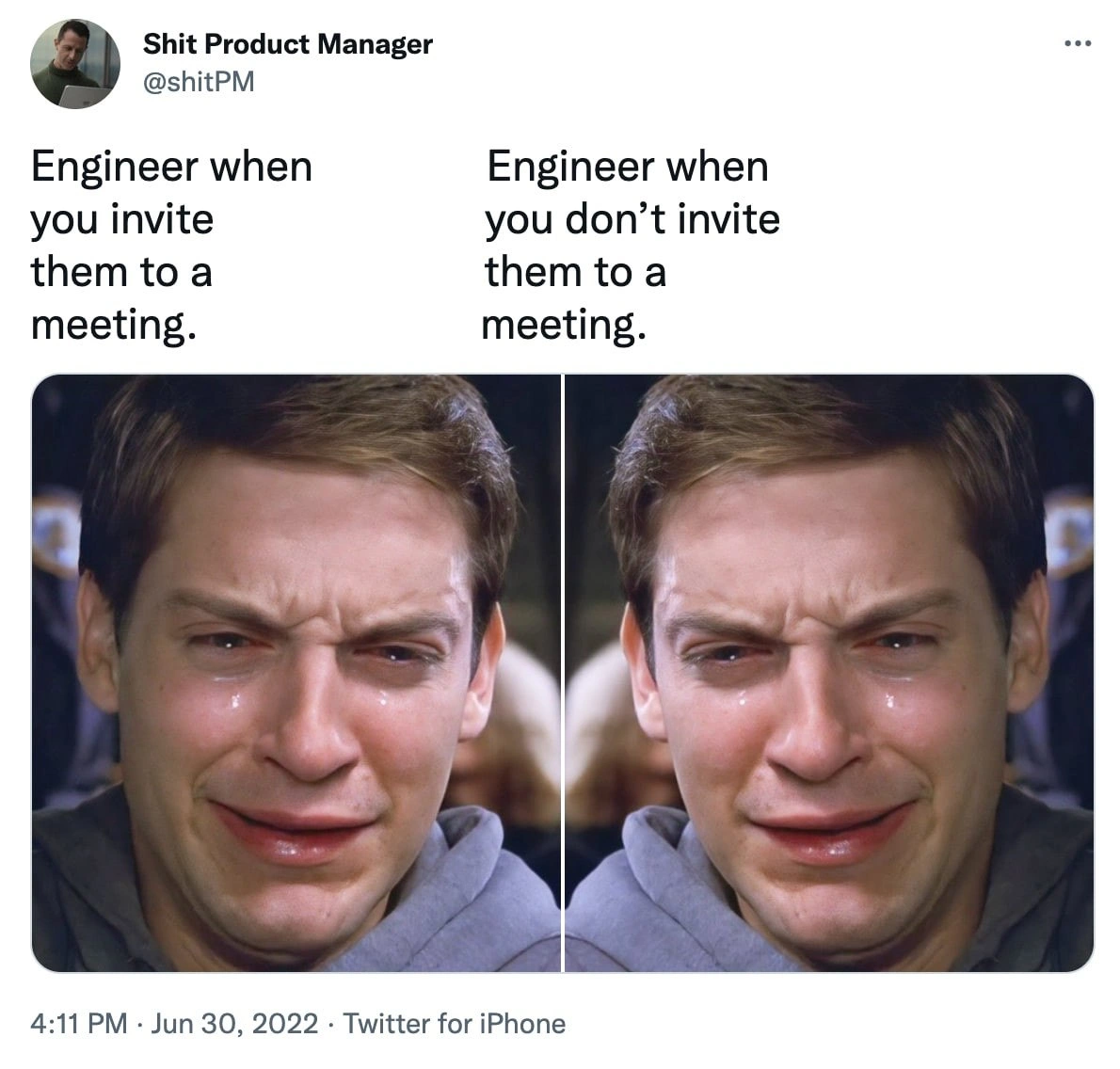
Engineers look identical whether invited or ignored for yet another meeting
Description
Tweet-format meme from the account "Shit Product Manager @shitPM". The tweet text reads: "Engineer when you invite them to a meeting." on the left and "Engineer when you don’t invite them to a meeting." on the right. Below the text is a side-by-side image of the same young man’s face with a neutral, slightly tired expression; both halves are identical, visually communicating zero change in emotion. The joke highlights developer indifference toward meetings and pokes fun at product-manager - driven calendar overload. Technically, it satirizes the communication gap and meeting culture friction common in software teams
More like this
More like this in Meetings →


Use J and K for navigation
Comments
6Comment deleted
After two decades of stand-ups, my class Engineer has onMeetingInvited() and onMeetingSkipped(); both override to return const NeutralFace, while the real processing keeps running in a background thread
After 15 years in tech, you realize the real distributed systems challenge isn't CAP theorem - it's simultaneously wanting to be excluded from all meetings while also being offended when you're not invited to the architecture decision that will haunt your on-call rotation for the next three years
The engineer's Schrödinger's meeting paradox: simultaneously wanting to be left alone to code in deep focus while also needing to be in every meeting to prevent architectural decisions that will haunt the codebase for years. It's not about the meeting itself - it's about the existential dread of either context-switching hell or discovering three sprints later that the PM promised a feature requiring a complete rewrite of your carefully crafted abstraction layer
Invite or don’t - on a senior engineer, meeting invites are an idempotent API call; response is always 200 OK: send the doc, async
Meetings obey CAP theorem: can't guarantee Communication, Attendance, *and* Productivity for engineers
Schrödinger’s calendar: attend and pay the context-switch tax; skip and wake up to meeting notes declaring a new microservice and a ‘quick’ API change you now own