Skip to content
DevMeme
2264 of 7435
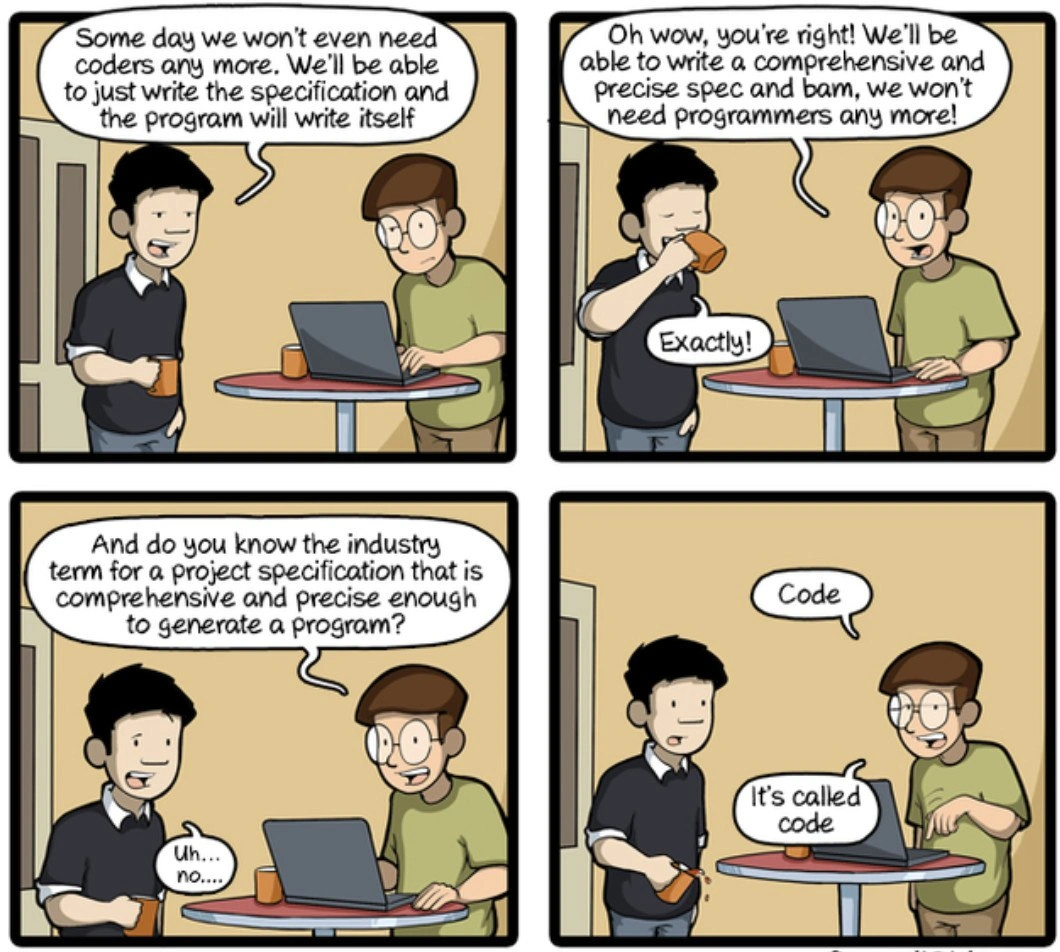
When the 'spec' is so detailed it magically becomes actual code
SDLC Post #2519, on Dec 24, 2020 in TG

When the 'spec' is so detailed it magically becomes actual code

Why is this SDLC meme funny?

Level 1: It's Called Code

Imagine you have a big Lego set and a friend who says, “One day, I won’t even have to build the Legos! I’ll just write down exactly how it should look, and the Lego set will assemble itself!” That sounds cool, right? You just tell the Legos what the final castle should be like, and poof, it’s built. But then you think a bit: if your friend has to write down exactly how to put every single brick together, step by step, with no mistakes, aren’t they basically doing the building work, just on paper? Writing those super detailed instructions for the Legos would take as much effort (and time) as actually snapping the bricks together. In the end, the only difference is one person writes the instructions and another follows them – but all the careful thinking (which brick goes where, what to do if a piece doesn’t fit) was done by the person writing the instructions.

That’s what this comic joke is about. Some people say, “someday we’ll just write what we want and the computer will build the program itself, no programmers needed!” The funny response is: if what you write down is that complete and that precise, then congratulations, you basically just wrote the program. You just wrote it in a detailed essay instead of in actual code. It’s like giving directions so exact that the journey is completely spelled out — you didn’t eliminate the work, you just shifted it. So the punchline “It’s called code” is a cheeky way of saying: those magical instructions that do everything? We already have that – it’s called writing code! In simple terms, you can’t get the computer to do exactly what you want unless you tell it exactly what to do… and telling it exactly what to do is programming. So, sorry, we can’t skip the hard part – whether we call it a spec or code, somebody has to figure out all those little details!

Level 2: Spec vs Code

Let’s take a step back and explain the basics behind this joke. In software development, a specification (spec) is a written description of what a program should do. It’s like a blueprint or a recipe for the software. For example, a spec for a simple login system might say something like: “The program should allow users to enter a username and password. If the username or password is incorrect, it should show an error message. If the login is successful, it should take the user to their dashboard page.” This spec is written in normal language so that humans (especially planners, designers, and developers) can discuss and agree on it.

Code, on the other hand, is the actual implementation of those instructions in a programming language that a computer can execute. Following the login example, a programmer would take that spec and write code, for instance in Python or JavaScript, to make it real. Code is very precise – every case must be handled in a definite way, because computers only do exactly what you tell them. Here’s a tiny illustration of turning a simple spec into code:

Specification (excerpt):
- If the user’s password doesn’t match the stored password, display an error "Invalid credentials".
- If the password matches, log the user in and show the dashboard.

Code (Python-like):
if input_password != stored_password:
    print("Invalid credentials")
else:
    log_user_in()
    show_dashboard()

In the spec (left side), we described the what: what should happen for a wrong password or a correct password. In the code (right side), we wrote the how: the exact steps for the computer to check the password and what functions to call in each case. The code is essentially a more detailed and precise version of the spec, written in a formal language the computer understands.

Now, the meme jokes about a future where we might only need to write specs and not code – basically telling the computer what we want, and the computer figures out how to do it. This idea isn’t new. You might have heard of things like no-code or low-code tools. These are platforms where, instead of writing code line by line, you can maybe drag-and-drop components or fill in some settings, and the tool generates some code for you. For example, a website builder lets you design a page visually and then it generates the HTML/CSS code behind the scenes. It sounds like we’re just writing a “spec” (the visual layout we want) and the program writes itself (produces the site code).

However, here’s the catch that makes the joke work: any specification that is detailed enough to cover every aspect of what the program does starts to look a lot like code. As a junior developer or student, you might have encountered this when writing pseudocode or very detailed project plans. Pseudocode is writing out the solution in plain language or simple structured steps before coding. For a trivial problem, pseudocode might be easy. But for something complex, the pseudocode can become almost as complicated as real code! That’s because you have to consider all the little details: What if the file isn’t found? What if the user enters an emoji in their name? Should we allow that? The more precise you try to make your plan or spec, the more it starts turning into a form of programming.

In real-world software projects, specs are super important, but they’re usually not sufficient by themselves. There’s a whole Software Development Life Cycle (SDLC) where we: gather requirements (talk to users about what they need), write a spec or design, then implement (code) it, then test it, deploy it, etc. The spec guides the implementation, but it doesn’t remove the need to implement. Think of the spec as a recipe and the code as the actual cooking. You can write a very good recipe for a dish, but someone still has to go into the kitchen and combine the ingredients exactly as instructed. And if the recipe is extremely detailed (“cut the carrot into 5mm cubes, boil for 7.5 minutes…”), the person writing the recipe basically did a lot of the thinking work that the cook usually does. They had to decide all those precise steps. In programming terms, a spec that detailed might as well be a form of code, because it’s telling the computer (or the coder) exactly what to do, step by step, leaving no decisions or creativity for later.

There’s also a bit of MisalignedExpectations between non-developers and developers sometimes. A manager might say, “Can’t we just describe the problem to the computer and have it solve it?” Developers know that describing the problem thoroughly is basically programming. Sometimes tools are advertised to bridge this gap. For example, a low-code fantasy is that a business analyst could draw some flowcharts and the system will generate a full application. While flowcharting and visual tools can help outline things, in practice those diagrams have to be extremely detailed to generate a complete app. Often developers end up having to tweak the generated output or write custom code for the missing pieces. So the dream of “the program will write itself” is, at this point, just that – a dream (or a sales pitch!). AI hype vs reality is similar: you might hear "Artificial Intelligence will soon write all our code." AI can assist (like auto-completing some code, or generating simple programs from prompts), but it’s not magic. It doesn’t truly understand the problem like a human does, and it can make mistakes especially with complex, nuanced tasks. In the end, a human developer must review and often correct what the AI produces.

So, the meme’s point in simpler terms: writing software isn’t just mindlessly typing – it’s figuring out exactly what needs to happen. If you do all that figuring out in a spec (no matter what fancy format it’s in), then you’ve essentially done the programming work. Calling it a “spec” instead of “code” doesn’t change the fact that you solved the problem’s logic. That’s why Developer A asks, “Do you know the term for a spec that is comprehensive and precise enough to generate a program?” and delivers the answer: “Code.” It’s a playful reminder that you can’t skip the implementation phase by just making the planning phase infinite; eventually, all the detail has to live somewhere. If it’s not in the code, it has to be in the spec – and then the spec is as complex as code itself.

Level 3: No Silver Bullet

For seasoned developers, this comic triggers a knowing smile (or an eye-roll) because it satirizes a recurring theme in our industry’s TechHypeCycle: the fantasy that someday software development will be so automated that we can eliminate those pesky programmers. The dialogue starts with Developer A saying we’ll just write a spec and the program will write itself. Developer B eagerly buys into this low-code/no-code utopia: “We won’t need programmers anymore!” If you’ve been in engineering long enough, you’ve heard this refrain in various forms over the decades. The punchline delivers the reality check: a spec comprehensive and precise enough to directly generate an application is code by another name. Essentially, the comic reminds us there’s no silver bullet that removes the need to actually write the logic of a program.

Why is this funny (and a bit painful) to experienced devs? Because we’ve seen management and industry pundits chase this mirage again and again. There was a belief that if we just describe what the software should do, some magical tool or AI will figure out how to do it. This idea surfaces with different trendy names: Computer-Aided Software Engineering (CASE) tools in the 80s, 4GL (Fourth-Generation Languages) and model-driven development in the 90s, UML code generation in the early 2000s, low-code platforms and visual programming in the 2010s, and now the AI code generation hype (like GPT-3 or Github Copilot in the 2020s). Each time, the promise is “Soon we won’t need to hand-code everything. Non-programmers or a smart system will do it for us!” And each time, reality proves otherwise.

Let’s break down the shared industry joke here:

  • RequirementsVsReality: In real projects, requirements are almost never complete or entirely unambiguous. There’s always some detail missed or a new scenario that wasn’t thought of. A spec that tried to account for everything would be insanely long and complex. Developers often joke about Requirements Ambiguity because turning fuzzy wishes into concrete, running software is our daily struggle. We know that a one-paragraph requirement might explode into pages of code handling all the corner cases. So when someone says, “we’ll write a comprehensive spec and bam! software!” we chuckle — if only it were that straightforward.
  • MisalignedExpectations: Non-engineering stakeholders (like some managers or clients) sometimes think coding is a mechanical translation of a well-written plan. “If you know exactly what it should do, can’t you just press a button and have the code?” This meme highlights the disconnect. The ManagementVsEngineering tension often comes from management underestimating the creative problem-solving and detail work that developers do. Engineers know that a spec detailed enough to require no programmer input would have to spell out every decision — essentially leaving nothing to translate.
  • specification_driven_development hype: There’s an almost mythical ideal in some methodologies (like strict Waterfall planning) that if you write the perfect specification document up front, implementation will be trivial. In theory, the devs just become typists copying the spec into code. The comic brutally simplifies why that fails: any spec precise enough to remove programmer creativity is the code. You haven’t avoided complexity; you’ve just pushed it into a different document. In practice, we either end up writing pseudo-code in the spec (which duplicates effort), or we keep specs high-level and let developers figure out the details during coding (which is usually what happens).
  • TechHypeCycle and AIHypeVsReality: Every few years, a new tool claims to generate code automatically. Seasoned devs have a reflexive skepticism to these claims. Sure, we can generate some boilerplate or use frameworks that handle generic parts of an application. But the humor here is that the hype always overestimates how much of the work can be automated. For instance, low_code_fantasies had business folks dreaming they’d make complex apps via drag-and-drop. Those tools work for simple CRUD apps or prototypes, but once you need something custom or complex, guess who has to step in? A developer, writing actual code. And those “comprehensive specs” often turn into visual spaghetti – flowcharts and forms so intricate that maintaining them is just another form of coding, only with a clunkier interface.
  • CodeGenerationHype reality: We do have code generation in some areas – like protobuffers or OpenAPI generating API client stubs. But these require very structured input (which again looks a lot like code or formal definitions). The laughable notion in the meme is the extreme end of this hype: complete programs from just requirements. It’s akin to believing a unicorn will do your on-call shift. Experienced devs know that if you try to shortcut actual programming, you usually just shift the effort elsewhere. Maybe you write a ton of configuration files, or you wrestle with the code generator’s quirks. In one way or another, you pay the price upfront or downstream.

A cynical veteran might put it like this: “I’ve seen this movie before. We spend months writing a super-detailed spec or drawing elaborate UML diagrams, then spend even more months writing code and fixing all the things the spec got wrong or forgot. In the end, we did double the work thinking we could avoid coding.” The final panel’s zinger – “It’s called code.” – is the punchline to years of wishful thinking. It’s a reminder that developer_job_security is safe: as long as humans dream up new software, there will always be a gap between ideas and executable reality, and bridging that gap is programming. No matter how fancy your spec or tool is, somebody has to sweat the details. After all, writing perfect instructions for an unknown machine (or an AI) is just as hard as writing the program. The universe has yet to give us a true “code writes itself” solution. Until then, we’ll keep our mugs of coffee warm and our IDEs open, ready to translate imperfect specs into working software (and chuckling at memes like this when someone claims we’ll be obsolete next year).

Level 4: Turing-Complete Requirements

At the most theoretical level, this meme pokes fun at a formal methods paradox. In computer science theory, a program specification detailed enough to automatically generate a working program is essentially an algorithmic description of that program. If a spec covers every input, output, and edge case with complete precision, you've basically written the logic of the software. In other words, the specification has become code in disguise. This is related to the idea of an executable specification: a description so precise it can be executed or transformed directly into a program. Formally, any specification language that can express arbitrary program behavior is effectively Turing-complete, meaning it can compute anything a programming language can (given enough detail). It’s a bit of a paradox – the moment your spec can magically generate a program, it has to be as rigorous as code itself.

In theoretical terms, you can't escape the complexity. The Church-Turing thesis tells us that any method of describing effective procedures (like a detailed spec or a programming language) has the same fundamental limitations. And Fred Brooks famously argued in No Silver Bullet that there's no shortcut to eliminate the essential complexity of software; whether you write it in code or in a spec, you must still wrestle with all the intricate details. The meme’s punchline (“It’s called code”) reflects this exact principle: a project specification comprehensive enough to produce a program is indistinguishable from the program’s source. You’ve essentially created a programming language out of your requirements document. Software engineers who dabble in formal specification languages (like Z, TLA+, or Alloy) know that writing a completely precise spec is as difficult as coding – often even more so, because you’re using mathematical rigor to capture reality. And once you have a spec that detailed, you typically feed it into a tool (a spec compiler or proof system) to either verify or generate code. By then, the hard work – deciding all the logic – is already done in the spec. In summary, at this deep theoretical level, the meme highlights a truth of computer science: you can raise the level of abstraction, but you can’t wish away the inherent complexity. A comprehensive spec is basically a program written in fancy prose or diagrams.

Description

Four-panel comic featuring two developers chatting beside a café-style round table holding a laptop and coffee mugs against a beige office backdrop. Panel 1: Dev A says, “Some day we won’t even need coders any more. We’ll be able to just write the specification and the program will write itself!” Panel 2: Dev B replies, “Oh wow, you’re right! We’ll be able to write a comprehensive and precise spec and bam, we won’t need programmers any more!”, to which Dev A affirms, “Exactly!” Panel 3: Dev A asks, “And do you know the industry term for a project specification that is comprehensive and precise enough to generate a program?”, and Dev B hesitates, “Uh… no…”. Panel 4: Dev A answers, “Code”, followed by Dev B conceding, “It’s called code.” The joke highlights the perennial myth that perfect requirements documents could replace real coding, underscoring SDLC reality, requirement precision, and hype about automatic code generation replacing engineers
Comments

7
Anonymous ★ Top Pick “Write the spec so precise the code writes itself”? Congrats - you’ve invented a Turing-complete Confluence page, and the moment Marketing edits a comma it’ll hot-deploy to prod
  1. Anonymous ★ Top Pick

    “Write the spec so precise the code writes itself”? Congrats - you’ve invented a Turing-complete Confluence page, and the moment Marketing edits a comma it’ll hot-deploy to prod

  2. Anonymous

    After 20 years of 'low-code will replace developers' promises, we've discovered the only specification precise enough to generate working software is the one we've been writing all along - it just happens to compile

  3. Anonymous

    This comic brilliantly captures the fundamental paradox that's haunted software engineering since the 1960s: any specification precise enough to unambiguously generate working code must itself encode all the logic, edge cases, and business rules - which means you've just written code in a different syntax. It's the same reason why 'low-code' platforms inevitably have an 'advanced mode' where you're writing JavaScript, and why every generation rediscovers that the hard part isn't typing - it's thinking through the problem space. The real kicker? Even with perfect AI code generation, someone still needs to write that 'comprehensive and precise spec,' and that person needs to understand software architecture, edge cases, performance implications, and security concerns. Congratulations, you're still a software engineer, just with a fancier compiler

  4. Anonymous

    A spec precise enough to replace developers is called a programming language - enjoy debugging the PRD

  5. Anonymous

    A spec ‘precise enough to generate a program’ is just a DSL with a compiler-shaped TODO - engineers call it code, PMs call it magic

  6. Anonymous

    Prompt engineering: trading curly braces for natural language, only to debug the hallucinations anyway

  7. @Fatimel 5y

    🤫

Use J and K for navigation