Skip to content
DevMeme
2130 of 7435
The Programming Learning Curve: A Nosedive into Humility
Learning Post #2379, on Nov 28, 2020 in TG

The Programming Learning Curve: A Nosedive into Humility

Why is this Learning meme funny?

Level 1: A Bumpy Ride

Learning programming is like learning to ride a bike on a tricky road. Imagine you just started biking with training wheels on. At first, you pedal a short distance and think, “Wow, I’m really good at this!” – it feels easy. But then, as you go a bit further, someone takes off the training wheels and suddenly the road gets super bumpy and steep. You try to turn or speed up, and boom! you hit a big bump and fall over. You sit on the ground dazed, maybe a little scraped up, thinking, “Why was that so hard? Who built this crazy road?!” You went from feeling like a biking superstar back to feeling like a beginner who can barely stay upright. That emotional journey – from confident to confused – is exactly why this programming meme is funny. It’s saying that learning to code often feels just like that bumpy bike ride: just when you think you’ve got it, you hit a big bump that sends you right back to feeling like you’re still learning how to ride.

Level 2: The Confidence Crash

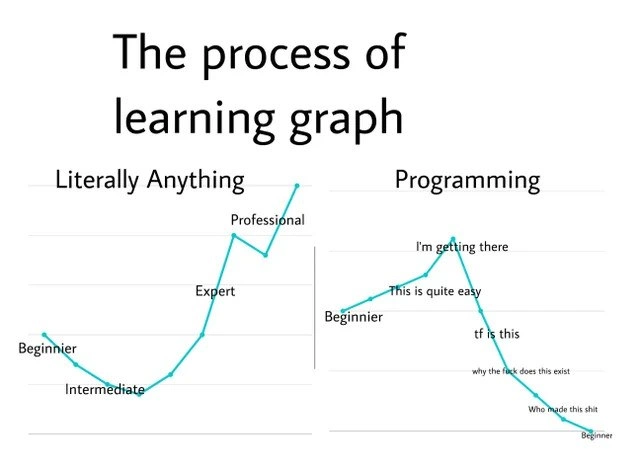
This meme compares learning programming to learning literally any other skill. On the left is the graph for any normal skill – say, learning to cook or play guitar. It starts at “Beginnier” (a playful misspelling of Beginner, hinting that beginners don’t even spell it right), dips a bit at Intermediate (when things get a tad challenging), then rises steadily through Expert and up to Professional. That’s the usual learning trajectory: some struggles early on, but generally a smooth climb as you gain experience.

Now, look at the right side titled “Programming”. It also starts at Beginnier, but then it shoots up to a point labeled “This is quite easy”. This reflects how, in the early days of coding, you often get quick wins. For example, you might write a simple Python script to add two numbers or make a “Hello World” program in JavaScript, and it works. Success! You feel “I’m getting there”, gaining confidence fast. This is a common early experience in the LearningToCodeJourney: the basics can feel straightforward.

But then the line suddenly plunges dramatically. The labels along this downward plunge are hilarious and painfully accurate:

  • “tf is this” – Here “tf” is internet shorthand for “the f***”. This is that first big moment of shock and confusion. Maybe you encountered a weird error message like NullPointerException or undefined is not a function, and you have no idea what is happening. You’re basically saying, “What on earth is this?!”
  • “why the f* does this exist”** – This is deeper frustration. It’s when you discover some bizarre feature or convoluted part of a language/framework. For a new coder, it might be something like learning about pointers in C (“Why do we even need these addresses thing?!”) or encountering asynchronous code in JavaScript. You start questioning the design of the technology itself. “Who thought this was a good idea?” you wonder.
  • “Who made this shit” – Now you’re outright blaming whoever created the tool or language for your misery. It’s a mix of anger and despair. For instance, you might be wrestling with a confusing library or badly documented framework and curse the nameless developers behind it. It’s a very DeveloperFrustration moment: you feel the system is intentionally out to get you.

All these stages on the way down correspond to what many call a “confidence crash”. One day you feel on top of the world, the next day you feel like you know nothing. In the graph, the line ends up all the way back at Beginner. In other words, after that brutal plunge, you feel like you’re back to square one. This is actually a known part of learning complex skills. In programming, it happens because once you dig deeper, you realize the easy stuff was just the tip of the iceberg.

But here’s the twist: after going through that valley of despair, you actually are more knowledgeable than before. The meme exaggerates by dropping you to “Beginner”, but what it’s really showing is that humbling feeling of starting over. In truth, you’ve leveled up, but it doesn’t feel that way because you’ve also become aware of how much more there is to learn. Every developer – whether learning basic web development or a new machine learning library – can relate to being totally lost and thinking "I must be dumb; I’m right back at being a newbie." The meme resonates as a RelatableDevExperience because it captures that rollercoaster of confidence: from “I got this” highs to “I know nothing” lows.

In simpler terms, the process of learning programming is full of ups and downs. Beginners should know it’s normal: you hit a confusing bug or an incomprehensible concept and suddenly feel clueless. Meanwhile, learning other things might not smack you in the face quite so hard all at once. The humor here is in that extreme contrast. Programming is portrayed as this almost absurd learning journey where even as you progress, it feels like you’ve accomplished nothing because of how much new complexity keeps appearing. The meme is basically a light-hearted way to say: “Don’t panic, it’s not just you – coding is just a wild ride!”

Level 3: From “Hello, World” to Hell

At the highest level, this meme is nodding to the Dunning-Kruger effect in a LearningToCodeJourney. When you first dive into programming, there's an illusion of mastery after writing a few scripts or finishing a basic tutorial. Seasoned devs recognize that cheeky phase: you print "Hello, world!" and think “This is quite easy”. That's the short-lived climb up Mount Stupid – the peak of unwarranted confidence. But as the graph humorously shows for Programming, that confidence soon nosedives into a chasm of confusion. In other fields (the left chart “Literally Anything”), your skill tends to grow more linearly – or at least smoothly – from beginner to professional. But in software development, the learning curve is more like a learning cliff: one minute you’re an Intermediate, the next you’re sliding into the “tf is this” abyss.

This dramatic confidence crash – often called the “valley of despair” – is a rite of passage for developers. It happens when the initial simplicity (like writing a few functions) collides with the vast complexity of real-world code. Why is programming so prone to this plunge? A few reasons resonate in our DeveloperHumor circles:

  • Abstraction Layers: At first you learn high-level concepts (easy wins), but then you peek under the hood. Suddenly you’re wrestling with pointers, memory models, or asynchronous callbacks, thinking “why the f** does this exist?”*. Every new layer of abstraction (from simple scripts to full-blown frameworks to operating system internals) reveals another WTF moment.
  • Unknown Unknowns: In coding, there’s an infinite iceberg below what you initially see. The graph’s plunge past “Who made this shit” captures that shock when you encounter a bizarre API design or a language quirk (looking at you, JavaScript type coercions and C++ template errors). You realize whole domains of complexity you never knew about. Experienced devs chuckle here because we all hit that wall where we suddenly felt like total beginners again.
  • Rapid Evolution: Unlike learning, say, woodworking which has ancient, stable techniques, programming tools and best practices change constantly. You might have become an Expert in one technology, only to find the landscape shifted (hello new JavaScript framework of the week). Boom – you’re back at “Beginner” on the graph for that new thing. It’s a perpetual cycle of learning curves within learning curves. This meme nails that RelatableDevExperience of being an expert in one corner of tech and a clueless newbie in another.

There’s a darkly funny truth here that senior engineers know: the more you learn, the more you realize you don’t know. The right side of the meme shows the line ending at Beginner again – which reflects how true professionals often feel. After wading through the muck of complexity (“Who did make this, anyway?”), you emerge more humble. As your understanding deepens, your perspective resets. You see the endless ocean of knowledge still out there and cheekily rate yourself back at Beginner. This ironic loop is at the heart of why this meme hits home. It’s DeveloperFrustration portrayed in a simple graph: the expectation that you’d keep climbing vs. the reality that programming’s learning curve graph has pit stops in hell. And every senior dev is basically nodding along, possibly with a scarred smile, remembering their own plunge into the abyss (and knowing it likely won’t be the last time).

Description

A two-panel meme titled 'The process of learning graph' that contrasts the learning process for two different subjects. The left panel, labeled 'Literally Anything,' displays a line graph showing a typical learning curve: a start at 'Beginner,' a slight dip to 'Intermediate,' and then a steady, upward climb through 'Expert' to 'Professional.' The right panel, labeled 'Programming,' shows a dramatically different graph. It starts at 'Beginner,' rises sharply with labels 'This is quite easy' and 'I'm getting there,' but then peaks and plummets vertically. The labels along this steep descent capture a complete loss of confidence and growing frustration: 'tf is this,' 'why the fuck does this exist,' and 'Who made this shit,' ending at a point labeled 'Beginner' again, but far below the starting level. This meme humorously illustrates the Dunning-Kruger effect in software development, where initial confidence is shattered by the sudden realization of the field's immense complexity. It is deeply relatable to experienced engineers who have ridden this rollercoaster of confidence and despair with every new language, framework, or paradigm


Comments

13
Anonymous ★ Top Pick A senior engineer is someone who has fallen off that peak so many times they've learned to pack a parachute woven from cynicism and Stack Overflow tabs
  1. Anonymous ★ Top Pick

    A senior engineer is someone who has fallen off that peak so many times they've learned to pack a parachute woven from cynicism and Stack Overflow tabs

  2. Anonymous

    In most careers the curve ends at “Professional,” but in ours it peaks right after your first microservice deploy - then plummets when the eventual-consistency bug hits and you realize you just reinvented two-phase commit in YAML

  3. Anonymous

    The only difference between a junior who thinks they know everything and a senior who knows they don't is about 47 existential crises, 3 complete rewrites of 'simple' systems, and the haunting realization that the person who wrote that legacy code you're cursing at... was you, six months ago

  4. Anonymous

    This graph perfectly captures the moment every developer realizes that 'Hello World' was the peak of their career. You start thinking you're the next Linus Torvalds after your first successful compile, then you encounter async/await, race conditions, and memory leaks, and suddenly you're Googling 'is programming for me' at 3 AM. The real professional level isn't at the top of the curve - it's when you've cycled through this graph enough times that you've accepted you'll always be somewhere between 'I'm getting there' and 'who made this sh*t', and you're okay with that

  5. Anonymous

    Programming is the only craft where confidence has a local maximum at “Hello, World!” and a global minimum between encoding, caching, and concurrency - senior level is just converging on the stable equilibrium called “it depends.”

  6. Anonymous

    Programming's curve doesn't asymptote to expert - it fractals into 'Now learn Rust async' forever

  7. Anonymous

    Programming’s learning curve is the Dunning - Kubernetes effect: confidence peaks at “works on my machine,” then nosedives at distributed cache invalidation, and bottoms out when git blame reveals the villain is you

  8. @NiKryukov 5y

    yes

  9. @Vlodeslav 5y

    tf is this Where are the axes

    1. @ANeufeld 5y

      Lost in time.

  10. @saniel42 5y

    Reminds me of that video where Valve programmers loosing their sanity over time

    1. @maximilionus 5y

      https://youtu.be/k238XpMMn38

      1. @saniel42 5y

        Amazing

Use J and K for navigation