
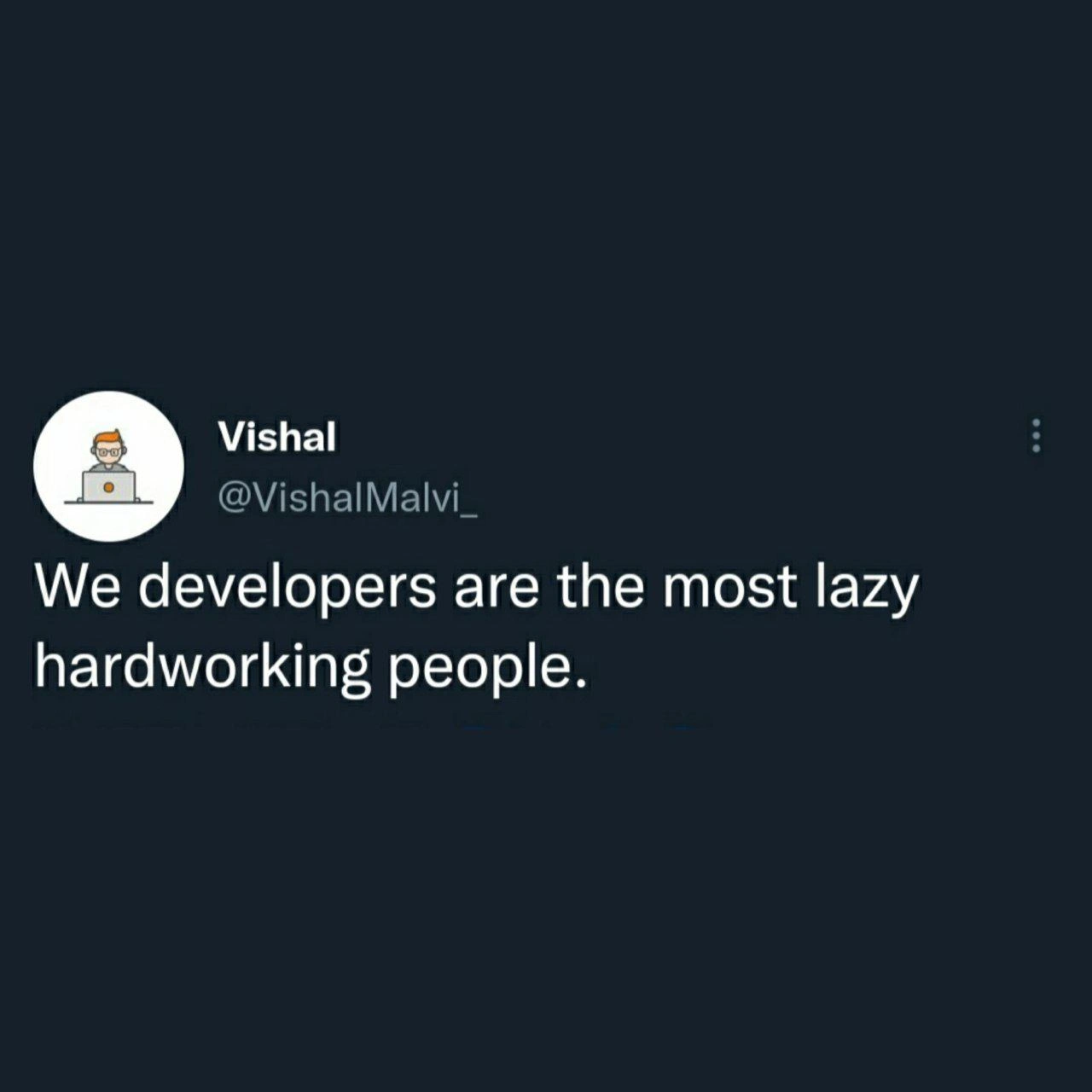
The Developer's Paradox: The Laziest Hardworking People
Description
This image is a screenshot of a tweet from a user named Vishal (@VishalMalvi_). The tweet, set against a plain dark background, contains the simple, paradoxical statement: 'We developers are the most lazy hardworking people.' This phrase captures a core tenet of the engineering mindset. The 'hard work' refers to the intense effort, focus, and complexity involved in designing and building software, particularly automation. The 'lazy' aspect refers to the ultimate goal of this hard work: to create systems that eliminate repetitive manual labor, making future tasks easier or entirely automated. Senior developers find this relatable because they understand that investing days of complex work to automate a 10-minute manual task is often a worthwhile long-term strategy for efficiency, scalability, and reducing human error



Comments
24Comment deleted
The principal engineer's motto: 'Why spend 15 minutes doing a manual task when you can spend 15 days automating it so no one ever has to think about it again?'
True developer laziness: burn two sprints writing a self-healing Kubernetes operator so we never have to log into prod again - then spend the rest of the quarter debugging why the operator itself is in CrashLoopBackOff
The eternal developer paradox: spending 6 hours automating a 5-minute task, then calling it 'efficiency.' We're not lazy, we're just pre-optimizing our future workload with a O(1) time complexity mindset
This perfectly encapsulates the developer ethos: we'll gladly spend 6 hours writing a script to automate a task that takes 10 minutes manually, then defend it as 'investing in infrastructure.' We're not lazy - we're just recursively optimizing our laziness function until it returns maximum efficiency with minimal future effort. It's not procrastination; it's strategic technical debt reduction through proactive automation architecture
We’re the laziest hard workers: spend a quarter on Terraform + GitOps + canary rollbacks so nobody ever has to SSH into prod - and two more quarters keeping that abstraction from paging us at 3 a.m
We automate yesterday's manual toil today, so tomorrow we can debug the script that automates the debugger
True developer laziness: three days building an idempotent Terraform/Ansible pipeline to avoid a five-minute manual step - and a lifetime of 3am pages
-> True. "u" should not be parsed as "ls" because it is the only connected pair of letters, and their spacing if parsed as "ls" will be slightly smaller that between others Comment deleted
I asked Comment deleted
I !Agree Comment deleted
+1 our main work is ctrl+c ctrl+v😂 Comment deleted
I prefer Ctrl+Ins / Shift+Ins Comment deleted
I: work till 2.00 am, because suddenly got too concentrated In the morning: *my stupid brain cannot believe that it was me who wrote these 400 lines of code* Comment deleted
does suddenly mean "at 0:00 am"? because 400 lines of code don't seem like a big amount of code to me Comment deleted
Depends on language Comment deleted
Russian Comment deleted
Prolog. Writing each line of code is like drawing a calligraphically-perfect hieroglyph as a piece of art. Comment deleted
i think its prologue on english if i dont miss something Comment deleted
It's language name, not an English word. https://en.wikipedia.org/wiki/Prolog Comment deleted
tooHard(prolog). Comment deleted
Directly to chatGPT Comment deleted
4000 is more correct Comment deleted
The most disgusting part is that you suddenly realised how to resolve that problem, and you did, but forgot how Comment deleted
I think impostor syndrome comes from there Comment deleted