Skip to content
DevMeme
793 of 7435
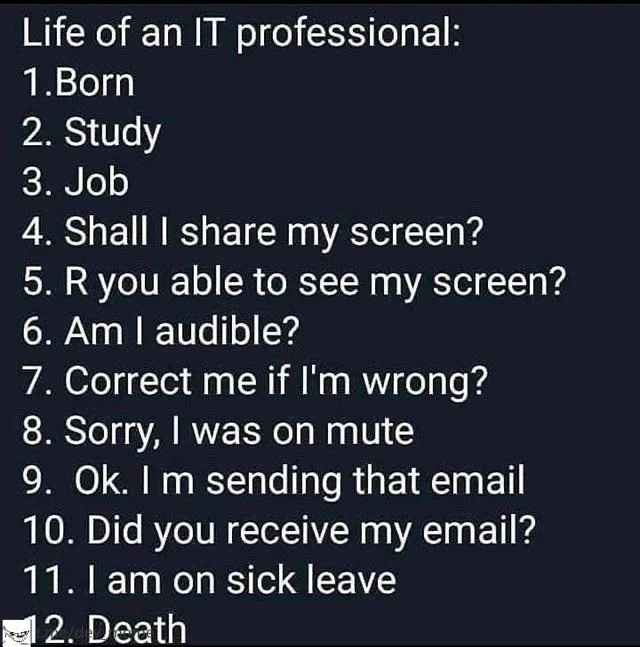
The Twelve-Step Program for an IT Career
CorporateCulture Post #897, on Dec 9, 2019 in TG

The Twelve-Step Program for an IT Career

Why is this CorporateCulture meme funny?

Level 1: Can You Hear Me?

Imagine you’re playing with walkie-talkies or those tin-can telephones with a friend. You know, the ones where you talk into a can connected by a string or a toy phone and hope the other person can hear you. You spend a lot of time going, “Hello? Can you hear me? Over.” Maybe your friend is saying something back, but their side was muted (like if they forgot to hold the button or cover the can), so you hear nothing. You might shout, “Are you there? Did you hear what I said?” and then they realize and yell, “Oops, sorry! I had it off.” When you want to show them a drawing you made, you ask, “Should I hold it up now? Can you see it?” just to make sure they’re looking. And if you send them a letter in the mail about your secret club, the first thing you’ll ask next time is, “Did you get my letter?” This meme is saying that being an IT professional is a bit like that: a lot of time is spent just checking if people can see and hear each other or got the message, rather than talking about the fun stuff. It’s funny because it’s true – even grown-ups in tech feel like they’re doing a big kids’ “can you hear me now?” game on their computers every day. It’s a silly way to look at it, but it helps us laugh at the annoying parts of working together from far away.

Level 2: You're on Mute

For newer developers or those just entering the tech world, let’s break down what all these phrases mean and why they’re so relatable. Modern IT work heavily relies on remote meetings and communication tools, especially when teams are spread across different cities or working from home. That’s why phrases like “Shall I share my screen?” and “Are you able to see my screen?” pop up daily. Screen sharing is a common practice in virtual meetings where one person shows their computer screen to everyone else (for example, to present a slide deck, demo an application, or walk through code). When someone asks “Shall I share my screen?”, they’re basically saying “I have something to show you, should I put it up for everyone to see?”. And asking “Can you see my screen?” is just double-checking that the technology is working – trust me, nothing is more awkward than thinking you’re presenting an important graph while in reality everyone sees a frozen loading spinner. Newcomers quickly learn that a lot can go wrong: maybe you shared the wrong monitor (showing your music playlist instead of your code) or maybe a colleague’s slow internet means your shared screen is blank for them. So it’s normal to pause and ask if everyone can see what you’re showing.

Next up, “Am I audible?” is a polite way of asking “Can you hear me?”. In crowded online calls (especially with dozens of participants or international dial-ins), it’s common to start speaking and then realize nobody can hear you due to a muted microphone or a bad connection. So people say “Am I audible?” to confirm their voice isn’t just lost in the void. It might sound formal, but it’s pretty common in global teams where not everyone’s first language is English – it’s a straightforward phrase to ensure the audio is clear. On any given Zoom or Skype call, you’ll often hear someone ask this at the beginning, especially if they join late or after a noise issue. It’s essentially a sound check. As a junior developer, don’t be surprised if you catch yourself asking the same thing whenever there’s a long silence after you speak. It’s better to check if folks can hear you than to assume – you’ll save yourself the embarrassment of talking for five minutes on mute (which, by the way, will happen to you at some point!).

Now, “Correct me if I’m wrong?” is a phrase you’ll hear in meetings when someone is trying to recap or make a point but wants to show humility. It’s like saying, “I believe this is the case, but I’m open to corrections.” In a team discussion, you might say, “Our server can handle 10,000 requests per second, correct me if I’m wrong?” This invites others (maybe a senior engineer or a subject matter expert) to jump in if you got the number or concept wrong. It’s a friendly way to encourage collaboration and accuracy. As a newcomer, you might not use this phrase immediately, but you’ll notice experienced colleagues using it to double-check facts without sounding too pushy. It’s part of polite communication in IT teams – nobody knows everything, and it’s okay to ask for corrections.

The infamous line “Sorry, I was on mute” is practically the catchphrase of the remote work era. This happens to everyone: you mute your microphone to cough or block out background noise, then someone asks you a question or you start talking, and… nothing. The entire meeting misses your input because you forgot to unmute. After a few seconds (or when a coworker waves frantically on video), you realize and quickly hit the unmute button, followed by an apologetic “Sorry, I was on mute.” It’s so common that it’s become a running joke at most companies. Don’t worry – whether it’s your first week or you’re a seasoned pro, you’ll do this dozens of times. In fact, companies started adding little warnings – for example, Zoom will now alert you if you speak while muted, precisely because this happens every single day. The good news is your team is likely used to it and will just nod or chuckle, because they’ve all done it too. It’s a tiny facepalm moment that we’ve collectively decided to laugh off.

After the meeting ends, the communication doesn’t stop. When someone says “Ok, I’m sending that email”, it usually means they’re going to follow up with information or files via email so there’s a written record. For example, a manager might say this to wrap up a call: they’ll send the meeting notes or an important document to everyone. And “Did you receive my email?” is often heard a few minutes later, especially if it’s something urgent. Maybe the person expects an immediate reply, or they’re worried it went to spam. It might feel a bit repetitive (they literally just said they’d send an email, and now they’re checking if it arrived), but in fast-paced environments, this double-check ensures everyone got the memo. As a junior dev, you might find it redundant at first – “if I didn’t get it, I’d speak up, right?” – but you’ll soon realize emails do sometimes vanish or people miss them in a flooded inbox. So this phrase is just about being thorough. It’s part of what you could call the email confirmation loop: send info, then confirm receipt. A tip: when you get such an email, a quick “Yes, got it, thanks!” reply can prevent this question altogether. That’s something you pick up to streamline communication.

Finally, the list mentions “I am on sick leave” and “Death” – those obviously step outside the meeting scenario, but they round out the life of an IT pro with a bit of dark humor. “I am on sick leave” is what you’d tell your team (usually via email or Slack) when you’re too ill to work that day. It’s a reminder that yes, even IT pros need rest and can fall sick – perhaps after one too many late-night deployments or marathon meetings, you need a break. And “Death”… well, that’s not a phrase anyone actually says in work (!), but the meme is just dramatically ending the Life of an IT professional list. It’s implying that after decades of school, then a job, then countless “can you hear me?” and “please see my screen” moments, the final stop is, inevitably, the end of life. It’s a tongue-in-cheek way to say that these conference call clichés accompany us throughout our career until we keel over. Morbid, yes, but meant in jest. As a newcomer, you don’t have to worry that your life will only be these phrases – there’s plenty of actual coding, problem-solving, and exciting tech work too. The meme is exaggerating to get a laugh. Still, it highlights a real feeling: sometimes the day-to-day routine of IT work can feel hilariously monotonous, dominated by meetings and status calls. It’s an encouragement to find the humor in those little frustrations. After all, every time you ask “Am I audible?” and someone replies “loud and clear”, you’ve shared a tiny universal IT moment that even the most senior architects and CTOs have experienced. Welcome to the club!

Level 3: Conference Call Purgatory

Seasoned developers can’t help but smirk (or maybe groan) at this meme because it nails how meeting overload has become the default state of modern IT work. The joke here is that after the exciting parts of life (born, study, get a job), an IT professional’s existence devolves into one endless conference call. It’s a darkly funny exaggeration of RemoteWork reality: our days are dominated by screen-shares, audio checks, and frantic email follow-ups. This list of quotes reads like a twisted it professional life cycle – once you land that Job, suddenly your life is an infinite loop of “Shall I share my screen?”, “Am I audible?”, “Sorry, I was on mute”, and other virtual_meeting_cliches that every developer knows too well. In other words, the meme is poking fun at corporate culture: instead of the heroic coding quests we imagined, much of our time is spent wrestling with collaboration tools and shouting into the digital void, “Can you hear me now?”

Anyone who’s survived a few years in software will recognize the specific pain points being skewered. Screen sharing issues? Check – there’s always that meeting where someone asks “Are you able to see my screen?” and half the team nervously murmurs that they can’t (usually right when critical graphs are up). Audio glitches? Absolutely – how many times have you joined a ZoomMeeting or Teams call only to hear “Am I audible?” because someone’s headset mic sounds like a cyborg underwater. And of course, the dreaded on_mute_moment: you deliver an inspired speech about the new architecture, wonder why everyone’s oddly quiet, then realize (to your horror) that you’ve been on mute the entire time. Cue the chorus of “Sorry, I was on mute” as you cringe and repeat yourself. These recurring fiascos are practically industry inside jokes. In fact, there’s a reason jokes about “You’re on mute” have become the new knock-knock jokes in 2020 – it’s an everyday communication breakdown that we’ve all learned to laugh at (because otherwise we’d cry).

The latter part of the meme shifts to email etiquette, underscoring how our digital communication never ends. “Ok. I’m sending that email” followed promptly by “Did you receive my email?” captures the paranoid email_confirmation_loop we’ve all seen. It’s comical because it’s true: even with read receipts and fancy collaboration tools like Slack, people still mistrust technology enough to double-check that an email went through immediately. We’ve essentially recreated the classic “Did you get my fax?” routine on modern platforms. A cynical veteran might note that Slack and Teams haven’t eliminated this ritual – they’ve just shifted it to “Did you see my Slack message?” instead. No matter the medium, we’re stuck verifying that our messages aren’t lost in the ether. It’s WorkplaceHumor born from real frustration – after spending 15 minutes meticulously drafting a status update, you still have to ask if anyone actually saw it.

What makes this meme particularly funny (in a painful way) is how it bookends life with “Born” and “Death”, implying that everything meaningful in between gets drowned out by conference calls. There’s a grain of tragic truth there that senior engineers recognize. We came into tech to build cool things, but somewhere along the line we became professional meeting attendees. The line “Correct me if I’m wrong?” sandwiched in the middle is the cherry on top – it’s that overly polite corporate phrase used right before someone points out a mistake in your plan (another familiar scene to any team lead). By the time you hit “I am on sick leave”, you can almost feel the burnout and exhaustion from all those back-to-back meetings (mental health day, anyone?). And the final dark punchline “Death” is a macabre wink: after decades of “Can you hear me?” and “Please confirm receipt”, the poor IT pro’s journey ends. We joke that their tombstone might read “Sorry, I was on mute”. It’s a sarcastic swipe at how RemoteWorkCulture can consume our entire lives if we’re not careful. This is the MeetingHumor we share in tech – laughing about endless calls and absurd communication snafus, because every experienced developer has been there, stuck in conference call purgatory where the Hold music never ends.

Typical Morning Stand-up:
Dev Lead: “Shall I share my screen?”
Team: (silence)
Dev Lead: “Uh… are you able to see my screen now?”
QA Engineer: “Got it, it’s visible.”
Dev Lead: “Great. Am I audible to everyone?”
Junior Dev: “Can you speak a bit louder? You’re cutting out.”
Dev Lead: “How about now? … Sorry, I was on mute. Let me repeat that.”
(several status updates later)
Dev Lead: “Okay, action items: I’m sending that summary by email…”
Project Manager: “All right. Did everyone receive my email from yesterday about the deployment?”
Team: “Not yet… oh, there it is.”
(Facepalms and knowing chuckles all around.)

This little dialogue might as well happen in every IT department daily. It’s both hilarious and sobering how universal these experiences are. The meme exaggerates for effect, but not by much – ask any developer about back-to-back Zoom marathons or the phrase “Sorry, go ahead, I was on mute” and watch them roll their eyes in solidarity. In the end, The entire career of IT pros summed up by conference-call clichés resonates because it takes a slice of our everyday professional absurdity and blows it up to life-and-death scale. It’s a senior-level reminder that sometimes the hardest part of software engineering isn’t the code at all – it’s surviving the never-ending parade of meetings with your sanity intact.

Description

The image presents a numbered list titled 'Life of an IT professional:' against a dark blue background. The list outlines twelve stages, starting with '1. Born', '2. Study', and '3. Job', and ending with '12. Death'. The bulk of the list, steps 4 through 10, consists of a series of repetitive phrases commonly heard in online meetings and corporate communication: 'Shall I share my screen?', 'R you able to see my screen?', 'Am I audible?', 'Correct me if I'm wrong?', 'Sorry, I was on mute', 'Ok. I m sending that email', and 'Did you receive my email?'. Step 11 is 'I am on sick leave'. The meme satirizes the perception that an IT professional's life, particularly the working years, is dominated by the mundane and often frustrating rituals of remote collaboration and digital correspondence, reducing a career to a checklist of technical difficulties and communication overhead

Comments

7
Anonymous ★ Top Pick The IT professional's lifecycle is the only script that runs from `init` to `exit(0)` where the most frequently called functions are `isMuted()` and `canSeeMyScreen()`
  1. Anonymous ★ Top Pick

    The IT professional's lifecycle is the only script that runs from `init` to `exit(0)` where the most frequently called functions are `isMuted()` and `canSeeMyScreen()`

  2. Anonymous

    My whole career is basically a distributed state machine on Zoom: Init → ShareScreen → “Am I audible?” exponential backoff → “Sorry, on mute” rollback → Decommission(); SLA upheld, agenda long since garbage-collected

  3. Anonymous

    Twenty years ago we optimized for zero network latency. Now we've optimized our entire career for zero human latency - spending more cycles on connection handshakes than actual data transfer

  4. Anonymous

    After 20 years in the industry, I've realized my entire career can be summarized as a recursive function that infinitely loops through 'Can you hear me?' and 'Let me share my screen' with no base case - except death, which is really just a forced garbage collection by the universe

  5. Anonymous

    Twenty years in, I’ve accepted the enterprise runs on a human transport layer: liveness probe = “am I audible?”, readiness probe = “can you see my screen?”, and the idempotent write is “did you receive my email?”

  6. Anonymous

    IT lifecycle: a distributed system where mute achieves perfect partition tolerance, but availability craters on every 'Am I audible?' probe

  7. Anonymous

    Modern IT career: implementing distributed protocols with humans - TCP handshake (“Share?”/“See?”/“Audible?”), mute timeouts, email for eventual consistency, sick leave as the circuit breaker, and “Correct me if I’m wrong” as our DIY Raft

Use J and K for navigation