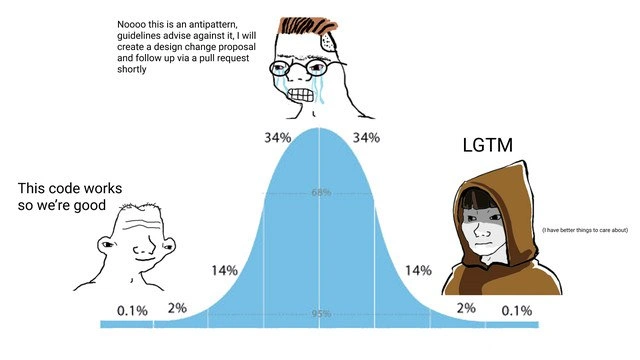
The Bell Curve of Code Review Pragmatism
Why is this CodeReviews meme funny?
Level 1: Goldilocks and the Three Code Reviewers
Imagine you and two friends are checking a big Lego castle one of you built to make sure it’s sturdy and well-made:
Friend 1 (Left side) takes a quick look at the castle, sees that it’s standing and the door opens and closes, and says, “Looks done to me! It works, so it’s good.” This is like someone who sees a project running and thinks that’s all that matters. They don’t worry about anything else because nothing’s broken right now.
Friend 2 (Middle) comes in with a giant rulebook for Lego building. They notice the castle’s drawbridge is attached in a tricky way. They start crying out, “Oh no, this is not how the instructions said to do it! We were supposed to use the red bricks for the base, not the blue ones. This is all wrong. We need to take it apart and rebuild it the right way!” This friend is focused on following every rule exactly and gets upset if the castle isn’t built the “official” correct way, even if it stands fine. They mean well — they think following the guidelines will make the best castle — but it sure slows things down and can start an argument about how to build.
Friend 3 (Right side) is an older, calm friend wearing a hoodie, kind of like a wise owl. They walk around the castle, maybe give a little knock on some walls, and then just shrug and say, “Yeah, looks good to me.” This friend has built a bunch of castles before, so they’re pretty confident this one will be okay. They don’t fuss about the color of the bricks or small details. They figure, “The castle is standing, the doors work, and we’ve got other things to do, so let’s not overthink it.”
Now, the funny part: Friend 1 and Friend 3 both end up saying the castle is fine, but for totally different reasons. Friend 1 might not know any better or just doesn’t want to check too much. Friend 3 does know better but chooses not to worry about small stuff. Poor Friend 2 in the middle is super stressed, trying to make the castle absolutely perfect by the book. The reason this scenario makes us smile is because it’s easy to imagine – whether it’s a school project, making a sandwich, or writing some code – there’s usually someone who doesn’t check much at all, someone who checks every tiny thing, and someone who quickly checks only the important parts. We call the castle “good” when the right balance is struck. In the end, it teaches a simple lesson: sometimes being too carefree can miss problems, and being too picky can cause delays, so often the best approach is in between – know what really matters and don’t worry about the rest. That’s the sweet spot that makes everyone happy and the project done well!
Level 2: The Code Review Spectrum in Practice
Let’s break down what’s going on in this meme in simpler terms. In a code review, developers check each other’s code changes (often in a pull request on GitHub or GitLab) before those changes are merged into the main codebase. The goal is to maintain code quality, catch bugs, and share knowledge. But as this meme shows, reviewers have very different styles:
Leftmost Reviewer – “It works, so we’re good”: This cartoon character with a simple happy face represents a reviewer who only cares that the code runs without crashing. They’re basically saying, “Hey, the program runs and does what it’s supposed to, so why not approve? No need to overthink it.” This is a carefree or even lazy approach to code review. Such a person isn’t looking for subtler problems like messy code structure or future maintainability. If the feature functions, they drop an approval and move on. In real life, this might be a junior developer or someone who’s in a rush. They might not yet know about design principles or they just trust the author and assume all is fine. While this approach makes developers happy in the short term (yay, my PR got approved fast!), it can be risky – issues like security problems, performance traps, or anti-patterns (common bad coding habits) might slip through unnoticed.
Middle Reviewer – “Nooo, this is an antipattern... (proposes design change)”: The middle of the bell curve shows a crying, upset nerdy cartoon (the Wojak with glasses and tears) who is freaking out about something in the code. This person is the opposite of the leftmost reviewer. They care a lot about details and guidelines. An antipattern is basically a coding solution that is known to be poor or problematic – for example, using global variables everywhere is a classic antipattern because it makes code hard to maintain. Our middle reviewer spots an antipattern in the code (or something that they consider wrong according to coding guidelines or best practices). They exclaim “Noooo this is an antipattern, guidelines advise against it!” meaning they believe this bit of code goes against recommended practices. They even say, “I will create a design change proposal and follow up via a pull request shortly.” This implies they want to stop the current code from merging and instead go design a better solution (likely a more complex or “proper” one) which they’ll then implement in a new PR. In real-world terms, this reviewer might be a developer who’s read a lot of documentation and style guides, possibly an intermediate engineer or someone who takes ownership of code quality. They often leave very detailed review comments: maybe suggesting different design patterns, pointing out every small thing that isn’t “by the book,” and possibly linking to wiki pages or style guide sections. Their intentions are good – they want to avoid maintainability issues and code smells – but they can come across as overly critical or nitpicky. Other developers might feel frustrated by this style if it blocks progress for minor reasons. This can lead to what we humorously call pull request drama: long threads of arguments on the PR about whether a certain approach is truly bad or if it’s acceptable given time constraints. Many people in the software field have experienced a scenario where one reviewer’s strictness turns a simple change into a drawn-out discussion or extra work (sometimes called overengineering, because it might feel like using a sledgehammer to crack a nut).
Rightmost Reviewer – “LGTM (I have better things to care about)”: On the far right, we have a calm-looking hooded figure (often depicted as an enlightened or wise character in meme culture). They just say
LGTM, which stands for “Looks Good To Me.” In code reviews, typingLGTMis a quick way to approve a change – basically saying “I’ve looked at it, it seems fine.” The small text “(I have better things to care about)” suggests this reviewer is pretty hands-off. They’re not getting into the nitty-gritty of the code. This attitude is often attributed to a very experienced developer or a busy senior engineer. Why would a senior dev just say LGTM and not comment much? There are a few possible reasons:- They quickly grasp the change and truly think it’s fine, because they’ve seen similar code many times. Nothing about it sets off alarm bells, so they don’t feel the need to nitpick minor details.
- They trust the author or the team’s established practices. Maybe automated tests passed and static analysis didn’t flag anything major, so they’re confident enough to approve.
- They are focusing their energy on bigger issues (the “better things to care about”). Perhaps they’re dealing with production issues or larger architectural questions, so for this change, as long as it doesn’t obviously break anything, they’re okay with it.
- They might also be a bit tired of lengthy code reviews. A seasoned dev might remember being the guideline enforcer in the past, but over time they’ve learned that being overly strict on every single pull request can slow the team down. So they choose their battles – and for relatively harmless changes, they just give it a thumbs-up.
In summary, the meme’s bell curve illustrates three archetypes of code reviewers:
- The casual approver (left) – minimal scrutiny, just cares that the code runs.
- The pedantic perfectionist (middle) – maximal scrutiny, cares deeply about rules and patterns, sometimes excessively so.
- The zen approver (right) – balanced scrutiny, relies on experience to know what matters, and doesn’t sweat the small stuff.
These extremes are funny because they’re relatable in Developer Land. If you’re new to development, you might initially be like the leftmost guy (just happy the code works at all!). As you learn more, you might swing to the middle – suddenly you see all these things that could be improved and you feel responsible to point them out. With even more experience, you often swing back towards the right – you still care about quality, but you’ve learned where to be pragmatic. You realize some “imperfections” are okay if the code is understandable and gets the job done, especially if deadlines or bigger issues loom.
The DeveloperExperience (DX) angle here is about how it feels to be part of code reviews with these personalities. Newer developers might be confused why their simple change got a 500-word critique on formatting. Mid-level devs might get frustrated that seniors sometimes rubber-stamp approvals without detailed feedback. And seniors might sigh when a review turns into a bike-shedding session over trivialities. All these feelings feed into why this meme is developer humor gold: it captures a pain point (code review friction) and exaggerates it just enough to make us laugh at ourselves. After all, who hasn’t seen an overly eager reviewer turn a one-line change into a week-long saga? And on the flip side, who hasn’t secretly felt relief when a senior just says LGTM and merges your code without a grilling?
One more thing: The bell curve graphic with percentages (2%, 14%, 34%, etc.) is borrowed from statistics – it represents a normal distribution (like how many things in nature or human behavior cluster around an average). Here it’s joking that maybe only ~2% of reviewers are as carefree as the left guy, another ~2% are as zen as the right guy, and the vast majority (the 95% in the middle combined) lean towards being somewhat pedantic or at least detail-focused. Those numbers aren’t to be taken seriously, but it’s a playful way to say “most people act like the middle guy, only a rare few act like the extremes.”
Key terms mentioned:
- Code Review: The practice of examining code written by a colleague (or yourself, by someone else) to suggest improvements or catch issues before merging it into the main codebase.
- Pull Request (PR): A method used in Git-based version control (like on GitHub) to request that your code changes be merged. It’s where code reviews happen – team members comment on the code differences (the diff) shown in the PR.
- LGTM: Shorthand for “Looks Good To Me.” Often used in reviews to approve changes. It’s like saying “I’m okay with this code.”
- Antipattern: A common solution to a programming problem that is actually ineffective or harmful in the long run. It’s the opposite of a good design pattern. When someone says “this is an antipattern,” they mean “this approach is known to be problematic; we should do it differently.”
- Guidelines/Best Practices: Many teams have a set of rules or recommendations for writing code (naming conventions, how to structure functions, etc.). These help keep the code consistent and maintainable. A pedantic reviewer often refers to these as the authority (“guidelines advise against it” means the team’s agreed rules say “don’t do this”).
- Design Change Proposal: A more formal suggestion to modify the software’s design. Instead of just commenting on the code in the PR, the reviewer in the meme wants to write a separate document or plan (a proposal) to change the overall approach. This is a big escalation – it’s like saying “we need to rethink this entire solution, not just tweak this code.”
- Over-engineering: When a solution is more complicated than necessary, often because someone tried to account for every edge case or future requirement that may never happen. Over-engineering can happen if a reviewer forces the author to implement a super elaborate design just to avoid a minor antipattern. The meme hints at this with “design change proposal” – arguably overkill if the code already works.
- Rubber Stamp: Slang for approving something with minimal or no inspection. A “rubber-stamp code review” means the reviewer just quickly says OK without really looking (similar vibe to our leftmost meme guy, though he at least noted the code works).
So, this meme uses a funny chart and familiar Wojak characters to show a truth in software teams: during code reviews, people fall into a spectrum from very lax to very strict. The key laugh factor is realizing that the extremes (lazy vs. enlightened) both give the same short “looks fine” response, while the middle person loses their mind over the code. It’s poking fun at how sometimes the simplest or the wisest approach results in the same “LGTM,” whereas those in-between might be stressing out to prove their point.
Level 3: Antipattern Anxiety on the PR Battlefield
At the high end of complexity, this meme highlights a code review culture war between pedantry and pragmatism. It’s a normal distribution of reviewer mindsets, with two tiny 2% extremes and a whopping 95% middle. On the far left tail, we have the carefree rubber-stamp reviewer. This person sees the code compiles and maybe runs a quick test: “It works, so why are we still talking? Merge it!” They treat CodeQuality as binary: if the program runs, it’s good enough. There’s no consideration for maintainability or potential AntiPattern usage – if it ain’t crashing, it’s shipping. This approach is blissfully ignorant of best practices, and while it avoids pull_request_drama, it can let serious issues slip through.
Smack in the towering 95% middle of the bell curve, we encounter the overzealous code quality crusader (the crying Wojak in the image). This is the reviewer who’s memorized the company’s 50-page style guide and every item from Clean Code. They spot one whiff of an antipattern and sound the alarm: “Noooo, this violates Section 3.2 of our guidelines! It’s an antipattern, we simply cannot let this pass.” They’ll reference blog posts, past incidents, and maybe the tenets of SOLID principles to justify a complete rework. The meme text has him proposing a design change document and a follow-up PR – basically escalating a routine code review into a full-blown architecture committee. We’ve all met this type: the pedantic reviewer who treats a minor naming issue like a critical security flaw. Their passion for CodeQuality is admirable, but it often creates overengineering_anxiety. Teams dread their reviews because a simple refactor can spiral into days of debate (a breeding ground for pull_request_drama). Ironically, these mid-level reviewers often have enough knowledge to recognize problems but not always the wisdom to gauge impact vs. intent – everything is a hill to die on.
Now, look to the far right 2% of the bell curve – the calm hooded figure uttering a minimalist LGTM (Looks Good To Me). This character represents the zen master of code reviews – likely a senior engineer or a battle-hardened tech lead. Unlike the naive left tail, this reviewer isn’t approving out of ignorance; they’re approving out of experience (and perhaps a pinch of burnout-induced pragmatism). They scan the diff and quickly sniff out if anything is truly dangerous. If not, they drop an LGTM and move on, thinking “I have better things to care about (like prod outages or that looming release deadline)”. This zen reviewer has seen enough CodeReviews to know which battles to fight. They understand the codebase’s context deeply, possibly recalling that half the so-called “antipatterns” in there were deliberate trade-offs made at 2 AM during an on-call firefight. In other words, they can distinguish between a theoretical issue and a real blocker. This rightmost stance satirically implies an enlightened state: after years of chasing perfect code, the seasoned dev realizes the perfect is the enemy of the good. They won’t waste energy bikeshedding about a minor stylistic infraction when the code works and meets the need. The result? A swift LGTM approval that avoids needless friction.
The humor here comes from how the extremes mirror each other in simplicity. The junior-like reviewer (far left) and the veteran (far right) both give a quick thumbs-up, but for opposite reasons: one from obliviousness, the other from enlightened prioritization. Meanwhile, the bulk of reviewers in the middle agonize over every detail. This bell-curve format is a popular developer meme template to show a distribution of opinions or behaviors. It pokes fun at the idea that most developers fall into an overthinking middle, whereas the outliers either don’t think at all or have transcended thinking too much. The bell_curve_meme percentages (2%-14%-34%-34%-14%-2%) underline that notion: truly carefree or truly zen reviewers are rare; the rest are trapped in the code_review_extremes of nitpick purgatory. It’s a relatable inside joke about DeveloperExperience_DX – dealing with code reviews can swing between frustrating nitpicks and rubber-stamp approvals. Experienced devs chuckle because they’ve been on all sides of this curve: they remember being the eager rule enforcer fresh out of reading Effective Java, just as much as they now feel the temptation to just say LGTM and go back to real problems. The meme exaggerates these archetypes, but that exaggeration reveals a truth: in code review culture, balance is hard to find, and it’s hilariously common to see the pendulum swing between “ship it, who cares” and “stop everything, this violates the sacred text”.
To sum up the deep cut: this meme skewers the CodeReview process by charting reviewer personalities along a statistical normal distribution. The joke lands because it’s DeveloperHumor grounded in reality – from the AntiPattern panic to the indifferent LGTM rubber stamp, we’ve all encountered these personas. It’s a tongue-in-cheek reminder that, in practice, the healthiest reviews lie somewhere between “It compiles, LGTM” and “Rewrite this entire module because one variable name doesn’t fit our pattern”. After years in the trenches, even the most fervent pedant may evolve into the hooded LGTM monk, having learned which fights are worth fighting. And as every cynical veteran knows: sometimes a quick LGTM is the smartest review, especially when you truly have better things to care about (like that bug in production that just paged you at 3 AM).
Description
This meme uses the 'IQ Bell Curve' or 'Galaxy Brain' format to illustrate the evolution of a developer's mindset. It features a blue bell curve representing the distribution of intelligence or experience. At the far left (low end), a simple-minded Wojak character says, 'This code works so we're good,' representing a junior's focus on pure functionality. In the middle of the curve (average), a crying, panicked Wojak character exclaims, 'Noooo this is an antipattern, guidelines advise against it, I will create a design change proposal and follow up via a pull request shortly.' This depicts the mid-level engineer who is dogmatic about rules and processes. At the far right (high end), a stoic, hooded Wojak character simply states, 'LGTM' ('Looks Good To Me'), with a small parenthetical thought, '(I have better things to care about).' This represents the seasoned senior engineer who has the wisdom to be pragmatic, understanding that perfect is the enemy of good and that some battles aren't worth fighting. The joke is a commentary on how developers mature from a naive state, through a period of rigid adherence to theory, to a final state of experienced pragmatism
Comments
9Comment deleted
A junior dev asks if the code works. A mid-level dev asks if it follows SOLID principles. A senior dev asks if it solves the business problem and is easy to delete
Our bell-curve of code reviews: two juniors approve because it compiles, the statistically significant middle bikesheds SOLID for three days, and the staff engineer drops a Zen “LGTM” knowing the feature flag’s already set to 0% in prod anyway
The middle 68% are writing design docs for a getter method while the extremes are either shipping to prod on Friday or have already mentally checked out to work on their blockchain startup
Seniority is realizing the design change proposal will outlive the service it proposes to change
The bell curve perfectly captures the career arc: junior devs ship code that 'just works,' mid-level engineers spiral into analysis paralysis over every antipattern and RFC, and senior engineers circle back to 'LGTM' because they've learned that perfect is the enemy of shipped - though now they're wise enough to know which battles actually matter and which PRs deserve a rubber stamp at 4:59 PM on Friday
Left tail writes RFCs for a setter; right tail LGTMs refactors - meanwhile, peak just compiles
Code review bell curve: junior “it works”; mid “guidelines say it’s an antipattern, RFC inbound”; staff “LGTM - wrap it behind an interface and ship; SLOs trump purity and the rewrite isn’t funded.”
Senior review heuristic: if it’s feature‑flagged, idempotent, and easily rolled back, the opportunity cost of perfect architecture exceeds the error budget - LGTM
True Comment deleted