Skip to content
DevMeme
3800 of 7435
The Ergonomics of Escapism vs. Corporate Reality
MentalHealth Post #4142, on Jan 31, 2022 in TG

The Ergonomics of Escapism vs. Corporate Reality

Why is this MentalHealth meme funny?

Level 1: Storybook vs Homework

Imagine you have a big storybook full of exciting adventures that you love reading – you could spend hours with it and feel happy. Now imagine you also have a pile of homework papers from school to read – things like rules or chores or assignments that you have to do. The meme is saying the first situation (reading the fun story, even if it pretends to be “work” in the story) makes the person relaxed and comfy. But the second situation (reading real instructions and tasks for work or school) makes the person feel upset and hurting, even if they only do it for a little while. It’s like how reading a cool comic book or a mystery story is fun, but reading a dry textbook or a list of chores for just a few minutes can feel tiring and painful. In short, fun pretend stuff = 😊, real boring stuff = 😣. That’s why it’s funny – we all get that feeling that something can be easy when it’s a game, but the same thing feels hard when it’s for real.

Level 2: Fake Emails, Real Pain

Let’s break this down more simply. The meme contrasts two types of email reading experiences:

  • Fake work emails in DOOM³ (the game) – These are fictional emails you find on computers or devices inside the video game. DOOM 3 is a first-person shooter game set on a Mars research base. Throughout the game, your character picks up PDAs and logs that contain emails and reports written by in-game characters (scientists, security staff, etc.). They might talk about experiments, maintenance issues, or personal stories – basically serving as game lore and clues. For example, you might find an email from a scientist about a malfunctioning door, which conveniently includes the door’s access code you need. Reading these is fun and voluntary: they enrich the story and sometimes help you progress. Even though they look like “work emails” from one fictional employee to another, players treat them like little reward nuggets or pieces of a puzzle. It’s like reading a mini sci-fi story or scavenger hunt clue. A developer who’s also a gamer might spend hours eagerly reading every one of these in-game emails and logs because it’s entertaining and immersive.

  • Real-life (irl) work emails – These are the actual emails sitting in your inbox from your real job. They could be from your boss, teammates, HR, or automated systems. Common examples include project updates, task assignments, meeting requests, company announcements, or discussions about bugs and features. Unlike game lore, these emails are typically not optional – you’re expected to read and respond as part of your job. And frankly, they’re often written in dry, formal language or filled with corporate buzzwords. For instance, you might get an email like: “Please review the Q1 TPS reports and attend the mandatory synergy meeting.” Or an update: “The deployment has been delayed, please provide an ETA for the fix.” Reading these can feel dull or stressful because they usually mean there’s work to do or some issue at hand.

Now, why does the meme show the person completely relaxed reading DOOM³ emails, but in agony reading real work emails? It’s highlighting a funny truth about WorkplaceHumor and human psychology:

  • Engagement vs. Obligation: The DOOM³ emails are basically entertainment. You read them because you want to, out of curiosity. There’s no pressure – if you skip one, the worst that happens is you miss a bit of story or maybe a door code. Real work emails, on the other hand, often come with a sense of obligation or urgency. You might dread finding out you have a new task or that something went wrong. Even if the email is “friendly” or routine, it’s still work-related, so your brain treats it like a responsibility. Just a few minutes of reading work emails can remind you of deadlines or problems, causing real stress.

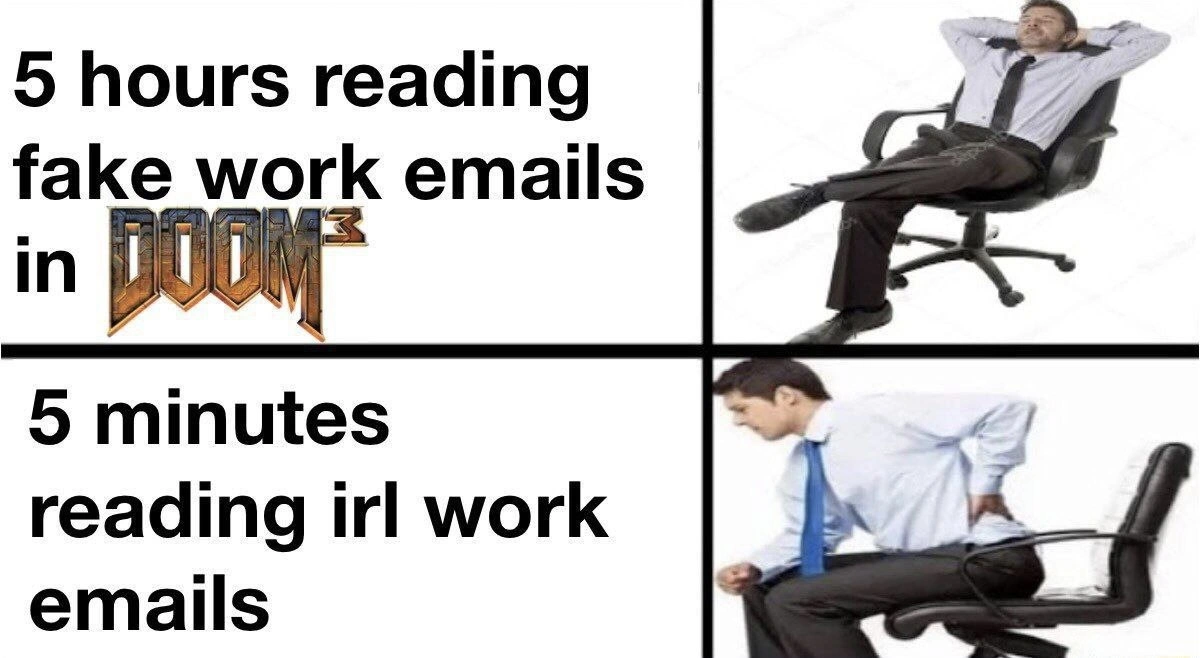
  • Content: Fun vs. Boring: In-game emails might describe, say, a spooky incident in the Mars base (exciting! you think, as you read on to find out more). Real emails might be talking about quarterly budgets or asking you to fill out a timesheet (ugh… boring). Developers often joke about how they’ll gladly read a 20-page game lore document or a fantasy novel, but struggle to read a one-page status report from the office. The meme plays on that contrast directly. “5 hours reading fake work emails” is obviously an exaggeration, but it rings true – time flies when the content is enjoyable. Conversely, “5 minutes reading irl work emails” can feel excruciatingly long when the content is dull or stressful. We see the guy in the bottom picture bending over in pain after just a short time, which dramatizes how painful those few minutes of reality can feel.

  • Physical Posture = Emotional State: The top-right image (relaxed, feet up, hands behind head) represents how comfortable and chill the developer is when diving into DOOM³’s world, even if it’s full of virtual demons. The bottom-right image (man clutching his back in discomfort) symbolizes how reading real emails is literally a pain. Of course, reading emails usually doesn’t cause immediate back pain – it’s metaphorical. It means real emails are a mental pain, so much so that the meme jokes it’s as if they cause actual physical agony. It’s a form of OfficeHumor: we exaggerate our reaction (cringing, rubbing temples, slumping in the chair) when opening work emails we dread.

Now, let’s clarify some terms and tags in context:

  • “IRL” – This stands for “In Real Life.” It’s internet shorthand to distinguish real-world stuff from something in a game or online. So “irl work emails” just means the actual emails you get at your real job, not part of a game.

  • Communication Overhead – This is a term for the extra work involved in communicating within a team or company. It includes writing emails, reading others’ emails, attending meetings, updating documents – basically, time spent on coordination instead of hands-on coding or building. In software teams, especially large ones, communication overhead can be huge. New developers might be surprised how much of their day can get eaten by emails and meetings. The meme is poking fun at how draining that overhead feels: after a few corporate emails, you’re already wiped out.

  • Corporate Culture & Workplace Culture – These refer to the way people behave and communicate in an office or company environment. Many companies rely on formal emails for communication. There can be a lot of “office-speak” – polite phrasing, acronyms, and sometimes long email threads discussing things that could perhaps be solved quicker in person or with a quick chat. Part of corporate culture in many places is that you’re expected to stay on top of your email inbox. That expectation itself can cause anxiety, especially if you step away for a day and come back to 200 unread messages. The meme dramatizes that feeling: just catching up on unread work emails can hurt.

  • DOOM³ and in-game lore – DOOM³ (released in 2004 as the third major installment of the DOOM series) is not just about shooting demons; it also tried to build a story. The game introduced these PDA devices you find, which contain emails, audio logs, etc., to make the Mars base feel like a lived-in place. This concept of discovering story through found documents or emails is common in games (for example, the System Shock and BioShock games use audio logs, and Half-Life has scientist chatter). Gamers often enjoy this method of storytelling because it doesn’t force cutscenes on you – you discover the narrative at your own pace. For a developer who loves sci-fi, reading DOOM³ emails feels like a treat, not work. We sometimes jokingly call this “gamer procrastination” – doing a fun reading task in a game to put off a boring task in real life.

  • Real life email anxiety – This isn’t a formal technical term, but it’s a relatable concept. It describes that little spike of stress or nervousness you get when checking work emails. Maybe you’re worried there’s bad news waiting (like a bug report or a critique of your code), or you just know it’s going to be a slog to go through them. If you’ve ever seen an email subject like “RE: URGENT – Build Failed in Production” pop up on your phone late at night, you know the feeling. Even a subject line like “Meeting follow-up” can make your shoulders tense, because you suspect it means more tasks for you. The meme exaggerates it to the point of physical pain, which is why it’s funny. It’s obviously not that extreme normally, but it captures the vibe.

To really illustrate the contrast, consider an example of each type of email:

In-game DOOM³ Email example:
From: [email protected]
Subject: Re: Containment Protocol Update
Body: “Hey team, as mentioned in yesterday’s briefing, some specimens escaped in Lab 7. We’re temporarily sealing that sector. Dr. Ishiyama also left a storage locker code 731 in case you need extra plasma cells. Don’t worry, I’m sure those noises in the ventilation are just the pipes… 😉 Stay safe!”

This fake email is short, story-driven, even a bit humorous (with that winking emoji about the noises). Reading it in the game, you’d be intrigued (“Uh oh, escaped specimens? What’s lurking in Lab 7?”) and also happy to note the locker code 731 which might unlock goodies. It feels rewarding to read.

Real Work Email example:
From: Corporate HR <[email protected]>
Subject: Mandatory Training Reminder – Please Complete by EOD
Body: “Dear Employee,
This is a reminder that the quarterly compliance training (Cybersecurity & Workplace Conduct) is due by end of day Friday. Please log in to the LMS portal to complete the modules. Let your manager know once done.
Thank you for your cooperation,
– HR Team”

This real email, by contrast, is pure obligation. It’s not hard to read in terms of language, but it immediately screams “boring requirement.” There’s no story, no fun — just a task you have to do, probably a dull online course. After reading it, you might sigh, mark it unread again to “deal with later,” and already feel a tiny knot of stress in your back because it’s one more thing on your plate.

So, in straightforward terms: the meme is funny because developers would rather read pretend emails about a demon invasion for fun than read actual emails from work. It exaggerates how draining workplace communication can be. The top part indulges our inner nerd – “Ooh, emails in a Mars base, cool!” – and the bottom part captures our inner procrastinator – “Ugh, my real inbox… do I have to?”. It’s a mix of DeveloperHumor and OfficeHumor that anyone swamped by emails can relate to, especially those of us who’ve ever alt-tabbed from Outlook to a video game to escape for a bit.

Level 3: Demonic Lore vs Corporate Chore

In this meme, a developer is blissfully absorbed in reading fictional work emails on Mars (in DOOM³) for hours, yet cringes in actual pain after just a few minutes skimming their real office inbox. The humor strikes at a core tech-worker truth: communication overhead in real-life jobs can feel literally hellish compared to the oddly enjoyable “paperwork” inside a video game.

On the top half, the meme name-drops DOOM³, a classic shooter where you explore a Martian base crawling with demons. Uniquely, DOOM³’s designers filled the game world with in-game terminals and emails – fictional office correspondence between scientists, engineers, and administrators at the UAC (Union Aerospace Corporation). Reading these lore-rich emails and reports in the game is surprisingly engaging. They contain juicy backstory, door codes to secret caches, and creepy foreshadowing of the demon invasion. Essentially, they’re fake work emails that deepen the narrative. Developers and gamers love this stuff – we’ll happily spend 5 hours combing through every PDA log and in_game_lore_digestion entry to immerse ourselves in the story. It’s all upside: interesting information, no real duties attached, and a dopamine hit whenever you uncover a useful clue (like finding the code to that ammo locker). This is the fun kind of reading, more akin to solving a puzzle or enjoying a sci-fi novel than doing actual work. The top-right image shows a guy in a tie kicked back, hands behind head, completely relaxed – he’s the picture of contentment because, in the game world, even “work” email is entertainment.

Now contrast that with the bottom half: “5 minutes reading irl work emails” – and we see the same office-dressed man doubled over, grimacing and clutching his lower back as if in agony. It’s a comedic exaggeration of the very real mental and physical discomfort many developers feel toward their real inbox. Real-life work emails often mean obligations, confusion, or bad news. Five minutes into checking emails on Monday morning and you’ve encountered a meeting invite that could’ve been an email, an email that should’ve been a Jira ticket, a surprise “FYI” about some production issue, and a long thread where half the team is CC’d for no clear reason. Instead of lore and intrigue, you get a wall of corporate jargon and action items: product roadmaps, compliance training reminders, last-minute “URGENT” tasks from your manager, or the dreaded “Let’s schedule a meeting to discuss.” It’s the opposite of fun – it’s CorporateCulture drudgery.

This meme cleverly uses DOOM’s literal hellish setting to highlight the irony: even reading about demonic outbreaks on Mars via doom3_fake_emails is more relaxing than reading real emails about quarterly earnings or code review feedback. Developers often joke about “Inbox Zero” being a mythical state – our work inboxes overflow with long threads and CommunicationBreakdown moments (like that one colleague who Reply-All’s to the entire company). It’s a form of workplace humor born from shared experience: almost every programmer has procrastinated on reading a dull project update email, yet that same person might eagerly scroll through a 20-page in-game research report or spend an afternoon on a gaming wiki. This contrast is about intrinsic motivation. The game emails are optional and interesting, so reading them feels like a reward. Real emails are mandatory and often tedious, so they feel like a chore or even a threat to one’s development time.

There’s also a deeper tech perspective here: context switching and cognitive load. When you’re playing a game like DOOM³, reading those emails is part of the immersive flow – it amplifies your engagement. But when you’re in the middle of coding at work and you Alt+Tab to check Outlook or Gmail, each email yanks you out of the zone. It’s disruptive. A senior developer knows that a “quick email check” can derail an afternoon of productivity. And often, the content of work emails raises your stress: maybe a bug was found in production (heart rate up), or someone asks for an update on that feature you’re behind on (blood pressure rises). The meme’s bottom image – the man clutching his back – visually represents this stress-induced pain. It’s like his body is rebelling against the onslaught of corporate communication. (We’ve all felt that email anxiety cringe – seeing a subject line like “Re: Urgent Issue – Please Respond” can be scarier than any demon in DOOM.)

From a systems standpoint, excessive email can be viewed as a poorly optimized communication protocol in the workplace. Engineers appreciate efficient, low-latency communication (say, a quick chat message or a one-click code review). Email, however, is high latency, often high verbosity, and frequently irrelevant due to over-CC’ing and reply-all storms. It’s the communication overhead that saps energy without delivering much joy. This meme nails that sentiment: actual office emails often cause productivity pain, while fictional emails in a game ironically spark joy.

In summary, the senior-level humor comes from recognizing that WorkplaceCulture and communication norms can be draining. We laugh (a bit ruefully) because we know it’s true: reading a co-worker’s real email about Q3 OKR updates is torture compared to reading a fake co-worker’s email about a Martian science experiment gone wrong. The developer community shares this gamer_procrastination tendency – we’d rather engage with fun in_game_lore than sift through our “IRL” tasks. As the saying goes, “Hell is other people’s emails,” and in this case, even a literal Hell (DOOM’s demon-infested Mars) has emails that are preferable to the ones waiting in our Outlook inbox.

Description

This is a two-panel meme comparing the experience of reading in-game lore to reading actual work emails. The top panel features the text '5 hours reading fake work emails in DOOM 3' with the game's official logo. To its right is a stock photo of a man in business attire relaxing comfortably in an office chair with his hands behind his head. The bottom panel has the text '5 minutes reading irl work emails.' To its right is a stock photo of a similarly dressed man hunched over in his chair, clutching his lower back in pain. The meme humorously captures the stark difference in mental and physical toll between engaging with immersive, fictional content (like the environmental storytelling in the game Doom 3) and the draining, often stressful nature of corporate communications. For tech professionals who are often also gamers, it's a highly relatable commentary on work-related burnout and the appeal of digital escapism


Comments

8
Anonymous ★ Top Pick The signal-to-noise ratio in Doom 3's PDA logs is infinitely higher than a corporate email thread with ten project managers CC'd
  1. Anonymous ★ Top Pick

    The signal-to-noise ratio in Doom 3's PDA logs is infinitely higher than a corporate email thread with ten project managers CC'd

  2. Anonymous

    I’ll happily grep 50 pages of UAC incident logs in Doom 3 to find a door code, but one Outlook thread with “gentle reminder” in the subject triggers a full GC pause on my motivation heap

  3. Anonymous

    The DOOM emails had better frame rates, clearer objectives, and no one asking you to "circle back on the synergies" while cc'ing seventeen stakeholders who each need their own status update thread

  4. Anonymous

    Doom 3's emails foreshadow a demonic invasion; mine foreshadow a 'quick sync' that should have been an email about an email

  5. Anonymous

    The real production incident isn't the server going down at 3 AM - it's realizing that 'urgent' email from the VP you've been ignoring for 5 hours while optimizing your .vimrc was actually about your team's budget getting cut. At least DOOM 3 had a pause button; corporate email threads don't

  6. Anonymous

    DOOM's UAC emails build lore with tight threading; corporate ones spawn infinite reply-all demons that crash your flow state

  7. Anonymous

    I’ll read Doom 3 terminals for hours - those emails have door codes and zero stakeholders; five minutes in Outlook and I’ve spawned a Reply-All boss fight and three recurring meetings

  8. Anonymous

    I’ll parse 10k lines of DOOM 3 PDA lore for a door code, yet real inbox triage still hides the only action under a logo farm, timezone-free invite, and a SOC2 disclaimer

Use J and K for navigation