The Microsoft hypocrisy for Linux elitists
Why is this Microsoft meme funny?
Level 1: You Can’t Escape Microsoft
Imagine a kid who says they hate a big candy company and refuses to buy any of its candy. He’s really proud of avoiding that brand. But then a friend points out that all his favorite sweets – the ones he’s been enjoying every day – are actually made by that same company, just under different names. Cue a stunned face… followed by an angry pout when he realizes the truth. 😠
In this meme, the developer is like that kid. He claims to hate Microsoft and only use “pure” independent stuff, but all the tools he loves for coding (like where he stores his code, the app he writes code in, and the library service he gets code from) are owned or run by Microsoft. In other words, he was supporting the very thing he thought he was avoiding. The funny part is the surprise and irony: he tried so hard to be free of the big company, and yet there Microsoft was, sneaking into his workflow the whole time. It’s a classic “gotcha!” moment — showing that sometimes, in the tech world, you can run from the big guys, but you just can’t hide from them.
Level 2: Check Your Dependencies
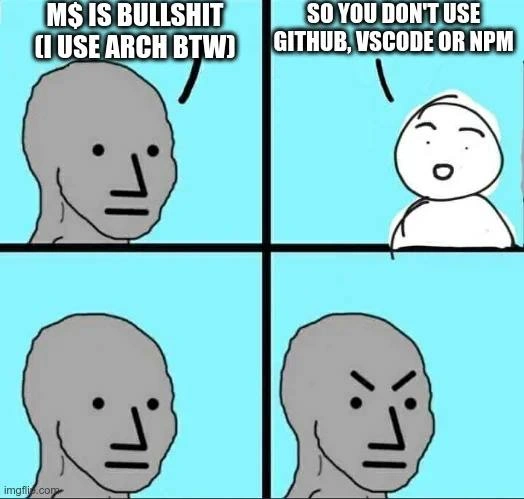
Let’s break down the meme’s joke in simpler terms. The grey character is an NPC (Non-Player Character) meme figure, used to represent someone with a one-track mind or a default opinion. He’s shouting “M$ is bullshit (I use Arch btw)”. “M$” is internet slang for Microsoft, swapping the ‘s’ for a dollar sign to imply the company only cares about money. So our grey NPC is basically saying, “Microsoft is garbage. I only use true open-source software. By the way, I run Arch Linux.”
Now, Arch Linux is a free operating system, a flavor of Linux known for being minimalistic and hands-on. Tech enthusiasts love Arch because it lets you customize everything. Saying “I use Arch, by the way” is an old meme in developer culture – Arch users are stereotyped as proudly mentioning their OS at every chance (it’s like bragging rights for being hardcore). They often prefer FOSS (Free and Open Source Software) for everything, avoiding big corporate products. In short, the NPC sees himself as a purist who won’t touch anything from “Micro$oft.”
In the next panel, a smiling character calls him out: “So you don’t use GitHub, VSCode or npm?” These three – GitHub, VS Code, and npm – are super common tools in programming. The question is basically a reality check: “If you truly avoid Microsoft, surely you avoid all these tools… right?” Here’s why that question hits hard:
GitHub – This is a website/platform for developers to store and share code, using the version control system Git. Think of it as a social network for code: you can collaborate with others, contribute to open-source projects, or just back up your code in the cloud. It’s incredibly popular (almost every open-source project lives on GitHub). But surprise: Microsoft bought GitHub in 2018. So even though GitHub is used for open-source projects, it’s owned by Microsoft. If our Arch user has a single project on GitHub or contributes to someone else’s repo, he’s indirectly using a Microsoft service.
VS Code (Visual Studio Code) – This is a powerful code editor, basically an app programmers use to write their code. VS Code is free and open source (available under an MIT license), and it runs on Linux, Mac, Windows – everywhere. It’s beloved for its ease of use and rich extension ecosystem. Crucially, VS Code was created by Microsoft. Even though anyone can download, use, and even modify it for free, Microsoft is the one that develops it and maintains the official version. Many Linux users, including die-hard Arch folks, use VS Code because it’s just that good. So if our Arch-loving NPC does any coding, there’s a high chance he might be running VS Code – meaning he’s using a Microsoft-made tool on his open-source OS.
npm (Node Package Manager) – npm is the default package manager for Node.js, which means it’s like a huge public library of JavaScript code packages. If you’re building a Node.js application or even front-end (web) projects, you use
npm install <package>to fetch dependencies (pre-made code modules) from the npm registry. Millions of developers do this daily. Now initially, npm was its own open-source project and company (npm Inc.). But in 2020, GitHub (and thus Microsoft) acquired npm. So Microsoft ended up owning the primary hub where JavaScript developers get their libraries. If our Arch user builds any JavaScript apps or even uses tools built on Node.js, he’s likely pulling packages from Microsoft’s servers without even thinking about it.
When the friend in the meme lists these (“GitHub, VSCode, or npm”), the Arch NPC is left speechless (that blank face in the third panel). Why? Because he does use those! Almost every developer does. The realization hits that by using those “so-called FOSS” tools, he’s indirectly supporting Microsoft – the very company he claims to hate. In the final panel he’s scowling and angry, which humorously shows he’s either irritated at being caught in a hypocrisy or upset that Microsoft’s influence is that unavoidable. (Probably both!)
This highlights a key concept: toolchain_dependency. A “toolchain” is the set of tools and services you use for software development (editor, compiler, version control, package managers, etc.). In today’s developer world, a lot of that toolchain is connected to big companies. Our Arch-loving friend tried to build a completely FOSS, non-Microsoft setup – he runs Linux, avoids Windows and Office, etc. – but his dependencies (the tools he relies on) are still tied to Microsoft. It’s like building a house out of “independent” bricks only to find the foundation is owned by someone else.
For a junior developer or someone new to this context, the meme is pointing out a common developer culture irony:
- Arch Linux users pride themselves on being independent from corporate software (no Windows, no Mac, just Linux).
- They often compile programs from source or use community-run repositories (like the Arch User Repository, AUR) to get software, avoiding official vendor downloads.
- They might rant against Microsoft (hence the derogatory "M$") because historically Microsoft represented closed-source, proprietary practices against the open-source ethos.
However, in reality, completely escaping Microsoft (or any big tech firm) is really hard today. Microsoft has strategically acquired or built many developer tools: not to “lock you in” maliciously in the old sense, but it means if you participate in the wider developer community, you likely touch Microsoft somewhere. This is the microsoft_acquisition_effect in action. The company realized that supporting open-source and offering free tools gains them good will and influence. So now:
- If you share code with others, you’re probably on GitHub – hello Microsoft. (There are alternatives like GitLab or Bitbucket, but GitHub is by far the biggest fish.)
- If you write code, you might use VS Code because it’s feature-rich and free – hello Microsoft again. (Sure, you could use alternatives: e.g., Atom editor – which was GitHub’s, ironically now also Microsoft; or Sublime Text, which is closed-source; or classic editors like Vim/Emacs, which are truly independent. But many new developers flock to VS Code for its user-friendliness and extensions.)
- If you need a library for your JavaScript project, you run
npm install– hello Microsoft servers delivering that to you. (Yes, there’s yarn as an alternative client, but it uses the same npm registry by default. There’s even something called pnpm – but again, registry is npm. Unless you go out of your way to use a completely separate registry, which is rare, you’re hitting Microsoft-owned infrastructure.)
This meme’s comedic sting lies in exposing that foss_purism_vs_reality gap. The “FOSS purist” (our Arch user) talks a big game about avoiding corporate tech, but the reality is that modern development has a lot of interdependence with big players. It’s not necessarily all bad – GitHub and VS Code are popular because they’re useful and generally open-source-friendly. But it is ironic! It’s like yelling “I boycott Big Tech!” from an iPhone – a bit contradictory. The meme holds up a mirror and says, “Check your dependencies, my friend. Are you really as free of the big corporations as you think?”
For a newer developer, the takeaway is: Microsoft is everywhere in the dev world now, often in ways you might not realize. The company that once was enemy #1 to Linux and open-source is today one of the largest contributors to open-source projects and a provider of many tools you probably use. So the meme is poking fun at that one guy in the community who hasn’t caught on to this fact. It’s a gentle roast of the Arch/Linux zealot who must confront that even his beloved open tools have a bit of Microsoft’s DNA (or money) in them. And judging by that scowl in the last panel, he’s none too pleased to learn this!
Level 3: All Roads Lead to Redmond
The meme lampoons a strain of archlinux_elitism and the classic FOSS purism vs reality paradox in modern tech. In the top-left panel, our grey-faced NPC character (a meme for someone mindlessly parroting a stance) proclaims, "M$ is BULLSHIT (I use Arch BTW)". The "$" in M$ is a decades-old jab at Microsoft, implying it’s a money-grubbing villain. And the quip “I use Arch, btw” is an inside joke about Arch Linux users’ pride (they notoriously brag about running that hardcore Linux distro as a badge of honor). This setup screams: “I’m a pure open-source rebel; down with the Evil Empire!”
The punch comes in the top-right panel: a smiling figure asks, “So you don’t use GitHub, VSCode or npm?” In one sentence, the challenger rattles off the holy trinity of a modern developer’s toolchain – and, not coincidentally, each one is tightly linked to Microsoft. This is where experienced devs smirk knowingly. The meme highlights open_source_irony: even the loudest Microsoft-hater probably pushes code to GitHub (owned by Microsoft), writes code in VS Code (made by Microsoft), or installs packages from npm (also effectively under Microsoft’s umbrella). It’s a hypocrisy many of us have witnessed (or lived). We hear “M$ is evil!” from the guy deploying apps to Azure and laugh because, well, the call is coming from inside the house.
This scenario reflects an industry irony born of toolchain consolidation and the Microsoft acquisition effect. Over the past decade, Microsoft executed a dramatic pivot from the days of openly calling Linux a “cancer” (yes, former CEO Steve Ballmer said that in 2001) to embracing open-source and buying up its key infrastructure. GitHub is the planet’s de facto code forge for version control, home to millions of open-source projects – and as of 2018, it’s a Microsoft property. The npm registry, the heart of Node.js and front-end JavaScript package management, was scooped up via GitHub in 2020. And Visual Studio Code, launched by Microsoft in 2015, is an open-source editor so good that even Linux die-hards use it as their daily driver. It’s a bit like the Borg’s mantra from Star Trek: “Resistance is futile.” Microsoft’s influence has been assimilated into everyday FOSS workflow at every turn.
The humor cuts deep because it’s true: the self-proclaimed free software zealot finds out he’s been unwittingly holding a package_registry_monopoly product in each hand. It’s reminiscent of the old trope “Embrace, extend, extinguish” – Microsoft’s 90s strategy to dominate tech – but with a modern twist. Today it’s more like embrace, extend, invest: instead of killing open tools, Microsoft buys them or builds its own and offers them free. It feels community-friendly (who doesn’t love free tools and huge platforms?), but it also quietly makes Microsoft the linchpin. The result? Even a proud Arch Linux user yelling “No closed source! No big corporations!” ends up depending on Redmond’s ecosystem. It’s foss_purism_vs_reality incarnate.
Seasoned developers will recall how code-sharing was once on community sites like SourceForge or self-hosted Git. Now, network effects and sheer convenience funnel everyone into GitHub – effectively a monopoly in code hosting. We laugh (perhaps a bit bitterly) at the meme because we’ve been there: we’ve watched colleagues claim independence while logging into GitHub daily, or we’ve personally experienced that twinge of dissonance opening VS Code on a Linux box. The meme’s final panels (the blank stare, then scowling anger) perfectly capture that “oh crap” moment of realization. It’s the face of a developer connecting the dots: that their toolchain_dependency leads straight back to the very company they vilify. In other words, “All roads lead to Redmond.” The relatability of that rude awakening — and the inevitability of Big Tech’s reach — is what makes this so funny and so real for those of us in the trenches. We smile because we’ve all learned: in tech, you can run, but you can’t hide (not even on Arch).
Description
A four-panel comic meme format featuring an NPC Wojak character. In the first panel, the emotionless NPC Wojak states, 'M$ IS BULLSHIT (I USE ARCH BTW)', representing a stereotypical anti-Microsoft Linux user. The dollar sign in 'M$' is a common pejorative used to criticize the company's historically commercial nature. In the second panel, another character with a simple, smug expression challenges him with the question, 'SO YOU DON'T USE GITHUB, VSCODE OR NPM'. This highlights the hypocrisy, as these essential developer tools are all owned or developed by Microsoft. The third panel shows the NPC Wojak character silent and expressionless, seemingly unable to respond. In the final panel, his expression turns to anger with furrowed brows, indicating that the point has struck a nerve and exposed the flaw in his absolutist stance. The meme satirizes the cognitive dissonance of developers who profess to hate Microsoft while relying heavily on its massive contributions to the open-source ecosystem

Comments
33Comment deleted
Hating Microsoft while using VSCode on Arch to push to a GitHub repo via an npm script is the modern developer's equivalent of 'Sent from my iPhone'
At this point the only way to keep Redmond out of your stack is to alias ‘git’, ‘code’, and ‘npm’ to /bin/echo - congrats, you’ve achieved air-gapped productivity
The real package dependency here is the cognitive dissonance required to maintain your anti-Microsoft stance while your entire CI/CD pipeline runs through GitHub Actions, your IDE is VSCode with 47 extensions, and half your node_modules are maintained by Microsoft employees
Ah yes, the classic Arch user's dilemma: spending 6 hours configuring i3wm and dotfiles to achieve the perfect anti-corporate setup, then immediately opening VS Code (Electron app running on Chromium, owned by Microsoft) to push to GitHub (acquired by Microsoft for $7.5B) using NPM (also Microsoft-owned). It's like being a vegan who only eats at McDonald's - technically you can make it work, but you're missing the philosophical point. The real irony? They probably compiled their kernel with proprietary Intel microcode while lecturing others about freedom. At least they're consistent in one thing: telling everyone they use Arch BTW, even when nobody asked
We boycott M$ so hard that our IDE, git remote, and dependency resolver all handshake with Microsoft-owned endpoints - principles eventually consistent with convenience
Every “I’m Microsoft-free” rant ends with CI on GitHub, reviews in VSCode, and releases to npm - vendor-neutral the same way AKS is “just Kubernetes.”
MS is bullshit until a merge conflict hits and `gh pr create` becomes your best friend
Well. Nope Comment deleted
Microsoft own npm? Wow, I didn't think they could get worse Comment deleted
questionable company buys a wrapper over questionable vcs which buys questionable packet manager which is essential to the initial company's questionable scripting language... looks perfect to me 🌚 Comment deleted
I used to use Atom, Microsoft promised they wouldn't kill it when they bought Github.... Then of course they killed it. Womp womp. Comment deleted
EEEEEEEEEE Comment deleted
Yup. Alive and well as always Comment deleted
they also have made open LLMs (Phi) Comment deleted
GitHub wasn't created by Microsoft Been using it for years before they bought it Comment deleted
Skype wasn't created by Microsoft. .... PowerPoint wasn't created by Microsoft. ... MS-DOS wasn't created by Microsoft. Comment deleted
PowerPoint? I had no idea! But I can add Hotmail to this list. Idk if it even exists anymore, though. Comment deleted
I'm old enough to encounter the original author in copyright section of About. Hotmail was renamed to Outlook dot com Comment deleted
Wait what NPM is Microsoft? Comment deleted
Forgejo, a JetBrains editor (still evil, I know, VSCodium is also still there) and no just no lmao Comment deleted
developers don't use github. Companies do Comment deleted
worst opinion I've heard in ages Comment deleted
okay, maybe companies don't do either, I mean it is not up to individuals to decide Comment deleted
? Comment deleted
Ah yes, a company which was doing just fine before getting acquired, an IDE which works flawlessly because community maintained and the worst package manager in human history Comment deleted
not to mention there's capable alternatives Comment deleted
and not in the "just use GIMP bro" sense, codeberg is actually just better than github, vscode is an ass IDE, and npm … don't even get me started on this hellhole of a package manager Comment deleted
and the packages they serve at npm... Comment deleted
Codeberg has free ci? Comment deleted
https://docs.codeberg.org/ci/ Also GH Actions is worse CI than pre-release Jenkins Pipeline suite was, which is an achievement in itself. Comment deleted
I think the issue with ditching github is the same as with ditching any popular social media / platform. codeberg may be way better than github in every aspect, but there is no practical point in migrating - if everyone already uses github, even not exclusively, you will attract more collaborators / users on there than on codeberg, and smearing one project across multiple different platforms negates any benefit of said migration. it has become a de facto standard at this point Comment deleted
Ok, GitHub Is actually good, infact M$ buy it, the real M$ is DevOps and it is actually in M$ style (shit). The VsCode is good editor. npm is a bullshit without any doubt.. Comment deleted
npm does its job okay-ish Comment deleted