Skip to content
DevMeme
3258 of 7435
Technically Correct CLI Help
CLI Post #3582, on Aug 23, 2021 in TG

Technically Correct CLI Help

Why is this CLI meme funny?

Level 1: The Sign That Says Sign

This is like asking someone, "Can you help me read the instructions?" and they hand you a huge poster that only says "HELP." It is funny because they answered the word you said, but they did not solve the problem you actually had.

Level 2: Flags Are Promises

A command-line interface lets a developer type commands into a terminal. Many commands accept flags, which are extra arguments like --help that change what the program does. By convention, --help usually means "show me how to use this command."

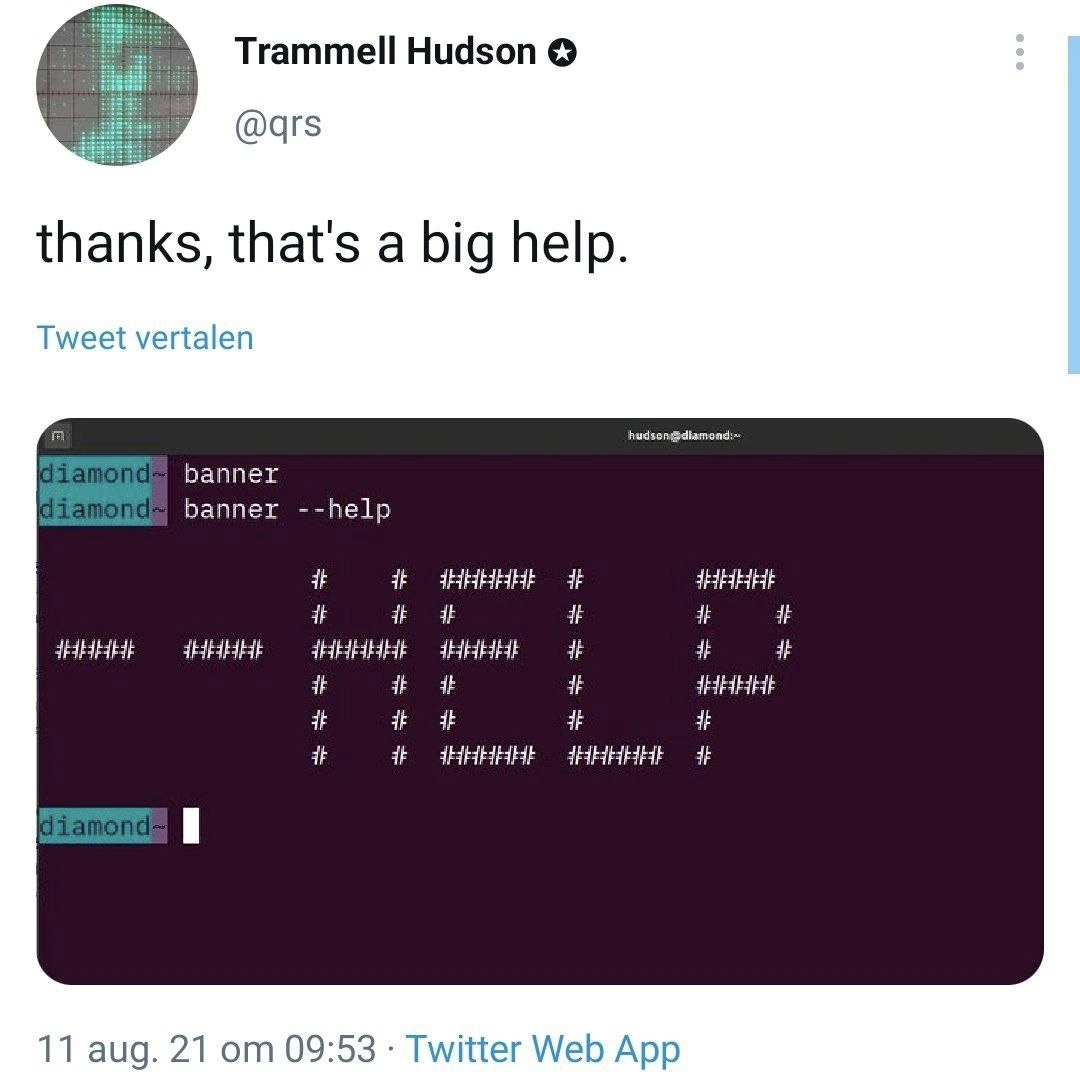
In the screenshot, the tool appears to be banner, which prints big ASCII text. When the user types banner --help, the program treats --help like text to render and prints the word HELP in a large block style. That is why the tweet says it is "a big help": the help is literally big, but not useful.

This connects to documentation and developer experience. Developers rely on quick help output because they cannot memorize every command. When help output is missing, confusing, or too clever, it slows down troubleshooting. The joke is gentle because the tool did exactly what its name suggests, but the result is still the opposite of what the user wanted.

Level 3: Helpful in Name

The tweet says:

thanks, that's a big help.

Below it, the terminal shows the user running:

banner banner --help

Instead of printing usage instructions, options, examples, or even a terse error message, the command prints a giant ASCII-art HELP. That is the joke in its purest Unix form: the program obeys the word "help" with maliciously literal innocence. It has, technically, displayed help. It has not helped.

The senior developer pain here is CLI contract violation. Command-line tools have cultural expectations. A --help flag should explain syntax, flags, defaults, input format, output behavior, and maybe point to a manual page. It is one of the few interfaces developers use when everything else has already gone wrong: late-night deployment, broken build, unfamiliar server, half-remembered command. When --help returns a visual pun instead of documentation, the tool stops being charming and becomes another little test of character.

The image also satirizes old-school Unix culture, where tools can be powerful, tiny, under-documented, and aggressively unconcerned with your feelings. The banner command's whole job is to produce large text as ASCII art, so banner --help being interpreted as "please make the word help big" is consistent with the tool's normal behavior. That consistency is what makes it funny and infuriating. The parser did not recognize --help as an option; it treated it as input text. The program is not broken. Your assumption is.

This is the kind of developer experience failure that hides behind "works as designed." The behavior may be defensible from an implementation standpoint, especially for a simple text-rendering utility, but it violates user intent. Good CLI design is not just about accepting bytes; it is about meeting conventions so humans can recover quickly when memory fails. A help flag that needs a help flag has already lost the room.

Description

The image is a tweet by Trammell Hudson, @qrs, saying "thanks, that's a big help." with a "Tweet vertalen" link below it. The embedded terminal screenshot shows a prompt at "diamond~" where the user runs "banner" and then "banner --help". Instead of usage documentation, the command prints a giant ASCII-art word "HELP" made of hash marks, then returns to the prompt. The humor is classic Unix literalism: a help flag that delivers the word help rather than helpful information.

Comments

3
Anonymous ★ Top Pick The help flag passed QA because it returned HELP with 100% character coverage.
  1. Anonymous ★ Top Pick

    The help flag passed QA because it returned HELP with 100% character coverage.

  2. @nuntikov 4y

    man banner

  3. @vo1dee 4y

    есть в apt-get?

Use J and K for navigation